Brisbane Times story: ‘From dreadlocks to shaved for World’s Greatest Shave’, March 2012

March 22nd, 2012

A story for Brisbane Times which was also filmed and edited into a two-minute video. Click the below image to view the video, and read the article text underneath.

From dreadlocks to shaved

Andrew McMillen has his dreadlocks shaved off for the Leukaemia Foundation's World's Greatest Shave
Click to play video

According to Scottish comedian Billy Connolly, “a primary-coloured beard is a perfect arsehole-detector”. I’ve long felt the same way about my dreadlocks, which I’ve had in place since September 2004.

Connolly referred to the tendency of dreary folk – or “beige people”, as he would call them – to reveal themselves in the presence of someone whose unusual appearance upsets them. So too with my hairstyle, which elicits a range of responses – verbal or otherwise – when I meet people for the first time.

At music festivals, I’m frequently assumed to be holding pot or other treats by both punters and police. When shopping, staff tend to drop their manner a few notches and engage with me in terms of “dude” and “man” far more often than “sir”. At election time, LNP and ALP hawkers don’t bother pressing fliers into my hands – it’s assumed that the Greens are the political party for me. In the street, charity peddlers smile and see me as an easy mark; someone naturally sympathetic to whichever planet-saving scheme they’re pushing.

It’s endlessly fascinating to me how much people can read into a hairstyle. I’ve gotten far more enjoyment from observing how people react to me than from the dreadlocks themselves, which I chose purely for vanity: I liked how they looked on some of my favourite musicians, most notably the singer from Gold Coast hard rock act Sunk Loto, so I decided to try it on for myself.

I’ve never regretted the decision, though seven and a half years of growth – coupled with the gradual thinning and breaking of the locks on top of my head – meant that it was always going to be a finite style.

For years, my plan had been to support the Leukaemia Foundation and their World’s Greatest Shave initiative by turning a fairly drastic measure into a public spectacle. Handily, one that would encourage those around me to donate money and support a worthy cause.

Since 1998, the annual shave has been undertaken by over one million Australians, who’ve raised over $120 million for the Foundation. Donations support families when they need it most, by providing leukaemia, lymphoma and myeloma patients – there are over 11,500 new cases across the country each year – with a free home-away-from-home near hospital during their treatment.

The Foundation also funnels millions into blood cancer research. Although survival rates are improving, blood cancers remain the second biggest cause of cancer death in Australia.

In light of these life-and-death scenarios that occur with troubling frequency – today, 31 Australians will be given the devastating news that they have one of the above three blood disorders – shaving my head to raise awareness and money for the cause always seemed a very pedestrian decision.

I’m cancer-free and perfectly healthy – touch wood, I’ll remain that way forevermore – yet the concept of losing my ridiculous hair suddenly became an asset for leukaemia sufferers and their families to benefit from. Most of the people in my life at the moment have only ever known me with dreadlocks: I moved to Brisbane to study in 2006, after graduating from Bundaberg State High School the year before.

I knew that going from full-head-of-hair to bare would spur the people around me to donate. I set my fundraising goal at $1,000. This seemed a reasonable amount. Thanks to the generosity of my friends and family, I reached this goal three weeks after starting the campaign. At the time of writing, the total climbs toward $1,500, which is astonishing to me.

The shave itself took place earlier this week at a Price Attack salon in Indooroopilly. Leukaemia Foundation’s Beverley Mirolo was there to make the first cut, followed by a few of my friends. My girlfriend was particularly happy to shave off my sideburns, which had grown unruly after months of neglect. I watched in the mirror as a new me emerged. Suddenly, I looked vastly younger than my 24 years. Vastly different, too, though not as alien-like as I’d expected.

I love how hair can become a social object; a topic of conversation, a reason to interact with another human. Those with dreadlocks know this better than most. It’d surprise you just how many people are curious enough to stop us in the street and ask to touch our hair. (Just as common: “is that your real hair?”)

This is what I’ll miss most about my dreadlocks: looking slightly different from other folks, and watching them adjust their interactions to suit their idea of what my hairstyle represents. But for now, I’m embracing the baldness: tomorrow, I’m taking it a few millimetres further and getting my first ever ‘open blade’ shave, which will reduce my head hair down to nothingness. Wish me luck.

Andrew McMillen is a Brisbane-based freelance journalist. You can follow him on Twitter at @NiteShok. You can donate to his World’s Greatest Shave fundraising here.

Above photos taken by Scott Beveridge. More photos from the shave can be found by viewing the story on Brisbane Times here.

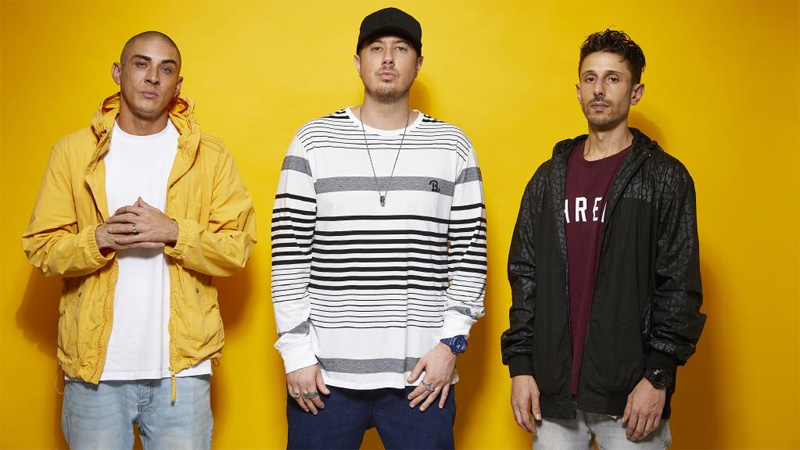
The Weekend Australian album reviews: Last Dinosaurs, Hilltop Hoods, March 2012

March 22nd, 2012

Two album reviews published in The Weekend Australian in March 2012.

Last Dinosaurs – In A Million Years

Does the world really need another guitar-pop band? Brisbane has proved fertile ground for the genre of late: the Grates, the John Steel Singers and Yves Klein Blue all achieved national notoriety in recent years mining this rich vein.

Funnily enough, all three are labelmates with newcomers Last Dinosaurs, suggesting that Dew Process has something of a local monopoly.

The young quartet’s debut LP practically radiates with neon intensity, so smooth, shiny and punchy is the production on these 11 tracks. Every frantic guitar strum and finicky hi-hat hit rings clean, and Sean Caskey’s vocal melodies are strong without becoming overbearing – though he does fall into the pop musician’s trap of writing instantly forgettable lyrics.

It’s either confidence or arrogance that convinces a band to open an album with its best track. I’m leaning toward the former, though Zoom is such a perfect example of guitar-pop done right that the rest of the album pales a little in comparison.

Earlier single Honolulu almost scales the same heights. The steel drums in Andy suit the track, but come off a little outdated in the wake of Sydney band the Holidays nailing the use of that instrument on its 2010 debut, Post Paradise. Spacey mid-album instrumental Satellites is the only unnecessary track here; its presence makes no sense amid an otherwise impressive, tight collection.

LABEL: Dew Process
RATING: 3 stars

++

Hilltop Hoods – Drinking From The Sun

The best track on Hilltop Hoods’ sixth album, ‘Rattling the Keys to the Kingdom’, is built on the familiar lyrical trope of rap group pitting itself against its many competitors.

Yet here the narrative rings true: this Adelaide trio genuinely owns the Australian hip-hop throne, so when they rap “We came and we conquered” while a chant of “Hill-top! Hill-top!” repeats in the background, they’re being both arrogant and honest.

Their last release, 2009′s State of the Art, was the genre’s bestselling album yet. Fans and rivals alike look to these three to see where they’ll take the art form next; likely, more than a few hope they’ll falter and cede control to another crew.

To their disappointment, this offering is another jewel in the crown. The meaning of its title is made clear in the second of three interludes entitled ‘The Thirst’, when a voice explains “It’s a metaphor that we’re from an underground culture that’s risen up into the limelight; we’re down below, drinking from what’s coming above.”

Since the overwhelming success of the Hoods’ breakthrough 2003 release The Calling, Australian hip-hop has joined the mainstream. Where cultural cringe once confined the genre to the margins, the nation’s biggest music festivals are now just as likely to book hip-hop acts as they are pop and rock artists.

Drinking from the Sun represents the trio’s first real attempt at penetrating the North American market. It’s impossible to view this album through any other lens: all signs point to a concerted effort to impress newcomers.

At a touch over 41 minutes, it’s also their shortest album to date. While MCs Pressure and Suffa certainly can’t hide their distinctive accents, DJ Debris turns in perhaps his most impressive effort to date. The beats and instrumentation are uniformly world-class, and will give the trio its best shot yet at turning foreign ears.

They’ve also enlisted a pair of instantly recognisable American voices – Black Thought (of The Roots) and Chali 2na (Jurassic 5) – to lay down tidy, if unspectacular verses; another guest is Australian singer Sia Furler, who has written and sung for mega-sellers David Guetta and Flo Rida.

Lyrically, the two MCs discuss death (‘Lights Out’), break-ups (‘Now You’re Gone’), self-doubt (‘Good for Nothing’) and Suffa’s new-found sobriety (‘Shredding the Balloon’), while brass, strings, guitar and Debris’ beats fill out their now-signature sound.

LABEL: Golden Era
RATING: 4 stars


The Vine festival review: Future Music Festival 2012, Brisbane

March 20th, 2012

A festival review for The Vine, co-reviewed with my editor Marcus Teague. Excerpt below.

Future Music Festival
Doomben Racecourse, Brisbane
Saturday 3 March 2012

By Marcus Teague and Andrew McMillen

MT: Being based in Melbourne, I hadn’t been to a festival in Brisbane before today. I have sat outside Ric’s Cafe in the human drain Valley at 5am many times however, marvelling at the annihilated car-wash-of-the-mind humans of all stripes can put themselves through. “A dance festival in Brisbane’s different mate,” said a friend. “You’ll see.”

I did. The first hint comes when I’m in a cab on the way to the grounds at 12:30pm, and witness a couple of clearly munted guys hanging off each other while stumbling down the footpath; one of whom is covered in grass as if having earlier fallen over in the light drizzle. “Must be coming home from the night before,” I thought. Twenty metres on there’s a girl passed out in the gutter, head on her hands, pool of vomit between her feet. A friend is pushing a water bottle to her lips while a flock of five stand nearby on their phones. The scene continues, as if I’m being towed past some complex diorama of dilapidated 21st Century Youth Culture: masses of screeching girls with (what seemsurely like) fake boobs; everyone with tatts akimbo; all swinging empty bottles of booze and energy drinks. The deeply oxymoronic scene of hugely-buff, chest-waxed angry bros—wearing nothing but tiny shorts—yelling out “FAGGOT” at kids running past is mind-bending. Closer to the gate, a range of people pose outside stretch hummers. It’s completely awesome — “awe” having once been common shorthand for “an overwhelming feeling of reverence, admiration, fear, etc., produced by that which is grand, sublime, extremely powerful.” 

AM: What does the name of this festival mean? The other major Australian festivals are easy enough to grasp: Big Day Out is true-to-name, Laneway originally took place in a series of side-alleys, Splendour In The Grass is named after a film and er, largely takes place on grass (?). Soundwave, admittedly, is a strange one. But this? If the line-up comprised entirely of acts from the future, people wouldn’t be paying $170 at the gate for the pleasure of witnessing acts they’d never heard before. ($210 each for VIP.) Considering one of the headliners is a band formed in 1980, an argument could be made for Past Music Festival. Anyway, nitpicking. A disclaimer worth noting at the outset: this review was written by two sober guys. So why am I here? To see a handful of live performances and otherwise amuse myself among the teeming hordes.

The first thing I notice upon arriving is that complete lack of sniffer dogs. I accidentally walk past the VIP entry down toward the general admission gates and don’t see any there, either. Perhaps they’re just inside the festival: if so, smart call. But considering that this has the reputation of being the druggiest festival on the annual calendar, I expected a strong presence from our canine friends. This is the first time I’ve been to Future. As I walk inside, I’m reminded that every other day of the year this ground hosts horses and gamblers, not tens of thousands of dance fans and half a dozen stages wielding enormous speaker stacks. Organisers have constructed bridges across the horse-racing track so that the turf remains unabused by human feet. Nice touch.

MT: I arrive just inside the festival grounds as rain begins sweeping across the land in great bursts. It’s not cold: I’m in a tee shirt and—unlike 99% of punters—jeans; a dress code that’s akin to walking around as Santa Claus in a nudist colony. But it’s still wet enough to stay seated in the great grandstand, comfortably undercover. From there I watch the lower concourse, seeing five muscly guys rip each other’s singlets off, people dancing in the rain while others run for ponchos, and a girl trying to artfully paste her wet hair across the sides of her exposed boobs. A sign in the distance reads “brisbane – australia’s new world city” — the lack of capitals as deeply unnerving as its implication. The EARSTORM stage is quiet. A bird flies past and it’s momentarily stirring to think of nature.

AM: Future has an interesting stage configuration, in that the four main stages are arranged almost in staggered rows—like consecutive aeroplane seats, say—spread across a couple of hundred metres. None of the stages face each other, though, so there is no sound bleed (but for one memorable occurrence late in the day). Dubbed the Flamingo and Las Venus, both main stages have adjacent VIP areas, meaning I’m up in the bleachers for Gym Class Heroes, who exist somewhere between hip-hop and pop — they boast a capable MC in Travie McCoy and a load of pop-hook choruses. Their on-stage banner shows four guys, yet there’s six here today, including one guy with blue hair who sometimes does back-up vocals but mostly waves a GCH flag, shakes a tambourine, and jumps into the crowd. McCoy pauses for a moment to encourage the huge crowd to hug the stranger to their right, then to their left. Not something you’d see at most hip-hop shows. The crowd particularly enjoys ‘Cupid’s Chokehold’ and ‘Billionaire’. A strange band, but thanks to their confident genre-hopping, easy to see their appeal. They end the set by encouraging the crowd to hold ‘love hearts’ in the air. Most do.

Immediately afterwards, there’s a mass exodus toward the Las Venus stage. I had planned to stick around here for The Naked & Famous but since they’re running 10 minutes late—allowing for a 15 minute changeover between bands was never, ever going to work—I abandon the unmoving crowd stuck before DJ Ruby Rose and head to Las Venus for Skrillex.

For the full review and many more photos, visit The Vine. Above photo credits: Justin Edwards.

The Vine festival review: Soundwave Festival 2012, Brisbane

March 20th, 2012

A festival review for The Vine. Excerpt below.

Soundwave Festival
RNA Showgrounds, Brisbane
Saturday 25 February 2012

After taking in last year’s festival, I wrote “The only question for Soundwave is: where to from here? Where do you go once you’ve booked [headliner] Iron Maiden? Metallica? AC/DC?”

Their answer was evidently ‘none of the above’. But the headliner is many hours away as we file into the Showgrounds just before the clocks strike 11am. The days preceding have seen heavy rain pelt Brisbane for extended periods, so it’s admirable that organisers have managed to greet us upon arrival with what appears to be a smoothly running festival. Ground staff are relying heavily on plastic matting to cover up the muddiest spots, and for the time being, the entire venue is easy to navigate with regular footwear while staying dry.

The sun shines overhead as I take up position before the metal stages, 4a and 4b, in anticipation of Finnish metal act Turisas. It seems they’re late; stagehands continue soundchecking, until twenty past, when they instead hoist the next band’s banner, The Black Dahlia Murder. Hundreds of disappointed people file out; nothing has been communicated to the audience as far as I can tell. (I later learn from a friend that they were moved to a midday slot at another stage.) A rare organisational hiccup, and not a good start to the day.

The sky breaks for the first time at 11.48am. I’m standing under a tree watching Chimaira, who sound OK. A little keyboard-heavy, which is odd for a metal band. Lots of blast beats and breakdown. There’s a heart-warming singalong to ‘Pure Hatred’ – namely, the chorus of “I hate everyone!” - while I apply my poncho for the first of many times today. The tent before stage 3 sees a sharp increase in visitors seeking shelter. Zebrahead are playing. Eh, pop-punk. The merch tent between the stages features the most impressive wall of shirts I’ve ever seen.

Out in the main arena, Stage 1 bears a banner that reads Pinkerton. Underneath, a band is playing Weezer’s ‘El Scorcho’. Turns out it’s Saves The Day halfway through playing that album in full. It’s weird, but their version is competent enough and I guess it’s much cheaper than booking Weezer. At stage 6a, CKY draw a couple thousand people before the rain returns at 12.50pm, scattering the casual observers and encouraging the dedicated throng up front to thrash harder. From a distance, it looks and sounds like they’ve got a different singer – his voice seems way off Deron Miller’s on-record delivery – but research afterwards suggests that Miller’s still in place. Just having a bad day, then. Their set is enjoyable enough, but most (all?) of these songs are 10+ years old. I referred to them as “a band seemingly near the end of their tether” in a review of their August 2010 tour, and I feel the same way today. Telling that the quartet don’t even bother with more recent or unreleased material; just the hits, thanks.

“So many good bands today, oh my god. Cannot believe that!” says the singer of French metal band Gojira from stage 4b. He’s right. It helps that his band kick arse. They’re one of the heaviest acts on the line-up, and one of the most anticipated by the metalheads: this is their first-ever Australian show, and they’ve drawn a big crowd to take in their seriously impressive and brutal sound. Sample song intro: “This song is about whales that fly… into outer space!” *crowd roars, horns raised* Apparently they only play for 20 minutes – four songs’ worth – which is disappointing, but in that short time they stand out as one of the day’s best acts. Friends have been recommending them to me for years, but today is my first exposure to Gojira. I’ll definitely be returning.

For the full review and many more photos, visit The Vine. Slipknot photo credit above: Justin Edwards. iPhone photo credit: Andrew McMillen.

The Weekend Australian album reviews: Yeo, The Peep Tempel, February 2012

March 20th, 2012

Two album reviews published in The Weekend Australian in February 2012.

Yeo – Home

To those familiar with Melbourne-based Yeo Choong’s past releases, the opening bars of his third album, Home, will come as a shock.

Acoustic guitar, harmonica and his voice are high in the mix, rather than the synthesisers and electric instruments that characterised his debut album, 2006′s Trouble Being Yourself.

There, Choong walked the tightrope between pop and funk; to pin him as an Asian-Australian Justin Timberlake/Pharell hybrid was close to the mark.

On Home – available for download at http://snackswithyeo.bandcamp.com/ – the songs are near-nude in comparison, which forces the listener to focus on Choong’s vocal and songwriting abilities.

It’s a bold move, yet Choong clearly has the confidence in his own abilities. These are songs of gentle beauty. A banjo can be heard on ‘Selma Blair’ and ’10 & A Whiskey’, while third track ‘Meeting at Sea’ is the gentlest and most beautiful cut.

There are two rockers, ‘August 28, 1973′ and ‘Caves’, which break up the mellow instrumentation with electric guitars and forceful percussion. The gut instinct is to view Choong’s stylistic change in terms of maturity. The 13 tracks show he has lost none of his writing abilities, but one hopes that Choong hasn’t disposed of the synthesisers just yet, either.

LABEL: Independent
RATING: 3 ½ stars

++

The Peep Tempel – The Peep Tempel

Given the considerable success of two-piece garage rock acts such the White Stripes and, more recently, the Black Keys, the formation of Melbourne duo the Peep Tempel in 2009 makes a lot of sense.

The addition of a bassist for their debut album certainly won’t hurt their chances, though, as what the three achieve here is incredible: they manage to make bare-bones rock and roll sound fresh and exciting.

The Peep Tempel is a dark, invigorating set of songs that demand to be played front to back, repeatedly. The style swings between breakneck rockers (‘Lance’, ‘Collusion’) and the slow, foreboding lurch of ‘Mission Floyd’ and ‘Do What You Want’. Each of the 10 songs imparts a sense of urgency in the listener.

It takes considerable skill to operate within such strict confines – the classic configuration of guitar, bass, drums and vocals – and still conjure up memorable musical and vocal hooks. There isn’t a single moment on The Peep Tempel (the name comes from a strip club in an Inspector Rex episode) that sounds played-out or predictable.

It’s hard to know how much of the narrative, which includes tales of unemployment and police brutality, is based on the band’s inner-city west Melbourne existence and how much is fiction. One thing is certain: this debut is very near to rock and roll perfection.

LABEL: Wing Sing Records
RATING: 4 ½ stars

Live footage of The Peep Tempel’s song ‘Down At The Peep Tempel‘ is embedded below.

Rolling Stone ‘My Record Collection’ interview: Gary Lightbody of Snow Patrol, January 2012

March 20th, 2012

An entry in Rolling Stone’s regular ‘My Record Collection’ interview series, published in the January 2012 issue. Click the below image for a closer look, or read the article text underneath.

My Record Collection – Gary Lightbody

Snow Patrol’s frontman takes us through his favourite albums

“I’m certainly the one who listens to the craziest music,” Gary Lightbody says of his four bandmates in Irish rock act Snow Patrol. “I make mix CDs for everybody. Sometimes they’re met with raised eyebrows. If I make one for my Mum, it’ll definitely be little country songs, some pop songs, nothing too crazy. But I might throw in a cheeky wee Four Tet song!” Lightbody is on a promo tour in Amsterdamwhen RS calls, ahead of the release of their sixth album, Fallen Empires.

Metallica – …And Justice For All (1988)

“This was their best record, and probably the one I listened to most. That style of music was a bit lost on me, because I couldn’t emulate it on guitar. It sounded like alien beings were creating the music: virtuoso guitar solos, and chugging that I couldn’t match with my right hand. Maybe it’s because I wasn’t masturbating enough as a teenager. But it was still intense; I’d always be thrashing away, headbanging to it in my room, or with my mates.”

Nirvana – Nevermind (1991)

“This record changed everything for me. It made me realise that I can actually do something with my guitar. Nirvana brought music into the real world, for me. Writing from the heart, rather than playing from the head and thinking from the ballsack. Kurt’s songs were extraordinary deconstructions of the human mind. As a sullen, sensitive 15 year-old – who was very insular, awkward, and loved his poetry – Nevermind spoke to me, just as it spoke to millions of other kids around the world.”

Super Furry Animals - Fuzzy Logic (1996)

“This is just an insane record. These are all songs that I still absolutely adore today. The Super Furries are one of those bands that opened up all sorts of music. People call them psychedelic because they don’t have any other words to describe them. They’re on their own little trip; in a class of their own. If their boundary-less expression of music has showed us anything, it’s that you should never keep doing the same thing again and again. It taught us to be adventurous.”

Young MC – Stone Cold Rhymin’ (1989)

“When I was 18 I started going to clubs, so my music tastes widened. I still listened to guitar music, of course – I mean, I’m in a band that plays guitar music – but I found a lot of dance music, funk, soul and hip hop. This is my favourite hip-hop album of all time. I love it when hip-hop is playful, and not about guns, bling and bitches. His records were about things like ditching school, and first loves. There was a naivety about it that’s unusual in hip-hop these days, and even a little unusual back then, when hip-hop was so political and racially charged.”

Midlake – The Trials of Van Occupanther (2006)

“I completely fell in love with this record, as well as that whole genre of music – Americana-ish, bluesy- and folky-tinged rock music. ‘Roscoe’ could possibly be my favourite song of all time. It’s an extraordinary piece of music: sweeping, lyrically phenomenal, and dense. It’s incredibly tricky to take in on the first goodness-knows-how-many listens. That’s the testament to a great song: you’re always finding new things in it.”

Bon Iver – Bon Iver (2011)

“Their first album was incredible, too, but this is just a beautiful, beautiful record. I’ve just been in its little universe for the last few months, loving every minute of it. ‘Michicant’ and ‘Holocene’ are two songs that I’ll take with me forever, I think. They’ll always be on my mind.”

Arcade Fire – The Suburbs (2010)

“On The Suburbs, themes and little motifs reoccur. You discover more about the song before by listening to the song after. It’s the sort of record that is essential, and cherishable. That’s the style of record that we wanted to make, too. Goodness knows if we’ve achieved it [with Fallen Empires], but my God, our ambition was high. Bands like Arcade Fire make your ambition high. When I listened to it, I went, ‘Fuck me, we’re gonna have to be better.’”

Rolling Stone album reviews: Tim Freedman, The Bon Scotts, January 2012

March 20th, 2012

Two albums reviews published in the January 2012 issue of Rolling Stone.

++

The Bon Scotts 
We Will All Die At The Hands Of C.G.I. 
Popboomerang

Misleadingly-named outfit deliver quality LP

The second LP from this seven-piece exhibits folk pop with none of the over-earnestness you might associate with the genre. Each of the 11 tracks clocks in at under four minutes, and all are neatly contained musical ideas adorned with brass, flute and chanted band vocals, the latter of which adds a real sense of fun. The Melbourne-based septet have found a fine balance between beautiful instrumentation – fingerpicked guitar, graceful piano runs – and raucous theatrics. Neither element is overbearing, and the result is a well-rounded set of songs informed by irony, humour and – as the title hints – an undercurrent of mortality. Just ask the morose, overweight Batman on the cover.

Key tracks: “Let’s Do What The Catholics Do”, “Polluted Sea”

++

Tim Freedman 
Australian Idle
Sony

Whitlams frontman fails to excite in solo mode

The Whitlams singer/pianist steps out for his first solo album and delivers a collection of middling pop tunes with nary a memorable hook between them. Freedman has displayed a knack for clever wordplay in the past, but there’s a dearth of evidence here: his gags and puns invariably fail to hit the mark, album title included. Most songs exhibit an overproduced sheen, which acts as a repellent. It’s only when Freedman allows some tenderness to shine through that we’re reminded of the talents that made him a household name. These comparatively subdued moments allow Freedman’s band to shine, too. Such songs are in the minority though. A thoroughly disappointing solo debut.

Key tracks: “Back When We Were Beautiful”, “In The Current”

++

The Australian story: ‘Dirty Three’s divine trinity of sound’, March 2012

March 5th, 2012

A story for The Weekend Australian’s Review section, published in the March 3-4 edition.

Dirty Three’s divine trinity of sound
by Andrew McMillen

In his 2009 book The 10 Rules of Rock and Roll, Australian singer-songwriter Robert Forster wrote that “the three-piece band is the purest form of rock and roll expression”. The author had American band Nirvana in mind when he penned that line but admits instrumental trio Dirty Three fits “the whole theory and idea perfectly”.

Brandishing an unconventional guitar-drums-violin configuration, Dirty Three formed in Melbourne in 1992 and has celebrated its 20th anniversary by releasing its eighth album, Toward the Low Sun. Forster, co-founder of Brisbane pop giants the Go-Betweens, describes the band’s unique musical style as “the magic of a chemical explosion”, and notes “they come from the time of grunge. They existed when Nirvana existed; another three-piece who were chaotic, mad and intense on stage. You can probably still see a bit of that in them.”

Dirty Three’s catalogue evokes by turns deep melancholia – due largely to Warren Ellis’s emotive violin strokes – and sublime euphoria when the three members lock into a rhythmic pulse that is, oddly, reliant more on guitarist Mick Turner than drummer Jim White. Bobby Gillespie of Scottish rock band Primal Scream has referred to Turner’s idiosyncratic playing as “the way that stars are spaced out in the sky”, while White is more interested in exploring experimental percussive techniques than holding down anything resembling a standard rock drumbeat.

Yet viewing Dirty Three through the lens of rock – or, for that matter, jazz or folk – is wrong. And although the band lacks a vocalist, it doesn’t sit comfortably with what’s typically understood as instrumental music, either. “Normally people who do instrumental music can be quite dry and sedate, whereas Dirty Three put on a show,” Forster says. “They have an aesthetic of something like ‘minimal’, or instrumental music, but they have a rock ‘n’ roll attitude. It’s almost like there was an invisible lead singer there. That was part of their appeal, besides the fact that they have very good melodies, and that there was something charismatic about the band.”

The group’s absence of vocals has affected the course of contemporary Australian music in strange ways.

Gareth Liddiard says Dirty Three has been “a huge influence on what I do lyrically” with Melbourne band The Drones, of which he is lead singer, as well as his solo material. “They made me realise that if you’re going to have words, they need a f. . king good excuse to be there in the first place. They better be good, otherwise why bother?”

Liddiard says Dirty Three’s music “sounds like someone pushed a drum kit down the stairs and plugged a violin into a f. . kin’ Marshall [amplifier]“. He follows this stark assessment with the highest compliment: “For my money, they’re the best band from this country, ever.”

Before the band’s formation, all three members had spent years playing in various rock groups. “It seemed like there was this healthy live scene starting in Melbourne,” Ellis says of the early 1990s. “There was a lot of venues to play in, a lot of opportunities to get out and play in front of people. The live scene provided a livelihood for a lot of people. Bands were really trying to confront and challenge you, and there was this great crowd of people going along to check it out each week.”

Ellis puts the band’s irregular musical components down to a desire to be different. “When we started off, we really wanted to challenge people’s conceptions and also to go against the mainstream,” he says. “There’s something great about feeling like you’re out there, flying your own flag. There is something really empowering about it.”

The story behind the trio’s debut gig is emblematic of the hunger for original live music in Melbourne at the time. Ellis had a friend who owned a bar called the Baker’s Arms; he told the violinist that he wanted background music but didn’t want to play CDs. Ellis asked White to play drums; he, in turn, asked Turner to play guitar. On a Friday afternoon, hours ahead of the band’s first performance, the trio rehearsed some ideas in Ellis’s kitchen, then played them that night.

“We had to play for three hours, so we made the songs really long,” Ellis says. This ideology is occasionally reflected in the length of the band’s recordings, too: ‘Deep Waters’, from the 1998 album Ocean Songs, runs for 16 minutes. Ellis’s pal enjoyed the performance, paid them $50 apiece and asked them to come back the next week. To three young men trying to support themselves as working musicians, this was a great deal. “We’d go down and play every Friday night, and get out of our brains,” Ellis says. “Our mates would come along; it was just this great Friday night where nobody had to clean up the mess after.”

Two decades later, the trio commands a worldwide following and the kind of deep respect among the Australian music community that has been afforded to few acts. All three attribute the band’s longevity to the fact they rarely meet face to face: Turner lives in Melbourne, Ellis calls Paris home, and White splits his time between Brooklyn, Detroit and Australia.

A week or two before its national tour in March to celebrate the release of Toward the Low Sun, the band will convene in the Victorian capital for rehearsals and simply to catch up. “We usually sit around talking for a few hours talking, just because we haven’t seen each other for so long,” Turner says. “We don’t necessarily talk about music; just about life, our friends, our families.”

The guitarist believes this close friendship is another reason they have lasted the distance. “We’ve all got a high regard for each other,” Turner says. “If you lose respect for your bandmates, that’s when it’s going to fall apart, I think.” Ellis agrees. “We’ve always treated each other as equal in the musical sense, and in terms of the group’s profile. We share all the songwriting, and royalties equally,” he says.

“Nobody’s seen as contributing more or less. We’re a group, in the purest sense.” The trio are in regular contact via phone and email; a necessity, given that they split band management duties three ways.

“We did that a long time ago,” White says. They were once managed by Rayner Jesson, who also handled Nick Cave and the Bad Seeds, but that relationship ended a few years before Jesson’s death in 2007. “It ebbs and flows over the years in terms of how engaged we are,” says the drummer, who handles their tour bookings. Last year the band played just two shows together: a festival slot at All Tomorrow’s Parties in Tokyo and a benefit concert in January for 3RRR announcer Stephen Walker (to raise money for the legendary broadcaster’s multiple sclerosis treatment) at the Forum in Melbourne, featuring Cave on keyboard.

Turner admits the lack of a single decision-maker can be problematic. “If a question comes up, it’s got to be fielded around, so it takes a while to be answered,” he says. “One of us might be on tour, and it’s hard to get down and do your email when you’re in the middle of travelling.”

The three men occupy themselves with other creative outlets during the band’s downtime. White regularly tours and records with other bands: last year he toured with Australian folk-pop trio Seeker Lover Keeper, and the week after we spoke he was scheduled to play shows in Helsinki, Geneva, Istanbul and Tel Aviv with American singer-songwriter Cat Power (real name Chan Marshall) who is one of only two vocalists to have lent their voices to Dirty Three songs. The other singer is Sally Timms, of British rock act The Mekons; both contributions appeared on the trio’s previous release, 2005′s Cinder.

Ellis has been a member of Nick Cave and the Bad Seeds since 1995; he plays electric mandolin and guitar in the band. With Cave, he has scored several films, including The Assassination of Jesse James by the Coward Robert Ford, The Road and Australian film The Proposition, directed by John Hillcoat, which won the pair an AFI award for best original music score in 2005. He also played in Cave’s other rock band, Grinderman, which announced a hiatus at the Meredith Music Festival last December after releasing two albums together.

Turner splits his focus 50-50 between art and music. His distinctive paintings have appeared on the cover of all of the band’s albums besides its 1995 debut, Sad & Dangerous. His work has been exhibited at galleries across the world and he plans to release a fourth solo album later this year. The guitarist recently attended his primary school reunion, and was amused to discover not one of his former Black Rock State School classmates had heard of his 20-year-old band; unsurprising, perhaps, given that the trio’s sound exists on the periphery of contemporary Australian music tastes.

Ellis’s Bad Seeds bandmate, Ed Kuepper, calls Dirty Three’s output “a form of pure expression”. According to Kuepper – who co-founded Brisbane punk rock group the Saints and whom Turner considers “one of my only guitar hero figures” – the band consists of “three very recognisable, distinct musicians and they don’t get in each others’ way. They probably become even stronger together. It’s a rare thing.

“It’s a really unusual thing that they do in terms of Australian music; the approach to the way they play, and the non-standard rhythm [section],” Kuepper says.

“Very few people do that. Even fewer have any sort of success because in some way it’s quite an esoteric thing that sits outside of the kind that seems to get lauded in Australia, which is generally a lot more mainstream and musically conventional.”

Since Toward the Low Sun is an extension of the band’s remarkably consistent canon, rather than a stylistic reinvention, it’s unlikely Dirty Three’s eighth album will set the ARIA charts alight on release. The nine theatre shows the band has booked in March, though, are likely to sell out, if its previous national trek two years ago – billed as a performance of the 1998 LP Ocean Songs in full – is to be used as a benchmark of popularity on the live circuit.

The new album had a particularly long gestation period: the band recorded for six days in February 2010, then didn’t review the recordings for more than a year. It did some additional recording in March last year. An American producer based in Melbourne, Casey Rice, captured the first session at Head Gap Studio in Preston: he worked with the band on its last release, Cinder, too.

“They’re very focused,” Rice says of Dirty Three’s work ethic in the studio. “A lot of time it’s not just a matter of trying to get it right in a performative sense; it’s more of a feel thing.” The band will play a song slowly, then speed it up for the next take; it will try a song played softly, and then louder; White will work the kit with his drumsticks, then try his brushes for a softer percussive tone.

“The basis of everything is tracked live,” Rice says. “If there’s more than an electric violin, guitar, and drums on a song, then it’s been added as an overdub. So the bass, extra strings, mellotron, and nylon stringed guitar were overdubbed. But the process remained the same for Toward the Low Sun: they set up, and played it down. That’s what works about Dirty Three; that’s where the magic comes from.”

There’s that word again, the one Forster used: magic. A distinct sense of the otherworldly encompasses everything the trio does. Yet it’s not exactly the most accessible sound in the world, and there are few points of reference for unfamiliar listeners to latch on to. Liddiard recounts an anecdote that highlights the band’s divisive nature.

“I’ve seen Dirty Three 40,000 times,” says Liddiard, exaggerating only slightly. “I remember standing behind two dudes at one of their gigs; it could have been in Sydney, or Perth. One guy’s like, ‘This sounds like cat shit, let’s go.’ The other guy just looks at him, incredulous. Like: ‘What the f. . k? Can you not hear that?’ That really sums them up. Some people just don’t get it. And if they don’t get it, there’s something wrong with them, I find.”

Dirty Three‘s tour starts in Perth on Friday, then WOMADelaide, Adelaide, March 10; Port Macquarie, March 12; Melbourne, March 16; One Perfect Day Festival, Gippsland, March 17; Castlemaine, March 18; Sydney, March 21; Brisbane, March 22; Lismore, March 23.

Toward the Low Sun is out on Remote Control Records.

This story was originally published in The Australian; view online version here. For more Dirty Three, visit their website.

A Conversation with Scott Bagby and Carter Adamson of streaming music service Rdio, February 2012

February 24th, 2012

The concept of paying month-by-month to stream music from your computer and smartphone remains a relatively new idea in Australia. In the last year or two, a number of contenders have emerged. Nokia has had their ‘Comes With Music’ service for a while now. Sony launched their ‘Music Unlimited’ product in February 2011. Hulking, canary-yellow retailer JB Hi-Fi launched their own streaming platform in December 2011, dubbed ‘NOW’. BlackBerry, Samsung and Microsoft all have proprietary systems operating in some capacity. Rumours abound of Spotify’s Australian launch. A site named Guvera offers a slight twist on the idea: ‘guilt-free’ mp3 downloads. None of these services have yet gained any real traction in the Australian market.

Clearly, it’s becoming an increasingly crowded marketplace, as app developers and record companies alike cosy up to the assumption that most people don’t give a fuck about music ownership anymore. That whatever CDs, vinyl and cassettes they own gather dust on a shelf somewhere, immobile and largely useless in the era of interconnectivity. These companies believe that most music fans – ‘consumers’ – simply want the ability to take all the world’s music with them, wherever they go. For a monthly fee, of course.

The newest contender on the Australian market is named Rdio [pictured above]. It’s web-based and also has apps for the main phone platforms (iOS, Android, BlackBerry… Windows Phone?). It was founded by a couple of the guys behind Skype, it’s been public in the States since August 2010, and it’s pronounced exactly like it’s written (‘radio’ minus the ‘a’). For AUD$13.90 per month, you get access to unlimited PC and mobile streaming of their library, which apparently consists of over 14 million songs. Ahead of a launch party at Bondi’s Beach Road Hotel in early February 2012, a couple of the Rdio guys flew me to Sydney, bought me lunch, and answered my questions as best they could.

Andrew: How long has Rdio’s Australian launch been in the works?

Scott [Bagby, VP Strategic & International Partnerships; pictured left]: I first came down to Australia to start the discussions at Easter 2011. We were pretty much sewn up by the end of the year. So not quite a year.

There’s been a few streaming services available in Australia over the last few years, but none of them have had any real success in terms of market penetration. Is that fair to say?

Scott: Streaming services on the whole, globally, are quite nascent. I was just hanging out with a bunch of labels. I can’t verify these numbers, but this label guy told me that worldwide, there’s only about 7 million subscribers, to any streaming service. It is very much in the early days of all streaming services. But the potential is huge. They’re planning on massive growth in the area, especially this year. I think you’ll find that here in Australia, as well. There’s still an education that needs to happen for the user to understand streaming services. [They need to] just learn about ‘em, and use ‘em, and get what I refer to as the ‘a-ha’ moment, of why streaming services are so much better than buying individual tracks.

Carter [Adamson, co-founder; pictured right]: But seven million music subscribers in a world where everyone loves music? There’s a lot of room to grow. For ten years, we’ve had various fits and starts with digital music: DRM, tethered CDs, and that kind of stuff. We have services like Rhapsody in the US, who are stuck at around 600,000 subscribers. Now within the past year, you have more than a handful of services that have well over a million subscribers apiece. That only happened within the past year. You have markets like Australia, where 40% of all music revenue is digital music revenue. Korea’s over 50%. For the first time, digital music revenue globally is growing quicker [than physical sales]. I think we’re now at an inflection point with digital music subscription services.

Scott: The timing’s also great, because of the iPhone and other smartphones. People want to take their music with them. Back in the old days, when I was travelling around I used to have a CD case [for a discman], but that’s just too much of a hassle now. With this streaming service, we have 14 million songs at your disposal, no matter where you are in the world. You can download songs to your phone, switch ‘em out; every Tuesday, there’s new releases [on Rdio]. These sort of things – that’s the education that has to happen, and that’s the ‘a-ha’ moment when you get all of that going. The perfect alignment of the ubiquity of smartphones is what’s really helping it along.

Carter: Well, connected devices. Any single device that can talk to the internet is a playback device now. Whereas before you had one device; a record player, CD player, 8-track player. Now there’s a wide array of devices that are effectively playback devices, so it no longer makes sense to buy one song for each device. It no longer makes sense to port all the downloads that you bought a la carte via external hard drive to every single device that you have. The only thing that makes sense is for you to access it seamlessly wherever you are, using whatever platform or device you have.

Using the US service as an example, what percentage of users are using Rdio on their phones?

Carter: Over 85% of our subscribers are on the higher-priced tier. [Note: PC-only access to Rdio is AUD$8.90 per month – five bucks cheaper than the PC/phone combo.] And that makes sense, because the value proposition has always been seamless mobility. People always wanted to move their music around. No-one’s ever bought a song on iTunes to just play it on their computer. They’ve been waiting for 10 years for this whole seamless mobility thing to become a reality. Now it’s finally here.

Scott: I think that’s one of the reasons that the music industry faced such a piracy problem in the past, because they didn’t offer it in a format in which people wanted to consume music. Now that it’s coming into that format, you see a lot of people moving into services like ours. They wanted to listen in several places at once, but they couldn’t, so the only way they could do it is to steal it. It was still happening up until a month ago in Hong Kong. Everyone was saying, ‘I want to buy music, but there’s no iTunes, there’s no digital services here. I can’t buy what I want; you leave me no choice but to steal it’. These people were lawyers, bankers – people that had the means [to pay], they didn’t want to steal it, they just didn’t have it.

Carter: And also, the price has never been so low. We’re talking about 34 cents a day for access to the world’s music, across all your devices. That’s an insanely low price.

Tell me about that education process you mentioned earlier. How do you turn seven million streaming music subscribers into seven billion?

Scott: [laughs] Well, one of the benefits is to have your music everywhere and anywhere. Part of my job is to go around to all the different countries and get the rights sorted, so at least it’s available to everyone. Once it’s available, the education process is an ongoing one. And it’s one for the entire industry to be involved in. The best way to get there is to allow people to get that ‘a-ha’ moment. That moment comes at certain times, like when they’re at their friend’s place, they’re sitting around and they want to hear that song from their childhood that they’re all laughing about. Obviously no-one has it in their collection anymore, but then you – boom – you stream it down, you get a big laugh, and it kicks off. You can almost have Rdio and some beers, and you have a party.

I think a lot of people would be using YouTube for that purpose at the moment.

Scott: But YouTube, again, isn’t all that mobile. I mean, not as mobile as Rdio is.

Which labels do you have on board for the Australian launch?

Scott: We’ve got all the major labels, and we have some indies like Shock, MGM and Inertia. We won’t open up in any market, anywhere in the world, unless we have the domestic music, as well. At the end of the day, it’s about enjoying the content. That’s what makes a good service – the titles that you have. We have a whole team who just make sure that we have as much music as we can on the service. Funnily enough, I was just in Germany, doing a radio interview with a DJ. She is in love with Australian music, specifically Australian hip-hop. She used to fly out here, buy the CDs, then play it on her station. What she loves about this now is that she can now follow Australian influences [using the service], get the music that she wants, and find new music just through the service.

Will Rdio have an Australian office?

Scott: Yes.

In Sydney, I suppose?

Scott: We’re looking for some key players. Who’s the best person to hire? Once we find that person, they can determine where the office is going to be. Sydney, Melbourne, Brisbane, Perth… they’re all options. It all depends on who the best person is to run [Rdio] Australia.

You talked about the ‘a-ha’ moment earlier. For me, when I was testing out the app, that moment was when I realised that Rdio had taken over the iPod player interface on the iPhone [ie the screen that appears when you’re playing music]. I thought that was pretty clever, how similar and familiar that screen was, even though I was using a web streaming service.

Carter: Two of the most common pieces of feedback we receive: “I just deleted my iTunes collection because I no longer need it,” and “I’ve discovered more music on Rdio in the past two days than in the past two decades”. We’ve obviated a lot of what you would’ve needed iTunes for, and we’ve made it even better with the whole discovery [aspect].

Scott: How we discovered music in our teenager years is we’d go to our mate’s house and you’d wait to hear their song. It wasn’t until you’d heard it a couple of times that you’d go out and buy it. It’s rare that you’d buy a song without hearing it first. That was one of the disadvantages that iTunes has; you couldn’t hear it without purchasing it.

Carter: Every Tuesday, new music comes out [on Rdio]. You don’t have to pay a dollar a song, or eighteen dollars an album: you can play literally everything that’s out on Tuesday. You can save it to your mobile device, you can un-save it and throw it back into the water if you don’t like it. People are consuming more music now. I’ve never seen higher retention or engagement metrics in the 17 years I’ve been doing consumer software, or consumer services. It’s insanely high. People get on it, they love it, they use the hell out of it.

The recommendation worked really well for me. It’s probably a simple thing, but it seemed to work better than most other services I’ve tried.

Carter: We wanted to be the most comprehensive service out there. Unlike the other services, we offer a little of everything. We not only have the social music discovery stuff, which is always front and centre, no matter where you dial up the service; we also have the algorithmic recommendations, which you were playing around with. They’re getting better and better every day as we see more data, and learn more about you. We also have the on-demand aspect; “I know exactly what I want to listen to,” whether it’s a song or a playlist. And we have the passive listening stuff; “I like an artist, but I don’t really know which song or album to play. Just play me some of this artist’s songs, and maybe mix in related artists.” Or you can play your ‘heavy rotation’ or your entire collection as a radio station. Or your network’s ‘heavy rotation’, or collection.

In the US… we haven’t carried it over anywhere else because no-one uses it, but we have built our own iTunes store. So you can buy [songs] a la carte in the US, but we found that no-one uses it, because once you’ve used the streaming service, there’s really no reason to buy stuff a la carte.

How does the Australian subscription price point compare to the American version?

Carter: Scott, I’ll let you take that one…

Scott: [laughs] Thanks. The price point is heavily influenced by the rights holders. Between different markets, we have similar… every market to us is the exact same. So the price point basically was just taking into [account] what we had to pay the artists, the labels and publishers. How does it compare? Unfortunately it’s more expensive than the US market. That was just due to market circumstances when we came here. But we personally didn’t treat Australia any different to the US.

How do you pitch the service to fence-sitters? Those people who say they love music, but rarely pay for it. They might go to a lot of shows, but most of the music they download is via torrents and other shady methods, not via iTunes or equivalent stores.

Scott: I think in general, most people want to do the right thing. Music lovers want the artist to get paid. I’ve never come across a music lover that says, “Screw the artist, I want to steal from them”. I think the key is making the service as easy and quick to use that it’s almost the default. So that you’re almost paying for the convenience. Instead of researching on BitTorrent, I have ‘social discovery’ [on Rdio]. I’ve built my playlists around my influencers. I like a particular DJ, and a good friend of mine knows a lot about music, so it just kinda bubbles up [in my playlist]. What used to take me a half hour of reading different music blogs and listening to their tunes, it just comes to me easily, now. As Carter says, discovering more music in two days than in two decades – that is what’s going to engage these music lovers, and make it worth them spending the money that they would otherwise gain through BitTorrent.

Can the service be used offline, or do you have to be connected to a 3G network or equivalent for it to work?

Carter: You can save as much music as you want to your device’s memory card. So if you have a 32gb iPhone, you can save that much. Again, for 34 cents a day – instead of spending $10,000 to fill up your iPhone or iPad…

The mp3s are saved onto the device’s hard drive?

Carter: They’re locally cached, yeah.

Has that been hacked yet?

Carter: Not yet. [laughs]

What are the most common comments you get when people are engaging with Rdio for the first time?

Scott: The people who’re born before 1980, their concern is: “why am I just renting my music? I want to own it; I want to have a collection.” I think that’s just a lack of understanding of the access model. It almost goes back to the heyday of having a massive CD collection, and looking at it, touching and feeling it. But more and more, as that moves on… there are a lot of 21 year-olds who’ve never owned a CD. So that question is more of a theoretical until they start using the service, and then they realise, “Hey, I can hear all my songs, and it’s actually better because I can hear my entire collection no matter where I am, not just in my house.”

Carter: I think there’s a general lack of knowledge. Most mainstream consumers don’t understand why they need a service like this, but strangely, they’re already doing it with other types of services, like movies, videos and books.  You have a digital book reader; you pull down your books electronically, you don’t have a physical copy. Same with video. They’re getting the fact that, “Oh yeah, this is what I do with other forms of content. Now I have this wide array of connected devices, I don’t need to buy one song for every device.” But I think there’s a general lack of education on why you need the service. I don’t think it’s a resistance, per se.

The desktop client – which is optional to download – has a matching feature, which looks at the music on your iTunes or your computer, and if we have the rights to stream it, it automatically moves it to your Rdio collection. It’s kind of like a locker service, for those people who’ve paid a ton of money – or any money at all – buying digital downloads a la carte. We do that as well. We make it an easier transition.

Going back to what you were just saying about existing libraries; part of my job is being a record critic. It shits me to tears when labels still insist on sending me a CD – which I’ll rip to mp3 immediately anyway – rather than supplying the mp3s so that I can hear the music instantly.

Scott: The industry itself is still in a physical mode. It’s turning around. I get CDs all the time, but I don’t have a CD player. My laptop doesn’t have a CD drive. I can’t rip the CDs. I say “thank you very much” and I usually hand ‘em over to the maid at the hotel. [laughs] It’s a transition period.

Carter: In general, we’re leaving a hit-driven business when you move to services like this. It’s a more personalised view on music. You follow specific people because you like their taste in music. You don’t go to Rdio and look at a ‘top 50’. You go there and you look at what’s relevant, what your friends are listening to. That is a fundamental shift in the industry – along with the mobility [the app allows].

I want to touch on what artists are being paid through Rdio. As I’m sure you’re aware, Spotify had some bad press about how little artists were being paid per-stream. What’s your model like compared to Spotify’s?

Scott: The model’s similar, because the tariff is going to be similar.  There’s a couple ways to approach this question. First and foremost, we don’t know about the labels’ relationships with their artists. Those are confidential. I have no idea how the labels are paying the artists. I know the majority of our revenue goes to the rights holders. How that’s being distributed afterwards is a black hole as far as I’m concerned. Having said that, there’s other ways to look at this. Net present value of money and all that other stuff aside, if you buy a [music] download, you only get paid once. That person can listen to that song thousands and thousands of times and you don’t get paid for that. On Rdio, you get paid every single time that song gets played. If it’s a good song, and it goes on for a long time [in terms of popularity], you’ll get paid a lot more than you’ll ever get paid than by a [single] download.

The second way of looking at things is, there’s been cases where artists or labels will pull their music off streaming services off Spotify. It was funny, because this label guy I was talking to – the one I mentioned earlier – was talking to a big artist of his. He turned around and said, “OK, you want me to pull it off streaming for these reasons? That sounds good. So you want me to close YouTube as well, and also the radio?” [The artist] was like, “No no no, keep those open…” The label guy was like, “Hang on a second. You make 200 times more on the streaming service than you do on YouTube, and 150 times more on the streaming service than you do on the radio. So… I don’t understand your reasoning.”

So I think there’s another education [required] on how these [services] can help and build the labels. The actual money pool for these artists, as of 2011 – two months ago? It probably was too nascent, too small to be anything significant to walk away from. However, the way that the ‘hockey stick’ [graph] of digital music and streaming services are going? I don’t think you’ll see those same stories this time next year, because the pie is getting bigger. That is one of the biggest complaints – that dollar-for-dollar, they’re not getting as much from our service as they are from iTunes. But the iTunes pie is a hell of a lot bigger than seven million people worldwide. I understand the gripe now – again, I don’t know what [the artists] are getting from their labels – but if they look at it in a promotional way and also that this is a nascent service and it will grow, you’ll see more and more people come online and stay online.

Carter: In a nutshell, we’re driving up music consumption. Once people are on this service, they’re listening to a lot more music. As Scott said, there’s been a model shift in terms of how they’re paid. So you’ll no longer get paid from only one transaction; you get paid each time you play a song. And we’re driving up consumption. So theoretically, that should even out very soon, as we get to scale. The other part of the equation is, we’re hitting segments of the music value chain that have never paid for music, or only pay $30 or $40 a year through iTunes gift cards. We’re reaching new segments. More people will be paying for music again, as we reach scale.

Scott: And not only that, but the smaller independent labels in each country – because we do worldwide deals – we’ve now given them reach, very quickly and with no cost to the label or artist. In America, in Brazil, in Germany. That exposure can translate into a great opportunity that they’ve never thought of before.

Carter: They can be big in Japan.

Scott: Yeah – it’s not just a t-shirt! [laughs] Going back to our Skype days; when we first launched Skype, we had no idea that Brazil was going to be as big as it was [in terms of users]. It was huge. I’m sure there’s some artists sitting here going, “I don’t know if we can do stuff in Brazil.” Now they’re getting feedback from streaming services and they’re like, “OK, everyone in Brazil is streaming our music, now it makes sense for us to tour there, rather than taking a blind punt.” Or maybe they wanted to go to Rio anyway, which is an understandable blind punt. But this sort of exposure is global, at very, very little cost.

Those are some well-rehearsed answers to a very hard question.

Scott: [laughs] Well, we think about it. It is a concern for us. Because if all of a sudden, the artists don’t want to be on streaming services, we’re in trouble. But we’ve thought about it. It’s an industry-wide discussion.

++

Andrew McMillen (@NiteShok) is a freelance journalist based in Brisbane, Australia.

For more on Rdio, visit their website.

Australian Penthouse story: “The High Road: Silk Road, an online marketplace like no other”, January 2012

February 7th, 2012

A story for the January 2012 edition of Australian Penthouse, reproduced below in its entirety. Click the main image for a closer look (which will open a PDF in a new window), or read the article text underneath. You can click any of the below images and screenshots for a larger version, too.

The High Road
by Andrew McMillen

Silk Road is an online marketplace like no other. Totally anonymous, the website uses sophisticated encryption software and a digital currency to facilitate the worldwide sale of prohibited items, particularly illicit drugs. Australian Penthouse investigates.

“Imagine how exciting it is when you get something in the mail; even the shittiest thing, like a free sample. But in this case, you’re getting drugs that you really want to take, and get high on. It’s a compounded experience of excitement; an exponential high.”

A 24-year old man who lives in an inner-city suburb of Brisbane is describing what he felt upon opening his mailbox one day in 2011 and discovering a package containing one gram of cocaine. It was addressed to a person who does not exist. He does not know the source of the substance beyond its country of origin. This was not the first time he had purchased drugs online; his first order was for one gram of MDMA powder. That package was sent to a house that he knew was unoccupied; it took around nine days to arrive from Canada. He checked the vacant mailbox daily. “I’m still waiting for some undies off of eBay from Hong Kong,” he says. “[The MDMA] arrived way quicker than that.”

Why the alternate address in the first instance? “Because having something illicit sent in the mail seems fairly thick,” he replies. “It seems so simple; too good to be true. I wanted to put some form of buffer between myself and the order I made, as a ‘test run’.

“One day it was in there and it hadn’t been intercepted. I didn’t get immediately arrested when I took it out of the mailbox. Since I didn’t use my real name, it didn’t seem possible to get traced back to me. It still hasn’t been.”

These orders were made using a website called Silk Road. It can only be accessed after installing anonymity-enabling software called Tor. All purchases are made using Bitcoin, a currency which only exists online and whose public transaction history can be untraceable if handled correctly.

My interviewee randomly discovered online mentions of Silk Road in May 2011, and pursued the intriguing concept all the way through to installing Tor and trading Australian dollars for Bitcoin; a process he calls “semi-prohibitive” owing to the persistence and tech-knowledge required to check all the boxes before users can place an order. In four transactions, my interviewee has ordered three grams of MDMA and three grams of cocaine at a cost of “close to AUD$700”.

So what motivated him to take a chance on buying illicit substances online from a complete stranger?

“I’m interested in taking drugs casually, but I hate the process,” he says. “I don’t know any dealers. Even if I want to get weed, I don’t know anyone, so it always becomes this drawn out process of finding someone who knows someone who knows someone. It’s a real pain in the arse. Whereas this way, it’s so direct and private. I didn’t leave my room, and then nine days later there was something in the mailbox that was for me. It’s discreet and exciting. Imagine the fun of shopping on eBay, but then you can also get high.”

Visiting Silk Road for the first time, I feel a little like Alice falling down the rabbit hole. After downloading the correct Tor software bundle, I connected within five minutes. A warning appears at the bottom of the registration screen: “Be advised: This website is experimental. We do not guarantee your anonymity, protection from law enforcement in your jurisdiction, or protection from other users of this service. You and you alone are responsible for the risks associated with entering and using this website.” The site does not request any information from its users beyond a username and password; not even an email address. And then, you’re in.

The site’s bright, clean design displays images of nine items for sale; among them, ‘red joker’ ecstasy pills, one-ounce of the ‘purple kush’ cannabis strain, a $50 Australian banknote and syringes. When I first visit the site in late August 2011, one bitcoin is worth USD$11.15; a fortnight later, the exchange rate has dropped to USD$6.18 per bitcoin.

The nine ‘featured’ items change upon each page refresh. A column on the left categorises the goods for sale: ‘drugs’ is split into sub-categories like ‘dissociatives’ (11 items for sale), ‘psychedelics’ (123 items), ‘stimulants’ (65) and the most popular category, ‘cannabis’ (237). Other categories include ‘digital goods’, ‘money’, ‘XXX’, ‘weaponry’ and ‘forgeries’.

At first, it’s a little overwhelming. What Silk Road [SR] offers is the online equivalent of strolling down a dim-lit alley filled with surly guys wearing heavy trenchcoats, except that you can contemplate purchasing their goods while lounging in your underwear, without fear of being stabbed.

Each page on the site generally takes a few seconds to load, regardless of the user’s connection speed, due to an overcrowded Tor network. A page called ‘how does it work?’ describes the site as “an anonymous marketplace where you can buy and sell without revealing who you are. We protect your identity through every step of the process, from connecting to this site, to purchasing your items, to finally receiving them”. Lengthy guides for both buyers and sellers are freely available. The latter guide states that “every precaution must be taken to maintain the secrecy of the contents of your client’s package. Creatively disguise it such that a postal inspector might ignore it if it was searched or accidentally came open.”

It concludes with a ‘final note’: “Regardless of your motivations, you are a revolutionary. Your actions are bringing satisfaction to those that have been oppressed for far too long. Take pride in what you do and stand tall.”

There’s an active and boisterous SR forum community, which is hosted off-site and requires an additional registration; this process requests an email address, but a note states that it doesn’t have to be a legit address.

After poking around the site and smirking at some of the items for sale – condoms, an e-book of Neil Strauss’ pick-up artist classic The Game, military training manuals – I decide to engage with a few sellers by requesting interviews using the site’s private messaging system.

Within 10 minutes, three sellers respond enthusiastically to my request; one says, “I’ll even give you a media discount if you order.” The website’s administrator, who goes by the username Silk Road, also responds. “Sorry, we aren’t doing interviews at the moment,” he says. “Good luck.”

Of the 27 SR sellers I approach during a two-week period on the site, seven respond thoughtfully and at length to my questions. They are mostly based in the US and Canada, though one is Australian. All seven request that I don’t mention their usernames. A few prefer to conduct the interview using PGP text encryption, which adds another element of spookiness to the situation. Most of the sellers found their way to Silk Road after the site was covered online by Wired and Gawker in June 2011.

When I ask what they like about Silk Road, I’m met with a range of responses. “Being able to provide a safe and anonymous way for someone to purchase that they choose to put into their body,” says one seller. “It’s nice how it turns drug dealing into an office job, with less risk and more stable demand while interacting openly with customers,” replies another. This focus on administrative duties is echoed by another seller, who says it’s “nice to have everything so organized and centralized, it really cuts down on the time spent per order which is a huge plus when you’ve got a mountain of them to work through.”

One source remarked aloud, ‘this is the future’, upon finding the site. “The free market has provided for one of the oldest needs in human history,” they elaborate. “[SR] removes the elements of danger that exist in in-person black market arrangements, and offered anonymity for all parties involved.”

I ask what sellers don’t like about the service. One tells me, “while the majority of users are honest and trustworthy, you always have to keep your guard up. There are plenty of scammers here on SR.” Another is frustrated by the long wait between making a sale and receiving the bitcoins in their account. “It can take a while for people to finalize transactions, so the money gets stuck in escrow until the customer remembers to finalize, or it auto-finalizes after like 20 or so days.”

One seller is concerned about the silo-like nature of the site: “Having everything organized – vendor statistics easily accessible, reliance on a single server, etc – all makes any vendor, or even SR itself, a juicier target for LE [law enforcement].” An Australian seller replies, “I don’t like being out in the open. Even though I feel rather anonymous within SR, I could always make a simple mistake with my packaging or use of encryption that would give me away.”

A few of my respondents reveal that they have sold drugs in the real world. One dubs the online process “much easier” than face-to-face sales. “SR buyers have no info about me whatsoever. Whereas with a face-to-face transaction, a buyer might know my name, what I look like, the car that I drive, or the city that I live in. So if they get caught, LE goes up the food chain. Here on SR, there’s nowhere for LE to go.”

Another seller says SR is preferable because it “takes potential violence right out of the equation, and mitigates theft; you can’t exactly take someone to court for robbing you during a black-market trade, which is why there is so much violence. I prefer SR to offline, any day of the week.” One seller candidly replies, that SR is “better and cleaner. Customers are more educated and nice, and it leaves you more spare time to study, play with the kids, and clean the house. It’s telecommuting at its finest.”

None of the seven sellers I interviewed would detail how they package the illicit substances sent through the international postal system. A couple mentioned that it’s an unwritten law among SR sellers to not disclose such methods, though I learn by reading the forums that vacuum sealing is common. The young man from Brisbane who received MDMA and cocaine in the mail didn’t want to discuss the appearance of the packages he received, either.

All this illegal activity must be a rush, even if the process does become somewhat normalised due to the volume of orders that some sellers process. I have one final question. What does it feel like to sell illicit drugs over the internet to complete strangers?

One replies, “honestly, it can be quite nerve racking. I have no idea if I just sent some illegal items to LE. That’s why it’s so important for a good vendor to use all precautionary tactics to keep important info away from them. Leaving no DNA or fingerprints, and sending from an area where you don’t live. It’s not unusual for a vendor to be wearing hairnets and multiple layers of gloves while packaging the material. If there is even a one-percent chance of some identifying marks on or inside that package, it will be thrown out.”

Another says, “It’s awesome. Most of the users on Silk Road are good people, and it’s always been a pleasure providing them goods that their corrupt governments have denied them. By simply living our lives and doing what we want to do, we break the government’s iron fist. It’s pretty satisfying.”

“It feels great,” agrees another. “I get to make a positive contribution in the lives of people who otherwise wouldn’t have access to drugs, such as old folks, and people in remote locations.” The seller shares some feedback received by a buyer that they found “really touching”. The feedback reads, “I don’t want to sound all sentimental and crap but in all honesty, my friends and I have become closer and happier with ourselves and each other, thanks to you and your stuff. It’s really been a bonding experience for everyone. We aren’t really the partying type and instead like to chill and talk for hours. Thanks to you, we have shared some amazing experiences.”

The seller tells me that “getting feedback like that makes those nights spent sweating over a hot vacuum sealer seem worthwhile!”

For more on Silk Road, visit its Wikipedia page.