All posts tagged australia

  • Sydney Morning Herald story: ‘How hackers can switch on your webcam and control your computer’, April 2013

    A feature story for smh.com.au, the website of the Sydney Morning Herald. Excerpt below.

    How hackers can switch on your webcam and control your computer

    A malicious virus known as Remote Administration Tools (RATs) can be used by hackers to switch on your webcam and control the machine without your knowledge. Andrew McMillen reports.

    'How hackers can switch on your webcam and control your computer' story for Sydney Morning Herald by Andrew McMillen, April 2013

    The 14-year-old couldn’t believe his eyes. The virtual currency he’d worked so hard to amass in the online role-playing game Runescape had vanished. He’d lost the equivalent of $700 in the blink of an eye, after investing his pocket money into the game’s economy for months. All that remained was an instant message dialogue box: “Haha, you got RATted!”

    Sitting in his bedroom in Wauchope, on the mid-north coast of NSW, the teenager wrote back: “What does that mean?” He didn’t know at the time that his machine had been compromised by a Remote Administration Tool (RAT), an aggressive form of malware that allows hackers to access a victim’s entire computer. It was too late. The thief had disappeared. “He ran away with my money, like a girl,” laments Alex (not his real name).

    Weeks later, his desolation and rage had been replaced by joy. After researching RATs and spending an entire day spreading an innocuous link using Runescape’s in-game chat function, in the hope that someone would visit the page and run the Javascript application embedded within, Alex had his mark.

    Within a few clicks, the teenager had access to a stranger’s entire computer, without their knowledge. “I was the happiest kid in the whole entire world,” he says. “I could see their desktop, what they typed, the history of what they’d typed, stored passwords, files – everything.”

    His victim didn’t have a webcam, so Alex wasn’t sure of their gender or their appearance, although he assumes they were male. But he knew that they played Runescape, so he got straight to work on what mattered: looting their gold, just as he’d recently experienced himself.

    After emptying the stranger’s account, the teenager watched, intrigued, as his mark realised that he’d been hacked, and began trying to close the connection. Fifteen minutes later, Alex’s first “slave” – hacker shorthand for a compromised user – had disconnected himself.

    The RATted had become the RATter. “I felt unstoppable,” says Alex, now 17 and studying Year 11. “I was really insecure about myself at the time. I felt like the most powerful person on Runescape.”

    The senior security manager at antivirus software company Trend Micro has another name for RAT: Remote Access Trojan. “It’s a piece of software loaded onto somebody’s computer that allows it to be controlled or accessed from a third-party location,” says Adam Biviano in Sydney.

    “They often arrive on a computer masquerading as something else,” he says. “Just like the mythological story, you open your gates up and you allow it inside your protected walls. All of a sudden, you think you’re getting one thing, but in reality you’re getting what they call a ‘RAT’. You’re giving access to your computer to … who knows who.”

    To read the full story, visit smh.com.au.

  • CNET story: ‘The Man Who Virtually Has It All’, March 2013

    A feature story for CNET Australia; excerpt below.

    The man who virtually has it all

    A 30 year-old Sydneysider has amassed a small fortune by trading virtual items for real cash in the online game Entropia Universe. What next, though?

    Zachurn "Deathifier" Emegen in Entropia Universe, pictured as part of 'The Man Who Virtually Has It All' story for CNET Australia, March 2013

    In game, the nearest moon to Planet Calypso sits huge in the sky, framed against a blanket of twinkling stars and space clouds. Surrounding mountains tower above and oddly bendy palm trees sway in a gentle breeze. It is beside the teleporter located at Camp Icarus, Planet Calypso’s seaside outpost for new players, that I met with Zachurn “Deathifier” Emegen, leader of the Dark Knights society and one of the wealthiest men ever to play Entropia Universe.

    With a few quick mouse gestures, Deathifier — a tall, handsome avatar clad in shiny red armour — had spawned a Quad-Wing Interceptor, an impressive and expensive-looking aircraft. He then added me to the vehicle’s guest list and invited me to take a seat inside. Our destination? Treasure Island.

    Deathifier is the owner of the 25-square-kilometre plot of in-game land called Treasure Island. He purchased it for US$26,500 in December 2004 and set a Guinness World Record for the largest amount spent on a virtual item. We had to take the long air route, though, because Entropia Universe game developer MindArk had, without notice, disabled the teleporter that allows new players to travel between Camp Icarus and Treasure Island with ease.

    My pilot wasn’t pleased about this unexpected change: he’s reliant on hunting tourism for much of his income, and if players can’t easily get there via teleporter, he’s missing out on potential Project Entropia Dollars (PED), the in-game currency that’s tied to the United States dollar at a fixed exchange rate of 10-to-one. (Treasure Island cost 265,000 PED in 2004.)

    In real life, outside of this vast virtual planet and its two continents, Deathifier is David Storey, a 30-year-old Sydneysider who has been playing Entropia Universe for almost 10 years. Throughout that decade, behind the screen, in-game investments and earnings have comprised the bulk of Storey’s income. With help from a handful of silent partners, whose identities he has never revealed, Storey has invested over US$1 million into the game. The $26,500 Treasure Island purchase broke even in its first year, thanks to Storey’s tireless development, salesmanship and marketing, both online and off.

    At first, this is a strange concept to get one’s head around. This man makes a good living by spending his work week inside a computer game, a space more readily associated with fun and entertainment than commerce and profit. While Storey piloted the Quad-Wing Interceptor south-west across vast oceans and jagged mountain ranges toward Treasure Island, my avatar sat in the gunner’s seat — the aircraft is armed and able to shoot down opposing vehicles if necessary — while we spoke over Skype.

    I asked him whether it’s been difficult to separate the fun from the business side of the game. “They’ve always been intertwined,” Storey replied. “At some points, it’s been more for fun; at others, more for business. More recently, I’ve transitioned more toward business, because the fun elements have declined, so to speak. The core gameplay hasn’t changed in 10 years.”

    To read the full story, visit CNET.

  • Rolling Stone album review: The Drones – ‘I See Seaweed’, March 2013

    An album review for the April 2013 issue of Rolling Stone Australia. Click the below image for a closer look, or read the review text underneath.

    The Drones
    I See Seaweed

    The Drones explore cracks of beauty and humour amid the darkness on sixth LP

    The Drones - 'I See Seaweed' album reviewed in March 2013 issue of Rolling Stone by Andrew McMillenThis album’s greatest surprise is saved for the penultimate track, ‘Laika’: an orchestral upswing suddenly blooms from nowhere, and it’s later paired with a harmonising female choir. Neither stylistic decision sits well with The Drones’ reputation for misanthropic, noisy rock ‘n’ roll, but the result is beautiful.

    This Melbourne band’s sixth studio album sees keyboardist Steve Hesketh expanding the quartet to a five-piece. His contributions here work well, often providing another layer of rhythmic bedrock to keep these eight tracks grounded; on ‘How To See Through Fog’, though, Hesketh’s tinkering accounts for a memorable lead melody.

    Singer Gareth Liddiard is well-known for penning some of the most original rhyming couplets in Australian music; I See Seaweed is no exception. The eight-minute title track alludes to rising seas and overpopulation: “We’re locksteppin’ in our billions,” he sings, “Locksteppin’ in our swarms / Locksteppin’ in the certainty that more need to be born”. It’s the heaviest song – lyrically and musically – that The Drones have released since ‘Jezebel’, the devastating opener to 2006’s Gala Mill.

    But it’s not all dark. ‘Nine Eyes’ sees Liddiard using Google Street View to visit his childhood home – accompanied by a sinister groove – and wondering “what kind of asshole drives this lime green Commodore” parked out front; ‘A Moat You Can Stand In’ matches a hilarious skewering of modern religious practices to a taut, thrash-rock tempo that nods at their early material.

    I See Seaweed captures a singular band in scintillating form, delivering yet another astounding collection of songs.

    Label: MGM
    Rating: 4.5 stars

    Key tracks: ‘I See Seaweed’, ‘Laika’, ‘Nine Eyes’

    Elsewhere: I interviewed Gareth Liddiard for The Vine a fortnight before the album’s release

  • Voyeur story: ‘Helping Hand: Modern mentorships’, February 2013

    A story for Virgin Australia’s in-flight magazine, Voyeur. Click the below image to view a PDF version, or read the article text underneath.

    Helping Hand

    To be the best, it’s said, it pays to learn from the best. Finding the right mentor is the first step to realising your full career potential.

    Voyeur magazine story: 'Helping Hand: Modern mentorships' by Andrew McMillen, February 2013There’s a lot to be said for one-on-one mentoring relationships, as great things can grow from even the simplest alliances. Sometimes, this is literally the case: Alexander The Great received private tuition from the Greek philosopher Aristotle, who taught his 13 year-old student about practical matters such as medicine, logic, and art, but also concepts such as self-control, honour and discipline. Clearly, Aristotle’s pupil benefited greatly from this relationship: by the age of thirty, he had created one of the largest empires in ancient history. Though that distinct master-apprentice relationship may not apply in all business scenarios, the broader concept of mentoring is certainly alive and well in Australia in 2013.

    “Great mentors push you to the edges,” says Wendy McCarthy AO. “They make you find that you could do things you’d never dreamt of. Great mentors do that for you; that’s the magic of mentoring.” McCarthy, who founded McCarthy Mentoring in Sydney in 1998, is also an experienced company director, and currently chairs Headspace National Youth Mental Health Foundation, Circus Oz, McGrath Estate Agents and Pacific Friends of the Global Fund. McCarthy’s daughter, Sophie, came on board at McCarthy Mentoring in 2007 as general manager, and the pair now arranges mentoring programs with senior executives, corporations, emerging leaders and individuals located in Australia, the UK, China and New Zealand.

    McCarthy‘s experiences with the power of mentoring relationships began in her first career, before entering the business world. “I was the beneficiary of organic mentoring, certainly, even as a very young teacher at a girls’ school. There were older women in the staff room who took it upon themselves to help me find my way around – people whose wisdom I wanted to listen to, who were always there for support and advice.” This is an example of what she deems ‘organic mentoring’, which tends to grow in the workplace, beginning with a tap on the shoulder. “Someone senior sees someone junior, and thinks, ‘I’ll see what I can do for that person,’” Wendy explains. “It’s always a generous thing.”

    The alternative is ‘formal mentoring’. “It’s quite different: it’s more structured, and it reaches a much wider group of people, because it’s not just self-selecting,” Wendy says. In such situations, “a CEO might look at how to develop high-potential people and how to have a diverse, inclusive culture,” she says. “It makes you look at people in a different way. It’s a reward program; it’s not just somebody tapping you on the shoulder. There’s a place for that, but nothing beats the formal discipline of meeting with someone for 20 hours a year, or 2 hours a month, to talk about and clarify their plans and what they’d like to be; and to be validated, in many ways.”

    According to David Gonski, businessman and philanthropist, striking up a mentoring relationship is a very professional thing to do on the part of the mentor. As for the mentee, Gonski believes that it’s an “incredibly courageous and correct thing to do, because you’re investing time in thinking about yourself – which, often, one doesn’t do.” The simple fact that a mentee must open up completely, warts and all, before the earnt wisdom and experience of a senior figure is a significant gesture. “And of course you don’t know what the mentor will say to you. Sometimes it can be quite confronting,” he admits. “It takes a lot of guts to work under someone in your own profession.”

    Gonski is a fine position to ruminate on his experiences on both sides of the mentorship coin. Although he currently chairs the boards of Investec, the Australian Stock Exchange and Coca-Cola Amatil, among others, he first became aware of the virtues of being mentored around the age of 22, when he began training at the law firm Freehills. Gonski calls his master solicitor and first mentor, the late Justice Kim Santow a saint. He taught Gonski not only how to be a good solicitor, but how to be a good person. Santow was enthusiastic about displaying a generosity of spirit in the community as a whole; by sitting in his office, Gonski learned “by osmosis” how Santow ran his life, his practice, as well as the way he looked at the world.

    Ever since that first, fortuitous mentorship, Gonski has felt indebted to Santow, and has sought to give back what he got from the experience by mentoring others as often as possible. “If you can give somebody assistance, and see them succeed, it is fantastic. It is almost as good as seeing a child succeeding,” he says. Gonski says that many of his mentees are “much, much better than me, and it is absolutely wonderful to see them – as they say in the movies – ‘going for gold’.”

    One of Gonski’s mentees is Ilana Atlas, a former group executive at Westpac. The pair was introduced through a mentoring program overseen by the Australian Institute of Company Directors in 2010. Although the program stipulated that the two were to have hour-long meetings every second month, Atlas says she was delighted to find Gonski was readily available outside of these if she wanted to talk through any issues. “For someone who has his obligations, I was frankly amazed that he was always accessible to me,” she says.

    When queried on this, Gonski smiles and says he has a theory whereby, if someone asks him go to the ballet, he’s “extremely busy. But if you want me to go to a play, I’m available.” He recalls that, as a younger man, he was extraordinarily busy; at the time, mentorship was an extra to a very full-time load. Today, however, he views mentorship as part of his load, rather than an extra.

    To get the most out of such an arrangement, Atlas, who serves as a non-executive director on Coca-Cola Amatil’s board,  believes that the two most important ingredients are respect and trust. For the relationship to be successful, there needs to be mutual respect. “There also needs to be clarity about what you want to achieve, and clear rules so that each party understands what to expect from the relationship.”

    McCarthy believes that internally operated mentoring programs have a low success rate. “Internal mentoring programs often fall apart,” she says, “even if they’re formally constructed, because the two people walk past each other in the workplace and make apologies; ‘Oh, I’m sorry we didn’t make our meeting last month. We must catch up.’ Quite often, it loses its intensity. My experience is that internal mentoring programs tend to be more effective when they’re organic; if they’re short, sharp and crisp, and across portfolios.”

    Career consultant Katie Roberts advises her clients that, when seeking a mentor within their company, it’s important to look beyond their immediate managers. “It’s unusual for someone to have their boss, or their manager, as their mentor,” Roberts says. “I’d recommend that they go for someone at a higher level, who can be a little bit more objective in the advice they give; someone who is not directly impacted by the decisions they make.”

    Roberts has operated her career consultancy since 2002, and has provided services for more than 10,000 individuals and organisations. “Mentorships work best in competitive industries, where there’s a lot of people vying for the same role. For people who are not given a clearly defined career development program within their company, mentoring relationships can help give them some solid steps that will help them move forward in their company and their industry,” she says. “As the job market becomes more competitive, it’s more and more important for people to look for mentors to help them out.”

    David Gonski’s top tips for a good mentoring relationship

    1. Choose wisely

    “The mentor and mentee must be compatible. The best situation is where the mentee is keen to work at getting the guidance – in other words, they make sure to make another appointment, and make sure that they get the best out of the time they’ve got.”

    2. Meet before mentoring

    “In all the mentorship situations I’ve been involved in, I’ve always sought to meet the potential mentee first, before committing to do it. I’ve made sure that the mentee is somebody I believe I can work with, for their benefit.”

    3. Mutual enthusiasm

    “As a mentor, it’s important to be both listening and remembering. They have to work at it, too, rather than just taking it as a comfortable hour to listen to the mentee’s story.”

  • Rolling Stone story: ‘Hungry Kids of Hungary Get Serious’, February 2013

    A story that was published in the March 2013 issue of Rolling Stone Australia. Click the below image for a closer look, or read the article text underneath.

    Hungry Kids Of Hungary Get Serious

    Personal tragedies and isolation inform the Brisbane band’s second album

    'Hungry Kids of Hungary Get Serious' story in Rolling Stone by Andrew McMillen, February 2013A band that writes a debut album brimming with sunny indie pop songs can be reasonably expected to write more of the same for their follow-up. Such was the situation in which Brisbane’s Hungry Kids of Hungary expected to find themselves following 2010’s Escapades, which hit a sweet-spot between classic Sixties-era pop and their modern take on the form. Real life has a habit of intervening, though.

    In March 2011, the four-piece – Dean McGrath (lead vocals, guitar), Kane Mazlin (lead vocals, keys), Ben Dalton (bass) and Ryan Strathie (drums) – were booked for a three-week tour in North America, including showcases at South By South West and Canadian Music Week – great opportunities to extend the band’s growing reputation overseas. Then, suddenly, all shows were cancelled and the band was homeward bound.

    “2011 was a pretty full-on year for me,” says McGrath, whose experience triggered the return journey. “A lot went down. Naturally, that really coloured the songs I was writing.” He won’t be drawn on specifics, but notes that a “personal tragedy that affected someone I was close to” meant that he had to catch the next flight home.

    “That incident echoed throughout the whole year for me,” the singer/guitarist continues. “It was an ongoing ordeal. It’s funny; writing songs for this band, we’ve always been fairly carefree, but after that [experience], these songs started coming out that were fairly intimate and personal. I was like, ‘shit, how are people going to react to this when they hear it?’”

    The result is You’re A Shadow, a collection of songs somewhat divorced from Escapades’ brimming optimism. Kane Mazlin’s contributions were coloured by a sense of isolation and melancholy, too, in part influenced by a stint in Denmark while his girlfriend took an internship. “She was busy during the day. I was by myself: I didn’t speak Danish, didn’t know anyone,” he says, over a beer in late December. “That had a huge impact on two or three of the songs that I wrote.”

    It wasn’t all bad news internationally, though: footage filmed at the Dutch festival Pinkpop in May 2012 shows the band performing before a crowd of thousands. “The Netherlands seems to be the area where it’s taken off, which is weird,” says McGrath. “When we started talking about doing overseas stuff, that’s not really the area that we imagined we’d be delving into.” Mazlin chimes in: “I think Nirvana started there, didn’t they? It’s a goldmine!”

    After the rush of Pinkpop, though, it was an abrupt comedown in Belgium. The band played that show – “a giant blur of fun” is how Mazlin describes it – and then drove half a day to Antwerp. “We played a tiny show there, where no-one knew who we were,” says McGrath. “We were like, ‘what the hell? We only drove for a few hours, why don’t people know us here if they know us there?’ You forget that it’s a different country! We crossed a border, and they don’t get the same radio [stations]. Touring Australia has conditioned us to think that it’s natural to drive a few hours to get to the next big city!”

    When it came time to choose which tracks made the new album, the four tended not to argue too much about what made it past the rehearsal room. “We do try to keep it to four equal votes, but if two of us feel really passionately about something, then the other two will probably either give it a go, or scrap it,” says McGrath. “Song-wise, we haven’t had to do that a lot leading up to this record, because we’ve seen eye-to-eye on most things without any need for debate – which makes life easier.”

    Five things that influenced You’re A Shadow

    Classic pop

    Kane Mazlin: “I listened to a lot of Camera Obscura, The New Pornographers and The Shins; really nice, classic-sounding pop records with great guitar sounds.”

    Live quintet

    Dean McGrath: “Knowing that there’s a second guitarist during live shows drastically affected the way that I write my parts – it’s not so chordal, busy and strummy.”

    Debut co-write

    Mazlin: “We were on the same wavelength this time, to the point where we were able to co-write a song, ‘When Yesterday’s Gone’ – something we’d never done before.”

    Deerhunter

    McGrath: “I listened to Halcyon Digest on repeat for months, and it heavily influenced how we recorded a few songs in the studio: that ‘lo-fi pop songs, washed out’ approach.”

    Producer Wayne Connolly

    Mazlin: “He had great ideas from the very first email: he told [bassist] Ben Dalton, ‘you need a hollow-body bass and flatwound strings’. It sounded awesome!”

  • CNET story: ‘Josephmark: the Australian architects of the new Myspace’, January 2013

    A feature for CNET Australia; my first story for the site. Excerpt below.

    Josephmark: the Australian architects of the new Myspace

    The Brisbane design studio tasked with rebuilding Myspace tells CNET Australia about its vision for bringing Myspace its sexy back.

    "Josephmark: the Australian architects of the new Myspace" story for CNET Australia by Andrew McMillen, January 2013

    Picture a racehorse wearing blinkers, galloping across the turf, completely oblivious to its competitors. The animal runs its own race, at its own pace, never for a moment considering whether it’s leading or whether it might ultimately win. This is the image used by Ben Johnston, co-founder of Brisbane-based digital design studio Josephmark, when describing the ethos of a unique Australian team that has just put the finishing touches on a refreshed version of Myspace.

    Speaking exclusively to CNET Australia, studio director Johnston was enjoying a rare opportunity to touch base in Brisbane with Josephmark’s general manager Carl Watney and creative director Jess Huddart. The studio’s 21-strong team has scarcely been in the same room in the last year, when Josephmark [pictured above] landed a contract to retool the world’s first truly global social network.

    Johnston prefers the racehorse-with-blinkers analogy because he lives by the same mantra in his personal life. “[The point is] not to win a race, but to not get distracted by what’s on either side of you,” the 29-year-old said. “You set your own benchmarks, I guess. That, joined with a sense of curiosity, is what drives us to work, to go beyond a brief — to invest heavily in our own learning.”

    The blinkers are evidently helping. All three Josephmark leaders told CNET Australia that they can’t name any other company in the design sector that they aspire to emulate. “There are aspects of other companies [that appeal], but I think we inherently live those traits,” said Johnston. “It feels good, because it means that as a company, we’re leading — even if we’re going in the wrong direction!” he laughed.

    Though Josephmark has driven unique web design projects in recent years — including real-time music chart We Are Hunted and Australian independent journalism hub The Global Mail — this is the first time it is competing on the world’s stage as Myspace’s design and vision partners.

    The pitch

    Five design studios were invited to tender for the Myspace partnership; four of those were based in North America. The invitation arrived at just the right time for Josephmark. “Past clients helped firm up our resolve about what we know, and how we know things can work, too,” said general manager Watney. “If you’re going to do something bold and radical, and it’s design-led, the design has to overcome bureaucracy and egos and whatever else might be involved, and actually push through it. We have to stick to our guns if we’re committing to something of this size.”

    Josephmark’s approach to the Myspace tender was straightforward. They simply asked themselves, “If Myspace was ours, what would we do with it?” Though the brief was “quite thorough”, creative director Jess Huddart said that the team soon decided to ignore it.

    “We looked at it and went, ‘if you do what you think you want, then we’re just going to end up creating what you already have. That’s not going to solve this massive problem that’s ahead of you’,” Huddart recalled. “Then we took ownership of it, and I think that’s a massive difference between us and perhaps other studios in their responses. Rather than just simply doing what the client’s asking you to do, we actually own it as if it’s our own project.”

    “There’s a certain boldness in that [approach],” admitted Johnston, “but effectively, it comes back to how we value our own time.” Josephmark didn’t approach the project with a pay cheque in mind. The studio saw this as an opportunity to make a real difference to an ailing, yet historic online media brand. “Obviously, there were certain things in the back of our minds, like, ‘it’s f***ing Myspace! Is there a chance for this thing to turn around?” And what would it take to turn it around?’” Johnston said.

    The solution developed by Josephmark was delivered as a video pitch — which Johnston described as a “two and a half minute narrative capsule with a voiceover that painted a picture of what Myspace could be” — accompanied by a more traditional pitch document. “Unbeknown to us, the video went down extremely well, to the point where [Myspace executives] called everyone in and showed the whole company, saying ‘this is where we’re going!’ This is before they even engaged with us.” That video then went on to be used in the company’s sales pitches as they sought potential partners.

    Josephmark’s pitch became the company’s decisive flag in the ground, allowing the company to state proudly: “This is what we’re doing.”

    For the full story, visit CNET Australia. More on Josephmark here.

  • The Vine feature: ‘A Guide To Cannabis Law In Australia’, December 2012

    A feature for The Vine. Excerpt below.

    A Guide To Cannabis Law In Australia

    “Marijuana Use Most Rampant in Australia,” read a New York Times headline in January 2012. Cannabis – marijuana, weed, pot, hash; whichever other name you prefer – remains the most widely used illicit substance in Australia today by a big margin. Approximately 1.9 million Australians aged 14 years and over have used cannabis at least once during the past year; more than a quarter of a million smoke cannabis every day, according to data compiled by the National Cannabis Prevention and Information Centre (NCPIC). Keep in mind, too, that these figures were taken as part of the 2010 National Drug Strategy Household Survey; plenty more users were either unaccounted for, or chose to lie about their drug usage, so the true figures are probably even higher. This reality can be viewed one of two ways, depending on your personal politics.

    Either: it’s great that so many Australians enjoy the occasional puff, as its illegality is an arbitrary hangover from conservative generations past, and its negative effects are significantly less serious than those incurred by alcohol abuse or tobacco addiction.

    Or: it’s outrageous that so many Australians smoke up, as cannabis is a devil weed whose availability should be pushed further underground lest its psychological and subversive effects further corrupt otherwise sensible citizens.

    Illicit drug use is not a topic that attracts moderate views. Weaned on the powerful moralising of media sensationalism, political cowardice, and harsh words from the police force, many Australians are raised to believe that drugs are bad; the province of losers and law-breakers.

    Progressive views are slowly prevailing across the Western world, though, as many realise that the Nixon-led ‘war on drugs’ – which celebrated its 40th anniversary in 2011 – did very little to break the cycle of power, violence and addiction that has forever plagued illicit drug culture. (For a succinct primer on the topic, my brother Stuart McMillen recently published a 40-page comic, ‘War On Drugs’, which outlines why drug prohibition hasn’t worked.)

    Immediately following the 2012 Presidential Election results in November, cannabis users worldwide rejoiced at the surprising news that two states in the war-on-drugs heartland, Colorado and Washington, had voted to legalise recreational use under state law. Colorado users will be able to grow up to six plants; in Washington, users will buy from state-licensed providers, and the sale of cannabis will be taxed and regulated, much the same as alcohol and tobacco already is. If you’re over 21, the drug will be legal to sell, smoke and carry – as long as you don’t drive while high.

    Australian pot smokers wondered whether they might see a similar decision – if not soon, then at least in their lifetimes. TheVine snooped around on your behalf, with a view to determine Australia’s current cannabis laws on a state-by-state basis and look to its future legal status.

    Dr Alex Wodak, president of the Australian Drug Law Reform Foundation, points out that Australian states don’t have ballot initiatives like the one that led to the recent weed votes; in fact, most US states don’t. “Australia will not see ballot initiatives on taxing and regulating cannabis like Colorado and Washington states,” Wodak tells TheVine. “Our cannabis reforms started in the 1980s in South Australia. We have had two decades of creeping liberalisation of our cannabis laws at the state/territory level. I think this process will accelerate now, but that it will still take a couple of decades before Australia taxes and regulates cannabis in all states and territories.”

    Legal weed in Australia? “It’s now inevitable,” continues Wodak. “There are so many contradictions and issues undermining cannabis prohibition. Sooner or later, the bosses of one or the other major [political] parties will realise that it is in their interest to get there first. But all social policy reform is slow.”

    To illustrate, Wodak points out that 2012 is the 40th anniversary of South Australia becoming the first state to begin reducing the emphasis on the criminal law in relation to homosexuality. Jailing someone on the basis of the sexuality is a social policy that looks completely abhorrent and archaic nowadays. “I might be wrong,” he says, “but I think taxing and regulating cannabis will be slow to happen in Australia, and we will first go through many stages of watering down our criminal laws.”

    So what is the current state of Australia’s cannabis possession laws? The answers might surprise you. As The New York Times put it earlier in 2012: “The prevalence of marijuana use in Australia is widely accepted, if not openly condoned, and at least three states have moved to decriminalise the possession of small quantities for personal use.”

    For the full story, visit The Vine.

  • The Vine interview: Maynard James Keenan of Puscifer, December 2012

    An interview with Maynard James Keenan for The Vine. Excerpt below.

    Interview – Maynard James Keenan of Puscifer: “You can’t please everybody”

    Don’t ask about Tool. Don’t ask about A Perfect Circle. Definitely don’t ask when Tool’s next album – their first since 2006’s 10,000 Days – is due. These are the publicist-stated rules of engagement when interviewing Maynard James Keenan, frontman of those two bands and also Puscifer, a “multimedia project” that encompasses music, film, performance, wine and clothing, and has released two albums so far: 2007’s V Is For Vagina and 2011’s Conditions Of My Parole. Keenan is touring the Puscifer show outside of North America for the first time in February 2013, with three Australian theatre shows booked around his commitments with A Perfect Circle at Soundwave Festival.

    These interview restrictions open up lines of questioning largely outside of Keenan’s music, which has enthralled millions of hard rock fans since Tool’s first LP, Undertow, was released nearly 20 years ago. The singer owns and operates Merkin Vineyards and Caduceus Cellars in Arizona, where he’s lived for 17 years. Winemaking would be a gimmick – a distraction from his enormously popular musical outlets – if only Keenan wasn’t so damn serious about it. Multi-million dollar start-up costs aside, the business was built with a view to be sustainable, and Keenan says he has met this goal. A remarkable achievement, considering that Arizona had no wine reputation to speak of prior to Keenan’s involvement. Such is the pulling power of the man, perhaps, but it also helps that the wine is fantastic.

    Hello Maynard. Where are you calling from?

    The bunker. [At the Caduceus winery]

    Australia was the first country to import your wine: I’ve met the two guys behind [Caduceus wine importers] Sip & Listen here in Brisbane. I’m guessing that exporting was always on your list of goals, but were you surprised the Australian opportunity came up as soon as it did?

    I guess so. We don’t really have a lot of volume, so that we had enough to actually export was a surprise. It was good timing; we had a little extra.

    Australians will also be the first outside of North America to see Puscifer tour. Why is that? 

    The opportunity came up. It’s a tough project to get out of the country because of all the extra stuff we put into the performance. It had to be the right scenario, the right situation for us to be able to afford to do it.

    You said in [2010 documentary] Blood Into Wine that touring becomes more gruelling on your body as you get older. How do you take care of yourself, and your voice, while on the road these days?

    Just like anybody else would: just pace yourself, get good sleep.

    Is that different to what you were doing when you were touring in your 20s and 30s?

    Well, you know, back then you have a little more resilience, and you can kinda push it a little harder, move a little faster. You don’t necessarily have to pay attention to maintenance much.

    I get the impression that all of your musical output these days – touring, releasing music – is done primarily to fund your wine business. Am I way off the mark?

    Hmm… no. I think the touring is just because we like to play music and we like to perform. The wine business – it takes care of itself. Of course, there’s a lot of initial investment, from prior touring. I used a lot of that money to get it going, but that was instead of buying a Ferrari.

    So after the initial start-up cost, the ongoing costs aren’t so great?

    Yeah, I mean, it’s barely paying for itself, but it is sustaining itself. The point of even doing it was to establish a sustainable endeavour.

    Do you feel that reorganising your life around the wine business has had a positive effect on your art so far? 

    I would think so, yeah. It’s in tune with where I am. So if your art is, in theory, you expressing your take on the world, or your place in it, or your interaction with it, then I guess, yeah, it’s more in tune.

    Do you find it freeing to create music around the wine season, or restrictive?

    I haven’t really found anything that was restrictive. I kinda schedule things as I schedule ‘em. There’s a timing involved with harvest, so a lot of stuff has to take a backseat during that period of time, but it’s not like I’m writing every day.

    Which is more satisfying: completing a recording session, or finishing a wine harvest?

    I think they both stroke you in a different spot.

    For the full interview, visit The Vine.

    Further reading: my first interview with Maynard, in late 2010 ahead of Tool headlining the 2011 Big Day Out.

  • Rolling Stone story: ‘Building A Better Brain: Wired on Nootropics’, November 2012

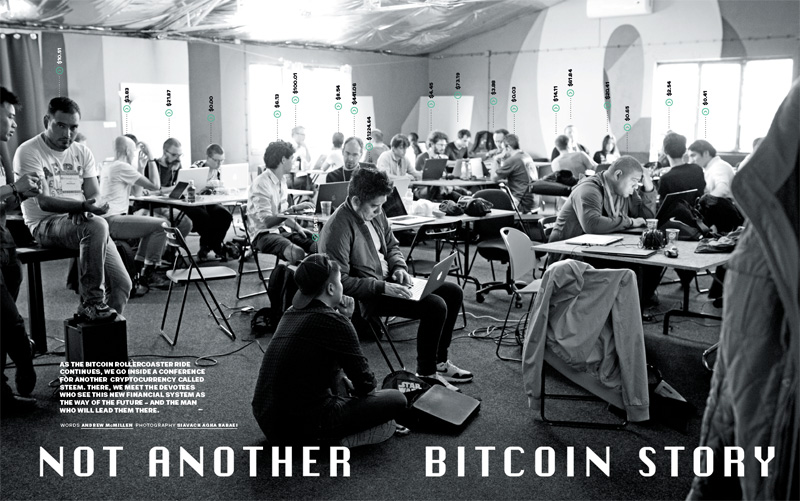
    A 4,000 word feature story published in the November 2012 edition of Rolling Stone Australia; my first non-music feature for the magazine. Click the below image to view a PDF version, or scroll down to read the article text.

    Building A Better Brain: Wired on Nootropics
    By Andrew McMillen / Illustration by Amanda Upton

    A new generation of “smart drugs” that promise to enhance cognitive ability are now available, but are they the key to the human race’s next evolutionary leap or merely 21st century snake oil? Rolling Stone finds out…

    Before he swallowed the designer drug NZT, Bradley Cooper was having a shitty day. Scratch that; he was having a shitty life. Cooper was an unproductive, depressed writer with few prospects and fewer friends. His long-suffering girlfriend had recently left him. His unkempt appearance implied that his deep apathy extended to his body image. Here was a man broken by the accrued stress and malaise of living a seemingly pointless, joyless existence in modern day New York City.

    Moments after taking the transparent, odourless NZT pill, though, Cooper’s world changed dramatically. His visual and auditory perceptions sharpened significantly. His brain could instantly summon previously forgotten snatches of glanced-at facts and figures. His empathy and charm were suddenly amplified to the point where he was able to bed a woman who previously loathed him. A burst of inspiration saw him cleaning his apartment for the first time in years while forgoing both food and his usual addiction to nicotine. Within a few hours, Cooper produced a hundred pages of brilliant writing, which pleased his editor like never before.

    As his interior monologue put it, “I was blind; now I see. I wasn’t high, wasn’t wired; just clear. I knew what I needed to do, and how to do it.”

    This isn’t a scene from Bradley Cooper’s actual life, of course. It’s the life of a fictional character named Eddie Morra, which Cooper portrayed in the 2011 thriller Limitless. Right now, I’m psyching myself up for a Bradley Cooper moment of my own. My version of the make-believe NZT is a little, white, very real pill named Modalert. Produced by Indian manufacturer Sun Pharmaceuticals, the drug’s generic name is modafinil and it costs around $2 per 200mg dose. In Australia, it’s only prescribed to narcoleptics and shift workers who have difficulty staying awake. I’ve acquired some through an online retailer and at 5pm on a Monday, I take the drug for the first time.

    By 10pm I’m wide awake, and aware that my resting heart-rate is higher than normal. By midnight my mind is racing around like an agitated puppy: “Hey! Here I am! Play with me!” I occupy myself with the normally tedious task of transcribing interviews; when I next look at the clock, it’s 3.30am and I’m finished. I’m washing dishes to take a break from work, when I realise that my randomly chosen soundtrack has taken on an eerie parallel to real life. In the classic Nas track ‘N.Y. State of Mind’, he raps: “I never sleep / ‘Cuz sleep is the cousin of death.”

    For as long as I can remember, my answer to that age-old ‘just one wish’ hypothetical has been ‘to never fatigue’. To never need to sleep. To be able to learn, create and achieve more than any regular human being because I’m no longer confined by the boring necessity of a good night’s sleep.

    Thanks to modafinil, I’m closer to this long-held dream than ever before. And I feel incredible. Not high, not wired; just clear. The computer in my skull is crunching ones and zeroes while the rest of the world sleeps. I yawn occasionally, but my mind feels focused, at capacity, even as 5am approaches.

    It’s a kind of cognitive dissonance I’ve never experienced before; I know I should be feeling fatigued by now, but everything’s still working well. At 8.30am – roughly fifteen hours after taking the drug, which corresponds with its stated half-life – its effects wear off, and fatigue sets in. I take a three-hour nap, then pop another modafinil upon waking. I’m back on the merry-go-round of sleeplessness, and loving it.

    Giddy at the near-endless productivity possibilities that I’ve suddenly unlocked, I confess my off-label use of Modalert to a Sun Pharma spokesperson via email in a moment of clarity (or, perhaps, over-earnest honesty). The reply arrives in my inbox a short time later, and I’m briefly quietened by its ominous tone.

    “You’ve seen Limitless?” the Indian drug rep replies. “The cost is too much. Please evaluate what you are doing, even for test purposes. Neuronal circuitry is not to be messed with.”

    ++

    Modafinil is the brightest star in a galaxy of drugs and supplements called ‘nootropics’. The word was coined by a Romanian doctor in 1972; in Greek, its definition refers to ‘turning the mind’. More commonly known as ‘smart drugs’ or ‘cognitive enhancers’, nootropics work in one of three ways: by altering the availability of the brain’s supply of neurochemicals; by improving the brain’s oxygen supply; or by stimulating nerve growth.

    Smart drugs are not a new concept. Last century, both cocaine and amphetamine were considered to have enhancement potential. As researchers at the University of Queensland wrote in a 2012 paper, “…their use for this purpose was regarded in a wholly positive light. [Cocaine and amphetamine] were seen as safe and effective ‘wonder drugs’ that increased alertness and mental capabilities, thereby allowing users to cope better with the increasing demands of modern life.” These views became unpopular once both substances were found to be addictive: cocaine became a prohibited substance, though amphetamine is still widely prescribed as a treatment for attention deficit hyperactivity disorder (ADHD) under the brand name Adderall.

    The Therapeutic Goods Administration (TGA), Australian drug regulation authority, does not yet recognise nootropics as a class of drug, as “the information available on nootropic products provides a very broad definition.” A TGA spokesperson tells Rolling Stone that they are unable to comment on the matter, as “the issue here is that the definition of nootropics goes from nutritional supplements all the way through to prescription medicines, so depending on what the product is and its claims, it might be considered as listable, a registered complementary medicine, or a registered prescription medicine.”

    So regulation is a murky topic, then. But nootropics aren’t illegal, either. Admittedly, taking modafinil off-label is not a smart thing to do. I am not a narcoleptic. I sleep just fine, if begrudgingly. I am a healthy 24 year-old male who exercises regularly and eats well. My recreational drug use is occasional. I’ve never been addicted to anything, and I intend to keep that clean sheet. I would like to be able to concentrate for long periods during the work week, though. I’d like to be able to instantly summon previously forgotten snatches of glanced-at facts. In short, I’d like to be smarter. Who wouldn’t?

    In the fictional account of Limitless and its inspiration, a 2001 techno-thriller by Irish author Alan Glynn named The Dark Fields, the universally appealing idea of self-improvement through minimal effort is explored by a guy taking a designer drug to boost his brainpower to superhuman levels. In reality, nootropic enthusiasts claim significant cognitive benefits with few, if any, side effects from taking these supposedly non-addictive, non-toxic substances.

    Sounds too good to be true? You bet. With my bullshit detector cranked up to eleven, I’m wading into this contentious field with the goal of separating science from fiction. Are smart drugs the snake oil of the 21st century? Or am I about to become a better man just by taking a bunch of coloured pills?

    ++

    After Eddie Morra tires of writing while under the influence of NZT, he turns his attention to the far more lucrative stock market. When I tire of writing on modafinil, I waste away the night-time hours by shooting terrorists in Counter-Strike: Source online, trawling internet forums, and reading about nootropics.

    With a newfound surplus of time arises an interesting dilemma: how to spend it? I chose to alternately work, read, and play games. What if every night was like that, though? What if I had all that time? How soon would I become accustomed to operating on little, or zero, sleep? What would be the side-effects of this for my health, my relationships, my career? Would I become a kinder person? Would parts of my personality become amplified, or atrophy? Obvious productivity gains – or productivity opportunity gains – aside, would less sleep make me a better person?

    All Tuesday night, I’m keyed into a writing task with laser-like focus. By sunrise, I’ve produced an article which, at the time, feels like some of my best work yet. (When it’s published online, weeks later, I read it with fresh eyes and I’m pleasantly surprised to find that I still feel the same way.) On Wednesday, I choose to take a break from the drug, but I’m still up until 4am. My sleep cycle has been totally disrupted.

    Thursday just feels like a regular day. I’m yawning more than usual, probably due to the sleep debt I’ve incurred this week. But it does feel a little… boring to be operating at this level, rather than on modafinil, where I feel like I’m connecting all of the dots all of the time. I suddenly find myself weighing up the costs and benefits of taking a pill right now. I have nothing in particular that needs to be completed for the remainder of the week, but there’s an internal argument happening: “Being awake is so much more enjoyable than sleeping. Who needs sleep, honestly?”

    I dose another 200mg, and within the hour, I again find myself making connections in music that I’d never previously noticed. The Black Rebel Motorcycle Club song ‘Stop’ aligns with my current mindset: “We don’t know where to stop / I try and I try but I can’t get enough…

    I feel like an outlaw; as though I’m in on a secret to which everyone else is oblivious. I know how to subvert sleep; that knowledge is in the shape of a small white disc containing 200mg of modafinil. I feel as though taking this drug might be one of the best decisions I’ve ever made. I want everyone around me to take it, too, so that we can share our experiences and revel in the euphoria of the unclouded mind.

    That night, I drive to and from a rock show. I meet friends and strangers at the venue; as I talk, I feel as though I’m not making sense, and that those around me are acutely aware of this. I feel in control, but my mind is racing faster than my mouth can keep up. I buy one beer and feel a little drunk, but I don’t come close to crashing my car on the drive home. Around 2am, I note that I’ve got an impending feeling of doom going on. Like I’m riding this too far, and it’s about to start doing some serious damage. I turn in at 3.30am on Friday.

    My first nootropic odyssey whimpers to a close, after beginning with a giddy bang at 10am on Monday morning. I’ve taken three 200mg doses of modafinil during that time – 5pm Monday, 1pm Tuesday, 2.30pm Thursday – and napped for around 11 hours total. In all, I’ve been awake for 79 out of the last 90 hours.

    I arise at midday, refreshed, having effectively reset my debt with one normal sleep. I reflect on how my views toward modafinil have veered between utter devotion to, now, in the cold light of day, a realisation that it’s probably not a good idea to be taking that shit on consecutive days. I was feeling so fucking average the night before. I couldn’t bear the thought of continuing to stay awake. The body and the mind aren’t made for it.

    ++

    Next, I purchase some homemade nootropics from a vendor named Tryptamine on Silk Road (SR), an anonymous online market where illicit drugs are purchased with virtual currency and sent through the international postal system. Tryptamine’s vendor profile states, “I am a biologist who develops nutritional supplements to improve your health, sleep, and cognition. I use only natural or orthomolecular ingredients, and no adverse effects have been reported from my products.”

    Tryptamine makes and sells three nootropics. I order two 24-pill bottles of MindFood (“designed to optimize brain function, protect against stress- and drug-induced neurotoxicity, prevent/alleviate hangovers, and reverse brain aging,” among other alleged effects), and ChillPill (“designed to promote relaxation, attenuate stress, calm excess brain activity, enhance mood, and promote dreaming”). The seller kindly includes a bonus five-pill sampler of ThinkDeep (“designed to stimulate brain metabolism and glucose uptake, improve memory formation/recall, expand attention span, prevent mental fatigue and enhance blood flow”), too.

    The total cost is around AUD$100. As I pay this seemingly exorbitant amount, I’m reminded of that old aphorism about fools and their money. The package lands in my mailbox via the state of New York around two weeks later. The pills are brightly coloured and strong-smelling. I try all three nootropics in isolation, one or two at a time, on different days.

    After swallowing a ThinkDeep for the first time, I realise that I just took an anonymous black and red pill created by an anonymous internet seller who claims to be a biologist. They’ve got a 100% feedback record from over 400 transactions on SR, which counts as a sort of social proof, but still: bad things could happen to me after taking this pill, and the person responsible would never be caught out. (Tryptamine denied Rolling Stone’s request to verify his/her identity, or scientific credentials. “Whatever image you have in your mind’s eye from reading this, that’s how I look,” the seller wrote.)

    “Silk Road allows me to sell my products anonymously, and provides me with hundreds of thousands of potential customers who already take pills that aren’t made by pharmaceutical companies,” Tryptamine tells me. “On the other hand, it is a bit off-putting to see my products listed beside bags of heroin.”

    As it turns out, ThinkDeep doesn’t do much for me, even on another day when I double-dose. In fact, the only significant effect I notice from these three products is when one dose of MindFood eradicates a hangover much faster than my regular methods of paracetamol and/or ibuprofen. Perhaps ThinkDeep and ChillPill are so subtle that I don’t notice their effects; perhaps they don’t work at all. Potential hangover cure aside, it’s difficult to recommend these products for cognitive enhancement purposes.

    At the other end of the nootropic spectrum, far from secretive biologists and solo recipe-tweaking, is an Austin, Texas-based company named Onnit. Their flagship product is named Alpha Brain, which is slickly marketed as a “complete balanced nootropic”. Their biggest public advocate is the comedian, podcaster and former host of Fear Factor, Joe Rogan; they also have a few World Series of Poker players hyping the product on their website. I ordered a 30-pill bottle of Alpha Brain for around $40.

    Each green pill includes small amounts of eleven impressive-sounding substances, from vitamin B6 and vinpocetine, to L-theanine and oat straw. The serving size on the label suggests two pills at a time; as I discover, taking one does nothing. With two Alpha Brain pills circulating in my system, though, I feel an overall mood elevation and a heightened ability to concentrate on tasks at hand: reading, writing, researching. These effects last for between four to six hours.

    Alpha Brain worked for me, but it also feels like a triumph of marketing, too. As there are no clear estimates about the financial side of the nootropics industry, I ask Onnit CEO Aubrey Marcus whether it’s a lucrative field. “Absolutely,” he replies, though he won’t comment on Onnit’s annual turnover. “It’s something that everybody can benefit from. Whenever you tap into something [like that], there’s ample opportunity to make good money.” Marcus says that Alpha Brain has been purchased by around 45,000 customers across the world since launching last year. The company currently employs 13 full-time staff.

    He acknowledges that nutritional supplement manufacturers are met with their fair share of critics. “The pharmaceutical industry has done a good job of telling people that synthetic drugs are the only things that have an effect on the body. There are plenty who’ve never tried our products who’ll swear that they’re snake oil,” Marcus laughs. “We encounter that, and we just do our best to show as much research behind all the ingredients that we have.” He mentions that Onnit are intending to commission a double-blind clinical study on the effects of Alpha Brain, which he believes “will go a long way to silence the critics.”

    ++

    Perhaps nootropics aren’t a mainstream concept yet because the people most enthusiastic about their potential benefits are all scientists, marketers out to make a buck, ‘body hackers’, and other weirdoes. There are few ‘normals’ taking these drugs and supplements on a daily basis, so it all looks too strange and confronting for outsiders to try. As a society, we’re taught by our peers and the media that if something sounds too good to be true, it probably is.

    There’s also the possibility that nootropics will never become mainstream because their effectiveness is difficult to qualitatively measure, or alternatively, they don’t work at all. In this regard, Australian researchers are world-class sceptics of cognitive enhancement. When I visit the University Of Queensland’s Centre for Clinical Research (UQCCR) in Brisbane, I’m greeted by Professor Wayne Hall, who was first published on this topic in 2004. His essay, which appeared in a European biology journal, was entitled “Feeling ‘better than well’: Can our experiences with psychoactive drugs help us to meet the challenges of neuroenhancement methods?”

    Hall has studied addiction and drug use for over 20 years. “There’s been a fair amount of enthusiasm for cognitive enhancement [in scientific circles], but it hasn’t looked critically at the evidence on how common this behaviour is,” he says. The professor and his peers argue for “taking a step back, and not getting too excited or encourage unwittingly lots of people to experiment with stimulant drugs for the wrong sorts of reasons”.

    “If you look at the lab studies that have been done on whether these drugs [work], the effects – insofar as there are some – are fairly modest and short-lived,” Hall says. “To be jumping from that, to saying it’s good idea for people to be using these drugs regularly to enhance their cognitive performance, is a bit of a long bow.”

    Dr Bradley Partridge is another UQCCR academic who specialises in investigating “the use of pharmaceuticals by healthy people to enhance their cognition”. I bring along my bottles of Alpha Brain and Tryptamine’s homemade nootropics for him to cast a critical eye over. “I have never used any of these things,” Partridge says. He peers at the labels with bemusement. “And I’ve never heard of most of these ingredients.”

    He places the bottles back on the table. “The thing is, a lot of these supplements are touted as being ‘all natural’, and for some people, that implies that they’re perhaps safe. But it’s very hard to evaluate exactly what’s in it. Aside from safety, where’s the evidence that they actually work for their stated purpose?”

    “There’s no scientific literature on some of this stuff; for others, the results are very mixed. Also, there might be a really strong placebo effect.” He holds up the Alpha Brain bottle, which mentions ‘enhancing mental performance’ in its marketing copy. “You take this and you do an exam; maybe simply taking something makes you feel like you ought to be doing better, and maybe you convince yourself that you’re getting some effect.”

    Hall and Partridge co-authored a study which analysed media reports on “smart drugs”. They found that 95 per cent of media reports mentioned some benefit of taking a drug like Adderall, Ritalin or modafinil, while only 58 per cent mentioned side effects. “I tend to be very cautious about this stuff,” Partridge says. “I don’t like to see this getting portrayed as a widespread phenomenon, as a fantastic thing, that it works, that there are no side effects. That runs the risk of encouraging people who hadn’t thought about it to take it up, which could cause problems for people.”

    I offer to leave some of my nootropics with Dr Partridge for him to conduct his own research; he laughs, and politely declines.

    ++

    Underscoring this entire discussion is the threat of one-upmanship. If I’m taking these drugs and they markedly improve my performance, am I nothing but a filthy nootropic cheater? To address this question, I spoke with Dave Asprey, who has used modafinil constantly for eight years and describes himself on Twitter as a “New York Times-published Silicon Valley entrepreneur/executive/angel who hacked his own biology to gain an unfair advantage in business and life.”

    Asprey has a prescription for the drug, after a brain scan showed a lack of blood flow at the front of his brain – a common symptom of attention deficit disorder (ADD), he says. “Modafinil is actually used commonly as a treatment for ADD,” he tells me. “It’s an off-label use, but it’s accepted; it’s even reimbursable by some insurance companies.”

    Asprey takes modafinil most workdays, upon waking. “It’s not like it’s a great secret out there, it’s just that people don’t talk about it because there’s some feel as though it’s ‘cheating’,” he says. “My perspective is different: if you eat healthy food, then you’re also ‘cheating’, because that impacts brain function. Surprisingly, the only people who’ve ever given me shit about taking modafinil are like, ‘but how do you know it’s not hurting you?’ I’m a bio-hacker; I’ve done all sorts of strange things to my body and mind in the interests of anti-aging, health and performance. I look at my body as part of my support system.’”

    Asprey says that he considers modafinil to be on the healthier spectrum of drugs. He’s also a fan of aniracetam, a fat soluble version of piracetam, which itself was the first-ever nootropic discovered in 1964. “It’s longer lasting [than piracetam],” Asprey says. “I recommend it as a basic biohack. I’ve been using it for a very long time.”

    Though Asprey has never met anyone who bluntly considers nootropics to be bullshit, he hears another argument reasonably often – and he has a clever rebuttal ready. “People say, ‘[nootropics] are evil, because if you take them, then everyone else will have to take them!’ I don’t think that’s a very fair argument, because from that perspective, fire is evil. Back when there were two cavemen, and one had a fire, the other said, ‘you can’t use fire, that’s unfair!’ Well, we know who evolved.”

    ++

    Whether or not I’m qualitatively smarter after experimenting with nootropics for this story is difficult to measure. I feel slightly wiser, and more aware of the limitations of both mind and body after that week of bingeing on modafinil. I certainly appreciate the restorative value of sleep better than ever before, after staying awake for the best part of a full work-week. I found that Alpha Brain is useful for focusing for a few hours, but considering that a two-week supply costs $40, it seems a touch on the expensive side.

    I did order a few dozen additional pills of modafinil, but I intend to use these only when emergency deadlines necessitate long hours. (I’ve read it’s good for combating the effects of jet lag, though, so perhaps I’ll try it on my next international flight.) Ultimately, the nootropic I found most useful – and intend to continue using regularly – is aniracetam, which Dave Asprey told me about. Its mind-sharpening effects are subtler than Alpha Brain, but it’s much cheaper – around $40 for a month’s supply if purchased online – and its effects taper off much more pleasantly than Alpha Brain’s comparatively sudden drop-off in concentration and energy levels.

    Late one night while researching this story, modafinil coursing through my body, I watched Limitless for the second time. It’s not a brilliant film, but it’s entertaining and thought-provoking enough to make the viewer consider seeking out smart pills of their own. It’s easy to see why the nootropic industry’s shadier sellers have attempted to draw parallels between their products and the fictional substance of NZT. After viewing the film, I contacted Alan Glynn, the author behind the 2001 techno-thriller The Dark Fields, which Limitless was based on, via email.

    “The original idea of NZT – called MDT-48 in my book – came from the idea of human perfectibility, of ‘the three wishes’, of the chance to re-invent yourself, of the shortcut to health and happiness,” Glynn tells me. “This is why the diet and self-help industries are so huge. Hold out a promise like that and people will respond. The fact that most of these products and therapies don’t work, or are bogus, doesn’t seem to matter. The real magic here, the real dark art, is marketing. I think that if nootropics ever go mainstream, they’ll be fodder for the marketing industry.”

    I send Glynn a link to the Alpha Brain website and mention that I’ve been taking it while researching this story. “Look, I’m just as much of a sucker as anyone else and when I look at that website, I’m going like, ‘Woah, gimme some of THAT!’” he replies. “And I’m actually seriously considering ordering some. So, from a marketing point of view, I’d say it’s a total success. It’s shiny, professional-looking and stuffed full of ‘the science bit’.”

    “But it’s the massaging of the science bit that is the marketer’s real dark art. The truth is, I couldn’t argue with someone who can talk about ‘GPC choline’ and ‘neurotransmitter precursors’. My instinct is that it’s all bullshit… On the other hand. I don’t know. Have you taken Alpha Brain? Does it work?”

    I reply in the affirmative, and describe my findings in some detail. Alan Glynn, author of the book that inspired the movie that inspired me to write this story in the first place, writes me back immediately: “That’s interesting indeed. I’ve ordered some Alpha Brain, and I’ve just got an email to say it’s been dispatched. I’ll report back to you – in the interests of science, of course.”

    Note: At no point should any of the products mentioned in this article be ingested without first consulting a health professional. An earlier version of this story incorrectly identified Ritalin as an amphetamine; it belongs to the methylphenidate class of stimulants.

    To read more on nootropics, I recommend that you continue your research at Smarter Nootropics. Good luck!

  • Qweekend story: ‘Goal Mining: Minecraft and education’, October 2012

    A story that was published in Qweekend magazine on October 13, 2012. Click the below image to view as a PDF (link opens in a new window), or read the article text underneath.

    Goal Mining
    Story: Andrew McMillen / Photography: David Kelly

    A video game that uses collaboration and communication to engage children online has inspired a new method of teaching.

    The first thing we need to do is collect wood. We do this by smashing our fists into tall trees until the wood disintegrates into small blocks, which then become ours to keep. Curiously, punching out the tree trunks makes no difference to their structural integrity; they continue standing tall, trunkless, while we pilfer their wood.

    The second thing we need to do is make sticks. “Using the crafting table, put one wood block on top of the other,” says James Keogh, who acts as group leader and instructs our gang of five as we navigate this strange world.  Easier said than done. Under the clear blue sky, I can’t interpret his instructions to make the most obvious and essential item.

    Sticks are the basis of the pickaxe, the shovel and the sword. I need all of these things to survive and prosper in the world of Minecraft, a computer game set in a randomly generated landscape of mountains, valleys, forests and deserts. Minecraft is unlike any game I’ve played – there are neither clear objectives nor clear instructions. The player is left to his own devices in this virtual playground, to spend his time however he wishes.

    My fellow adventurers – four 11-year-old boys who attend West Moreton Anglican College, west of Brisbane – try time and again to explain the simple process of creating sticks. I’m sweating as oblong clouds pass across the square sun. The blocky mountains surrounding us seem to be frowning at me. Dark squid float idly in the lake nearby, indifferent to my crafting struggles.

    I feel stupid and inadequate, especially in the company of these four well-travelled friends. Darcy Keogh, James’s twin brother, takes pity and gifts me a stone pickaxe, short-cutting the process considerably. It’s a relief. Without my companions, I’d be clueless; come nightfall, I’d surely be dead.

    James and Darcy have been busy using their pickaxes to excavate dirt out of the side of the nearest mountain for our “hidey-hole”, while their friend Liam Catlan patiently attempts to coach some success into me. Torrin Beverley has taken it upon himself to begin digging deeper into the earth in search of precious resources like iron, gold, and – if he’s lucky – maybe even diamond. Mining tools in hand – just a pickaxe and a shovel for now – I climb partway up the mountain and stand at the entrance, admiring their handiwork.

    James warns us that it’s almost night time. I step inside the hidey-hole, shutting the door behind me. Foolishly, Liam stays out and attempts to fight a giant spider. Anguished howls echo across the landscape as he dies at the fangs of his eight-legged foe. His now-itemless character respawns beside us. “Did you have anything worthwhile on you?” James asks. Two stone pickaxes, his friend types. “Not really much, then,” replies our leader nonchalantly.

    Torrin asks if anyone wants a sword. “Yes,” I type, before opening the door and stepping outside. It’s snowing. Pretty, digital snowflakes criss-cross the night sky, falling lazily to the ground. “Whoa,” I say to no-one in particular. It’s a beautiful sight.

    I check my inventory and find Torrin’s gift. All four boys have joined me outside, just beyond the light cast by the flames of our farthest torch. The square moon passes slowly overhead. I wonder aloud whether it’s a good idea for us to be out here, given that one member of our gang of five was so recently slain. “Not really,” says James, swinging his sword defiantly at nothing in particular.

    The boys tell me that there are zombies, skeletons, Creepers, spiders and Endermen out here, prowling the dark landscape. Horrible creatures all. We head back inside and close the door behind us. I turn and stare through the window once again at the mesmerising snowflakes, reflecting on the wide range of emotions I’ve experienced during my first 20 minute-long day/night cycle: confusion, frustration, satisfaction, wonder and, finally, fear.

    ++

    Minecraft is fun because it’s so divorced from reality that minds run free with possibility. Key attractions include its detachment from the responsibilities of daily life – school, work, parenthood, traffic, taxes – and the ease with which the digital world bends to your will. Want to dig a hole in real life? It’s bloody hard work, for starters. Then there are property rights and land ownership to consider, as well as the high likelihood of your dad going off at the sight of his well-tended lawn transformed into a crater.

    In Minecraft, though, it takes just seconds to carve into the ground, or a mountain, and begin exploring what’s beneath. (Once you’ve conquered the admittedly tricky first act of crafting your mining tools, of course.) Likewise, it’s just as easy to create solid structures in-game. Two of the most impressive mega-creations include a 1:1 scale model of the Starship Enterprise, from Star Trek, and a current project involving a few dozen people working on crafting the entire Westeros realm, from the fantasy series Game Of Thrones. Put simply, it’s Lego in a limitless virtual world where the only impediment is your imagination.

    Created by 33 year-old Swedish game programmer and designer Markus Persson, best known by his online handle “Notch”, Minecraft is an international phenomenon. Notch self-published the first “alpha” version of the game online in May 2009, charging a one-off fee of about $12 (€9.95) and updating Minecraft with new features until version 1.0 was released in November 2011 for $24.50 (€19.95). More than 10 million players have bought the game across both the PC and Xbox 360 platforms; it also boasts 42 million registered users, a figure still growing by around 140,000 new players per day.

    Few are immune to its charms, even those who struggle with the game’s mechanics at first – which is essentially everyone, as the PC version of the game offers no in-game assistance. (Minecraft Wiki – a popular first destination for the clueless – contains more than 2,000 detailed articles.) This is the kind of unorthodox design decision that few gaming studios or publishers would allow, yet since Notch created it all himself, he was beholden to no such orthodoxy. Evidently, it hasn’t hindered the game’s popularity.

    “Younger gamers are completely enthralled by Minecraft,” says Janet Carr, series producer of ABC TV’s Good Game, which screens Tuesday nights on ABC2 and attracts an average weekly audience of 108,000. “Since you create your own fun, it gives you the freedom to play it the way you want to. It’s personally satisfying because you have that feeling of discovery, and of creation. Normal game design theory would say that making it hard to play is lethal to your game. Minecraft is the complete opposite: because the kids have to work quite hard at getting a handle on it, they get invested in it really quickly, and very deeply.”

    Carr’s team also works on Good Game Spawn Point, a program aimed at gamers aged 8-12 watched by 80,000 viewers on ABC3 Saturday mornings. She estimates that half of the 10,000 emails sent to the show’s presenters each week are from younger gamers seeking answers to Minecraft gameplay questions. “It’s not even just the number of emails we get about the game that’s surprising, it’s the sophistication of the information they’re seeking,” Carr says. “It’s not, ‘how do I build a pickaxe?’ It’s ‘how do I set up my repeater units so that my mine cart will travel a few kilometres?’ Engineering questions.”

    ++

    It’s impossible to discuss Minecraft without acknowledging its potential to become truly consuming. Since the game world is randomly generated and limitless, it’s unsurprising that those who fall for its charms tend to invest serious hours in the never-ending process of day and night, mining and crafting, exploring and expanding. “A lot of parents are concerned their kids are spending too much time on video games,” says Carr, whose youngest son was obsessed with Minecraft but has since moved on. Unlike most other games, though, Minecraft is undirected. Players must use their own intelligence, intuition and inspiration to derive enjoyment from the game, rather than relying on objectives and rewards predetermined by game designers.

    “A large issue for parents is that they don’t understand what their kids are so enthusiastically raving about,” says Luke Bennett, a 49 year-old ecological consultant who lives in Castlemaine, Victoria and is the father of 11-year-old twins. “When our son first started playing, my wife and I discovered that if he played up until he went to bed, he was so mentally wired that he could not sleep. I’ve responded by letting him play, but not in large chunks of time. Minecraft is a valuable part of a complex lifestyle. You need to leaven it with the other stuff.”

    Recently, Bennett and a friend set up a private online server where about ten children aged 7-12 play online together most nights. “This means my own gameplay is now more of a moderator role, rather than just purely building,” Bennett says. “We’ve set up a blog for the kids so that they can discuss differing playing styles, and resolve conflicts. The biggest issues in the game are virtual urban and environmental planning. The kids’ default response is to ask me to intervene, which has resulted in some very odd conversations at afternoon school pick-up,” he laughs. “But I think it’s great,” adds Bennett, who now tends to play late into the nights with his middle-aged friend after their kids go to bed at 9pm. “Minecraft is a game that encourages players to think, create, solve problems, engineer, train reflexes and socialise. It’s almost education-by-stealth, in the guise of a video game. It’s like hiding cauliflower in mashed potato.”

    Janet Carr agrees that playing with children, rather than observing their behaviour from a bemused distance, is the best way to appreciate their enthusiasm and set limitations around gameplay. “If everyone in the household understands the rules, it doesn’t become an issue,” she says. “If you’ve got a child who’s really wanting to spend all their time talking about Minecraft, you’re almost beholden to get a great understanding of it yourself so at least you can have high levels of conversation about it, and talk about how to manage that time.”

    Steven “Bajo” O’Donnell is co-host of both Good Game shows. “I hate the word ‘addictive’, because it has a negative association,” he says. “I like to use the word ‘compelling’ instead. Minecraft compels you to go back into it, and keep playing it, and keep building.”

    His co-host, Stephanie “Hex” Bendixsen, agrees. “I don’t think it’s necessarily addictive in the way that [online role-playing game] World Of Warcraft is addictive, because that game offers you constant rewards for ‘X’ amount of hours that you’ve put in. Whereas Minecraft doesn’t really have any kind of reward system; it’s really about what you get out of it personally. It may be hard for people to stop playing, but that’s really due to their own experience rather than something that the game is doing.”

    The Good Game hosts regularly hear from teachers who’ve had to ban the game from their schools, or allocate specific times when kids can go into the computer labs at lunchtime to play. “Some teachers use it as a system of reward: if the students get through a computing studies class, then they’re allowed to play for 15 minutes at the end, because they just can’t stop kids from playing it,” says Bendixsen. “They’ve had to try to find ways to work it into school life. Since it’s a game that doesn’t have any kind of guns or shooting, and encourages kids to be imaginative to work cooperatively, it works quite well in the classroom.”

    ++

    High above the clouds, I’m standing on a transparent platform bathed in the orange glow of twilight. At the edge of one horizon, a square sun dips; behind me, a square moon rises. Underneath the platform is an enormous mass of blue-green. It’s the kind of view only an astronaut would see in reality: star-speckled blanket of infinite space above, stable blue marble below. Suddenly, a man in a white labcoat appears next to me. The glowing yellow text above his head reads “Elfie”. He begins giving me a virtual science lesson while showing me around his greatest Minecraft creation – an animal cell he built for his biology students.

    “The whole idea of these first platforms was to give the kids an overall picture of the cell, because it’s very hard to imagine what it looks like from the outside once you’re in there,” says 32 year-old Stephen “Elfie” Elford, who teaches science, maths and humanities at Numurkah Secondary College (enrolment: 300) in north-eastern Victoria.

    As we travel between observation decks by right-clicking on teleportation terminals, we’re getting closer to the giant blue-green mass. Its curvature is reminiscent of the human brain. On the fourth and final deck, I’m presented with the option of teleporting to four unfamiliar, scientific-sounding stations. I choose “Golgi”, the first option. Now I’m inside the giant mass, and before me is a roughly rectangular prism that represents the Golgi apparatus. Right-clicking on an information block at the edge of the platform gives a text overview of its function, written in the same straight-talking language Elford would use while standing at the head of his classroom. “This is an animal cell,” says Elford. “As my biology students tour the cell, they fill in a booklet. I wanted to deepen that understanding and give them a good visual representation they could call on, when needed.”

    So Elford invested six months, on and off, in creating this three dimensional, to-scale replica of how he understands the inside of an animal cell might look. He estimates that he’s moved two million virtual blocks during the 50-hour building process. The brightly-coloured textures of this fascinating structure bear little resemblance to the lifelike shades of the world I explored with the four 11-year-old boys.

    Elford’s animal cell is a remarkable, inspired piece of work from Australia’s foremost expert on MinecraftEdu, a modification (or “mod”) based on the existing game engine. Developed in collaboration by teachers in Finland and the United States, the mod’s disparate but growing network of Games-Based Learning practitioners see efforts like Elford’s as a way to engage the next generation of “digital native” students. (Elford runs a blog called “MinecraftEdu Elfie” where he shares his learning experiences with teachers throughout the world. He has also uploaded dozens of videos to YouTube showing how his classes have interacted with the game.)

    For the last eight years, Elford had taught Nurmurkah’s science students about animal cells from the textbook, two or three times a year. “I was kind of over it,” he reflects. “I don’t know if it was a seven-year itch a year late; I just didn’t feel like I was enjoying myself. And then this came along, and now I’m enjoying my job again. It’s given me that little bump to keep going.”

    Rather than learning through Elford’s descriptions and the biology textbook, it’s much more engaging for students to see his scientifically accurate representation of an animal cell with their own eyes. I didn’t take any science subjects in senior high school, partly because it all seemed so dry and dull. Had MinecraftEdu existed when I started year 11 in 2004, though, I could well have been drawn in by the technological lure.

    Elford is the first to admit that fanciful creations like this won’t entirely replace traditional teaching methods. In fact, he has used this incredible virtual environment in-class once so far, for a total of two hours. He has plans to upload the map so that other teachers can use the animal cell in their own classes. “The time and effort I put in is far outweighed by the students’ immersion in this cell,” Elford says. Using the game, he’s also led students through reaction time experiments; he’s explained the transformation between solids, liquids and gases (by setting his students on fire, in-game, of course); and he’s run an assignment wherein students built energy-efficient houses, then recorded video tours of their new creations. Despite these breakthroughs, MinecraftEdu is only used on occasion at Nurmurkah, when it’s appropriate to the learning at hand.

    “Personally, I think it should be in every school,” says Elford as he wraps up his tour of the animal cell while we stand outside, gazing up at the monolith. “The opportunities it provides for students to create, and to be creative, is something I haven’t found anywhere else in my time as a teacher.”

    Meanwhile, 15km north-west of Cairns at Kamerunga in far North Queensland is Peace Lutheran College, a prep-to-year-12 school of 585 students. Andrew Wright, 40, is eLearning mentor at Peace. He’s the one who drove the college’s IT department to adopt MinecraftEdu for the first time this term, across two classes of 25 students. “It’s been fantastic,” says Wright, who also teaches Year 7. “We’re studying Ancient Rome at the moment. We found a MinecraftEdu map of that, where the pupils started off in the Colosseum, then partnered up and walked around Rome to have their photographs taken outside iconic landmarks such as the Pantheon. They then went away and researched what that real building would have been used for, and made a presentation about it. You walk around [the virtual] Rome yourself and you think, ‘wow, someone must have spent years doing this!’”

    Though a classroom of 25 kids running rampant in MinecraftEdu sounds chaotic – despite the availability of teacher-only crowd control tools that can instantly freeze, mute or teleport students – Wright assures me it’s quite the opposite. “Because the students want to be learning, and they want to be engaged, they’re very respectful of the game and of each other,” he says. “That’s what we try and teach them – within the game, you have to cooperate, you have to use all the skills that you’d need in the real world. Collaboration, communication; it’s all there. There’s a real learning curve going on because the Year 7s are teaching the Year 1s.”

    Wright, who is now in his fifth year of teaching at Peace, says that “addictive” is “a strong word” when used in the context of Minecraft. “As a teacher, if you’ve got something that the students are keen on using, and you can use it in an educational way, you’re on to a winner. It can be seen as taking up a lot of time, but as with anything, you have to manage that time. When parents see their children coming home and working on this stuff after doing their homework, I don’t think you can put a value on that.”

    ++

    James and Darcy Keogh are showing me around their virtual world one week before my first in-game experience. It’s the first time I’ve seen Minecraft in action. James walks through their well-tended farm of pumpkins, melons, wheat, sugar cane and cacti while playing on a laptop that’s connected to a widescreen television in the living room of a house in Chuwar, about 6km north-west of Ipswich.

    Parents Robert and Grace, who are separated, watch intently from the lounge as their 11-year-old sons walk them through a world they understand a fraction as well as their youngest children do. Throughout the 90 minutes the twins spend pumping me with information, they chatter constantly, challenging one another on which elements of the game to demonstrate and how best to describe its complex functions. It’s a dizzyingly detailed language spoken by twins fluent in Minecraft-speak.

    “There are different ranks of tools,” James explains. “You start with wooden, which is the worst, then upgrade to stone, iron, gold and diamond.”
    “But you’ve got to mine all that stuff to make it,” says Robert, who has himself dabbled with the game.
    “You’ve got to chop down the trees to get the wood,” Grace adds. “That’s the first thing you do – punch a tree. I never got past wooden tools,” she says, with a hint of regret.
    “When you play, you just muck around,” James gently cajoles her, “putting blocks down anywhere …”
    “You’re not fanatical like some!” Robert interjects. The Keogh family laughs together.

    Countless hours sunk into this intriguing world built on blocks, mining and crafting. Millions of players absorbed by the limitless promise of what this game represents better than any before it – a tangible, tantalising sensation of freedom. Two 11-year-old boys who have been playing video games as long as they can remember, and who have played this particular game practically daily since their eldest brother, Brendan, first showed it to them in 2009.

    “So why do you guys play?” their father asks.
    “Because it’s creating, and you can basically do anything you want to,” replies James.
    “Where most games are just, ‘you do this, then you do that …’” says Darcy, “and you don’t get to …” James interrupts by finding the right word for his twin.
    “Most games are linear,” James says. “Minecraft isn’t linear.”