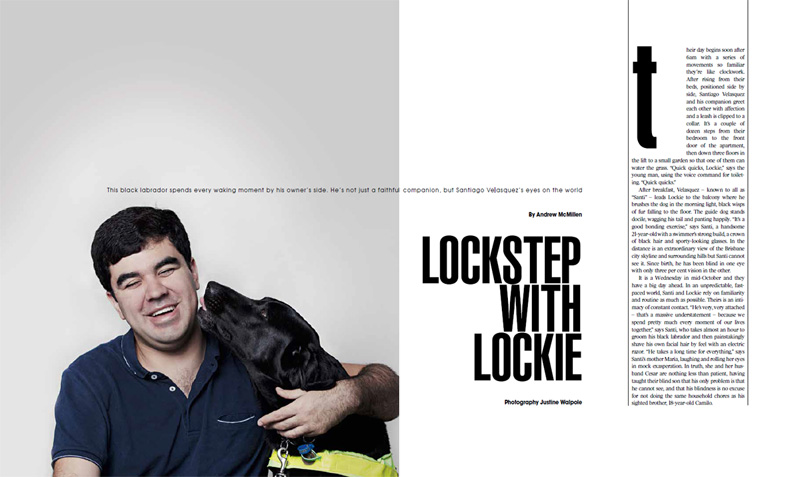
The Global Mail story: “Sources Of Tension: SourceBottle and online sourcing”, April 2012

April 27th, 2012

A story for The Global Mail, published in April 2012.

Excerpt below; click the image to read the full story on The Global Mail website.

Sources Of Tension
by Andrew McMillen

Times have changed for journalists, and some have changed the way they get their information. It’s time to let readers in on one of the shortcuts.

Pre-internet, journalists had it tough. If they needed quotes, they had to use initiative, combing their existing contacts, working their telephones, or wearing out their shoe leather meeting people face-to-face. Often, all three tactics were employed simultaneously.

In 2012, not only are supremely useful online tools such as Google, Facebook and Twitter making the hunt for sources a much more efficient process, there are now entire digital businesses built around connecting journalists with sources – namely, the “real people” you find dotted throughout broadcast, print and online news stories. While Facebook and Twitter are useful for this purpose, they can be limited by a journalist’s existing network of “friends” and followers. So, aiming to streamline the process by offering volume and efficiency, new digital services will push a journalist’s message out to a large audience as quickly as possible.

At face value, such businesses may appear no more than a slick machine pushing the antiquated skill of personal sourcing into the interconnected present. But the media-consuming public usually are unaware of how the voices in news stories have been gathered, knowledge that might colour the way readers interpret the quotes. To examine the ethical complexity of the issue, The Global Mail looks in detail at one such direct-connect business: an Australian website named SourceBottle .

A cursory scroll through the website’s Twitter account, @SourceBottle , offers a depressing insight into the way some Australian journalists are using the service. On SourceBottle’s Twitter feed, wedged among requests for the generic (“Magazine seeks Gen Y girls who ditched the city life for the country”), the hopeful (“Magazine seeks people to lose 5kg in 2 weeks”) and the plain lazy (“Magazine seeks details on the Titanic for article”) is this jaw-dropper, tweeted on December 10, 2011: “Mag seeks women who have rejected a 6-figure salary, gone blonde, adopted a rescue dog or converted to Islam #beasource.”

It’s a shame that the link leads to a dead-end on the SourceBottle website — the journalist’s deadline has long since expired, and so the “call-out” is shielded from public view — as that story sounds amazing. (Imagine if they found one women who’d done all four disparate tasks?) Mirth aside, it also sounds like an Australian women’s magazine has planned an article and then attempted to find sources to fit their idea of reality, rather than using reporting to inform the outcome. It’s the journalistic equivalent of putting the cart before the horse.

SourceBottle, founded by former PR rep Rebecca Derrington in July 2009, advertises two functions. Firstly, it helps journalists and bloggers find sources for stories. These voices are essential across all forms of journalism: without sources, we’d only ever see, hear and read fiction or opinion. In order to find people to interview for their stories, journalists are allowed to post a “call-out” on the site. If all goes to plan, the journalist can “sit back and sources will find you”, according to the site’s bolded marketing spiel.The concept is instantly appealing to any time-strapped journalist (as most are, after all).

To read the full story, visit The Global Mail.

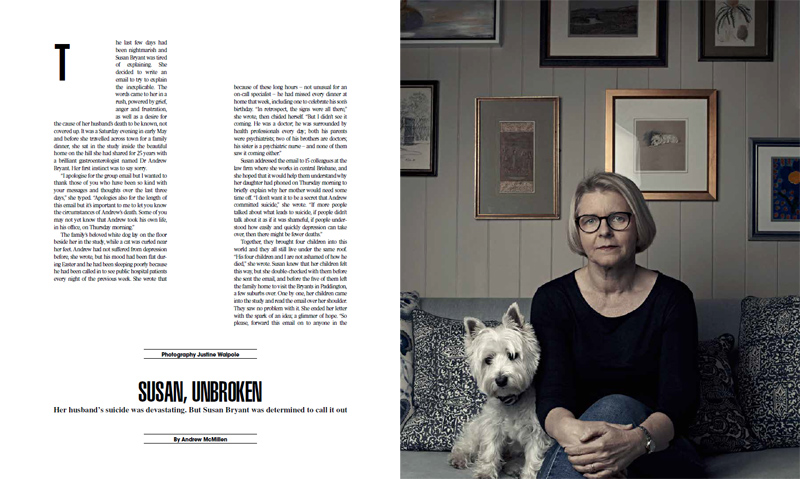
GQ Australia story: ‘Shock To The System: Electroconvulsive therapy’, March 2012

April 3rd, 2012

My first story for GQ Australia magazine: a 4,200 word feature about the psychiatric treatment electroconvulsive therapy, otherwise known as ECT or ‘electroshock’. This story appeared in the Feb-March 2012 issue of GQ.

Click the below image to read the story in PDF form (link will open in a new window), or scroll down to read the article text underneath.

Shock To The System

Electroconvulsive therapy has long been the stuff of cinematic nightmares. But after nearly four decades since One Flew Over The Cuckoo’s Nest, many are arguing it does much more good than harm.

Words: Andrew McMillen

As the young man is led into the operating theatre, the smell of salt water and sterilisation fluid hangs in the air. The room is unremarkable; all greys, blues and whites, just like any other theatre in hospitals across the country, except for a couple of innocuous-looking machines stacked on a bench. Twenty-five-year-old John Vincent doesn’t know it yet, but those machines would soon change his life.

Helped onto a gurney, Vincent lies flat on his back as a clamp is placed on his index finger to monitor his oxygen levels. He feels the cold wipe of saline solution on his collarbone, biceps and forehead, before a nurse applies several electroencephalography (EEG) electrodes to trace his brainwave activities. Moments later, a general anaesthetic makes its way up his arm, and he drifts out of consciousness.

Having been sedated, he doesn’t remember what happened next, but it goes like this. A specialist affixes an electrode to the middle of his forehead, and another one above his left temple, then switches on the Thymatrons – those machines in the corner – sending a series of short electric shocks coursing through his brain, bringing on a grand mal seizure. Fifteen seconds later, it’s all over. The current is switched off, the electrodes removed, and Vincent is wheeled into an adjacent recovery room.

It might sound like a scene from a ’70s movie, from the days of roguishly experimental medical procedures, but this was Boxing Day 2010, and Vincent had just received his first course of electroconvulsive therapy (ECT) at Toowong Private Hospital in Brisbane. A psychiatric treatment most commonly used on those with severe depression, ECT – better known by its outdated term, electroshock – is also called upon to treat patients suffering from acute mania or, in Vincent’s case, bipolar disorder. And despite the popular public perception of ECT as a barbaric, archaic practice, the treatment is administered on a daily basis at both public and private hospitals all over Australia.

Growing up, Vincent was a happy kid. He had lots of friends, enjoyed playing soccer, and loved going fishing with his younger brother while on regular camping holidays with the family. Then, aged 17, in his final year of high school, Vincent was diagnosed with bipolar disorder.

As he got older, his mental illness became harder to manage. “John was existing, but he wasn’t happy,” recalls his mother, Tina, a kind woman in her early fifties with a fair complexion and green eyes who runs a small business alongside her husband. “He wasn’t right, and at some stage he decided to go off his medication. Unfortunately, with his type of bipolar – type one – when he goes off medication, he goes into a state of catatonia. Everything shuts down; no communication, nothing happens.”

Things worsened as the years passed, and by late 2010, Vincent was living a life of isolation in Townsville, north Queensland. He’d withdrawn from the people around him: friends, family, even the younger brother he lived with. “You know those wildlife documentaries on TV, where they record the animals’ every move, behaviours and moods, and all that?” he asks, his hazel eyes burning with intensity. “I felt like I was an animal; like I was being surveyed.”

This was a dark time for Vincent, who says he spent a lot of time in his room “trying to hide away”. He constantly felt as though there was someone outside looking through the windows at him, recording his behaviour.

One Friday in December, his parents went to Mackay for their first trip away together in a year. The next morning, Tina and her husband received a call from their youngest son. “He didn’t think John was all that well,” she says. “We jumped on the first plane and came home. We spent all Saturday with John. He continued to decline into a catatonic state; not eating, not talking. It was almost like he was in a coma.”

By 5pm, Vincent’s movements had become “robot-like”, with his body barely responding to the signals sent by his brain, and the famil rushed him to the emergency ward at Townsville General Hospital, before he was transferred to the mental health hospital. “It’s pretty sad, because there just aren’t enough facilities,” says Tina, remembering how they how desperate they were for a solution to their son’s illness. “We turned to friends in the medical profession, who gave us a great deal of support and help.”

A man named Dr Josh Geffen was mentioned, who specialised in ECT at Toowong Private Hospital. Vincent had never heard of ECT before his parents brought it up, but since he was in such a low mental state at the time, he didn’t argue. “I just went with it,” he shrugs. “I cooperated, and followed my parents’ advice. I did what I was told.”

He hardly remembers a thing about the journey. His mother continues: “We got John down to Brisbane straightaway, and when Dr Geffen saw the state John was in, the first thing he recommended was ECT,” she says. “We were pretty horrified; we’d heard stories from the olden days of ‘shock treatment’ and that sort of stuff. We hadn’t really given ECT a lot of thought. It’s a little bit frightening, because you really don’t know what’s involved. But Dr Geffen explained everything to us, showed us a DVD, and put our minds at ease. We consented to John having the ECT, and he agreed to it, too.”

They got to work immediately. Doctors warned Vincent that the muscles in his arms, legs and shoulders might feel sore once he came to, after receiving the electric shocks. And indeed, he did feel uncomfortable for a couple of hours – he likens the muscle soreness to the day after a big gym workout – but says, “Afterwards, I felt fine. It took a while for the anaesthetic to wear off, but after that I was OK.”

Vincent’s story is more common than you might think. Statistics from the Australian Institute of Health and Welfare show that in the 2009-2010 financial year, 26,848 individual ECT sessions were administered throughout Australia – although the exact number of people treated is unclear, as patients tend to have multiple sessions. “A typical course of ECT involves between six and 12 treatments,” explains Dr Aaron Groves, the director of mental health in Queensland, adding that, while ECT can be used on people of all ages, since depression is more common in adults than in children, around 80 per cent of treatments are on patients aged 30 to 80.

Based on those figures, on any given day here in Australia, 73 people get hooked up to a machine and jolted with electricity in the name of medicine. What’s more, far from being a curiosity from the past that hasn’t quite died out, it’s actually on the rise. Why? Well, because it works.

++

Electroconvulsive therapy has its roots in early schizophrenia research. In 1934, Hungarian neuropsychiatrist Ladislas Meduna saw improvements in schizophrenic patients after seizures were induced with chemicals such as camphor and Metrazol. Three years later, Italian neuropsychiatrists Ugo Cerletti and Lucio Bini discovered that these seizures could be more easily induced by electricity. In a TED.com presentation uploaded in October 2007, an American surgeon and author named Dr Sherwin Nuland relayed an eyewitness account of the first time ECT was performed on a human in 1937.

“They thought, ‘Well, we’ll try 55 volts, two-tenths of a second. That’s not going to do anything terrible to him.’ So they did that… This fellow – remember, he wasn’t even put to sleep – after this major grand mal convulsion, sat right up, looked at these three fellows and said, ‘What the fuck are you assholes trying to do?’ Well, they were happy as could be, because he hadn’t said a rational word in the weeks of observation. They plugged him in again, and this time they used 110 volts for half a second, and to their amazement, after it was over, he began speaking like he was perfectly well.”

“It eventually became apparent that it was a much better treatment for depression than schizophrenia,” says Dr Jacinta Powell, clinical director of mental health at the Prince Charles Hospital in Brisbane. “This is how these things develop: psychiatrists make leaps of logic, they try them out, and see whether it works.”

What they hope for with any treatment is remission. So, how does ECT stack up against other methods of treating depression?

According to statistics presented in May 2011 at the American Psychiatric Association Conference in Hawaii, 34 per cent of ECT patients were in remission after two weeks of treatment. Four weeks later, that had risen to 65 per cent; and after a full course of ECT, that figure reached a 75 per cent remission rate. Those success rates aren’t just good; they’re remarkable.

So, why are we still so scared? Perhaps Dr Geffen [pictured right] – the man who treated John Vincent – would have some answers. A stocky, silver-haired man in a dark suit, he leads me into the theatre where John was first treated on Boxing Day. He drags in a couple of chairs from the waiting room, which is adorned with intricate paintings of wildflowers and a poster entitled ‘Understanding Depression’. We sit in the middle of the theatre and begin talking ECT. “Intuitively, it does seem like a worrying thing to do,” he admits, “to pass a dose of electricity through somebody’s brain in order to treat them.”

And he’s right. A seizure-inducing electrical current sent through the brain, where all our memories, emotions, likes, dislikes, fears and secrets are stored; where our very personality is kept? The mind recoils in horror at the thought alone.

That’s partly because, for the majority of us, who haven’t had any first-hand experience of ECT, our knowledge is mostly based on what we’ve seen in movies. Take One Flew Over the Cuckoo’s Nest – the 1975 Miloš Forman adaption of Ken Kesey’s 1962 novel.

You’ll remember the scene when the main character, Patrick McMurphy, played by Jack Nicholson, is judged to be so disruptive to the daily routine of his fellow psychiatric ward patients that doctors see no alternative but to treat him with ECT.

McMurphy is led to a bed, his hairline coated with a conductive gel and a piece of leather placed between his teeth. Electrodes are applied to each temple, and his brain is exposed to a current of electricity. There’s no anaesthetic, nor is the patient forewarned of what’s about to happen. McMurphy appears to be in severe pain, with several men restraining his wildly convulsing body. It’s unclear whether McMurphy’s treatment is an attempt to ‘fix’ him psychologically, or simply to punish him for being a trouble-maker, but it was a very convincing performance that won Nicholson an Oscar, a Golden Globe, and a BAFTA for Best Actor.

“It’s a great movie. I love Jack Nicholson; he’s fantastic,” says Dr Geffen, with a grin. “It’s also nothing like modern ECT. It was set during a time when anaesthesia was already involved, so a bit of creative licence has cost us quite a lot of bad press.” He continues with his list of ways the film misrepresents modern ECT. “No treatment electrodes are placed on people until they’re asleep, because it’s not a very pleasant feeling if you’re coming in for your first treatment,” he says. “It’s much kinder for the person who’s anxious about what’s going on.”

It’s also worth noting that the vast majority of treatments do not induce enormous, full-body convulsions like the reaction portrayed by Nicholson. In most cases, the only physical sign of the electrical current is a slight twitching of the patients’ fingers and toes.

At the Prince Charles Hospital, Dr Powell shows me a segment from the 1990s-era television program Good Medicine, in which a greying man in his mid-forties is treated with ECT. The footage of his treatment is so incredibly mundane and unremarkable that I can’t help wondering what all the fuss and controversy is about. Particularly given the guidelines adopted by the Royal Australian and New Zealand College of Psychiatrists in 1982, which note that it’s “among the least risky of medical procedures carried out under general anaesthesia, and substantially less risky than childbirth.”

“It’s a very effective treatment for very ill people,” agrees Geffen. “It’s more likely to get you into remission than any other treatment.” Success rates with medication when used as a first-line therapy are only 30 per cent, he says. After a year of trying different strategies, this may rise to around 60 per cent in a best-case scenario.

And what about therapy for depression – you know, the kind where you lay on a couch and talk things through?

“The type of depression we see here, people are too sick to be having much talking therapy. Not that talking’s unimportant, but that’s part of the post-recovery.”

Yet somehow, even though lying on the therapist’s couch isn’t the right thing, and months of antidepressants aren’t very effective, people are instinctively more keen to stick to those methods than to volunteer to be subjected to a series of electric shocks.

“A few things soften that,” says Geffen, ever the salesman. “The dose of electricity is quite small; 0.8 to 1 amp. I was treating an electrician, and I asked him, ‘How can I explain it to people?’ He said, ‘Well, it’s about 10 per cent of what a toaster puts out.’ Now I always tell people, ‘Don’t stick forks in toasters, please!’”

Geffen breaks into a wide smile and continues, “Another way to put it is that the current is enough to light up a 25 watt bulb for about one second. Once or twice in the process, I’ll pass the electricity across my hand, and feel a little jolt. But it doesn’t throw me to the ground.”

And of course, ECT isn’t the only instance of doctors using electricity to reset an organ that’s not operating properly; cardioversion, for example, applies the same theory to correct a malunctioning heart. “I do wonder, sometimes, why the person who cardioversed Tony Blair is the ‘cardiologist hero’,” Geffen says, “but I can be painted as a ghoul for trying to treat people’s depression.”

++

Part of our reluctance to embrace ECT, though, may well be because, despite years of research, it’s still a bit of a mystery. We know it works best when used to treat severe depression, but when it comes down to it, we don’t really know why. “At one level, that’s true,” agrees Geffen. “We don’t fully understand all of the mechanisms of its action. However, that’s true of many treatments in medicine. We do know how damaging severe depression is to people’s brains and their lives. At another level, we’re understanding a lot more about how it works, as well as the key chemicals involved in depression: serotonin, adrenaline, dopamine, and this – being a powerful treatment – influences all of them. Most antidepressants work on one, or – at most – two of those. ECT is a potent stimulus for brain cell growth.”

His sentiments are echoed by Dr Daniel Varghese, a Brisbane-based psychiatrist in both the private and public health fields. “I think it’s true to say we don’t really know why or how it works,” Dr Varghese says.

“But then again, we don’t know why or how people get severe mental illness either, because the brain is clearly an inherently complex thing. That’s something that psychiatrists and people with mental illness have to deal with in a range of illnesses: we don’t really know why, but we do know some strategies and treatments that we’ve found to be helpful.”

++

Of course, it’s important to make it clear that ECT is not a catch-all miracle cure for depression, and some of the fears surrounding its usage are real. It certainly has its fair share of detractors.

On a chilly morning in the Brisbane suburb of Highgate Hill, I meet with Brenda McLaren, a spritely woman who loves to talk. Her face is riddled with deep wrinkles, which make her appear far older than her 57 years. Her memory is shot, however, and she has prepared notes in an A5 notebook ahead of my visit. Her relationship with ECT has not been an altogether pleasant one. She was first treated in 1988, as a severely depressed 34-year-old. At first she consented, as she wanted to get better and believed that the doctors at Prince Charles Hospital were acting in her best interests. Over 20 years later, she’s not so sure.

Brenda smokes a cigarette on the sun-soaked front balcony of the Brook Red Community Centre where she works as a peer support worker, and reads her handwritten notes. In 1988, her youngest son was six. “I can’t remember him between the ages of six to 15,” she says. “In some ways, [ECT] must cause some sort of brain injury for that to occur. He talks to me about things, and I honestly don’t remember.”

“My other children would come up to visit me at that time,” she says, “and I wouldn’t know who they were. This would happen quite regularly after ECT. This made them hate the whole system, which is still a big thing with them. It created relationship problems within the family. I’m not saying there weren’t already problems, but it didn’t help. Because… how can a mother forget her children?”

She looks up with sadness in her eyes, and it’s clear the memory loss still hits her hard. “It made me feel very guilty. When you really think about it, in some ways you lose your identity,” she says. “You lose who you are.”

“I would be the most forgetful person here,” she says of her peers at the Centre, which supports people living with mental illness. “I put things down constantly, and never know where they are. I lose things. I believe it’s affected that part of the brain that makes you remember things, long-term. I find it hard to retain information. I find it hard to bring information out. That’s why I’m reading this.” She points at her notebook.

McLaren says she received “dozens” of courses of ECT in her life, the last of which took place around 13 years ago. “I know they do it as humanely as possible,” she says, “but I think it’s barbaric, and in some ways, it’s a form of torture. If I was told I needed ECT today, they would have to take me screaming. Because I will never sign to have ECT again. Ever.”

++

In an adjoining room to the ECT theatre at Toowong Private Hospital, Dr Geffen and his colleagues have written some literary quotes on a whiteboard to keep them focused on the job at hand. “Diseases desperate grown by desperate appliance are relieved, or not at all” – William Shakespeare. “Diseases of the mind impair the bodily powers” – Ovid. “When you treat a disease, first treat the mind” – Chen Jen.

I tell Brenda McLaren’s story to Geffen, interested to hear his thoughts. “I feel sorry for her,” he says, after listening carefully. “I believe her when she says that ECT has damaged her memory, and that this affects her sense of identity. Recurrent ECT of this nature is a difficult scenario; if she was severely suicidal or malnourished from depression it may have saved her life, although obviously at some cost.”

What Brenda described is, he says, a mixture of the common side effect of peri-treatment amnesia – loss of memory of the period around treatment – as well as the rarer retrograde amnesia, which is the loss of memory for “weeks, months, even years” before being treated. “With modern techniques, the peri-treatment amnesia is less severe and retrograde amnesia is even rarer,” he says.

That’s partly thanks to the more recent side-lining of a variation of the treatment, called bitemporal ECT, in which an electrode is placed above each temple (as seen in One Flew Over the Cuckoo’s Nest). ECT guidelines note that “bitemporal ECT is associated with greater cognitive impairment, but these effects vary from patient to patient. Any memory impairment is usually resolved by 4-6 weeks following ECT, but a number of patients report persistent difficulty with retrograde memory.” The other, now more popular, method is unilateral ECT, where one electrode goes above the temple on the non-dominant side of the brain, while the other sits in the middle of the forehead.

We return to Brenda McLaren’s experiences. “The issue of difficulty learning new information some 13 years later is more problematic,” says Dr Geffen. “It’s not generally described in the literature, and may be contributed to by age, depression, and the impact of lifestyle factors like smoking. But,” he admits, “it is hard to rule out ECT as a factor.”

Geffen has been immersed in this world of ECT for more than 15 years. “We start at 6.30am every Monday, Wednesday and Friday, and we’re done by 9am; 10am if we’ve got a long list,” he says. “It’s generally done in the morning; it’s a lot kinder to do it then, as our patients fast from midnight.”

As he said earlier, it’s a treatment for the very ill, and here in this room, Geffen only sees those closest to the brink. I wonder whether the constant exposure to the severely depressed takes a mental toll on him. “When you see patients who are distressed coming in, or patients who have a really good response, you take that home with you and think about it a little bit,” he says, and then smiles. “My wife works in mental health, so it allows for a bit of pillow talk. She’s very familiar with all of this.”

What does he say when asked what he does for a living? “I talk quite openly and freely to my children about what my job is, and explain to them about this,” he says, gesturing at his workspace, with a hint of pride. “Although it’s a stigmatised area, there’s nothing terrible that we do here. We help people who haven’t done anything wrong; they have a brain illness. In that sense, in my social life, I do carry on that view that you can de-stigmatise this.”

++

John Vincent isn’t sure whether he received eight or nine treatments of ECT in total, as he, too, experienced peri-treatment amnesia. “I can’t remember a lot of things that happened when we were back at school,” he says with a shrug. “Birthdays, big events, I can’t remember so much. Things close to me I still remember, though.” Childhood camping and fishing trips, for example, take a while to recall, but his foggy mind does eventually reach back to find the details.

It can be difficult, but he’s philosophical. “I’d rather feel happy, and more myself, than have memories,” he says with a tone of finality. “My health is worth more than having memories.”

Vincent says his course of ECT made him feel more lively. “I’m not so anxious anymore. I’m not short-fused or jumpy. Now I feel more cooperative; I get along a lot more with people.” Not that ECT was a quick fix. “It was a gradual recovery. It wasn’t as though, when I got out, I was right as rain again. It took a while to slowly get to that stage where I felt comfortable.”

His parents stayed at John’s bedside for 12 hours a day through his month-long stay at Toowong Private Hospital. His mother remembers that, within 24 hours of John receiving his first treatment of ECT, she and her husband could see a “definite improvement”.

“John’s had very good results with it. It’s been really quite incredible,” she says. “It’s almost like having a flat battery in a car. You put the jumper leads on and give it a bit of a boost, and it comes back again.”

She doesn’t really understand how it works, and she doesn’t care: she’s just glad to have her eldest son back again. It’s been two months since his last treatment. “He’s on track, and everything is going well. Geffen says, ‘If you go for three months and you don’t need any more ECT, and the drugs are keeping you level, everything’s good,’” Tina says.

“We had no knowledge about ECT until John went into this meltdown and went into hospital,” she continues. “I think the more people talk about it, the better it’ll be. The more I can tell people, and the more open you are about it, the more it will become accepted.”

As for Vincent, now that things are on the up, he’s looking forward to returning to work at his parents’ small business in Townsville. He’d like to settle down with a girl and he can see himself – one day – getting married and having kids, “but they’re a while away yet,” he says with a grin. Vincent isn’t sure what career path he’ll take – something to do with machinery, perhaps, as he’s always had an interest in that area – but he knows that, thanks to ECT, he’s in a better mental state to confront the future than ever before.

*Names have been changed.

Note: due to an error in the production process, a photograph of Dr Josh Geffen’s father, Laurence, appeared in the original article, rather than Josh himself. This error has been corrected in this blog entry.

For more on electroconvulsive therapy, visit Wikipedia. If you are feeling depressed or suicidal, please contact Lifeline on 13 11 14, which is available 24 hours a day.

The Global Mail story: ‘Do You C What I C?’, March 2012

March 26th, 2012

My first story for The Global Mail: a feature about the use of the word ‘cunt’ in modern Australia.

Excerpt below; click the image to view the story on The Global Mail website (link will open in a new window).

Do You C What I C?
by Andrew McMillen

Long absent from polite society, it is widely considered one of the most obscene words in the English language — and yet this very vulgarity is suddenly very vogue in some circles. But even the twentysomethings who fling it around willingly wouldn’t use That Word in front of their parents. What’s changed with the C word?

“WHAT A CUNT OF A WEEK,” writes a female friend on Facebook one Friday afternoon, after an apparently stressful week of work at a Brisbane radio station. A live music promoter friend updates his Facebook status in the early hours of a Sunday morning: “Extremely tired. Just found out the fucking dog has pissed on my bed. I’m done with that cunt.”

When I’m playing a first-person shooter video game online and my character is killed by an opponent’s bullets, I’m likely to type those four letters among a ridiculous string of expletives, mostly to amuse myself while I wait for the next round to begin.

As a 24-year-old Australian male, I’m drowning in the word. It seems to be the go-to expletive for people around my age — mostly males, but females aren’t exactly a rare exception. The word cunt is in common usage — most often as a term of frustration or ironic endearment rather than an insult directed at any particular person.

We say it because we think it’s a funny word to say, to type, to express to other human beings. It’s something of a naughty vice that we knowingly indulge in, smiling inwardly at our own wickedness. Among my friends, its use is entirely context-specific. It is not a word that would ever be uttered during dinner table conversation with my parents. But in the lounge room with my housemates, all in their 20s, it falls from our mouths at a frequency that would undoubtedly shock my grandparents. I recall that during my early high school years, the word was perceived as risqué by my friends and me. When our schoolmates said it, we flinched. How dare they say that?

But by senior year, something had changed – trends, taboos, our maturity or lack thereof – and we’d regularly make each other laugh by quoting lyrics from a song titled ‘I’m a Cunt‘ by West Australian rappers Hunter and Dazastah. Sample: “I’ve done a lot of cunty things / And out of cunts you know / You know I be the king.”

CUT TO March 2012. I walk the streets of Brisbane with a blue A4 folder in my hand. Underneath the cover, wedged inside the plastic sleeves, I’ve printed six words in mega-sized fonts. Dark blue cardboard separates the six pages, so the next word can’t be seen until the page is turned.

I meet 43-year-old local author Krissy Kneen at a New Farm café as she flips through the words: bloody, arsehole, shit, fuck and motherfucker. Before she flips to the final word, I ask Kneen what she thinks will be next.

A brief pause. “Cunt?”

And there it is, in 255-point Times New Roman.

To read the full 4,400 word story, visit The Global Mail.

The Australian story: ‘Dirty Three’s divine trinity of sound’, March 2012

March 5th, 2012

A story for The Weekend Australian’s Review section, published in the March 3-4 edition.

Dirty Three’s divine trinity of sound
by Andrew McMillen

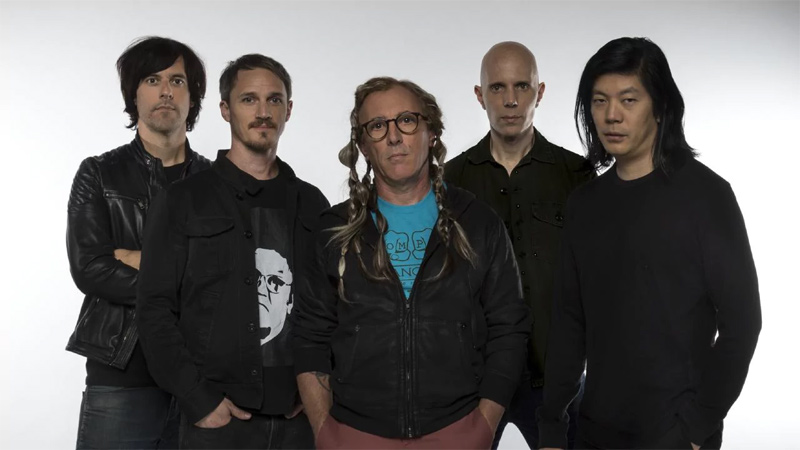
In his 2009 book The 10 Rules of Rock and Roll, Australian singer-songwriter Robert Forster wrote that “the three-piece band is the purest form of rock and roll expression”. The author had American band Nirvana in mind when he penned that line but admits instrumental trio Dirty Three fits “the whole theory and idea perfectly”.

Brandishing an unconventional guitar-drums-violin configuration, Dirty Three formed in Melbourne in 1992 and has celebrated its 20th anniversary by releasing its eighth album, Toward the Low Sun. Forster, co-founder of Brisbane pop giants the Go-Betweens, describes the band’s unique musical style as “the magic of a chemical explosion”, and notes “they come from the time of grunge. They existed when Nirvana existed; another three-piece who were chaotic, mad and intense on stage. You can probably still see a bit of that in them.”

Dirty Three’s catalogue evokes by turns deep melancholia – due largely to Warren Ellis’s emotive violin strokes – and sublime euphoria when the three members lock into a rhythmic pulse that is, oddly, reliant more on guitarist Mick Turner than drummer Jim White. Bobby Gillespie of Scottish rock band Primal Scream has referred to Turner’s idiosyncratic playing as “the way that stars are spaced out in the sky”, while White is more interested in exploring experimental percussive techniques than holding down anything resembling a standard rock drumbeat.

Yet viewing Dirty Three through the lens of rock – or, for that matter, jazz or folk – is wrong. And although the band lacks a vocalist, it doesn’t sit comfortably with what’s typically understood as instrumental music, either. “Normally people who do instrumental music can be quite dry and sedate, whereas Dirty Three put on a show,” Forster says. “They have an aesthetic of something like ‘minimal’, or instrumental music, but they have a rock ‘n’ roll attitude. It’s almost like there was an invisible lead singer there. That was part of their appeal, besides the fact that they have very good melodies, and that there was something charismatic about the band.”

The group’s absence of vocals has affected the course of contemporary Australian music in strange ways.

Gareth Liddiard says Dirty Three has been “a huge influence on what I do lyrically” with Melbourne band The Drones, of which he is lead singer, as well as his solo material. “They made me realise that if you’re going to have words, they need a f. . king good excuse to be there in the first place. They better be good, otherwise why bother?”

Liddiard says Dirty Three’s music “sounds like someone pushed a drum kit down the stairs and plugged a violin into a f. . kin’ Marshall [amplifier]“. He follows this stark assessment with the highest compliment: “For my money, they’re the best band from this country, ever.”

Before the band’s formation, all three members had spent years playing in various rock groups. “It seemed like there was this healthy live scene starting in Melbourne,” Ellis says of the early 1990s. “There was a lot of venues to play in, a lot of opportunities to get out and play in front of people. The live scene provided a livelihood for a lot of people. Bands were really trying to confront and challenge you, and there was this great crowd of people going along to check it out each week.”

Ellis puts the band’s irregular musical components down to a desire to be different. “When we started off, we really wanted to challenge people’s conceptions and also to go against the mainstream,” he says. “There’s something great about feeling like you’re out there, flying your own flag. There is something really empowering about it.”

The story behind the trio’s debut gig is emblematic of the hunger for original live music in Melbourne at the time. Ellis had a friend who owned a bar called the Baker’s Arms; he told the violinist that he wanted background music but didn’t want to play CDs. Ellis asked White to play drums; he, in turn, asked Turner to play guitar. On a Friday afternoon, hours ahead of the band’s first performance, the trio rehearsed some ideas in Ellis’s kitchen, then played them that night.

“We had to play for three hours, so we made the songs really long,” Ellis says. This ideology is occasionally reflected in the length of the band’s recordings, too: ‘Deep Waters’, from the 1998 album Ocean Songs, runs for 16 minutes. Ellis’s pal enjoyed the performance, paid them $50 apiece and asked them to come back the next week. To three young men trying to support themselves as working musicians, this was a great deal. “We’d go down and play every Friday night, and get out of our brains,” Ellis says. “Our mates would come along; it was just this great Friday night where nobody had to clean up the mess after.”

Two decades later, the trio commands a worldwide following and the kind of deep respect among the Australian music community that has been afforded to few acts. All three attribute the band’s longevity to the fact they rarely meet face to face: Turner lives in Melbourne, Ellis calls Paris home, and White splits his time between Brooklyn, Detroit and Australia.

A week or two before its national tour in March to celebrate the release of Toward the Low Sun, the band will convene in the Victorian capital for rehearsals and simply to catch up. “We usually sit around talking for a few hours talking, just because we haven’t seen each other for so long,” Turner says. “We don’t necessarily talk about music; just about life, our friends, our families.”

The guitarist believes this close friendship is another reason they have lasted the distance. “We’ve all got a high regard for each other,” Turner says. “If you lose respect for your bandmates, that’s when it’s going to fall apart, I think.” Ellis agrees. “We’ve always treated each other as equal in the musical sense, and in terms of the group’s profile. We share all the songwriting, and royalties equally,” he says.

“Nobody’s seen as contributing more or less. We’re a group, in the purest sense.” The trio are in regular contact via phone and email; a necessity, given that they split band management duties three ways.

“We did that a long time ago,” White says. They were once managed by Rayner Jesson, who also handled Nick Cave and the Bad Seeds, but that relationship ended a few years before Jesson’s death in 2007. “It ebbs and flows over the years in terms of how engaged we are,” says the drummer, who handles their tour bookings. Last year the band played just two shows together: a festival slot at All Tomorrow’s Parties in Tokyo and a benefit concert in January for 3RRR announcer Stephen Walker (to raise money for the legendary broadcaster’s multiple sclerosis treatment) at the Forum in Melbourne, featuring Cave on keyboard.

Turner admits the lack of a single decision-maker can be problematic. “If a question comes up, it’s got to be fielded around, so it takes a while to be answered,” he says. “One of us might be on tour, and it’s hard to get down and do your email when you’re in the middle of travelling.”

The three men occupy themselves with other creative outlets during the band’s downtime. White regularly tours and records with other bands: last year he toured with Australian folk-pop trio Seeker Lover Keeper, and the week after we spoke he was scheduled to play shows in Helsinki, Geneva, Istanbul and Tel Aviv with American singer-songwriter Cat Power (real name Chan Marshall) who is one of only two vocalists to have lent their voices to Dirty Three songs. The other singer is Sally Timms, of British rock act The Mekons; both contributions appeared on the trio’s previous release, 2005′s Cinder.

Ellis has been a member of Nick Cave and the Bad Seeds since 1995; he plays electric mandolin and guitar in the band. With Cave, he has scored several films, including The Assassination of Jesse James by the Coward Robert Ford, The Road and Australian film The Proposition, directed by John Hillcoat, which won the pair an AFI award for best original music score in 2005. He also played in Cave’s other rock band, Grinderman, which announced a hiatus at the Meredith Music Festival last December after releasing two albums together.

Turner splits his focus 50-50 between art and music. His distinctive paintings have appeared on the cover of all of the band’s albums besides its 1995 debut, Sad & Dangerous. His work has been exhibited at galleries across the world and he plans to release a fourth solo album later this year. The guitarist recently attended his primary school reunion, and was amused to discover not one of his former Black Rock State School classmates had heard of his 20-year-old band; unsurprising, perhaps, given that the trio’s sound exists on the periphery of contemporary Australian music tastes.

Ellis’s Bad Seeds bandmate, Ed Kuepper, calls Dirty Three’s output “a form of pure expression”. According to Kuepper – who co-founded Brisbane punk rock group the Saints and whom Turner considers “one of my only guitar hero figures” – the band consists of “three very recognisable, distinct musicians and they don’t get in each others’ way. They probably become even stronger together. It’s a rare thing.

“It’s a really unusual thing that they do in terms of Australian music; the approach to the way they play, and the non-standard rhythm [section],” Kuepper says.

“Very few people do that. Even fewer have any sort of success because in some way it’s quite an esoteric thing that sits outside of the kind that seems to get lauded in Australia, which is generally a lot more mainstream and musically conventional.”

Since Toward the Low Sun is an extension of the band’s remarkably consistent canon, rather than a stylistic reinvention, it’s unlikely Dirty Three’s eighth album will set the ARIA charts alight on release. The nine theatre shows the band has booked in March, though, are likely to sell out, if its previous national trek two years ago – billed as a performance of the 1998 LP Ocean Songs in full – is to be used as a benchmark of popularity on the live circuit.

The new album had a particularly long gestation period: the band recorded for six days in February 2010, then didn’t review the recordings for more than a year. It did some additional recording in March last year. An American producer based in Melbourne, Casey Rice, captured the first session at Head Gap Studio in Preston: he worked with the band on its last release, Cinder, too.

“They’re very focused,” Rice says of Dirty Three’s work ethic in the studio. “A lot of time it’s not just a matter of trying to get it right in a performative sense; it’s more of a feel thing.” The band will play a song slowly, then speed it up for the next take; it will try a song played softly, and then louder; White will work the kit with his drumsticks, then try his brushes for a softer percussive tone.

“The basis of everything is tracked live,” Rice says. “If there’s more than an electric violin, guitar, and drums on a song, then it’s been added as an overdub. So the bass, extra strings, mellotron, and nylon stringed guitar were overdubbed. But the process remained the same for Toward the Low Sun: they set up, and played it down. That’s what works about Dirty Three; that’s where the magic comes from.”

There’s that word again, the one Forster used: magic. A distinct sense of the otherworldly encompasses everything the trio does. Yet it’s not exactly the most accessible sound in the world, and there are few points of reference for unfamiliar listeners to latch on to. Liddiard recounts an anecdote that highlights the band’s divisive nature.

“I’ve seen Dirty Three 40,000 times,” says Liddiard, exaggerating only slightly. “I remember standing behind two dudes at one of their gigs; it could have been in Sydney, or Perth. One guy’s like, ‘This sounds like cat shit, let’s go.’ The other guy just looks at him, incredulous. Like: ‘What the f. . k? Can you not hear that?’ That really sums them up. Some people just don’t get it. And if they don’t get it, there’s something wrong with them, I find.”

Dirty Three‘s tour starts in Perth on Friday, then WOMADelaide, Adelaide, March 10; Port Macquarie, March 12; Melbourne, March 16; One Perfect Day Festival, Gippsland, March 17; Castlemaine, March 18; Sydney, March 21; Brisbane, March 22; Lismore, March 23.

Toward the Low Sun is out on Remote Control Records.

This story was originally published in The Australian; view online version here. For more Dirty Three, visit their website.

GameSpot story: ‘The State of the Aussie Game Development Industry in 2012′, September 2011

September 4th, 2011

A feature story for GameSpot. Excerpt below.

The State of the Aussie Game Development Industry in 2012

In the wake of THQ’s studio closures in Brisbane and Melbourne, GameSpot AU investigates the path forward for the Australian game development industry.


The State of the Industry

Fortitude Valley, Queensland. Four years ago, this suburb functioned as the central nervous system of the tight-knit Australian game development industry. Employees of the five big studios–THQ, Krome, Pandemic, Auran, and The Creative Assembly–all worked within walking distance of one another. It was an extraordinary period of growth, wherein contracts to build licensed games for overseas publishers were relatively easy for development houses to secure, and to profit from. Studio executives, developers, and the Queensland government’s “Smart State” flag wavers toasted each other’s success.

One by one, these companies were faced with insurmountable difficulties: new IP failing to attract adequate market attention; cost reductions by overseas headquarters; and licensed game contracts drying up, due to a rising Australian dollar. In early August 2011, another death knell sounded across the community: THQ’s sudden “right-sizing” saw the shuttering of its Brisbane and Melbourne studios, resulting in the loss of around 200 jobs. Less than a year ago, Krome Studios–once the country’s largest independent game development company, home to more than 400 employees across three cities–ground to a halt.

Around 40 of Krome’s best talent were kept on and quietly folded under the banner of KMM Brisbane, a local arm of Kennedy Miller Mitchell’s Sydney-based animation and development studio. Yet, recent online rumours suggest that once KMM Brisbane’s current project, Happy Feet 2, is completed, the studio’s lights will be switched off. (GameSpot AU contacted a KMM Brisbane producer for comment, but they would not respond; an anonymous source said that four artists were laid off in the first week of August, that “most” would be laid off at the end of the month, and that “a core few” would stay until October, when the game ships.) Once again, some of this country’s most experienced and talented developers will return to an ever-contracting job market.

On the first floor of an unremarkable office building, on Warner Street in Fortitude Valley, sits Sega Studios Australia, an 80-strong outfit that was known as The Creative Assembly until June 2011. They’re deep into the development of London 2012, an Olympic Games tie-in for the Xbox 360, PlayStation 3, and PC. The walls are adorned with interesting artwork and materials that can’t be described, due to the nondisclosure agreement signed upon entry.

“We’re now the biggest developer in Brisbane, and probably Australia,” says Gareth Gower, director of studio marketing. “We’ve got a bit of a responsibility to nurture as much talent as possible, and help the industry that way.” They’ve got only two vacancies at the moment, both high-level positions: studio art director and senior engine programmer.

“It’s brutal. Absolutely brutal,” says studio director Marcus Fielding of the job market. He held the same role at Krome at the time of its closure in late 2010. “I’m seeing people at the local gym who can’t believe it’s happened again. They’re asking the question of me, ‘Is Sega secure?’ All I can do is work really hard to ensure that we are secure.”

Of the studio’s 80 employees, 60 are full time; the other 20 are contractors, mostly animators. Fielding introduced GameSpot AU to several staff from a range of disciplines. Senior environment artist Chris Conte began his career with online gambling developer Eyecon in 2004 and then spent nearly five years with Krome and, later, KMM Brisbane. Senior animator Adam Dowley started with Ratbag Games, an Adelaide-based outfit that was acquired by Midway Games in 2005. After being closed by Midway, Krome rehired many of Ratbag’s staff and established Krome Studios Adelaide before eventually closing the doors in August 2010.

“It throws your entire life into disarray,” recalls Dowley of the closure. “When Krome went down, I’d just bought a house in Adelaide.”

“I’d just bought a house here in Brisbane, too,” says Conte. “It’s scary. It puts you in a mind-set where you don’t know what’s going to happen. I think we’re pretty good here at Sega, but there’s always that thought at the back of my mind now: ‘What happens at the end of this game?’ It’ll be there probably for the rest of my career, now; once we get to wrap-up time, what’s going to happen? Are we going to be able to do another project?”

“It’s a fear that’s in the back of every developer’s mind,” says technical director Mark Rowley. “As an industry, it’s far more fragile than most.”

“The problem is that people are very specialised in this industry,” adds Dowley. “They don’t have skill sets that are applicable to other industries. Game designers; where can they go? I can animate; how do I use that outside of games or film?”

“You’ve specialised yourself for the love of the job,” replies Rowley.

“You love it so much that you’ve kind of doomed yourself!” concludes the senior animator. He and his colleagues laugh knowingly.

For the full story, visit GameSpot.

Further reading: A Matter Of Size: The State of Triple-A Game Development in Australia

IGN Australia story: ‘Why Did L.A. Noire Take Seven Years To Make?’, June 2011

June 27th, 2011

A feature story for IGN Australia. Excerpt below.

Why Did L.A. Noire Take Seven Years to Make?

Examining the troubled development of Team Bondi’s opus.

by Andrew McMillen


Team Bondi’s film noir-inspired detective thriller L.A. Noire was released last month to critical and commercial success. Set in a lavish recreation of 1947 Los Angeles, the game eschewed a familiar open-world design for case-by-case detective gameplay that revolved around examining crime scenes and interrogating suspects. Featuring a vast city, cases that adjusted depending on the player’s actions and choices, and sophisticated motion capture technology that had never been used in a video game before, it was a mammoth project.

So mammoth, in fact, that it took over seven years to complete, with a publisher switch – from Sony to Rockstar – midway through. That’s not the whole story, however. The development of L.A. Noire was anything but smooth.

Much has been written about the long development cycles on games such as Duke Nukem Forever, Too Human, or Prey, but the story behind L.A. Noire’s rocky road to release stands out within Australia’s small, tightly-knit development community. Team Bondi’s crime drama is not just the biggest game development project ever undertaken in Australia, it also served as the first-ever project for many of the creative forces behind L.A. Noire. It’s perhaps the combination of all these factors that has resulted in surprisingly open testimonials from former Team Bondi members about their experience working on the game.

Recently, a group of former Team Bondi employees launched a public website with an amended staff roll for L.A. Noire that includes 100 developers omitted from the official game credits. But the look behind the curtain started much earlier. On January 23 2010, an anonymous source on Twitter began leaking stories heard through the grapevine regarding the Sydney-based studio. The account wasn’t run by an ex-employee; it was anonymously dishing the dirt on Bondi as heard through unnamed sources, Wikileaks-style.

The tweets alleged that studio founder Brendan McNamara had mismanaged Team Bondi and development of L.A. Noire, and had spent “tens of millions” on proprietary technology in just a year. Despite then-publisher Sony Computer Entertainment America’s faith in McNamara based on his PS2 hit The Getaway, Sony dropped the project in 2005, when the studio “had far exceeded SCEA’s expected price tag for the game.”

According to the tweets, this situation “threw the studio into disarray. Strangely, McNamara quickly found hospice in his former rivals–the Houser brothers–and L.A. Noire was picked up by Rockstar [Games] in spring 2006… Since then, the game has been revamped, ported, and delayed four times. Rockstar spent more [than] Sony in their efforts to make it not suck.”

Locally, when the tweets were reported by the Australian gaming industry hub Tsumea, several anonymous commenters stepped in to back up the reports: “I can certainly attest to the appalling working conditions, the angry and abusive boss and the ineffective leads who were completely unwilling to do anything to protect their team members,” wrote one. “It’s abhorrent that these young kids are being thrown into a 24/7 corpse grinder with perpetual crunch and weekend overtime,” wrote another.

The comments on Tsumea recall events that took place in 2004, when an anonymous LiveJournal post by a user named ‘EA_spouse‘ expressed frustration at the fact that she rarely saw her fiancé, an employee of Electronic Arts, due to the long hours he was forced to work while attempting to meet deadlines for the title The Lord of the Rings: The Battle For Middle-Earth. The blog received wide press attention and eventually led to three class action lawsuits against EA for unpaid overtime.

After the initial tweets and short-lived online discussions that followed, the situation returned to all-quiet-on-the-Bondi-front. In the meantime, there was finally light at the end of the tunnel: L.A. Noire’s worldwide release date had been set for mid-May 2011. The game would finally see the light of day, but many questions remained. Are the allegations true? Why did it take seven years to bring L.A. Noire to market?

IGN Australia reached out to dozens of former Team Bondi employees to help get a deeper look and tell the story. Eleven agreed to speak on the record, under the condition of anonymity; many feared reprisal from current and future employers if they were to be tagged as whistleblowers. The combined experience of these former staff is extensive: between them, they represent 24 years of service. Their individual tenures range from a few months, to four years, and they include artists, programmers, animators, and software engineers. We also spoke extensively with Team Bondi studio head Brendan McNamara for his perspective.

For the full story, visit IGN Australia.

This story runs to 4,500 words. It’s the biggest story of my career thus far, in terms of length, readership, and impact. As is hopefully apparent, a lot of work went into this story.

I first pitched it to my editor at IGN on February 14, 2011. My initial email, entitled ‘Story pitch: What was it like to work on L.A. Noire?‘, is below.

Hi mate,

Just catching up on some industry news via Tsumea and elsewhere. Am loving the allegations by (seemingly) dozens of anonymous ex-Team Bondi employees about the horrible working conditions behind L.A. Noire.

Favourite comment? “It’s abhorrent that these young kids are being thrown into a 24/7 corpse grinder with their perpetual crunch and weekend overtime.”

I’d like to investigate these allegations and find out how much truth there is to it. Like my Krome story, could be the case of ex-employees agreeing to speak anonymously. As long as we can verify that they were employed by the company and they know what they’re talking about, we should be good to go. Right?

Interested?

Andrew

It wasn’t until I got the nod from my editor and began reaching out to former Team Bondi employees that I realised the Tsumea story was published in 2010, not this year. Those allegations had existed for over a year, and no-one had checked them out. Curious.

As mentioned in the story, I contacted dozens of former Bondi employees. Some were silent; some told me to leave the story alone, as they didn’t want their former colleagues to suffer in the event of the allegations being found to be true. Over the months, I rounded up eleven ex-Bondi workers who were happy to speak to me, anonymously, about their experiences working for the studio.

Rockstar Games found out quite early on that I was investigating this story – via an overzealous source contacting an existing Rockstar employee, I think. They weren’t particularly happy. In an attempt to ensure balanced coverage, they eventually offered me access to Team Bondi CEO Brendan McNamara – though speaking with him was necessary if the story was ever going to be published, as it would be rather slanderous to publish the ex-employees’ comments without juxtaposing them against the responses of their former boss. Yet, as picked up by many of those who commented on IGN and the article’s resultant media coverage, McNamara did little to deny what I’d been told by his former staff.

With a gestation time of over four months, this is by far the longest amount of time I’ve spent pursuing a single story. It was worth it, though, because I feel that it’s a story that needed to be told. I hope you agree.

A final note: I’m interested in pursuing this story – and stories like it – on an ongoing basis. If you’d like to share your experience of working for Team Bondi and/or Rockstar Games, you can email me here.

triple j mag story: ‘How To Throw A Warehouse Party’, June 2011

June 5th, 2011

A short feature for triple j mag’s 50th issue. Click the below image for a closer look, or read the article text underneath.

++

How to: Throw a warehouse party

Think it’s just a matter of finding a space and asking some bands? Here’s how two different operators went about it

Phil Laidlaw is a co-founder of the Brisbane independent venue Lofly Hangar, which opened in 2007 in the residential suburb of Red Hill and held 100 events before closing in late 2010. Built on the warehouse model of booking cool bands and inviting friends to come party (BYO alcohol), the Hangar attracted more than 300 paying guests a month at its peak.

Did you rent the space legally?

The venue was rented as a recording and rehearsal space, and we had public liability coverage for those two elements of the business. We did look at getting public liability for events, but it was prohibitively expensive. There were a lot of requirements, like having security present at every event. So from the beginning we were operating as a private party at a residence, and we never had any problems.

What worked for Hangar?

Our sound gear. People will come if it’s an awesome warehouse, but they won’t keep coming back if it sounds shit. Having said that, you don’t have to start with the most awesome gear. You can build it up over time. It’s also important to keep some control over who you invite at the start, and try and establish a culture in the space that’s made up of your friends and associates before it gets too big.

What did you learn?

The earliest wake-up call was how loud it was for the neighbourhood. After a few shows, we realised we needed to do quite a bit more soundproofing.

Hangar’s door fee was always $10. Why?

You’ve got to decide if you want to be in it for the glory or the money. [laughs] It’s not a great way to make a stack of cash, but it’s a great way to have a really good time. It’s a good aim to keep it sustainable.

Advice for aspiring warehouse party starters?

Collect a group of friends that you can rely on to help you out, because you won’t be able to do it by yourself. It’s best done by a group of like-minded people. You’ll always need someone to run the door, or help clean up.

++

Another Brisbane-based crew, Sceneless, threw two warehouse parties on consecutive nights in October 2010. Whitelight was warmly lit and headlined by The Jezabels, while Dappled Cities headlined the UV-lit Blacklight. The events were hosted at a converted warehouse-for-hire and attracted a combined total of 800 people. Although attendees couldn’t BYO alcohol like they could at the Hangar, an arrangement with the nearby X&Y Bar allowed Sceneless to obtain a limited licence for the two nights.

Did you consider anything like public liability, or were the events considered private parties?

Yes, the venue owner had public liability insurance. It was included in the venue rental.

What worked?

The concept – an exclusive boutique, two genre, mini-music festival run over two nights, in an exclusive venue, subtly tailored to each night. We had two respected interstate headliners supported by mainly local acts, from newcomers to breakthrough acts.

What didn’t work?

We had more security than was required… We understood that this was the first official warehouse party in Queensland, and so being an unknown quantity it required some kind of official surveillance. We hope that now a precedent has been set and since the crowd were well behaved, we can continue to put on events without as much of a heavy ‘Big Brother’ presence.

++

Boring but essential stuff to think about

  • Security. Just how big could this party get? And what are you going to do if it gets Corey-style out of hand?
  • Talk to the authorities. If you’d rather your first meeting with the police and fire brigade didn’t come when they were shutting you down, think about letting them know what you’re planning. It’s only manners, and they may well have some good advice.
  • Limited liability insurance. Do you have it? Does the venue have it? Who’s gonna be responsible if someone falls down those lethal-looking stairs?
  • ‘Donations’? OK, so this is just a ‘regular’ party, but you’d like your ‘guests’ to kick in a ‘donation’ to cover expenses. Remember, there’s a big difference legally between a donation and a cover charge.
  • Locatio.n So, you’ve found the perfect venue. Except that it’s in a residential area, isn’t adequately soundproofed and is marked for demolition. Hmmm. Think again. Make sure the venue meets all the relevant codes and is well away from angry neighbours. And that you have actually have permission to be there.
  • Local council planning laws. Some of these might apply to your shindig, so do your homework.
  • Drinks. BYO alcohol? A liquor licence? Again, do your research.

IGN Australia story: ‘Blockbuster or Bust: The New Face of Development?’, 2011

April 19th, 2011

A feature story for IGN Australia. Excerpt below.

Blockbuster or Bust: The New Face of Development?

Triple A or the highway?

In February, IGN Australia took a magnifying glass to the state of the Australian game development industry. We found that locally, trends pointed toward bigger development studios – whose bread and butter was console game development, often for overseas publishers – closing down. In their absence, smaller businesses – who focus on developing games for mobile and social platforms – are where the real growth is happening. However, one of our interviewees suggested that it’s a “distraction” to talk in terms of geographically-specific industries. “It isn’t helpful to talk in local terms,” he said. “It’s a global industry.”

With that in mind, we substituted our magnifying glass for a telescope, and peered across the Pacific Ocean toward the United States of America, where many of the world’s largest video game publishers reside. With the inferences from Activision’s most recent earnings call – that, increasingly, console game development is becoming “blockbuster or bust” – rattling around our brains, we asked a couple of triple-A-scale publishers for their take on this topic, as well as questions like: is basing your business exclusively around triple-A level development a sustainable approach? Is it riskier than ever to be debuting new IPs [intellectual property; ie, new games] in a crowded marketplace, where a handful of household names earn the lion’s share of revenue? And finally, does it take a huge set of balls to launch new shooters that directly compete with Call of Duty’s current market dominance?

Bethesda Knows Best

We’ll deal with that last question first, since it’s the most provocative. The company best-positioned to answer it is named Bethesda Softworks, whose headquarters – and its in-house game studios – are located in Rockville, Maryland. Bethesda also has offices in London, Paris, Frankfurt, Benelux and Tokyo. We can’t be sure, since they’re a privately held company – “we don’t ever release sales figures, annual reports, or employee numbers,” says Pete Hines, VP PR & Marketing – but we believe they’re among the biggest privately-held publishers in the world. Hines responds cautiously when asked about the size of Bethesda’s balls in relation to its propensity for launching new IPs.

“The size of the balls it takes probably varies from [game to game],” he says “You could do a new IP that isn’t a big $30-50 million project. Look at Tiny Wings on the iPhone; that’s new IP. But if you’re going to try and put out a brand new shooter on the [Xbox] 360 and go head to head with Brink, Rage, CoD, Battlefield and the others, then certainly, it’s a bigger risk, and it takes some guts to say, ‘Yeah, we know what we’re up against, but we believe in this project and feel strongly enough about it that we’re going to do it.’”

As avid IGN readers would know, the first two titles Hines mentioned are Bethesda releases. Brink is being developed by British studio Splash Damage, and will be released in May 2011; while Rage is the new shooter from the legendary id Software, the team behind Doom, Quake and Wolfenstein. It’s due in September. Bethesda is publishing both games, and they also have another IP – a third-person action game for PS3, 360 and PC – called Hunted: The Demon’s Forge due in June. While Hines won’t discuss development budgets – “I wouldn’t want to give you ballpark [figures]; big games and big ideas cost a lot of money to make,” he responds – it’s clear that there’s a lot riding on these three titles.

To read the full story, visit IGN Australia.

The Courier-Mail artist profile: Reggie Watts, 2011

March 29th, 2011

An arts profile for The Courier-Mail. Excerpt below.

Reggie Watts: Unscripted, but well prepared

BEFORE American performer Reggie Watts even opens his mouth, you can’t help but form preconceptions.

Watts is keenly aware of this, which is why he does his best to challenge those who try to pigeonhole him based on his appearance, performance style or surroundings.

Watts’ act is unique; a compelling fusion of comedy, music, vocal prowess and impressionism, all delivered at a whirlwind pace.

“I like it when people are laughing hard,” Watts says, “but I also like it when audiences are confused.”

During his well-attended appearance at the Brisbane Powerhouse in May 2009, a bound-and-gagged Spiderman struggled to break free from his bonds throughout his set; he succeeded during the encore break, to wild cheers from the crowd.

Watts made no reference to the character throughout his act.

“It’s good to have things happening ambiently in the background,” he laughs when reminded of that night.

Much of Watts’ act is improvised. While he has a handful of snippets he can bring into the set at any time, for the most part he prefers to make it up as he goes along.

His inspiration comes from driving around and absorbing the sights and sounds of the city, or listening to his driver, who most likely will be local.

“He’s driving me around and telling me stuff about the city. A lot of this stuff will show up in the show,” Watts says. “I don’t really write down notes. I experience something, find a funny thing about it, and then log it.”

If it’s funny – or important – enough, Watts trusts that his memory won’t fail him while he’s on stage.

For the full article, visit The Courier-Mail. For more Reggie Watts, visit his website. The music video for his skit/song ‘Fuck Shit Stack‘ is embedded below.

Elsewhere: an extended interview with Reggie Watts in May 2009

Mess+Noise ‘Storytellers’ article: Ed Kuepper – ‘Eternally Yours’, 2011

March 29th, 2011

A ‘Storytellers’ article for Mess+Noise. Excerpt below.

Storytellers: Ed Kuepper

ANDREW MCMILLEN revisits the “Storytellers” series, whose premise is simple: one song by one artist, discussed at length. This week it’s Ed Kuepper on Laughing Clowns’ 1983 classic ‘Eternally Yours’. The song will be reprised acoustically with backing from drummer Mark Dawson at a trio of shows in NSW this week. Dates below.

If you were forced to summarise Laughing Clowns in a single song, it’d be hard to pass up ‘Eternally Yours’. The Sydney-based band – formed in the wake of guitarist Ed Kuepper’s departure from The Saints in 1979 – played a distinctive style of jazz-influenced post-punk that remains peerless to this day.

‘Eternally Yours’ was recorded in late 1983, released as a single in March 1984, and appeared on the Clowns’ second LP, Law Of Nature. The band recorded a promotional video for the song, too; a rarity among their short-lived career, which came to a halt by the end of the year. (The band reformed in 2009 for the All Tomorrow’s Parties festivals, and earlier in 2010, they supported Dirty Three’s Ocean Songs tour by performing the compilation album History Of Rock ‘n’ Roll Volume One.)

Characterised by Kuepper’s waves of open chords and Jeffrey Wegener’s proud drumbeat, the focal point of ‘Eternally Yours’ is a towering, timeless saxophone melody performed by Louise Elliott. The song remains a staple of Kuepper’s live set: during last year’s spate of reformed Clowns shows, it frequently appeared as the set closer.

Late last year, I visited Kuepper’s southwest Brisbane home to discuss the song. We drank tap water and sat in the shade underneath his house, while his dog Oscar noisily dug at the rocks underfoot in an effort to reach the cool dirt underneath (“I’m finding this very distracting,” he admitted halfway through our conversation). Kuepper smoked three cigarettes over the course of our 33-minute conversation, speaking haltingly at times; long pauses, and many knowing, ironic glances. Ultimately, though, he spoke freely about a song of which he’s clearly proud.

Were you surprised when I asked to talk about this song?
No. It’s kind of a standard song for me. It’s survived in a lot of different versions over the years … It’s more interesting than talking about ‘(I’m) Stranded’. Which I’m not knocking, but that has been … covered.

Extensively.
To say the least.

I’ve seen you play several times in the last few years, and ‘Eternally Yours’ still crops up in the set quite frequently. I could be wrong, but you seem to get some kind of pleasure out of it. You seem to go somewhere else when you play that song.
Most of the time, yeah. When it works, it still has the capacity to [become] something new, which is more than I can say for some songs that I do. Not that I expected that at the time. For a long time I didn’t play it at all. I think when the Clowns split, I didn’t touch it again for about five years or so. It made its first reappearance in a radically different way on Today Wonder, where it was just acoustic. I think because of doing that record – going off ‘Eternally Yours’ specifically here, a little bit – doing that record basically made me reappraise a whole lot of things, and luckily, that [song] was one of them.

It says a lot about the strength of the song if it can withstand an acoustic version, as well as the full-blown band treatment.
And also, really different full-blown band treatments. I haven’t really played the Clowns version live; maybe once, on one of the Clowns tours that we did recently. Generally each version has developed. Where it goes from here, I have no idea.

For the full interview, visit Mess+Noise. The video for ‘Eternally Yours‘ is embedded below. This article was a true pleasure to pitch, interview and write up. Probably because it’s my favourite song ever.