Archive for August, 2009

  • Cumulative Advantage and Social Currency

    A straightforward online exchange: Matt Granfield tweeted a link at @waycooljnr, the Twitter account I run with Nick Crocker for music and marketing links. It was an interesting link worth sharing, so I thanked Matt via Twitter and left a comment on David Gillespie‘s blog post.

    Simple, right? And, at first glance, pretty nerdy, especially when I describe what took all of 30 seconds. But it got me thinking about what is, in my mind, the real value of social networking: shortening the distance between people.

    Good thing there's no dice on the cover. Yeah, an NNT in-joke. Boom.For the last couple months, I’ve been reading a book by Nassim Nicholas Taleb called The Black Swan. I’m not going to feign complete comprehension, as frankly, it’s the most challenging thing I’ve read since Robert Greene‘s 48 Laws Of Power, which took me over a year to absorb.

    Among many taxing topics, Taleb discusses the ‘Matthew effect‘, otherwise known as cumulative advantage. It’s the concept whereby it’s easier for the rich to become richer, and for the famous to get more famous:

    This theory can easily apply to companies, businessmen, actors, writers, and anyone else who benefits from past success. If you get published in The New Yorker because of the color of your letterhead or attracted the attention of the editor, who was daydreaming of daisies, the resultant reward can follow you for life. [p. 218]

    The earlier Twitter exchange allowed me to bridge the gap between that concept and social networking. Put simply: the more you interact with someone online before you meet them, the greater the chances that you’ll get what you want for them, be it friendship, mentorship, or a job.

    Let’s run with the third option. Picture two undergraduate job candidates. One spends his days at university and his nights on the couch watching television. The other spends his days at uni and his nights online, reading blogs, participating in relevant industry conversations via social media, and identifying local influencers within the industry he hopes to begin a career.

    An ideal employer advertises a junior role. Until they shake hands at the interview, Dude #1 is nothing more than a resumé and a cover letter to the employer. But Dude #2 has been sharing valuable links and commenting on the company’s blog, so he strikes an easily rapport with the employer based on their mutual interests and knowledge. Their social currency.

    Which one’s going to get the job? [An aside: I'm as surprised as you that I autopiloted into a university-based thought exercise, given my past admonishment of its worth.]

    Okay, the scenario’s not applicable to every industry. A chemistry undergraduate would find it less pertinent than a web designer. But hell, everything’s online these days. It kinda blows my mind that so many people still don’t get this.

    They're definitely not signing any more electro acts, though.I’ve been online for like 10 years, and I’m only just beginning to consciously pay attention to this stuff. Cumulative advantage dictates that the more time you spend online building meaningful relationships and contributing to the internet, the easier it’ll be to get what you want.

    At the top, I wrote that it was kinda nerdy to describe a Twitter interaction. But when you’re using these tools to establish yourself as an influencer within the industry you’re passionate about, well, who the fuck cares if it’s nerdy? You’re winning.

    One of Australia’s top indie record labels today advertised a job via Twitter. You wouldn’t hear about that while watching television, would you?

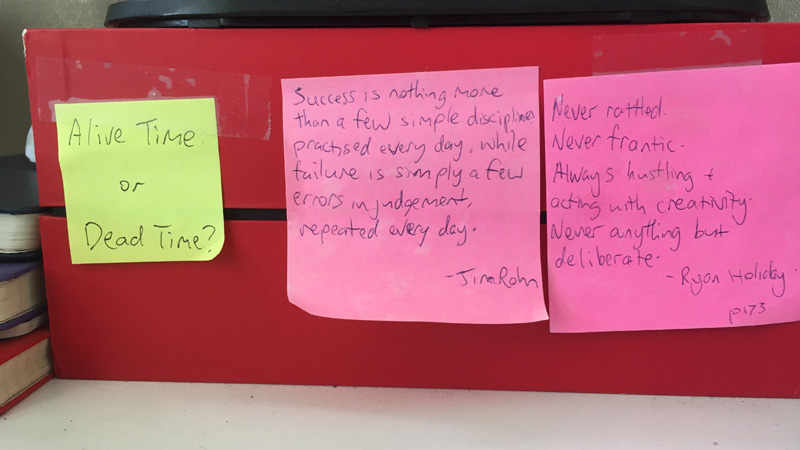
    Three quotes occurred as I wrote this. The last one’s the most important.

    Ryan Holiday, December 3 2007:

    [If I was starting all over again today]l I’d become a personal RSS reader for one or two of the big bloggers. “You’ll like this article.” “Do you read this blog? He hits a lot of the same themes that you do.” “I’m hearing rumors that ____ is going to acquire ______, just wanted to give you a heads up.” And I would tailor the results for that person based on what I know they like. I would kill myself doing it. Every day, 5-10 articles. And then I would start to integrate commentary or questions. Become the guy that they get their information from, the person that keeps them connected to the pulse. Maybe one week I’d take a break and send nothing, just to highlight the difference. The ultimate end game being that they would start to send you out to find things for them: “What can you tell me about ________” Yes, you’re a research bitch but in the end, you come away with something that even the person you’re serving doesn’t–not just a vast reserve of knowledge but the ability to find out where it is coming from.

    Ryan Holiday, June 11 2008:

    One day you’ll probably want something from the internet – you’ll have a book to promote, a business that needs customers, someone you need to meet, an ebay auction you’re trying to sell, a job you’re after. It’ll be too late then. You have to start before. And there’s only one way to do that.

    Tait Ischia, April 17 2009:

    You have to prove to business owners that you are good and that you’ll make them money. And of course the best way to prove it is by doing stuff. Blogs are the easiest way to do stuff. It’s basically like maintaining a Facebook but isn’t a complete time-wasting exercise in vanity. If all the kids these days spent the same amount of time writing blogs that they did on Facebook, then [the advertising] industry would be a hell of a lot more competitive.

  • “What Makes A Great Live Performance?” for Creative Deconstruction

    [A guest post for Refe Tuma over at Creative Deconstruction. Original post here.]

    This is a guest post by Andrew McMillen, a music writer based in Brisbane, Australia. Andrew is coordinating blog content for an Australian music event, One Movement For Music, which debuts in October 2009. The blog at OneMovementWord.com contains interviews with artists and speakers appearing at the event, Australian music news, as well as guest posts exchanged with the likes of Creative Deconstruction’s Refe Tuma.

    The Temper Trap: well-readFor both music fan and critic, the most exciting live music experience is the great unknown. Bearing witness to an act you’d not previously heard, but becoming completely immersed in their art. Becoming an instant convert to their cause. Becoming willing to hit the merch desk immediately after they’re done playing in order to buy something – anything! – that the band have created; to have, to hold, and to listen. Those are the kinds of performances that music critics such as myself love to write about; they’re also the kinds of performances that A&R folk spend their careers trying to witness, in order to sign and release the act’s music on behalf of their label.

    I’ve been a live music critic since June 2007. Two ‘great unknown’ performances stick in my mind. The first was in September 2008. I was reviewing an industry showcase event for the Brisbane-based Big Sound music conference. Four bands each had thirty minutes each to show their wares and attempt to build rapport with a crowd largely comprised of wary industry vets and conference delegates. Second on the bill were Melbourne band The Temper Trap [pictured right], of whom I had no concept. Their first couple of songs were enjoyable, if unremarkable. Then they played the track ‘Sweet Disposition’, which is embedded below.

    The singer’s high vocal range elicited the kind of spinal shivers you can’t manufacture, and the beauty of the chorus hook brought tears to my eyes. Four minutes later, my accomplice and I traded incredulous, “what-the-fuck-just-happened?” looks. One of the most passionate, astonishing and affecting single performances we’d ever seen, is what. I wrote:

    “Witnessing support bands unexpectedly and effortlessly capture the complete attention of an audience is always a joy to behold; the thirty-minute set that unfolds before me is a stellar example of this phenomenon. The Temper Trap’s brilliant pop contains all of the expected ingredients, but with the added spice of Dougy’s incredible voice. The performance of new single Sweet Disposition is one of the most moving, inspiring events I’ve witnessed this year. Outstanding.” – Andrew McMillen, Rave Magazine, September 2008

    No surprises, then, that The Temper Trap used the resultant industry interest to sign a record deal, tour the world and release their debut album to wide acclaim. In a Japanese hostel in June 2009, I saw the video for their track ‘Science Of Fear‘ on MTV, and smiled at the progress the band had made in nine months. This is the kind of rare success story – predicated on pure passion and talent – that unites music fans, music critics and industry professionals.

    My second example is less impressive in market reach, but closer to my heart. In November 2008, I accepted an assignment from my editor to review a couple of local bands on a rainy Thursday night. With a different friend in a tow, and little more than a hope that the bands would be entertaining enough to fulfil our craving for live music – and the necessity to describe the proceedings in 200 words – we were witness to a similarly inspirational performance.

    Hunz, a.k.a. Hans van Vliet. He's totally checking his Facebook.The second band were an electronic pop trio called Hunz [pictured left], of whom I was vaguely aware, based on the animated YouTube short that a workmate had shown me months earlier. My friend and I stood close to stage, among a few dozen of the seemingly equally-ignorant. Before long, we were spellbound by their skilful contrast of dark electronic sounds against uplifting pop melodies. I was one of several to buy the band’s CD from the singer/keyboardist at set’s end, and thanked him for the performance. I wrote:

    “Hunz augments electronic samples with his unique voice and live drum and bass to produce an enchanting sound. Why haven’t we heard him earlier? Blame ineffective promotion, blame infrequent performances; it doesn’t matter, as there’s several dozen new fans appreciating the trio’s thoughtful, restrained pieces. The frontman graciously accepts our hastily-spent cash in exchange for his remarkable debut, When Victims Fight.” – Andrew McMillen, Rave Magazine, November 2008

    That particular musical discovery stuck with me for months. Hunz’s album was never far from my Winamp playlist or iPod scroll-wheel. I shared their music far and wide; months later, I met the man behind the band, singer/keyboardist Hans van Vliet (a.k.a. Hunz). Our mutual appreciation – from humble musician, to music critic and passionate fan – forged a friendship that soon led to an offer to become the band’s manager; a role I continue to inhabit and cherish. View an animated YouTube clip below to get an idea of the band’s sound; visit Hunz’s Bandcamp page to download some tracks for free.

    These two examples are atypical of most live performances I see. While I can eke enjoyment out of the vast majority of shows I attend, my housemates could attest to the regularity with which I arrive home and state a show was merely “okay” or “good”. The reality, though, is that “good” isn’t good enough; “good” means I probably didn’t buy your CD after the show, and that your act probably won’t win their way into my playlist.

    I often read about how there’s more music being played and listened to by more people than ever before, and how the live show is where artists traditionally earn the most coin. Since the role of the music critic – in my mind – is to sort the gold from the pyrite, it’s vital for touring artists to develop an engaging, memorable show that’ll convince guys like me to champion bands like yours. When I review live music, I want to rave about bands I love, instead of painstakingly pinpointing my disappointment. As both critic and fan, I want to be excited and inspired, not bored and unimpressed.

    Written by Andrew McMillen for OneMovementWord.com.

  • The Music Network story: ‘For The Record: An Album Retrospective Part 5′, August 2009

    In the final piece of a five-part puzzle, Andrew McMillen examines the digitally-inspired shift in consumer habits away from the long-established album format. After speaking to passionate Australian artists like Hungry Kids Of Hungary, Urthboy and Eleventh He Reaches London last week, Andrew verbally prods two innovative Brisbane-based acts who have turned the album-release expectation on its head.

    Were this album-centric article series an actual album, we’d have since bypassed the hit singles, the forgettable middle filler, and the surprising experimental freak-outs. This’d be track twelve; the last gasp that’s strategically-placed to reward the attentive hard-core of fans. Luckily, reader, track twelve is this metaphorical album’s hidden gem: it describes two Queensland acts who’re subverting the traditional cycle in favour of a flexibility that benefits both artist and fan. Press play and get comfortable, won’t you?

    Drawn From Bees: animal loversBrisbane natives Drawn From Bees [pictured right] are riding a healthy buzz following their recent national tour and more than a few nods of approval from Triple J. The art-rock four-piece have self-imposed an interesting alternative release strategy: a new record every six months. Explains bassist Stew Riddle: “Over a few drinks after our first rehearsal last year, we decided to use the fact that we’re a band of four songwriters to our advantage, and aim for a prolific introduction to the band. We felt that it would be interesting to break from the new-band cycle of ‘release an EP, tour for 6-12 months, release another EP’, and instead try to put something out every six months.” But the Bees are in a unique situation that encourages frequent releases; Riddle admits: “Dan, our singer, is also a producer, so we can afford to record very cheaply. If we had to hire studio and producer time, it might be a very different story.”

    Two EPs into their two-year experiment, Riddle contemplates the band’s feeling toward the album format: “I tend not to think about what we’re doing in terms of working towards an album, as to me, the length is largely irrelevant. I feel that each record needs to make a statement, and to be a snapshot of where the band is at that particular time. Our third release is looking to be an 8 or 9 track record that has a more melancholy flavour. Is it an album or an EP? We don’t know, so we’ll just call it a record and let other people decide!”

    When asked where he thinks the album format belongs in the future of music, Riddle is sceptical. “It’s a hard one to judge. It seems that while the physical single is dead, the digital single is now king. No one buys albums anymore, but if you look on my friends’ mp3 player, they tend to collect not just full records, but full catalogues of acts that they love. I think that the album will live on. Certainly, at least in the sense of releasing bodies of music that make various statements at different points in an act’s career. Does it mean that the length of an album will remain between 30 and 70 minutes? Maybe not. Musicians aren’t constrained by the format anymore; vinyl and plastic don’t dictate the length.” With a fourth release due around Christmas to bring the four-EP commitment to a close, what’s next for Drawn From Bees? “We’ll probably do an album. Or a greatest hits box collection, who knows?” laughs Riddle.

    From a regular-release ideal to a staggered album: meet Brisbane indie rock band 26 [pictured below left], who’re midway through an ambitious project to release a twelve-track album in three-song installments every three months. After releasing two albums in the standard manner since their 2005 debut The King Must Die, singer/guitarist Nick O’Donnell explains the genesis of the concept dubbed 26×365: “We don’t sell all that many hard copies anymore, so we decided to release the next album in small portions. We were finding that people were buying singular songs rather than the whole albums off of iTunes.”

    Each of the four parts to 26×365 is priced at $3.39. O’Donnell continues: “We thought maybe we could package a couple of songs together at a lower price point and you could get people buying them because they think they’re getting a bargain, as they’re getting three songs for the price of two. By April next year we’ll have the twelve songs that you can buy as a whole product, but our true fans can get the songs every three months. This allows us to introduce the songs gradually into our live set; in terms of the record, it’s like our fans are coming along for the ride.”

    26: averse to smiling

    With the new release, the band are aiming to reduce the comparative tedium that they’ve experienced with past releases. “It’s not like the situation where the band records the whole album and they’re already already kind of over the songs; you know, you’ve already been playing the songs for a year or so. As an artist, you get to the end of the album process and the songs aren’t fresh for you, but they are for the public. So you’re pretending that they’re new to you, but they’re not.”

    The band’s website further addresses the reasoning behind the project. Perhaps unwittingly, 26 have put their heads together and specified a bold manifesto for independent artists the world over. 26 state:

    Unless you’re Coldplay, Metallica or Andre Rieu, the one thing a band must do is maintain momentum. Peoples’ attention span is becoming shorter and shorter, so we want to be attracting CONSISTENT attention.

    The 26×365 release process will allow:

    1. New material to the audience, but not so quickly that it will lose its impact.
    2. Offer a time-based point of interest for the band
    3. Allow the audience to see how we are progressing as a band
    4. New content for an entire year, including pictures, videos, blogs, and give aways
    5. New gig material for an entire year and having it ready for consumption on iTunes. No waiting for the whole album to be released.

    The purpose of this article series is not to eulogise the demise of the album, or to bemoan the recording industry’s omissions. Instead, it’s to highlight that right now is a better time than ever to consider the ideal manner in which to distribute music to an artist’s fanbase. For independent artists, a direct artist-fan (one-to-one) connection may be the most appropriate business avenue. For bigger artists – the aforementioned Coldplays and Andre Rieus – a one-to-many, traditional distribution method may still be the ideal outcome. The keyword in this discussion is choice. Not only do customers now have the ability to choose how they consume music with more freedom than ever before; now, artists are privy to a wealth of release strategies, business models, digital distributors, while still retaining the option to engage in traditional physical product manufacturing and distribution.

    “A lot of purists tend to complain now that an album’s artwork is gone. I think it’s really great, because what has gone is all the shit surrounding the music. You can still get the music itself, so you’re getting the purest version of the art, because it’s just the music. It’s nothing else.” – Nick O’Donnell, 26.

    Brisbane-based Andrew McMillen writes for several Australian music publications. He can be found on Twitter (@NiteShok) and online at http://andrewmcmillen.com/

    (Note: This is part five of an article series that first appeared in weekly Australian music industry magazine The Music Network issue #748, July 27th 2009. Read the rest of the series: part one, part two, part three, and part four)

  • The Music Network story: “For The Record: An Album Retrospective Part 4″, August 2009

    In the fourth piece of a five-part puzzle, Andrew McMillen examines the digitally-inspired shift in consumer habits away from the long-established album format. This week, Andrew quits hypothesising, and instead speaks to those responsible for history’s loved and loathed albums: musicians!

    In the last three weeks, we’ve indulged in much reminiscing and theorising on the value of the album format in an era of unparalleled consumer choice. “The track has been disengaged from the album!” “Artists shouldn’t automatically sprint toward the album endpoint as a result of historical programming!” “It’s easier to choose to part with around a dollar for a song you’ll love, rather than $15-20 for an unfamiliar collection!” You’re familiar with these arguments, professed from this writer’s listener/critic position. But, er – what about the artists themselves? The ones who make music? Where do they think the album belongs in 2009?

    Hungry Kids Of Hungary: Bigger fish to fryBrisbane’s Hungry Kids Of Hungary [pictured right] write hook-heavy songs that’re informed by a studious observation of the pop legends of generations past. Their two EPs have attracted radio attention, festival slots and, most recently, a Q Song award nomination. Are they treading down the pop-proven album release path? “We sure are!” replies singer/keyboardist Kane Mazlin. “We’re currently demoing and writing songs for a debut album. Like most independent bands, it’s a matter of balancing time and finance as to when we will record and release, but we’re certainly hoping to be in a studio within three months. I think it’s just a natural progression for us to put our ideas down on a long player. It will give us more scope to present ourselves more accurately, which is something we’ve only been able to touch on when creating EPs.”

    No surprise, then, that the Hungry Kids are album purists. Drummer Ryan Strathie explains: “Artists put a lot into creating an album as an entire piece – a single song is only one part of the album puzzle. I think it’s crucial for an album to be experienced in full, artwork and all. For me, its just not the same without the whole package.” Strathie cautions, however: “Artists – big or small – need to take responsibility for the quality they put out. If you can’t put out 10 great songs, then don’t do an album! It’s obvious that people will still buy a record if it’s any good; too many artists maximise on a single song or a hit and put out an entire album, even if it’s not good enough.” He concludes: “People aren’t stupid, they have been burnt!”

    From young upcomers to an established act: Perth’s Eleventh He Reaches London [pictured below left] have forged a respectable name for themselves at the intersection of the nation’s hard-rock, metal and hardcore communities. Their 2005 debut album The Good Fight For Harmony preceded 2009′s Hollow Be My Name, for which the five-piece received a $13,000 recording grant from the Western Australian Department Of Culture And Arts. Drummer Mark Donaldson rationalises the decision to release music in this manner: “We never really gave any thought to releasing an EP or singles, because we believe that you can get more enjoyment out of our band across an album. We wanted to release something that was quite cohesive, and had some continuity, with a good hour-long running time.”

    Eleventh He Reaches London: simply red“I’m still a huge fan of putting on an album and listening to it all the way through. It’s very rare to experience an album that you can listen to from start to finish, and not get bored. It’s very rare to experience that, and it’s one of the things you look forward to in life, as a music fan – that next band that you’ll become completely obsessed with.” When questioned about the free MP3 downloads offered on the band’s Last.FM profile, Donaldson continues: “It’s still good for people to be able to download a song in reasonable quality, just in case they are thinking about downloading the full album. Because we’ve basically arrived at the situation where you can download a song for free, get a feel for the quality of it, and then decide whether you want to waste your bandwidth on it!”

    We laugh at the madness of trying to explain the rationing of 60-100 megabytes to a music fan fifteen years ago. But how does he feel about fans of the band who purport to love their music, but who’ve never bought anything from the band? “There’s no ill feelings toward those who don’t pay. What I don’t like is when people download the album, love it, but then don’t attend a show when we’re near them. That really cheeses me off, because touring is such a massive effort. You look forward to sharing the music with the audience, and that’s what playing live is all about. Being able to share your love of your songs with others.”

    As co-founder of the Elefant Traks label and a renowned hip-hop artist in his own right, Sydney’s Urthboy [pictured below right] understands the record business better than most. Born Tim Levinson, his third album Spitshine is due in August 2009. He reasons: “I love the idea of the album because it allows an artist to make a little book, rather than a short chapter. I completely respect that people receive music in their preferred form, but as an artist I think the whole LP is worth holding onto. The album allows the artist to stretch out a bit, and from that perspective you’re able to tell a better story.”

    Urthboy: both dapper and chipperIt’s a valid comment, given that hip-hop song structures are perhaps more reliant on narrative than their rock counterparts. When asked about digital distribution’s effect on the album format, Levinson concedes: “It’s slowly changing people’s attitudes and expectations toward consumption of music. We’re in a transition period where albums retain a huge significance – but some signs suggest it’s disappearing. Stranger things have happened and trends don’t always result in their predicted outcome, though.”

    Levinson’s position at the helm of Elefant Traks informs his optimistic wisdom. When asked whether Elefant Traks have adopted alternative release strategies to album delivery, he responds: “We’ve discussed it a lot; I want to keep open-minded about it. One of our key methods of promotion is bundling as many activities into the one ad spend. Usually this is simple: the album and the tour. We’re a record label, but we’re also a default management company – we spend money to invest in the artist who hopefully invests in themselves, and in turn helps us sell their records. Touring is not lucrative across the board – that’s an industry myth – but it forms part of the overall picture. The point I’m getting at, is that not every artist can simply put out a few songs regularly, sling ‘em to radio, excite the public’s imagination and wait for the money to roll in. There are significant costs associated with any release, whether EP or album. The public may like the freedom of picking and choosing but I don’t believe they’ve fallen out of love with the album yet. Singles aren’t for everybody, but our music industry is; there’s no use writing eulogies at this point in time.”

    It’s worth reinforcing that the purpose of this column series is not to eulogise the album as a whole. Rather, it’s to highlight that digital distribution has allowed listeners to choose how they consume music, and musicians to choose how to deliver their creations to listeners. Next week, we’ll meet some artists who’re rejecting the album-release expectation in favour of innovation, and look to a bright future where musical expression isn’t necessarily confined to 10-12 tracks.

    Brisbane-based Andrew McMillen writes for several Australian music publications. He can be found on Twitter (@NiteShok) and online at http://andrewmcmillen.com/

    (Note: This is part four of an article series that first appeared in weekly Australian music industry magazine The Music Network issue #747, July 20th 2009. Read the rest of the series: part one, part two, part three, and part five)

  • A Conversation With Neil Ackland, Sound Alliance Managing Director

    Sound Alliance. You mightn’t be familiar with the name, but most Australian web users will be aware of their music communities: inthemix, FasterLouder, and recently, Mess+Noise. The alliance was formed when Neil Ackland joined Libby Clark and Andre Lackmann, who launched dance music community inthemix out of a spare bedroom in 2000. They’ve since expanded to a team of 45. Their influence on the Australian web industry is huge, so when the opportunity to interview Neil arose, I jumped at it.

    Andrew: Neil, you’ve obviously had a lot of experience with planning, goal setting, and so forth for the Sound Alliance. When planning a new venture, have you found it’s best to shoot for the top, as opposed to aiming for a less ambitious goal?

    Neil Ackland: Positively glowingNeil: I think it depends on how you value success, really, in terms of shooting for the top. I think we’ve taken a very long-term view to a lot of the ventures that we’ve launched. I think the game we’re in is not a make-a-quick-buck game, by any stretch of the imagination. I think our intent here is of running inthemix, for example, and sites like FasterLouder, and Mess+Noise, and [gay/lesbian community] SameSame require constant energy, nurture and investment – both in terms of time and money – to get them to continue to grow and to continue to flourish.

    I don’t think we ever went into this thinking that it was going to be a massive success [when inthemix first began in 2000]. We just saw an opportunity in the market to do something a little bit interesting. We saw some gaps there, and fundamentally just believed that online was the way of the future for the way people were going to consume content. Whether that happened in a year or ten years, we were confident that was eventually going to be the way it was going to go.

    Over the last couple of years, it’s started to really bear fruit. I think we’re an ambitious bunch and we obviously want each of our media properties to be the leading destination within that category. We didn’t come into it saying, “Let’s go global, and take in the world and become the next MySpace,” or whatever. It was always much more about providing a good solid base for Australian music fans, I suppose.

    What were your goals with Sound Alliance for those first couple of years?

    I’ll put it in context for you. Before we had Sound Alliance, inthemix [ITM] was the first business that we launched. It was set up as a hobby. We came together, the three partners here, and we’re all really passionate about dance music and electronic music, and we set it up as something that we do in or spare time, outside of our day jobs, and very humble beginnings.

    We never really had any great aspirations of it becoming Sound Alliance, at that time. It was more a case of wanting to do something we were really passionate about. All of us had day jobs that didn’t really fulfill our entrepreneurial flair, our passions, or our interests. They were just day jobs. We wanted to do something a bit different outside of that.
    It just flourished from there. The first couple of years were about were trying to establish enough of a business model around inthemix so that one day we could stop doing our day jobs and do it full-time. That was the first goal and the first dream that we wanted to achieve.

    It must have been an amazing time, at the point where you could quit your day jobs and focus on inthemix and Sound Alliance as a business.

    Yeah, I actually got fired from my job, so…

    That was convenient!

    [Laughs] It was actually the best thing that ever happened, to be honest with you. It was a good time. It was really exciting. I think whenever you’re launching a new business, you’re young, enthusiastic, and you are confident in your ideas and you want to go out there and have a go, it’s a really exciting time. I think that is what I love about setting up new businesses, that feeling of something new. I think ultimately, the three of us are all entrepreneurs at heart. We get a real buzz from seeing things, coming up with ideas, or working with other peoples’ ideas and taking them through to fruition.

    I look back on that stage of my career very fondly, because at that time, the game was much more about something that you’re really passionate about. I was just bouncing out of bed in the morning, really enthused and excited about the day. Working all the hours, going out on the weekend and getting amongst it and really immersing myself and seeing, and enjoying something that was very fresh and new at the time.

    inthemix was one of the first online communities in Australia that really had some momentum behind it. It was really exciting to be a part of that. You really felt like you were part of something bigger than just a business. It was much more than a business. It was a bit more of a movement, I suppose, at the time.

    So from starting as a part-time hobby, and not really measuring your goals in any specific way, how has that changed since Sound Alliance has become a profitable business, of late, with its numerous ventures?

    It’s changed a lot in a sense, but now there is a lot more responsibility. It’s far more professional and the scale of it has changed dramatically over those ten years. The same fundamentals exist; we’re still passionate about our product and our sites, and we’re really passionate about the subject matter: the music industry in general, and being a part of that.

    I think that running a team of 45 staff is a big responsibility. I think our business skills have probably expanded and evolved over time, quite a lot. I think we’ve really been able to refine our business model and our business skills, and learn about quite a diverse range of areas within the music industry. It’s become a real business now, rather than just a hobby.

    That’s good, because if you do the same thing for a long period of time, it has to constantly evolve and change, otherwise, you can’t stay engaged at the same level. I think for the three partners in this business, it feels like every year we’re almost taking on a new role and a new challenge. We’re constantly engaged, so it doesn’t feel like we’ve been in the same job for ten years because we haven’t; we’re always doing something new and fresh and interesting. It keeps us focused and really engaged with the business.

    You and your Sound Alliance co-founders were recognised as ‘Creative Catalysts’ earlier in the year. Are you often approached by young people who view you as a source of creative inspiration, or was that a new experience for you?

    We were really surprised by that. We were quite honored to be included in that list. I wouldn’t say that type of thing happens very often. I think we probably try to provide as much inspiration as possible to the people within our team: our staff, our contributors, our state editors and that type of thing, whenever we get an opportunity to speak to them face-to-face, or get some time with them. I think inspiration is really important.

    We put a lot of effort into trying to nurture talent within our business. We’ve had a lot of staff who joined us as contributors. Tim Hardaker joined inthemix as a part-time writer when he became a contributor while he was at uni. He’s been with us for six years and is now the General Manager of inthemix. Those are the types of things that we are quite proud of, in terms of not just giving people inspiration, but giving them opportunities to succeed, as well.

    In the early days of Sound Alliance, who were your sources of inspiration?

    Neil Ackland: eyez on the prize

    I was inspired by quite a few people in a lot of different areas, just generally people around me. I was quite inspired by different promoters and DJs. When I first came to Australia in ’98, I met quite a few different people around the Sydney scene. I found it really vibrant and really open and welcoming, versus what I’d experienced in the U.K.

    There were some interesting inspirations. Jon Peters, who was the brainchild of kGrind, back in the day. He was a really interesting guy who had some really stretched thinking and really out-there ideas. He managed to get people to buy into his ideas and I found that really inspiring at the time; that the power of an idea could be enough to bring a whole group of people together behind something. That was quite inspiring. I was always inspired by people who had come from not much, but who had still been able to achieve a lot with a bit of street smarts and because they were passionate about what they did.

    Did you have a mentor during that time?

    I didn’t, actually. I’ve always relied heavily on my business partners, and them on me in return. I don’t think it would have been possible to do what we’ve done with just me running the business, or just the two of us. I think the “alliance” part of Sound Alliance is one of our key strengths.

    There are so many facets of running a business and getting a business from where we were to where we are now. It’s not just beyond my own skill set, but just things I’m not passionate about that my other partners are, the technical or legal aspects or financial or accounting aspects of the business. All these different areas, I would look at any one entrepreneur who was able to launch a business on their own and try to do all those things and think that was pretty amazing, because the skill set required is really quite broad and quite vast. That’s why I always felt that I had support and a different skill set requirement amongst the three partners in the business.

    We help each other through the tough times, and we share in each others’ successes.

    Despite being the head of Australia’s largest independent online publisher, your personal online presence is reasonably subdued, in that you don’t tend to blow your own horn too often. Was this a conscious strategy from day one, or are you naturally modest?

    I’m not crazy about being thrust into the limelight, it has to be said. I prefer to let the results and our products do the talking rather than me, always. In the last year or so, I’ve probably taken a bit more outward approach to getting our name out there. I’ve had some success around that, but I don’t know. There is so much to our business that is just about the team effort. I’m happy to fly the flag for the team, but I don’t really see it being something that’s about any one particular person.

    You can see where I’m coming from though. Guys in their sales and advertising fields don’t tend to let their achievements speak for themselves too often. I respect that you’re pretty low key about your achievements. That’s really awesome.

    I suppose I’m very aware of the tall poppy syndrome in Australia. I’ve seen a lot of people come and go, over the years, who have come out telling a big story and shouting from the rooftops about not a lot, in terms of actual delivery, or the reality of what they’ve got. I’ve always looked upon that type of thing with a bit of cynicism, and I just think it’s never really been our style. We’ve got a slightly different approach to the way we do things and that’s worked for us so far. We haven’t really felt the need to go shouting too much.

    Is there a particular reason why you don’t share your business and motivational thoughts with the world, in the form of a blog, or is it just a matter of being time-poor?

    It’s funny you say that. I am actually setting up a blog at the moment, which will be probably going live in the next few weeks. We’re going to combine blogs, so there will be a developers’ blog, which will be Andre [Lackmann] who is the CTO here. He and his development team want to share some of the work that they’ve been doing and invite input from other developers, around some of the social media tools. Myself, and Stig [Richards], who runs the agency [Thought By Them] here, will be updating our side of the blog, which will be coming at the music industry from amarketing/brands/advertising/digital kind of perspective.

    A lot of it does come down to just being dedicated to something and being very time-poor. I’m interested in changing. I do read a lot of blogs and I follow some people whose opinion I really value. I think we’ve got some interesting stuff to share. I don’t think we’ll be updating it every day or anything, but I’m sure there will be some interesting tidbits coming through.

    Definitely. I think you’d attract a significant audience if you guys told the story behind what’s going on with Sound Alliance and how you got there. That’d be a great story.

    Cool, thanks for the feedback. Let me know what you think of the blog when it goes live.

    I will do. Personally, my connection to Sound Alliance began when I started writing for FasterLouder in June 2007. I now write for Mess+Noise [pictured below right, in magazine form], and I’ve always thought it was interesting that one of these sites pay its contributors, while the other doesn’t. What’s the difference between the two?

    Mess+Noise: definitely not available in the supermarket.When we were initially presented with the opportunity to acquire Mess+Noise, we were really interested in the community. We really loved what they’ve been able to create and recognized how unique it was, in the sense that it really didn’t take a lot of time and a lot of different factors to create success in terms of doing a community online. Those guys have achieved that really well.

    One of the things we were really attracted to about Mess+Noise is that it had a real focus on allowing its writers to focus on quality, and not be constrained by either an advertorial approach to content or word limits, or the speed at which they had to respond. They very much did things their own way, at their own pace, and they said exactly what they wanted to say. We really respected that. I liked that about what they were doing.

    I think FasterLouder, for us, is a great platform for writers, photographers, and creative people to start engaging with the live music scene. I think the way we would view Mess+Noise is that it was less about the immediacy of having the gig review and photos up a couple of days after the gig; it was much more timeless, and focused on quality over quantity.

    We wanted to take a different approach with Mess+Noise and try to focus on that; really try to nurture some of the great professional writers and professional photographers who are out there, and bring them across to Mess+Noise to engage with the site.

    Our reason, I suppose, is that a young writer could hone their skills, cut their teeth if you like, by contributing to FasterLouder, and eventually when they’re ready, they’ll be able to move up to start writing for Mess+Noise, and start to be paid for what they do. That’s the path we’re hoping we’re able to take young writers and young photographers on, and that they can see that we can nurture those skills, give them feedback, and pass them through that process to a point where they can hopefully become professional writers or professional photographers.

    That’s really cool that you talk about it like that because I’d like to continue the discussion along those lines. I found my experience to be exactly what you said. Taking the time to contribute for free is wonderful and a great opportunity for people who are just starting out in web publishing; often the experience, the community feedback and the industry freebies are seen as a reward in themselves. But as you know, there comes a time when these free contributors decide to move onto paid work. I think the Australian street press has a similar staff turnover: writers learn the ropes and then tend to leave within a few years.

    FasterLouder: goes to 11, sometimes

    I think it’s really tough. It’s changed the dynamics and the economic structures of a whole range of things. The one thing I do think something like FasterLouder helps provide is an opportunity for feedback. It gives a great feedback loop and an opportunity for writers to see how many people have viewed their articles, and to get people to ‘heart’ and comment on it, discuss it. I think that is one of the great things that FasterLouder offers, in terms of being able to get some feedback on your writing.

    You could put something out on a blog about a gig that you went to on the weekend, but the number of people who are likely to see it is quite limited. I think you get to expose your work to a broader range of people and the pressure is not as intense, and as high as it would be as if you were writing for a very critical, discerning audience on a site like Mess+Noise. The parameters are not quite as restrictive.

    I think that’s really cool that you guys have kind of had that strategy from the start at FasterLouder, and then progressed on to Mess+Noise when the time was right.

    I think we tried to adopt that approach even before we had Mess+Noise, in the sense that the heads of the talented and the really passionate always pop up above the crowd, and we try to bring them in. As I said before, we’ve got staff here who came through that contributor process, and have now come through to be full-time employees down the line, or just contributors being paid by Mess+Noise.

    There are not millions of opportunities, but they do come up occasionally. Where possible, we always try to include the people who’ve worked with us over that time.

    The people who are really outstanding do tend to rise above the crowd and receive more opportunities, so it’s kind of a natural selection process. That’s cool. Moving on; your LinkedIn profile states that you’re adept at establishing profitable business models from niche social media.

    You’ve done your research!

    How long did it take for inthemix to become profitable, broadly speaking?

    Off the top of my head, I’m not entirely sure about inthemix. I think inthemix was probably more of a phenomenon than even we thought it was going to be. Our approach with what we did with our business was always to reinvest. inthemix, in isolation, had we just kept that company running as five or six people working on the business, it would be an extremely successful business, but what we’ve chosen to do is to build our company out, create Sound Alliance, and reinvest all that money back into building the business we have today.

    I think in isolation, inthemix is still a fantastic company, business, and community; all of those things, and it continues to grow. Every time we think we’ve definitely reached our maximum audience at the site, it defies belief and keeps on going. That’s a really solid business model right there. I didn’t really answer your question, did I?

    No, not specifically, but that’s okay. [Laughs] Has Sound Alliance ever sought venture capital funding?

    Yes, we have. We’re one of the few Australian companies in our industry who have succeeded in getting venture capital funding. I know a lot of people who have tried and failed. The process is exhausting, and it’s a whole new world out there, I can tell you.

    We managed to get a round of funding last year, and the partner is Albert Investments Group, which is a parent company of Albert Music, the publishing and recording business. They have music studios over in Neutral Bay; they’ve got AC/DC and Dallas Crane, and a few other acts. They’re a really great fit for us.

    We’ve really seen eye-to-eye with them in terms of the cultural sphere of our business and the fact that they’re family-run. They’re one of the oldest music businesses in Australia, and they ended up being a really great partner. There were a lot of companies fishing around out there when we were entering that ‘boom’ period just before the financial crisis There were a lot of conversations going on. I don’t think there was a single online company worth its salt that hadn’t been approached by numerous people, at that time. It was just the way it was back then.

    albert_music

    We’re very fortunate. We managed to take on a partner as a minority shareholder in the business, who shares our goals and our vision for what we’re trying to achieve. They are hugely supportive in getting us there, and have been able to provide a lot of value and not just in terms of capital investment, but in terms of the network they’ve been able to open us up to, their skills, and knowledge of the music industry have all been invaluable.

    So you guys had pursued that for most of your time as Sound Alliance, but you only found a partner, just last year?

    No, we’d only been out there looking for about nine months, or something like that. It wasn’t something that had been a priority prior to that.

    Returning to yourself; do you have a daily routine?

    Not really. If I had the choice, I would probably a lot more routine focused. My day is pretty irregular, in terms of what happens. I have a lot of regularly scheduled meetings that happen week in, week out but outside of that, I could be pulled in any number of directions, depending on what’s going on at any one time.

    In a way, I kind of like that aspect of my role, in that it’s very dynamic and it requires me to use left brain/right brain, and switch on and off in different occasions and at different times. It’s what keeps it really challenging. No, I don’t have a massive routine in terms of the way I structure my day.

    Has this changed since you started ten years ago?

    I wouldn’t say I’ve always been a massive routine person, in terms of what I do. I will always try and dedicate some of my day to researching into keeping up with what’s going on out there. I don’t always do it at the same time every day, but I’ll always spend some of my day doing that whenever I can sneak it in; when I’m on a cab checking my phone, checking out news stories and blogs, or when I get home before I go to bed at night, or however I can squeeze those types of things in. I don’t say “At 9:00 in the morning, I’m going to do this for twenty minutes.” I’m a bit more sporadic than that.

    Do you ever struggle with procrastination?

    When I’m tired, yeah, but I tend to make quite quick decisions. I’ve learned over the years that you can’t dwell on things too long. You have to use your instinct and your gut to make a lot of your decisions, where when you’ve got time to procrastinate and pore over the details, that’s great, and sometimes I’ll do that. But generally, my instincts will tell me which way to go and I just don’t have the time to procrastinate.

    So you don’t have any trouble remaining focused on the task at hand? You just devote the time necessary and then move on?

    Yeah, I think I can get through quite a bit of stuff quite quickly. I can process a lot of things during the day and move through quite a few things in a short space of time. If I have to focus on something, I’ll go home and work from home. If I’m writing something really important or working on numbers or spreadsheets, I’ll put my headphones on or get out of the office and try to focus on it there.

    Let’s talk about [Sound Alliance marketing consultancy arm] Thought By Them for a moment. Is it at the stage where companies and events come to you for consultancy or do you guys still submit proposals for these projects, like regular businesses?

    Thought By Them: they make ideasIt’s a lot more people coming to us now. It used to be, in the early stages, us going out there and trying to tell people about what we’re doing. We’ve never really been out there in terms of pitching all the time, and trying to win big pitches. We have taken the approach that what we’re offering is quite a specialist thing and it doesn’t suit all brands; it only suits certain types of brands at some stage in their lifecycle. More often, they’ve kind of found us rather than us finding them.

    With Thought By Them, we didn’t want to get too big, too fast. We try to focus on delivering really good value and really good ideas, and constantly innovating, rather than exploding and taking on too many clients. We’ve really focused on having one client in one brand category, rather than having a lot of different clients in the same category.
    It’s been a really organic approach. I think that’s really suited us because we’ve been able to learn a lot during that time, and really hone our skills, like how unique our position is in the market.

    How did the music licensing and CD production arm of Thought By Them come about?

    We don’t do too much of that at the moment, to be honest. It was really more a case of just seeing opportunities for brands. We don’t tend to work within strict disciplines, in terms of our work arrangements and that type of thing. We tend to be quite fluid, and try and react as things are going on amongst consumers and provide our solutions right to that, rather than sticking within a mandate of just being a digital agency, or an events agency, or a music agency.
    With music licensing, and that type of thing, if it’s the right solution for what one of our clients is looking to achieve, then we would recommend it. It’s not something that we roll out as part of any standard product offering.

    I’m assuming that digital music distribution has affected the CD production aspect that you guys offer.

    Yeah, but the CD production stuff is such a small part of what we do. We’ve only really done it a few times for specific clients when it’s been a requirement, but it’s not really a core part of what Thought By Them is doing.

    You’re a few years older than me, so you knew a time before the web dominated our means of mass communication. Something that I’ve been doing more and more in the last year is reaching out to individuals who inspire or fascinate me, such as yourself. Do you have any tips for approaching these seemingly ultra-busy, really important figures?

    [Laughs] I can only look back on the people who have approached me, and the ones that have had success in doing so. I’ve never shut the door on anybody or denied anybody my time, if they’ve been polite in the way they’ve approached me and I think I can assist them. If they’ve taken an interesting approach, then I’ll always give my time.

    I’d be surprised if many other people who are in the industry would take a much different approach to that, but I’m sure some people do. Generally speaking, I think if people were reaching out, asking for information and advice, I’m more than happy to try and provide it, if I can squeeze in the time.

    Nick Crocker: checking all the boxes, and the checkered shirtsWith Nick Crocker [pictured right; Native Digital owner, and my mentor], for example, when he first got in touch with me, it was a matter of a mutual friend saying, “Hey, you should catch up with this person. It’s worthwhile meeting up with him,” as he came to me through Luke at Universal. There was never really an agenda. It was just an interesting guy worth catching up with, much the same way as he now passed your details along to me, and we’re talking today.

    I think it’s good to really try to work on your network. You don’t always have to start by targeting somebody who is right at the top of your inspiration tree. You can find your way there by other means.

    It’s best to just have a go. I think you’d be surprised; a lot of people have this misconception of “Oh my God, I could never just find that person’s email address, or contact them through LinkedIn or Twitter, and ask them if they fancy coffee.” There is no harm in trying. I think you might be surprised. I’ve probably had a couple of people approach me with an ulterior motive; maybe they were a recruiter or something like that and I might not have got back to them, but generally speaking, if I think it’s somebody who is doing it for the right reasons, I’ll always respond.

    I’ve definitely found what you mentioned about being surprised about who will meet up with me. It’s an approach that Nick introduced to me this year, and I’ve definitely been blown away by the response, the respect and attention that I’ve received from some people I would have never thought would have given me the time of day. It’s pretty amazing.

    There is this outward perception that the music industry is so unapproachable, and that all these people are up on a pedestal, but it’s not like that at all. I think they’re all just real people doing their thing, and one of the things that always attracted me to work in the music business is that I saw this bunch of people that had all come together of their own steam. Their own entrepreneurial tendencies and flare are at the core of what the music industry is all about. It’s a whole bunch of people who are really passionate and determined, and they really love what they do and really love the industry itself.

    I’ve found it’s quite consuming and quite seductive to be so drawn into a space by that. That’s why if you’re talking about getting someone’s time, they’ve all been in that position before, so I think most of them recognize that and they’re happy to pass on any pearls of wisdom they might have, to do their bit.

    Much as you have, today. Did you have any specific tactics that you used to connect with inspirational or motivational figures when Sound Alliance was starting up?

    Not really. I would just try and make sure that I was very present. I think if you’re really passionate about working in the music industry, you have to walk the walk and talk the talk. You got to do your research, get out there, go to the gigs, go to the clubs, or whatever your particular genre interest is. Meet the people, network, and get amongst it. That’s how opportunities and many things arise. I think you’ve got to live the life and get amongst it if you really want to be taken seriously in getting into this space.

    We’ve just been interviewing some staff this week. We invited some junior staff members to come back in and do a presentation to us on some ideas of how they would help promote some releases. The presentations yesterday were from this young guy and girl, and I was blown away by the amount of research they’d done, and how they seem to know our product. They’d gone into this great level of detail to understand what it was they were coming back with, even though they hadn’t really been given direction. Even though their ideas were slightly off in some areas, it was so impressive just to see people going to that level. I think that’s what it takes to get your foot in the door in this industry: you have to really stand out, and be really prepared to go the extra mile.

    There are a lot of people who just think “Oh yeah, it’d be cool to work in music,” or cool to work in fashion, or whatever, but it’s not really the right reason to be involved in something.

    My final question, Neil, I understand that Sound Alliance has a new web project on the horizon. Can you give me any hints on its focus?

    We’ve got quite a few actually. I don’t know which one you’re talking about. [Laughs]

    I can talk about a couple of things we’re doing. We’re re-launching inthemix towards the end of this year, though there’s no specific date set yet. It’s a fairly major sort of overhaul for inthemix, in terms of functionality, tools, the design, and what it offers.

    I think it will send that whole community off onto the next level, in terms of their engagement with the site, what they can do with it, and what it can give them. That’s something really exciting, whether you’re a DJ, producer, or just a punter, we’re going to offer a lot of things on those levels that are going to enable them to connect to other people in the same space and really take the essence of what ITM’s strengths are and style them up a little bit more.

    inthemix has been running on the same platform for about four years and we know it’s a little bit tired and dated; it’s not exactly Web 2.0. We’ve been honing a lot of those tools on our other sites and seeing how people use them and interact, and getting them ready to roll them out on the big beast [ITM]. That’s a pretty exciting project for us, pretty massive, and it brings to an end about a four-year development schedule.

    The Sound Alliance heirarchy

    We’ve basically been putting all of our sites onto one codebase, one unified codebase. It basically means you’ll be able to make a change or add a new piece of functionality and they’ll all simultaneously go across all the sites. It will just have a slightly different front-end design look and feel. It will mean we will be able to get new developments to the market quicker, cheaper, and much more effectively without reinventing the wheel every time. This is quite a big launch for us.

    We’re also working on a whole heap of mobile stuff at the moment; we’re just about to launch a mobile site for Mess+Noise, to give that a try. We’ve launched mobile sites for inthemix forums, and we’re going to be rolling out a whole range of mobile stuff, possibly some apps, and a few things down the track, as well.

    We have this other thing called Sound Alliance Labs which we just launched recently, where we’ve allocated a budget every year, and our staff can pitch their own ideas for development. We have a monthly meeting where they have to come in and pitch ideas, not necessarily revenue-generating, not necessarily great business ideas, but just things they’ve seen or things they think would complement what we’re doing. They can either pitch them to the management team either individually or as groups.

    If we like their idea, we give them a budget and they can work on it outside of their hours. So if the developers come up with a great idea for an iPhone app or something like that, we give them a budget and pay them outside of their standard work hours to go away and develop it. We’re going to give an award for the best lab project every year, based on all the submissions that come through. We’re trying to maintain a focus on innovation and make sure that our staff have an opportunity to do all the things they’re really interested in outside of work, while bringing the benefit back to Sound Alliance, for the greater good of the overall company rather than going off and doing them on their own. We can just see a lot of our team working on some really exciting things, and we wanted to bring that within these walls, rather than see that innovation go off elsewhere. It’s things like that which are exciting and fun and challenging.

    And it’s fascinating for an outsider. It’s been really interesting to hear you speak about your past, the present, and the future. It’s been great to speak with you, Neil, and I thank you for your time.

    Cool, happy to share with you. I hope it’s been useful, and I look forward to seeing what’s ahead for you.

    If you’d like to get in touch, Neil Ackland is on the emails and the Twitters. Coincidentally, Denise Shrivell of Digital Ministry published an excellent interview with Neil earlier this week that focuses on the business side of Sound Alliance. Take a look.

  • The Music Network story: “For The Record: An Album Retrospective Part 3″, August 2009

    In the third piece of a five-part puzzle, Andrew McMillen examines the digitally-inspired shift in consumer habits away from the long-established album format. This week, Andrew ruminates on the death of a pop icon, worldwide grief counselling through iTunes’ figurative cash register, and recent digital sales trends.

    One of the joys of writing on a short schedule is the agility with which weekly publications such as The Music Network can relate to current occurrences. After tracing the history of recorded music in the last two weeks – from technological advances, to the reduced reliance on singular album entities in favour of a more liquid, portable state – a significant event in musical history occurred. Thursday, June 25 2009 found Michael Jackson dead, aged 50.

    The grieving process translated into an outpouring of public reminiscence, which resulted in astounding sales figures for Jackson’s back catalogue. According to Billboard.com, US sales figures put the singer’s album sales for the week ending June 28 at 422,000, of which 225,000 were digital sales. A staggering 2.3 million individual song downloads found Jackson far and away the first act to sell more than a million downloads in a week. Within Australian shores, the disparity between albums and singles was curiously less noticeable: Jackson’s album and single sales were placed at 62,015 and 107,821, respectively, according to Undercover.com.au, while in another strange, archaic turn, only one out of every five Michael Jackson albums sold in Australia last week were digitally downloaded.

    Goodnight, sweet princeRegardless, Jackson’s enormous sales in the US simply couldn’t have eventuated ten years ago. Record stores inventories would’ve been exhausted across the country, and compact disc factories would’ve rushed to press more discs to meet the demand. Both of these outcomes still eventuated, but instead of experiencing weeks-long delays, music consumers have the option of instant online gratification: his 2.3 million download count resulted in six Jackson tracks appearing in the Billboard top ten.

    The Jackson phenomenon highlights several points central to the discussion raised in this column series. First, consumer choices are trending away from the album as the favoured mechanism of music release. Choice is key here: it’s easier to choose to part with around a dollar for a song that you’ll love, rather than parting with $15-20 for an unfamiliar collection. If money is no object to the consumer, then time surely is: as industry analyst Bob Lefsetz phrased it in his July 5th, 2009 Lefsetz.com column, “Who’s got the time to listen to an hour of music that you’re not truly interested in when there are all these other diversions that fascinate you?”

    Second, the popularity of digital music sales continues to snowball the trend away from the album as the industry’s singular organising principle. The modern music consumer can now purchase music from her home, without being subject to an array external factors while travelling to the record store. This operates in a similar manner to the ease with which she can cherry-pick her favourite songs from an online store, and ignore the rest, A simple point to make, but it’s worth reinforcing that digital distribution is the spark that set alight the consumer’s reliance on the album.

    Finally, a startling counter to the arguments that copyright theft is the primary factor crippling record labels’ established business models. In the period between Jackson’s June 25 death and July 1, streaming media analysts at VisibleMeasures.com report that combined views of the “Thriller” music video totalled in excess of 28 million. Considering that his aggregate single-song sales during the same period were 2.3 million – and just 167,000 for that particular track – it’s somewhat surprising that less than 10% of his fans chose to buy his music, and instead opted to stream it for free. But to step back within the boundaries of this discussion, let’s discount Jackson’s untimely demise and instead examine recent digital sales trends.

    The International Federation of the Phonographic Industry (IFPI) – comprising 1400 record companies in around 70 countries – released their annual Digital Music Report in January 2009. This report quickly became infamous within the recording industry, as media hurled themselves upon the IFPI’s estimation that, after collating studies in 16 countries over a three-year period, over 40 billion music files were illegally file-shared in 2008, which resulted in copyright theft rate of around 95%.

    But to focus on the near-past so as to not bore you with figures, here’s five key points garnered from the IFPI’s report on the international digital music business in 2008:

    • The digital music industry saw a sixth year of expansion in 2008, growing by an estimated 25% to US$3.7 billion in trade value
    • Digital platforms now account for around 20% of recorded music sales, up from 15% in 2007
    • Single track downloads, up 24% in 2008 to 1.4 billion units globally, continue to drive the online market, while digital album sales grew 36%
    • Consumer demand for music is higher than ever – NPD research found that total music consumption in the US rose by one third between 2003 and 2007

    The typical music listener, as imagined by marketing execs everywhereAt a national level, ARIA’s 2008 figures revealed that:

    • Physical sales declined from 51,866,917 to 44,438,874 (down 14%)
    • Digital sales overall rose from 47,267,034 to 128,532,126 (up 171%)
    • Digital album sales rose from 788,316 to 2,853,040 (up 261%)
    • Digital track sales rose from 17,647,057 to 23,464,576 (up 32%)

    It’s important to distinguish the disparity between album and track sales. While digital album sales experienced growth in Australia, they were still outsold nearly ten-to-one by single digital tracks. Why? In an era of musical abundance and complete portability, the consumer is spoiled for choice. We live in an age where you can experience “Thriller” for around a dollar, with a minimum of fuss – or you can stream it from YouTube, if you’d prefer. Freed from the constraints of physical products, we’re able to sample sounds before purchasing so as to reduce the rampant buyer’s remorse that we both feel while casting our eyes across our music collections.

    The record industry marketplace has fundamentally changed for content creators and consumers. To pound a cliché into your head: the internet has theoretically afforded any artist the chance reach your iPod earbuds. The barriers to entering the recording industry have been lowered, and the costs of bedroom production and online distribution are trending toward zero. As a result, it’s unreasonable for artists and labels to continue propagating an album-release business model that’s so firmly rooted in the past.

    But what about the present? I’m glad you asked, as part four of this five-piece puzzle will find me removing my hats marked “boring history” and “boring sales figures”. In their place, I’ll hatlessly hammer the thoughts that current musicians feel toward my incessant prodding of the album; that alleged, proverbial dead horse. Expect well-articulated rock-posturing, before part five finds us exploding in an orgy of alternative release models, innovative case studies and an unerring optimism for a recording industry who’ll eventually realise that as music fans, all we really want is our favourite artists to release great music as often as possible.

    Brisbane-based Andrew McMillen writes for several Australian music publications. He can be found on Twitter (@NiteShok) and online at http://andrewmcmillen.com/

    (Note: This is part three of an article series that first appeared in weekly Australian music industry magazine The Music Network issue #746, July 13th 2009. Read the rest of the series: part onepart two, part four, and part five)

  • A Conversation With Ben Corman, Rudius Media Creative Director

    I don't understand the significance, either.Ben Corman is the Creative Director of Rudius Media. They’re an American web publishing company founded by Tucker Max, who wrote a book called I Hope They Serve Beer In Hell which is being released as a movie in September 2009 (production blog here).

    I’ve followed Tucker Max since around 2004. Initially, because I was the typical teenage male attracted to his hedonistic story-telling; lately, because Rudius is an interesting case study as a (mostly) public web media company, given that their staff is largely comprised of writers. Corman is averse to publishing photographs of himself – he was adamant that the graffiti pictured right should be used to depict him – but he took the time to respond at length to my questions about Rudius Media, his role and their future.

    How did the opportunity to sign on with Rudius come about?

    I sort of fell into it. A couple of months after I joined the messageboard, Donika [Miller, Rudius Editor] and Luke [Heidelberger, Rudius Director of IT] started the Submitted Stories board and, being that I wasn’t doing much with my time, I started writing short stories to get posted there. I’d always (sort of) written, but it was hard to sustain any enthusiasm for it without having anyone to read my stuff. That board was great because for the first time my work was getting put in front of an audience who didn’t give a shit about me and would give me honest feedback.

    Donika noticed me and offered to help edit my stuff, which was a huge ego boost. It was really nice to have someone say, “hey, this is good and I believe in it.”

    I’m not sure what happened after that. I kept writing and about a week before I was supposed to see Tucker speak at UCLA he messaged me about my writing. We went out for drinks after the speech and talked about the company and what he was trying to put together; I told him that I’d love to come on board. I assume that Donika put my name out there as someone with a little bit of writing talent. and it was just luck that we happened to be in the city at the same time.

    How does your current role differ from what was described to you at that time?

    You assume that I had a role described to me. The night I got myself hired, I’m not sure Tucker ever said what I was going to do. He said something like “I’ll give you something easy to do, just to see how you do at it and to see if you’re a good fit. If you do well, then I’ll give you more work. If you blow it, no harm, but it means you’re not a good fit, and we’ll go our separate ways.”

    The first thing I did was some transcription work for Robert Greene’s site. Then after that I started editing a few of the projects that we had going at the time. I was just happy to be a part of the company; we never really had things like job descriptions or roles.

    How do you describe the company and your role when you meet new people?

    Rudius Media. Also pictured: Russell Crowe's silhouetteI sort of evade the question when I meet new people. For most people, what they do to pay the bills and what they’re really passionate about are two separate things. I like to get right at what they’re passionate about, because that’s always more interesting than the sort of small talk that surrounds “so what do you do?”.

    Usually, when the question comes up, I say I work for a start-up media company and I’m the creative director of the literary side. That’s enough of a mouthful that most people nod without knowing what that really means.

    Don’t get me wrong. I’ll talk all day about writing, but only because I find that sort of thing really engaging. And there are parts of my job that I really like discussing, like how the internet has changed content distribution, or what it takes to make a living as an artist. But those topics are usually divorced from the discussion of what I do professionally. Most people have some sort of creative outlet, whether it’s DJing or coding or climbing or writing or photography. It’s easy to have a wide-ranging discussion about those interests without it having to be bogged down with talk about the day job.

    Do you find that people tend to have difficulty accepting what appears to be a relatively unclassifiable, ‘new media’ company? Do you find yourself oversimplifying your role to fit into what people are able to understand?

    I think most people don’t know how the movies they watch or the books they read are made, and consequently they don’t really understand the difference between Rudius and a more traditional media company. Which is fine; I don’t expect people to know the ins and outs of either industry, and I certainly didn’t understand the nuances of this business before I worked in it. When I talk about what I do or what Rudius does, they don’t realize that we’re different from the other players out there. Conceptually, their understanding that we’re different stems from us being a start-up and that we’re still trying to establish ourselves in these spaces.

    When I talk about what I do and the many hats I wear, it’s in the context of a start-up. People understand that my job can change pretty much on a daily basis, depending on what Rudius needs at the moment. So I don’t ever really have to simplify what my job is. I do whatever needs to be done.

    People are more interested in the fact that we’re a start-up and that I work from home, than what I actually do day-to-day. In some ways I live the dream. I don’t have to worry about making it into an office. I don’t have hours to keep. I travel a lot. As long as the work gets done, everyone is happy. I think a lot of people would prefer the system we have over the traditional eight hour work day.

    When you first met Tucker, did he buy you a copy of [Robert Greene's] 33 Strategies Of War like he did for Ryan Holiday? [a fellow Rudius writer, pictured below right]

    Ryan Holiday at an American Apparel press conference. Photo by flickr user 'Steve Rhodes'Nope. But Tucker has this amazing library that I’ve borrowed more of my fair share of books from. For a while I was reading like a book a week out of it. And he has this habit of ordering books twice, so I’ve been able to get a number of free books that way.

    When I first met Tucker, I knew he was a Robert Greene fan, so I lied and said that I’d read all his books and was a huge fan myself. Things probably would have turned out the same, I’d have still gotten the job, if I’d been honest but I was reaching that night because I really wanted to work with Tucker. And once that lie was on the table, I had to go back and read Robert Greene. I was too poor to buy the actual books, so I blew off studying for my finals and spent the next week in the UCLA bookstore reading Robert Greene’s work.

    In “I’m With The Band“, you wrote: “And if you already think I’m an asshole this is where you should probably stop reading.” Can you explain that line? Why the pre-emptive self-defense?

    I was trying to say that I realize how ridiculous it is to complain about a positive. I’m aware that what’s coming is going to be good for all of us. If the movie [I Hope They Serve Beer In Hell] does well, we’ll be in a great place. We’ll have resources, we’ll be able to work the artists we want to work with, and we’ll have our pick of projects.

    A lot of people are going to look at what’s coming and think I’m crazy to miss the days when we were run out of a living room. And they’re probably right. I assume that things only get better from here on out and that I’ll have more opportunities going forward. Which is why I feel like an asshole writing that I’ll miss it. But Rudius has been such a big part of my life over the last few years that I can’t help but feel something now that we’re about to undergo this huge change.

    In September 2008, you took a hands-on approach to updating the Rudius Media homepage with new content almost-daily. What was the strategy behind this decision? Has it succeeded, or is it too early to tell?

    As we’ve grown and added sites and as some authors have fallen off from writing, we’ve not done a very good job showcasing who is writing and where the newest and best content is. The change was supposed to (in some small way) address that shortcoming, and give readers an easy way to stay on top of what’s happening in the Rudius universe. In looking around at Rudius Media, it was a pretty big oversight that a new media company wouldn’t have a portal for it’s own content.

    It was also the first part of a larger strategy to redesign the sites. I had hoped that we’d be able to get that redesign done this year, but because of the budget, it looks like that’s going to have to wait until 2010. I want to make Rudius Media more of a community instead of each site having it’s own little fiefdom. So we’re looking at features such as single login that will allow a reader to comment on any of the sites as well as log into the messageboard, dynamically updating blog rolls that show which sites have been updated and where the latest content is and the ability for our readers to interact with each other through profiles and other such web magic.

    It’s really too early to tell if all of this will be a success or not as the changes to the Rudius Media site are just the small first step. There should be a lot of cool stuff happening next year.

    How do you deal with procrastination? Have your work habits improved of late?

    I used to just throw myself at the day with this sort of checklist mentality. So if I wanted to update the blog, I’d just sit there first thing in the morning and sort of command myself “ok, now write.” Or if it was midnight but I had some editing to do, I’d sit down and try to edit. As a result, I’d just be super unmotivated to actually do the task in front of me. so I’d waste time on the messageboard or on my RSS reader.

    I’ve found that I’m better at certain tasks depending on the time of day. So mornings I can deal with the tech side and keeping the servers alive, usually over breakfast. Afternoons I usually spend on the content side; editing, looking at author applications, reading my RSS reader. And I’m better at writing post-8pm. So now I just block my day off into three-hour blocks and I just stay with whatever task I’m on for those three hours.

    It has the advantage of not feeling like I’m going to spend my whole day on one task and since I know, “okay, I’ve got three hours to get this done.”

    I also tracked myself for a week to see where I was wasting time. I realized that keeping my email open all the time was a huge problem, because every new email was an interruption to what I was doing. Now I only check it once an hour or so, whenever the natural breaks in whatever I’m working on come.

    The bigger problem though was my RSS reader. It’s easy to lose a whole day just sort of mindlessly reading articles and tagging them in del.icio.us. Now, if I find myself doing that, I make a conscious effort to close it and get back to whatever I should be working on.

    How do you define your business relationship with Tucker [pictured below left]? Do you consider him a mentor?

    Tucker Max. Six foot nothing.He’s my boss and the owner of Rudius Media.

    He’s not a mentor in the sense that he’s looking over my shoulder and giving me advice or direction but he’s always been there as a resource. And as I’ve tried to learn everything I can about this business, it’s been invaluable having him there to bounce questions off of. A lot of what I’ve been trying to learn, he pioneered with TuckerMax.com, and so when I’m not sure exactly what the next step is, I can go ask him, “What do I need to do here?”

    I’ve noticed that most people who comment on your blog entries tend to write something like “oh yeah I can totally relate, this is just like what happened to me”, before they go on to describe a similiar experience they had. I notice this happens a lot on Ryan’s blog, too. Maybe it’s a wider blog phenomenon, but it seems really concentrated on the Rudius sites. Does this kind of reaction to your writing bother you?

    Not really. I’m usually so happy that people are reading and commenting that unless someone is obviously trolling, I’m happy that they’ve taken the time to hang out at my site. It’s not like I know my readers; they have no obligation to me to keep coming back and reading what I have to say. But they do, and that’s incredibly rewarding. That they then want to share their experiences is pretty cool.

    There’s all these articles out there about narcissism, and about how blogging and Twitter and everything else is just an extension about how narcissistic we’ve gotten as a society. I’m sure there are elements of that out there, but for the most part, I think people blog and Twitter and share on flickr and goodreads and del.icio.us and messageboards because they’re looking for a connection with other people. I don’t see it as narcissism, but as us really trying to connect by saying “here’s what I’m about”, and seeing if that resonates with other people.

    Yeah, the downside is that there are a lot of people blogging about their cats, but you know what? If that person has twelve readers, I bet there’s a cool little vibe happening where they all get to just geek out about their love of cats. It’s easy to shit all over that, but most people aren’t trying to do this for a living; they just want to find other people who share their hobbies and passions.

    So if my writing connects with someone where they want to share their experiences back, I’m not sure how that could bother me.

    Since I began reading your site a couple of years ago, I found it frustrating how little you discussed the day-to-day working for Rudius Media. It’s great that you’ve recently started to write more about that side of your life.

    I tend to write about what’s going on in my life and what I find interesting at the moment. With the movie tour coming up and with the movie site about to go live, Rudius has definitely been on my mind. But it hasn’t been a conscious decision to write more about my work, or what happens day-to-day. When I sit down to write, there’s no real decision like “I have to go in this direction.” I just write about whatever happens to be on my mind at the moment.

    If you like the day-to-day Rudius stuff, there will be a lot more of it coming up. I’ll be on the movie tour, and I plan to write every day, sort of what I did with the Panama trip. So look for that.

    What are your goals with the non-fiction element of BenCorman.com? [site banner pictured below right - dude in suit isn't Ben]

    Fake Ben Corman standing in a fake suit among a fake building wreckage.I wish I had goals for the site. A few months ago, when I was having trouble writing post-Panama, I sat down and spent a few weeks mapping out my next novel. I’ve got a notebook full out outlines and character profiles and everything else that goes into a really big project. And for a few weeks I sort of nibbled around the edges, filling in parts of the outline or writing scenes, but not doing any of the heavy lifting.

    Then I had a pretty rough weekend and wrote about it in the entry about my grandmother dying (“January 22nd, 1917 – July 3rd, 2009“), and ever since then, the words have sort of tumbled out and on to the page. So I put the novel away for a bit, and I’m just going to ride this for as long as it’s fun and it’s working for me.

    I go through these periods where writing comes really easily and I have a lot to say; that’s when I really just love doing it. But as to where it’s headed or what the plan is, it’s pretty undefined. Just: do this, and see if people respond to it.

    It’s actually a dumb plan. I should be working on the novel non-stop so that it’s ready when we’re a big bad player in Hollywood.

    What do you hope others get out of your writing on the site?

    I hope people are entertained. Growing up, I read a lot. Even now, there’s nothing I like more than just killing half a day getting lost in a really good book. I don’t think my own writing is that strong yet, where people will just get lost in it for hours, but I hope that they sort of lose themselves in what I have to say - for a few minutes, at least.

    Finally, how do you feel about being interviewed?

    It’s harder than it looks in the movies. Like anything else, there’s this pressure to be engaging, to be funny, to be honest, all while still maintaining that fiction that I’m cool enough to be interviewed.

    I really hate reading interviews with people that I respect that are boring, because it feels like they’re not trying. That’s probably selfish of me, to want more than they’re willing to give. But now, being on the other side of the table … it feels like you’ve given me the chance to say something, and you’ve opened your audience to me. I want to respect that.

    So much of this blogging shit is just a shell game: it’s creating content because the template is to update (x) times a week on Y subject, and link bait sites A, B and C. In my own writing, I’m trying to get past that. I’m trying to create the kind of stuff I’d want to read, and not just create content because I need to hit that content template.

    So I’d feel really shitty if I just mailed it in with two line answers. But it’s fun too. And I can only hope that this interview turns out to be entertaining, or that someone gets something out of this.

    Ben Corman updates the RudiusMedia.com homepage most days, and writes mostly non-fiction at BenCorman.com. He’s joined Tucker Max’s movie tour in the lead-up to its September 2009 US release, which Tucker has blogged about extensively here. Contact Ben via his site or Twitter.

  • A Conversation With Mike Masnick, Techdirt.com Founder

    Techdirt.com has grown from a one-man operation founded by Mike Masnick in 1997 to become one of the web’s leading collaborative voices in analysis of issues relating to technology, economics, law and entertainment. The site has amassed 850,000+ RSS subscribers, 35,000+ posts, 250,000+ comments and a consistent rating within Technorati’s top 100.

    I interviewed Mike on behalf of the One Movement Word blog, where I focussed on questions relating to the music industry. Our unedited conversation is below.

    Mike Masnick of Techdirt.com

    Andrew: What inspires you to write about the latest in digital content?

    Mike: I actually think it’s a really important issue, that is, in many ways, an “early warning sign” of some economic changes that are going to impact many other industries, from healthcare to energy to consumer packaged goods to financial services. It’s just that digital content lays out the specifics much more clearly (and yet it’s still confusing to some people!). I’m hopeful that as people start to understand these issues, when the “bigger” similar issues come to the forefront, it will be easier to point back to what happened with digital content to make it clear how things should play out elsewhere.

    How do you keep Techdirt fresh with new topics each day? I imagine that you draw from a massive pile of sources.

    Yes, I definitely read a lot via RSS and (more and more) via Twitter. When I see something that strikes me as interesting, I write it up. We also get a fair number of submissions through the site’s submission page, which often alerts me to interesting stories I would not have seen elsewhere. These days, there’s always more content than I have time to write up.

    Which are the sites you check first when you wake up in the morning?

    I have to admit that I like to switch it up pretty regularly, so that I don’t get into a rut and find myself too focused on any particular source. That said, to get a sense of what’s going on, in general, in the tech world, I probably check News.com, Wired.com, Slashdot, Broadband Reports and Techmeme most frequently.

    You tend to decide your stance on an issue and argue passionately , as evidenced by the ‘from the (x) dept‘ lines under each article. How long did it take for you to hone this instinct to see issues in such an assured manner?

    Well, I’ve always looked at the blog as a part of a conversation, where I expect some discussion to take place — so I don’t necessarily think that I take a totally “assured” position on many things. Often I’m actually looking to see what discussion occurs in the comments, and from there my position becomes more clear as I discuss it.

    But, because of that, I do think the posts themselves have become more and more assured over the years, in part because of the earlier discussions I’ve had in the comments, where people maybe challenged this or that aspect of something, and it forced me to dig deeper and to better understand an issue to the point that I was pretty sure that where I was going with it was accurate.

    I learned, a long time ago when I taught university statistics that I ended up learning statistics much, much better once I started teaching it than when I was taking all those course and passing tests. That’s because when I was teaching it, students would ask “why” or wouldn’t understand the basic explanation I would give them. So I would need to really, really understand it myself, so I could better explain it to the students.

    I think the same thing is true with the blog. I definitely understood the economic framework when I started writing the blog, but when the discussions started and people started asking questions that I really was forced to understand the economics at play at a much, much deeper level, so that I could explain my positions back to people in a way (hopefully!) that they would understand.

    But, of course it’s always a learning process, and I’m always learning more. And it’s in those discussions that I learn, and I hope that the next post I’m slightly smarter for it. I think that will always occur. And it’s great. I love continually learning new stuff.

    From what I gather, Techdirt began as a source of customised news for tech companies. How has this role evolved since 2000?

    It’s certainly evolved quite a bit. We did customized news and analysis for many companies for a while (and we still have a few “legacy” customers in that space), but we’ve definitely moved on to focusing on the Insight Community as our business model, which was a quite reasonable evolution. Basically, as we were doing analysis for various companies, we often would realize that our internal team might not have as much insight or expertise on a particular story as the large readership on Techdirt. So we started to reach out to the folks in our community… and then evolved that into a formalized process called The Insight Community, to let companies tap into our wider community, rather than just our internal team.

    A second, more recent evolution, is the realization that the Insight Community isn’t just a great tool for internal research and analysis, but for marketing purposes as well. So these days, a growing percentage of the use of the Insight Community is to host public conversations that help market a company, allowing them to talk about issues with our community in a public way. It allows those companies to help build their brand and at the same time get insight back. On top of that, we allow companies to then repurpose that content, so many of them use the content developed by the Insight Community to help create their own blogs/whitepapers written by third party content. It’s really a win-win-win situation for everyone involved.

    Seth Godin [pictured right] has been a vocal critic of tertiary education for business students. What are your thoughts on the value of business school in the modern economy?

    Seth Godin: vocal.I think it really depends on what you want to do. You get out of it what you need to. For certain jobs, it’s still quite necessary. I didn’t go the standard MBA route, but I did get a ton out of my experience, with two key points:

    1. I learned a lot more from my professors directly than I expected to. The “book learning” wasn’t a very big deal. But we had a very close relationship with our professors, and much of what I talk about today was heavily influenced by conversations I had with three or four key professors who helped me learn this stuff.
    2. The personal connections I made in business school have been too valuable to count. It’s difficult to overemphasize what an incredible help the connections have been — whether it’s in getting new business or just getting helpful introductions to people who can help or point in the direction of help.

    Which school did you attend, when, and what did you study?

    Cornell’s Johnson Graduate School of Management. I graduated in ’98. It’s a general management school, so you learn all aspects, but I focused on entrepreneurship. As an undergraduate, I also went to Cornell, and got a degree in “Industrial and Labor Relations” which is sort of an antiquated name for a combination between law, human resources, economics, business and organizational behavior.

    Do you ever struggle to remain productive? I imagine you’re constantly being pinged by emails and other distractions.

    Yes, there definitely are a lot of distractions and interruptions. Beyond all the writing, there’s actually running the business side of things as well (and having a life). So it’s pretty constantly busy around here. I generally learn to focus in on certain things and break up the day to take care of different tasks at different times.

    While the content on Techdirt appears to be heavily driven by your opinion pieces, at times, you seem to take on the role of the traditional journalist/reporter. Are you happy with the balance between opinion and fact on Techdirt at the moment, and do you have plans to direct it further down one of those avenues in the future?

    Really? I don’t think of myself as a traditional journalist/reporter at all. If I do any journalism it’s by accident, not on purpose. I think, these days, that everyone is always a bit of a journalist, so sometimes that comes through. But, on the whole, I’ve never thought of myself as a journalist at all. I don’t think that’s likely to change.

    What are the most important discussions taking place about the changing newspaper/news-media industry?

    I think there are a lot of important questions about how the news media business can survive or thrive in the coming days, and there are some great discussions going on there. A big part of it is whether or not newspapers should block off their content with a paywall (in my opinion: a dreadful idea that will fail miserably) and/or whether they should look to try to force others, such as Google to pay them (or get the government to change laws to benefit them). I think most of these discussions are misguided, and the real discussion should be on ways that news media publications can look to provide more value.

    Which writers inspired you when Techdirt began, and whose writing inspires you in 2009?

    The Public Domain: Masnick recommendsOn copyright-related issues, William Patry is fantastic, though, unfortunately he mostly stopped writing his blog altogether (he just did a post recently however, out of the blue!). He’s got a book coming out in the fall, which is wonderful.

    James Boyle is another one, whose book on The Public Domain [pictured left] came out a few months ago and should be required reading for those looking to understand the music business.

    Eric Goldman, who writes the Tech & Marketing Law blog, is a great read as well on legal issues.

    On business thinking, Andy Kessler, who’s written some great books and writes columns that every time I read one it makes me view the world slightly differently.

    As for when Techdirt began… it was a mixed bag. One of the biggest influences was actually Danny O’Brien, who along with a couple other guys in the UK ran a hilarious tech newsletter called NTK, which stopped updating at the beginning of 2007. It was a great loss. Danny works for the Electronic Frontier Foundation now, but doesn’t get to make use of his brilliant humor so much in his writings. I’ve definitely been a big fan of Clayton Christensen for a long time, too.

    As a heavy reader, what makes for engaging writing in the tech arena? Do you think that you’re a strong writer?

    I don’t think I’m a particularly strong writer. It’s something I actually work on, but I’m just so-so. I’m always amazed when I see really beautiful writing and wish I could be half as good. But, I think what makes more engaging writing is the ability to tell a story simply, the ability to have an opinion that you can stand behind with facts (rather than just for the hell of it) and the ability to interject some well placed humor. I wish I could do all of those things better.

    In your mind, what are the most important discussions currently taking place about the changing music industry?

    Techdirt logoI think there are two key issues:

    • New business models
    • New legal frameworks.

    These overlap at times, but the business models are important, because we’re seeing more and more evidence that stuff works now. That it doesn’t require some big or massive change. Artists who figure things out can make money now and do so in a much better way than they could have in the past. That said, I am worried about some of the efforts that I think are attempting to crowd out other solutions before they’ve had time to grow.

    On the legal side, I’m definitely concerned. The industry has long focused on a legal path to protecting and extending their business model in the face of any sort of innovation that challenges that old business model. And I think that harms new business models and musicians who embrace them. The innovation that’s occurring has been enormously empowering to musicians, and much of what is happening on the legal front could serve to hold that back. And the end result, I’m afraid, would actually be less creativity, less music and fewer useful business models for musicians. And that’s quite troubling.

    You wrote in a Techdirt article that you’re in the camp of “folks who never buy single tracks, but always look to buy the full albums of bands I like”. How have your music tastes changed in the internet age?

    I prefer to listen to music I’ve purchased. In fact, I still mostly buy CDs, though do occasionally purchase music for download from CDBaby or Amazon. In terms of what music I like, I listen to a lot of early ska/rocksteady/reggae honestly. So these days, it’s bands like The Aggrolites and The Slackers.

    Mike Masnick speaking at MESH conference, 2009

    One Movement For Music‘s tagline is “Artist, industry, fan united”. What’s standing between this vision of unity between artists, fans and the music industry? What do you think it’ll take to achieve this unity in the coming years?

    Yeah, actually, this is a really good question, and it’s a point I’ve been trying to make for a long time. There are solutions in this industry that truly are (as cliche as it sounds) win-win-win, where all parties are better off. Yet, so many of the old guard view the industry as a zero sum game — which is that if someone else is making a dollar, it’s a dollar I’ve lost. So the idea that someone could get something for free is viewed as a “loss” even if, in the long run, it brings back $10 dollars (or more). So, because of that view, some have always treated the market as a competition to get the very last dollar, and that doesn’t make for a very “united” front between artists, the industry and fans. Instead, you get all grabbing for scraps, even if it means everyone’s worse off.

    I’m very hopeful that a growing generation of folks are beginning to recognize that by working together, these new models actually do benefit everyone — including the fans and the industry — in such a way that everyone is happy with the results, rather than anyone having to pull one extra dollar. It may be idealistic or utopian, but I think it’s possible. It will require a lot more success stories, a lot more examples, a lot more money to be made — and perhaps a few of the “old guard” to retire.

    But it will happen, at least to a certain extent. There will never be perfect bliss, of course. But the resulting industry can be a lot more aligned where everyone benefits when certain things happen.

    Aside from Techdirt, where are the most important discussions about the changing music industry taking place?

    Hmm. That’s a good question. I think they’re happening all over the place. Hypebot is a great blog. Music Ally. I actually think that Wired and News.com have some of the better discussions on these issues as well.

    Mike’s opinions on technology, law, economics and entertainment are published daily on Techdirt.com. Contact Mike via Techdirt.com or Twitter.