IGN Australia story: ‘Why Did L.A. Noire Take Seven Years To Make?’, June 2011

June 27th, 2011

A feature story for IGN Australia. Excerpt below.

Why Did L.A. Noire Take Seven Years to Make?

Examining the troubled development of Team Bondi’s opus.

by Andrew McMillen


Team Bondi’s film noir-inspired detective thriller L.A. Noire was released last month to critical and commercial success. Set in a lavish recreation of 1947 Los Angeles, the game eschewed a familiar open-world design for case-by-case detective gameplay that revolved around examining crime scenes and interrogating suspects. Featuring a vast city, cases that adjusted depending on the player’s actions and choices, and sophisticated motion capture technology that had never been used in a video game before, it was a mammoth project.

So mammoth, in fact, that it took over seven years to complete, with a publisher switch – from Sony to Rockstar – midway through. That’s not the whole story, however. The development of L.A. Noire was anything but smooth.

Much has been written about the long development cycles on games such as Duke Nukem Forever, Too Human, or Prey, but the story behind L.A. Noire’s rocky road to release stands out within Australia’s small, tightly-knit development community. Team Bondi’s crime drama is not just the biggest game development project ever undertaken in Australia, it also served as the first-ever project for many of the creative forces behind L.A. Noire. It’s perhaps the combination of all these factors that has resulted in surprisingly open testimonials from former Team Bondi members about their experience working on the game.

Recently, a group of former Team Bondi employees launched a public website with an amended staff roll for L.A. Noire that includes 100 developers omitted from the official game credits. But the look behind the curtain started much earlier. On January 23 2010, an anonymous source on Twitter began leaking stories heard through the grapevine regarding the Sydney-based studio. The account wasn’t run by an ex-employee; it was anonymously dishing the dirt on Bondi as heard through unnamed sources, Wikileaks-style.

The tweets alleged that studio founder Brendan McNamara had mismanaged Team Bondi and development of L.A. Noire, and had spent “tens of millions” on proprietary technology in just a year. Despite then-publisher Sony Computer Entertainment America’s faith in McNamara based on his PS2 hit The Getaway, Sony dropped the project in 2005, when the studio “had far exceeded SCEA’s expected price tag for the game.”

According to the tweets, this situation “threw the studio into disarray. Strangely, McNamara quickly found hospice in his former rivals–the Houser brothers–and L.A. Noire was picked up by Rockstar [Games] in spring 2006… Since then, the game has been revamped, ported, and delayed four times. Rockstar spent more [than] Sony in their efforts to make it not suck.”

Locally, when the tweets were reported by the Australian gaming industry hub Tsumea, several anonymous commenters stepped in to back up the reports: “I can certainly attest to the appalling working conditions, the angry and abusive boss and the ineffective leads who were completely unwilling to do anything to protect their team members,” wrote one. “It’s abhorrent that these young kids are being thrown into a 24/7 corpse grinder with perpetual crunch and weekend overtime,” wrote another.

The comments on Tsumea recall events that took place in 2004, when an anonymous LiveJournal post by a user named ‘EA_spouse‘ expressed frustration at the fact that she rarely saw her fiancé, an employee of Electronic Arts, due to the long hours he was forced to work while attempting to meet deadlines for the title The Lord of the Rings: The Battle For Middle-Earth. The blog received wide press attention and eventually led to three class action lawsuits against EA for unpaid overtime.

After the initial tweets and short-lived online discussions that followed, the situation returned to all-quiet-on-the-Bondi-front. In the meantime, there was finally light at the end of the tunnel: L.A. Noire’s worldwide release date had been set for mid-May 2011. The game would finally see the light of day, but many questions remained. Are the allegations true? Why did it take seven years to bring L.A. Noire to market?

IGN Australia reached out to dozens of former Team Bondi employees to help get a deeper look and tell the story. Eleven agreed to speak on the record, under the condition of anonymity; many feared reprisal from current and future employers if they were to be tagged as whistleblowers. The combined experience of these former staff is extensive: between them, they represent 24 years of service. Their individual tenures range from a few months, to four years, and they include artists, programmers, animators, and software engineers. We also spoke extensively with Team Bondi studio head Brendan McNamara for his perspective.

For the full story, visit IGN Australia.

This story runs to 4,500 words. It’s the biggest story of my career thus far, in terms of length, readership, and impact. As is hopefully apparent, a lot of work went into this story.

I first pitched it to my editor at IGN on February 14, 2011. My initial email, entitled ‘Story pitch: What was it like to work on L.A. Noire?‘, is below.

Hi mate,

Just catching up on some industry news via Tsumea and elsewhere. Am loving the allegations by (seemingly) dozens of anonymous ex-Team Bondi employees about the horrible working conditions behind L.A. Noire.

Favourite comment? “It’s abhorrent that these young kids are being thrown into a 24/7 corpse grinder with their perpetual crunch and weekend overtime.”

I’d like to investigate these allegations and find out how much truth there is to it. Like my Krome story, could be the case of ex-employees agreeing to speak anonymously. As long as we can verify that they were employed by the company and they know what they’re talking about, we should be good to go. Right?

Interested?

Andrew

It wasn’t until I got the nod from my editor and began reaching out to former Team Bondi employees that I realised the Tsumea story was published in 2010, not this year. Those allegations had existed for over a year, and no-one had checked them out. Curious.

As mentioned in the story, I contacted dozens of former Bondi employees. Some were silent; some told me to leave the story alone, as they didn’t want their former colleagues to suffer in the event of the allegations being found to be true. Over the months, I rounded up eleven ex-Bondi workers who were happy to speak to me, anonymously, about their experiences working for the studio.

Rockstar Games found out quite early on that I was investigating this story – via an overzealous source contacting an existing Rockstar employee, I think. They weren’t particularly happy. In an attempt to ensure balanced coverage, they eventually offered me access to Team Bondi CEO Brendan McNamara – though speaking with him was necessary if the story was ever going to be published, as it would be rather slanderous to publish the ex-employees’ comments without juxtaposing them against the responses of their former boss. Yet, as picked up by many of those who commented on IGN and the article’s resultant media coverage, McNamara did little to deny what I’d been told by his former staff.

With a gestation time of over four months, this is by far the longest amount of time I’ve spent pursuing a single story. It was worth it, though, because I feel that it’s a story that needed to be told. I hope you agree.

A final note: I’m interested in pursuing this story – and stories like it – on an ongoing basis. If you’d like to share your experience of working for Team Bondi and/or Rockstar Games, you can email me here.

Qweekend story: ‘The Long Dry Spell’; Chris Raine and Hello Sunday Morning, June 2011

June 6th, 2011

This is my first story for Qweekend, The Courier-Mail’s Saturday magazine. It appeared on the cover of the June 4-5 2011 issue.

Click the below image to read the story as a PDF in a new window, or scroll down to read the article text underneath.

The Long Dry Spell

Story: Andrew McMillen. Photography: Russell Shakespeare.

When Chris Raine gave up drinking for 12 months just to see if he could, he started a Gen Y revolution.

++

At just after nine on a Saturday night, Chris Raine greets me at the door of his Fortitude Valley apartment in Brisbane’s inner city and leads me upstairs where he fixes a couple of French martinis (vodka, raspberry liqueur and pineapple juice). It’s my first alcoholic beverage of the night; it’s his sixth. Or seventh. He’s not really sure. On the couch, his friend Tamara, 26, sits in front of an Apple TV streaming photographs, mostly of people and nature scenes. Dance music is playing on the stereo.

Raine’s two housemates – an engaged couple – are downstairs in the jacuzzi, requesting top-ups for their martinis. Plans for the rest of the evening are discussed. Raine and Tamara intend to head to a dance club in the CBD. I have plans to meet friends at a British pub at midnight to watch live soccer games. Some of Raine’s friends arrive at the apartment, already liberally soused and keen to continue drinking.

None of these momentary decisions will have much bearing on any of our wider lives. It’s just another Saturday night in Brisbane and a handful of young people are deciding how they will spend the next few hours. The only difference is that one man in the room – 24-year old Raine – is actively turning the tide of his generation’s unhealthy obsession with binge-drinking. Although he’s wearing a loud shirt and a new haircut, nothing about him screams “revolutionary”. Yet his idea – Hello Sunday Morning (HSM) – could be seen as such, at least by a growing army of Gen Y binge-drinkers.

Raine has spent two years developing, nurturing and disseminating the HSM philosophy. The project began humbly, but is now chipping away at Australia’s imbibing culture, one young drinker at a time. Raine’s idea acknowledges that Australia has a drinking problem, one that is both unhealthy and unsustainable. But it’s here that any resemblance to government-funded, multimillion-dollar anti-bingeing public health campaigns ends.

HSM is not about guilt or scare tactics. While federal taskforces and marketing teams execute plans that admonish and demonise young Australians who drink to excess, HSM prefers to start conversations around alcohol use by challenging those people to give up booze for three, six or 12 months at a time.

Built into this process – known as “doing a HSM” among self-dubbed “HSMers” – is a request that participants publish blog entries on the project’s website (hellosundaymorning.com.au). Many HSMers prefer to write their own blogs; some film and upload video versions. Most choose to share these confessional entries with friends and followers on Facebook and Twitter. You could call it abstinence by social network.

Blogging is a request, not a demand. Some HSMers choose not to blog, in the same way that some partygoers refuse to stop drinking. Instead, they work through their HSM by keeping their cards close to their chests, and telling only their close friends. But those who do blog add to an online resource that – with each additional webpage visit, comment, Facebook “like” and retweet – infiltrates the culture.

As Raine mixes my second cocktail, I ask him if he’s had many doors shut in his face over the past few years. “Constantly. Of course,” he replies. “Even the idea of being abstinent for a short period is confronting [to some people]“.

Then it hits me – isn’t the founder and CEO of Hello Sunday Morning “binge-drinking”, according to the National Health and Medical Research Council definition of the term? He’s had more than four standard drinks in a night.

“All that kind of public policy is important, but it’s not really my cup of tea,” he shrugs. “I’m more interested in individuals working out what works for them. And tonight, having French martinis is working for me.”

Raine’s a realist. And besides, he’s just completed a three-month break from the booze. In fact, since he began waving the HSM flag in January 2009, he has spent 15 of those 29 months stone-cold sober. If anyone deserves a few casual martinis, it’s him.

++

Christopher Keith Raine was born at the Royal Brisbane and Women’s Hospital on November 28, 1986. He has a younger sister, Jess, 22. Their parents, Ellen and David – both GPs – split when Chris was eight years old.

As a child, his first love was tennis. In primary school he would spend his lunch breaks with a ball, a racquet and a brick wall. Nothing else mattered. His father recalls that Chris “had a bit of McEnroe in him at one stage”. He routinely threw tantrums and launched his racquet over fences if he lost even a single game. Like his older half-brothers, Chris later boarded at Brisbane Grammar School in inner-city Spring Hill. Early on, a teacher’s offhand remark earned him the nickname “Nugget”, owing to his adolescent chubbiness.

The first time Chris got drunk was at his father’s third wedding. He was ten years old. “As a parent you hear about these things later on,” David laughs. “It’s amazing what goes on at the time.”

Chris Raine’s next formative experience with alcohol was when he was 13 and in Year 8. It was at a farewell party for his half-brother Andrew, who was leaving for Cambodia where he lived for a year as a junior diplomat. Chris “got written off” and embarrassed himself. He slept it off, then returned to boarding school.

His parents were vehemently opposed to excessive drinking. “Chris wasn’t allowed to drink [without our approval] until he was 18,” Ellen confirms. David was also very much against what he saw as the schoolies tradition “where they try to stuff as much alcohol into their systems as they possibly can”.

For a time, drinking and partying became Raine’s tennis; his obsession. There was no history of alcohol abuse in his immediate family, nor did he consider himself a problem drinker.

Raine’s entrepreneurial flair became apparent in Year 10 when he would smuggle $10 bottles of alcohol into his dorm and sold them for $20 each. This went on for six months, until he and most of his friends in their senior years progressed to obtaining fake IDs so they could drink in pubs. While Raine was never caught drinking on the school campus, his teachers might have been grudgingly impressed by the lengths to which he and his mates would go to sneak out of the dorm at night to attend boozy parties. Raine still relishes the chance to “push the social envelope” to see how far he can take things.

His academic results at school were never exceptional. “He spent 12 years not really knowing why he was at school,” mother Ellen says. “He thought it didn’t relate to his life [beyond school].” It was her idea for Raine to travel through South America for a year as an exchange student when he was 17. He recalls it was a time of “lots of drinking, lots of partying”.

On his return he began a Bachelor of Communication at the University of the Sunshine Coast (USC), also at his mother’s suggestion, and lived in his parents’ Caloundra apartment. He had no career plans, though he knew his talents lay in marketing because he’d always been a good communicator.

Raine hit what he calls “rock bottom” halfway through his degree after he broke up with a girlfriend. His parents were worried about him – he was depressed and drinking heavily, and often. He says he was stuck in a rut where his life had “no real purpose or vision”. Yet getting his heart broken was the impetus for him to climb out of the hole he’d dug for himself.

Simon Maher – a marketing and management student at USC – was Raine’s flatmate at the time. Maher had just gone through a difficult relationship break-up of his own when he first moved in with Raine. He says the pair of them shared a lot of thoughts, experiences and feelings at the time – unusual for two young men. Although there were times when Maher would arrive home and find his flatmate halfway through a bottle of tequila, he’d just as often be woken by a 5am knock on the door by Raine inviting him out on a morning jog.

“I developed a lot as a person, living with Chris. He challenges people in positive ways,” says Maher, who now works as a HR and marketing manager for Telstra and retains a strong friendship with Raine. “Sometimes he doesn’t even know he’s doing it.”

As a budding entrepreneur, Raine booked Mooloolaba’s Wharf Tavern for regular Thursday night alcohol-fuelled events for his fellow students. At 21 he became the venue’s marketing manager but says he found it unconscionable to participate in the exploitation of young drinkers.

Later, he hustled an internship at a Brisbane-based youth advertising agency called Fresh, his first job on graduating. It was here that he made his first pitch to a government client whose brief was to reduce alcohol-related violence among teens. “[But] none of what we were coming up with was going to change the way I drank,” he recalls. At the time Raine was drinking “quite a lot”, which led to another crisis of conscience.

His colleagues challenged him to come up with something better, so he decided to make it personal. Raine swore off alcohol for a year on New Year’s Day, 2009, just a couple of hours after midnight. He decided his findings should be made public, because he’d never heard of anyone sharing such an experience socially.

Naming his blog Hello Sunday Morning, he wanted it to be “something positive, fun, lighthearted, and focused on individuals”. “It was like ’carpe diem‘, you know?” he says. “Hello Sunday Morning, for me, was a call to action. It’s about making the most of every day, not just Sunday. You only have one opportunity to make the most of your life. And it all starts with ’hello’.”

++

Raine was a barely competent blogger at first. His web entries were brief, shallow and gave the impression he wasn’t too keen on teetotalling. But he was just too proud to back down in front of his mates or, more importantly, to reveal the truth about himself.

His first entry, grandly titled “The Odyssey Begins”, reads: “[It's] Sunday morning and I am actually sitting at my desk, typing in a mildly coherent fashion on my laptop … as apposed [sic] to being completely hungover, bedridden and dreading doing absolutely anything except lay [sic] in my bed and eat KFC. This is a blog about what crazy things can happen to a normal, social, 22-year-old when they don’t drink alcohol for an entire year. It is a real-time look into the wonderful Australian pastime of drinking through the eyes of someone who isn’t.” – January 11, 2009

Unexpected challenges soon cropped up. Just a week into his year of sobriety, Raine was dumped by another girlfriend.

“There would be nothing more I would like to do right now than go straight to [a bar] and write myself off on tequila shots,” he wrote. “But I can’t, so I type. It’s a strange place, having to sit in your own emotions.” – January 18, 2009

In the same blog entry, he confessed he had been dependent on the relationship with his ex-girlfriend because it meant he didn’t have to deal with the awkwardness of chatting up other women without the aid of liquid courage…

“I don’t think I ever actually learnt how to socialise with girls, sober. I mean, I’m good at talking to women. I have lots and lots of women friends, but when it comes to putting the moves on – horrible. What I don’t understand is: why aren’t young men taught how to communicate with women? 1. There would be less violence. 2. People would drink less, and 3. Kebab sales would plummet.” – July 28, 2009

Rather than suffering in lonely silence, during his HSM abstinence adventure Raine chose to put himself in social environments on a regular basis. He was going out on most weekends, taking notes and blogging all the while. By April, his new role as a sober observer led to an epiphany – while he was watching his hero Michael Franti, an outspoken 45-year-old American musician and social justice activist, perform at a festival in Byron Bay, northern NSW.

“In the past three months I have gone through a lot of realisations and I feel that Hello Sunday Morning is my life’s purpose. Even if it is small now, I feel like we are making a bit of a difference. I feel so good when people tell me that it makes them think about their own actions around drinking. It makes me believe.” – April 15, 2009

Over the next few months, Raine’s passive observations of drinking culture metamorphosed into deep, detailed essays – on drinking, social interaction, sobriety – which showed how seriously he now took his role. He left Fresh in September that year to give HSM his full attention and by November, five of his close friends had agreed to undertake their own HSMs. Their support strengthened his resolve.

“I’m humbled by the willingness of young people to stand up and make a choice not because they have to, but just because they believe in a better way,” he wrote. “They believe they can challenge those belief systems around alcohol which have been handed to them from one generation to the next. More importantly, they believe they can change it for the generations that will follow them. We are not many. But we have conviction and purpose, which is stronger than any number.”

Against the odds – and in defiance of his peers’ initial disbelief – Raine completed the year-long dry spell, and then decided to postpone that first drink a little longer, despite being out at a bar surrounded by friends…

“I didn’t end up drinking at 2am because I didn’t think it would add any value to the experience I was having. I look forward to giving it a ’yes’ sometime soon, but it will have to be for the right reasons. Wow. One year. One year of change, evolution and freedom. I’m 23 years old and my life has never been more full.” – January 1, 2010

++

Our martinis drained, Raine, Tamara and I catch a taxi to Rosie’s, a club on Edward St in Brisbane’s CBD. We head downstairs where dozens of young adults are dancing to dubstep (a sub-genre of electronic dance music) beneath strobe lights. We sip mixed drinks and take in a few songs. I leave them at the club and meet friends nearby at Brit-themed pub the Pig ‘N’ Whistle. After watching two full games of live English soccer, I walk home to New Farm. It is 4am.

Over the course of the night I’ve consumed two French martinis, a vodka raspberry, a gin and tonic, two pints of full-strength beer, a Coca-Cola, and two pints of water – about eight standard drinks, all up. By government definition, it’s a binge; by mine, an anomaly. I’m usually in bed, sober, by 1am.

On the walk home, my low-level booze buzz has been replaced by overwhelming exhaustion. I think of the parallels between Raine’s experiences with alcohol and my own. Though he’s a year older than me, we’ve both made poor decisions under the influence. He’s lost his licence for drink-driving. I was once taken home in the back of a police car as an underager. But as Raine points out, we’re no better or worse people for having made these decisions.

Since starting Hello Sunday Morning, Raine’s persistent networking – hustling, as he calls it – means he has positively influenced hundreds of young lives while also building a business around his idea. HSM is now primarily funded by The Australian Centre for Social Innovation which, in turn, is funded by the South Australian Government. TACSI’s $200,000 contribution to HSM last year allowed Raine to hire a full-time operations manager, plus a handful of part-timers specialising in research, web creative (programming, design and branding), membership coordination, and university relations. Raine halved his own salary so he could afford those five part-timers, although he says they’re still not paid half what they deserve.

Michael Thorn, CEO of the Canberra-based Alcohol Education & Rehabilitation Foundation (AERF) – who recently awarded HSM $20,000 in funding for a web documentary series – describes HSM as a logical step. “It’s dealing with a demographic where we know there are serious causes for concern,” he says. AERF research published in April this year found that most Generation Y survey respondents drink specifically to get drunk. “Over one-third (35 per cent) of all drinkers consume alcohol for this purpose,” the survey said, “but [it particularly] applies to the majority of Gen Y drinkers (61 per cent).”

HSMer Anthea Flint, 22, fell firmly into that category. She got drunk for the first time at 14 after raiding the liquor cabinet at a mate’s house. After that she drank every weekend until one too many public mistakes under the influence led her to HSM at age 21. During her seven months of sobriety, she saved money, travelled to India, regained her physical fitness and is finishing a degree in PR and advertising at Queensland University of Technology.

Flint remains a strong advocate of HSM. “It’s exciting to be a part of this as it gains momentum and as you see the reactions of other people to what you’ve achieved through not drinking,” she says. “It makes you feel like you’ve achieved something, and you’re a part of something really special.”

More than 800 Australians like Flint have publicly committed to taking a break from drinking through HSM. One of them, Jill Stark, a 35-year-old health reporter for The Age in Melbourne, condensed her blog posts into a feature story run by the newspaper in April. It summarised her own HSM experience, an initial three months without alcohol.

“Politicians, drug and alcohol sector workers, teachers, mental health experts – they’re all wringing their hands about this booze-soaked culture that we have in this country,” she says. ”Everyone talks about changing that culture, but no-one really knows how to do that.

“HSM is about changing a culture. You do that by engaging the people that you’re trying to reach with the problem. I’m not sure why it works, but it does. Possibly because young people can see someone like Chris, who looks like them, is the same age as them, and came from the same background. Even those who haven’t taken up HSM are looking at their own drinking habits and saying, ’Hold on, maybe I could do this a better way’.”

++

Footnote: As of June 4 2011, I’ve undertaken a three-month HSM of my own. You can read about that on my HSM blog.

++

This story in Qweekend was accompanied by a smaller, summarising story inside the main section of The Courier-Mail, on page 18. Article text below.

Social group leaving hangovers behind

ALL across Queensland on New Year’s Day, the words “not drinking again” escape the lips of innumerable hangover sufferers.

Most of them soon back down in the face of both social pressures and a desire to regularly imbibe alcohol that seems practically etched upon the DNA of our national identity.

A beacon of hope in dark, drunken nights is named Chris Raine. He uttered that commitment on January 1, 2009, and kept his word for an entire year.

Then 22 years old, Raine adhered to the straight and narrow through what could be called abstinence by social network. Rather than carry it close to his chest, he opted to create a blog and document his experience online.

Raine’s curiosity toward Australia’s cultural obsession with alcohol – and his desire to subvert that culture – was dubbed ‘Hello Sunday Morning’. Now, two and-a-half years later, Raine’s “HSM” community now numbers more than 800.

Not all of them blog about their experiences on the HSM website, but many do. In turn, its word-of-mouth marketing approach propels Raine’s message deeper into Australian culture with every subsequent blog comment and pageview.

Raine, now 24, and living in Fortitude Valley calls HSM “an opportunity for anyone who is ready to take a three-month break from our drinking culture and find out what life is like without a hangover”.

It’s not a life-long abstinence movement. Many who undertake an HSM a nominal period of three, six or 12 months without alcohol find that, once they return to the drinking scene, their relationship with alcohol has significantly changed … for the better.

Ask 32-year-old Shane Yearbury, who is midway through a six-month break from booze.

Previously, Yearbury business manager at a Motorama car dealership in Moorooka had subscribed to the “weekend warrior” mentality for over half his life.

Since signing on to HSM in March, his perspective has shifted and already the benefits are apparent in his work.

“I noticed an increase in productivity as soon as I stopped (drinking). I wanted to be involved in every process that we have here,” he said.

Raine’s long-term goal is to halve Australia’s cultural dependency on alcohol. If that seems a tall order, consider that, just over two years ago, the concept of HSM was real for just one person: him.

Now, it’s a part of daily life for hundreds of former binge drinkers.

For more on Hello Sunday Morning, visit hellosundaymorning.com.au.

The Vine interview: David Roads of Airbourne, June 2011

June 5th, 2011

An interview with Airbourne for The Vine. Excerpt below.

Interview – Airbourne

Airbourne are a rock and roll band from Warrnambool, Victoria. On face value, it appears that they like loud guitars, open chords, beefy drums, headbanging, and climbing scaffolding at festivals. They write songs with titles like ‘Too Much, Too Young, Too Fast’; ‘Blonde, Bad and Beautiful’; and ‘Cheap Wine & Cheaper Women’. At times, they sound a lot like AC/DC; which is to say, all of the time they sound a lot like AC/DC.

Their website URL claims ‘Airbourne rock’. The cover of their most recent album, No Guts. No Glory. (yes, the punctuation is compulsory), features an artful drawing of the four band members looking very rock ‘n’ roll amid evocative “rock” symbolism. Which, to their credit, tells you exactly what Airbourne are all about before you even hear a distorted G chord.

Witness: a smoke-belching industrial factory, including masculine workers exiting the gates, fists aloft; a doe-eyed woman in a bikini drinking a martini while covered in cash, empty shot glasses by her side; some young rockers/punks hoisting a skull-adorned flag on the edge of a cliff; and, best of all, a semi-trailer busting through a wooden barrier while being pursued by two helicopters and a light aircraft. The semi-trailer is driven by Lemmy – of Motorhead fame, who also appeared in their video for ‘Runnin’ Wild’ – but that’s not even the weirdest part of the album cover; which essentially a combination of everything that any teenaged male has ever mindlessly doodled in the margins of his high school notepads. No; the weirdest thing is that Lemmy’s semi is inexplicably pursuing a mini tornado. Yes.

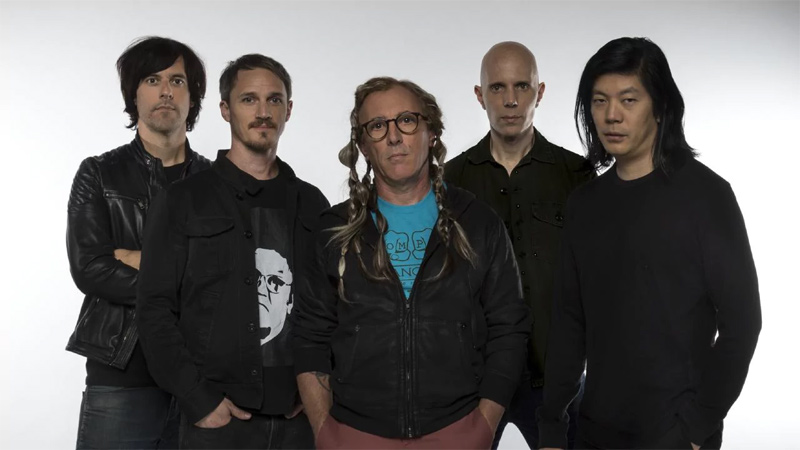
All of which makes them a very easy target for ‘serious music fans’—which, if I’m being honest, I probably consider myself to be. Meaning I’ve never paid much attention to Airbourne. The closest I’ve come is seeing them at festivals, watching from a hundred metres back with a smirk on my face, not really paying them attention or respecting them in any way whatsoever. Yet they’re probably among the most recognisable Australian bands at an international level—they’re signed to Roadrunner Records and are frequent festival bookings in both Europe and the United States. Yes, although there is a fair bit of cultural cringe attached to Airbourne,  it’s tough to deny that they’re good at what they do. And strangely, I couldn’t help but develop a newfound respect for Airbourne after chatting to guitarist David Roads (above, far right) for the first time, here now on TheVine.

What does an average day look like for you, when you’re not out on tour?

We’re very busy lately. We’re currently working on album number three. So at the moment we’re just kind of based in Melbourne and we’re rehearsing a lot. With the tour coming up next week, we’re starting to rehearse a lot more because we’re going back and [getting] the old stuff ready for the tour.

What gets you out of bed each morning? What do you look forward to when you first wake up?

Well lately, a sunny day! [laughs] The weather’s been so crappy here down in Melbourne. But, you know, we’re focused on what we’re doing at the moment with the album—I want to get in there and just make a rockin’ album. I guess our head’s in that at the moment, but [we'll be] back around Christmas time. And we just got back from tour. We’re trying to have a bit of a break. We still did Big Day Out and stuff, but we’re kind of still in ‘work mode’.

Do you view music as a job?

Yeah, we’re full-time with the band. If we’re not off the road, we’re on the road, touring. And when we release new albums, we go overseas for the majority of the year. Last year we were over there for 10 months touring for No Guts. No Glory.

If music is a job for you, what’s the most stressful part?

You can call it a job. It’s our living but it’s not really…I guess job’s a bad choice of word. It’s a lifestyle for us. As musicians, we love playing rock and roll, we love touring as a rock band. There’s nothing real stressful. There’s a lot of fun involved. It’s like, if you love what you do, you’re living the dream, I guess. We have a lot of fun when on tour and all that kind of stuff.

I guess sometimes it can get a bit stressful when you’re on the road. Sometimes when you’re sick of touring you can get sick with the flu, or a bad cold. That gets pretty hard, because the show goes on. You get up and have got to play that night. That can be about as stressful as it can get, really, I guess. But when you’re making an album it’s a bit stressful, because you’re still writing an album that’s going out to the world. You get in there and just do the best job that you can.

For the full interview, visit The Vine. The music video for their song ‘Bottom Of The Well‘ is embedded below.

triple j mag story: ‘How To Throw A Warehouse Party’, June 2011

June 5th, 2011

A short feature for triple j mag’s 50th issue. Click the below image for a closer look, or read the article text underneath.

++

How to: Throw a warehouse party

Think it’s just a matter of finding a space and asking some bands? Here’s how two different operators went about it

Phil Laidlaw is a co-founder of the Brisbane independent venue Lofly Hangar, which opened in 2007 in the residential suburb of Red Hill and held 100 events before closing in late 2010. Built on the warehouse model of booking cool bands and inviting friends to come party (BYO alcohol), the Hangar attracted more than 300 paying guests a month at its peak.

Did you rent the space legally?

The venue was rented as a recording and rehearsal space, and we had public liability coverage for those two elements of the business. We did look at getting public liability for events, but it was prohibitively expensive. There were a lot of requirements, like having security present at every event. So from the beginning we were operating as a private party at a residence, and we never had any problems.

What worked for Hangar?

Our sound gear. People will come if it’s an awesome warehouse, but they won’t keep coming back if it sounds shit. Having said that, you don’t have to start with the most awesome gear. You can build it up over time. It’s also important to keep some control over who you invite at the start, and try and establish a culture in the space that’s made up of your friends and associates before it gets too big.

What did you learn?

The earliest wake-up call was how loud it was for the neighbourhood. After a few shows, we realised we needed to do quite a bit more soundproofing.

Hangar’s door fee was always $10. Why?

You’ve got to decide if you want to be in it for the glory or the money. [laughs] It’s not a great way to make a stack of cash, but it’s a great way to have a really good time. It’s a good aim to keep it sustainable.

Advice for aspiring warehouse party starters?

Collect a group of friends that you can rely on to help you out, because you won’t be able to do it by yourself. It’s best done by a group of like-minded people. You’ll always need someone to run the door, or help clean up.

++

Another Brisbane-based crew, Sceneless, threw two warehouse parties on consecutive nights in October 2010. Whitelight was warmly lit and headlined by The Jezabels, while Dappled Cities headlined the UV-lit Blacklight. The events were hosted at a converted warehouse-for-hire and attracted a combined total of 800 people. Although attendees couldn’t BYO alcohol like they could at the Hangar, an arrangement with the nearby X&Y Bar allowed Sceneless to obtain a limited licence for the two nights.

Did you consider anything like public liability, or were the events considered private parties?

Yes, the venue owner had public liability insurance. It was included in the venue rental.

What worked?

The concept – an exclusive boutique, two genre, mini-music festival run over two nights, in an exclusive venue, subtly tailored to each night. We had two respected interstate headliners supported by mainly local acts, from newcomers to breakthrough acts.

What didn’t work?

We had more security than was required… We understood that this was the first official warehouse party in Queensland, and so being an unknown quantity it required some kind of official surveillance. We hope that now a precedent has been set and since the crowd were well behaved, we can continue to put on events without as much of a heavy ‘Big Brother’ presence.

++

Boring but essential stuff to think about

  • Security. Just how big could this party get? And what are you going to do if it gets Corey-style out of hand?
  • Talk to the authorities. If you’d rather your first meeting with the police and fire brigade didn’t come when they were shutting you down, think about letting them know what you’re planning. It’s only manners, and they may well have some good advice.
  • Limited liability insurance. Do you have it? Does the venue have it? Who’s gonna be responsible if someone falls down those lethal-looking stairs?
  • ‘Donations’? OK, so this is just a ‘regular’ party, but you’d like your ‘guests’ to kick in a ‘donation’ to cover expenses. Remember, there’s a big difference legally between a donation and a cover charge.
  • Locatio.n So, you’ve found the perfect venue. Except that it’s in a residential area, isn’t adequately soundproofed and is marked for demolition. Hmmm. Think again. Make sure the venue meets all the relevant codes and is well away from angry neighbours. And that you have actually have permission to be there.
  • Local council planning laws. Some of these might apply to your shindig, so do your homework.
  • Drinks. BYO alcohol? A liquor licence? Again, do your research.

triple j mag ‘We Salute You!’ party-starter profiles: Jaddan Comerford, James Wright, Zoe Barrett, June 2011

June 5th, 2011

A couple of short profiles of young Australian party-starters for triple j mag, as part of their party-themed issue (#50, May 2011).

Click the images below for a closer look, or just read the accompanying text.

++

Who: Jaddan Comerford

Where: Melbourne

weareunified.com

Although it wasn’t a party in the traditional sense, 2010′s No Sleep Til festival put thousands of music fans in a celebratory mood. According to promoter Jaddan Comerford, the mission statement was simply “to put on a punk rock event”. Headlined by Megadeth, NOFX and Dropkick Murphys, No Sleep took in five Australian capitals, as well as Auckland.

“There was a bit of stress involved,” 27 year-old Jaddan admits. The Brisbane event was most memorable, as it rained all day.

Jaddan says he love “organisation and making sure the ‘product’ is good”. That means ensuring people are enjoying themselves at the festival, and that there’s enough food, drinks, and toilets.

Though No Sleep Til 2011 is unconfirmed, Jaddan is busy as the owner of UNFD, a ‘music services’ company he founded. Part label, part manangement/marketing/booking agency, UNFD recently announced a deal with Warner Music.

Festival models Jaddan digs: “I love Laneway. It’s small, it books new acts and actually breaks them in the market. I also love the way they use venues not everyone else uses.”

++

Who: James Wright

Where: Brisbane

thefansgroup.com

For 22-year old James Wright, becoming booking and event manager of Brisbane’s most popular club night was a result of performing at similar events. As drummer in indie punk band Stature::Statue , James played a show put on by the Fans Group in 2008 and was intrigued to see its inner workings. “Fans is a party-throwing company started by four guys who wanted to do cool things with their love of music, girls and alcohol,” James says. “Their sole purpose on this earth is to effect that end.”

After asking Fans’ directors if he could learn more, James now sees Lambda Lambda Lambda – held each Thursday at Fortitude Valley’s Alhambra Lounge – closer than anyone: he books bands and DJs, coordinates worksheets, organises fees and makes sure that the night runs smoothly.

A recent highlight of James’ career was when most of the bands playing Laneway Festival crashed the party. Warpaint and Les Savy Fav were booked to DJ, but Yeasayer, Ariel Pink’s Haunted Graffiti and !!! turned up, too.

Qualities a good event manager should have: “Patience; ability to listen and comprehend carefully; be organised and open to ideas, even from unlikely sources. You also need to have a professional attitude and a penchant for late nights and drunken conversation.”

++

Who: Zoe Barrett

Where: Fremantle

thenewport.com

According to Zoe Barrett, four ingredients comprise a great party: being organised, creating the right atmosphere, social networking ads, and bubble machines. As Events and Marketing Manager at the Newport Hotel in Fremantle, Zoe loves the fact that she gets to see “loads of great live music for free”. With her help, the Newport has a growing reputation for putting on quality original bands each week; recent headliners include the John Steel Singers, Illy and Philadelphia Grand Jury.

Zoe recently launched a new club night, Bass Culture, which is “all about heavy, heavy bass music. It’s nerve-racking starting a brand new night,” Zoe says, “but when the place fills up and the new idea takes shape and kicks ass, it’s an awesome feeling.” If Zoe could’ve attended one legendary event, she’d pick the club party in London after The Beatles finished recording Magical Mystery Tour. “I would love to go back in time for that,” she says. “That’d be genius!”

Zoe’s CV: “I just moved to Freo and I was working at the bar [at the Newport] but I have a degree in Creative Industries majoring in Advertising, so when the Newport marketing manager left, I applied for that job.”

Interviewed: 4ZzZ Book Club on National Young Writers’ Month, freelance journalism, and UnConvention Brisbane 2011

June 3rd, 2011

This is a three-way live radio interview conducted by Sky Kirkham, Amy Stevenson, and Alexander Atkinson, the co-hosts of the4ZzZ Book Club, on Thursday 26 May 2011. 4ZzZ is a community radio station in Brisbane.

Our half-hour interview concerned National Young Writers’ Month 2011, my freelance journalism, and my role as co-organiser of UnConvention Brisbane 2011. Their questions are bolded.

If, for some crazy reason, you’d rather listen to the audio of this interview than read the transcript, you can do that here.

Welcome Andrew, and thank you for joining us today.

Thank you.

Andrew is the Queensland ambassador for National Young Writers’ Month. So I suppose to start off, tell us about National Young Writers’ Month.

Sure, National Young Writers’ Month starts next month, funnily enough. So I’ve been organising some events here in Brisbane and up in my home town of Bundaberg in anticipation of next month, to get young people inspired about writing and to start thinking about setting some goals to work towards during the month of June.

I’s really about getting young people talking about writing, and helping them work towards those goals by building a little community around young writers across the country.

How is the event doing that?

It’s online-based, and there’s a website which Express Media have organised. National Young Writers’ Month is promoted by Express Media, who are a Victoria-based arts company. The website is expressmedia.org.au/nywm.

We will put a link to that from our Facebook page at the end of the show. How did you get involved in National Young Writers’ Month?

The coordinator of the event came across my work somehow, I don’t know, through a search engine or something. And she liked what I was doing, so she asked me to be involved because she could see that I was under 25,and the event is targeted towards under 25s. She could see that I’d done a fair few interviews with writers in the past, and hoped that could translate through to helping other people be inspired enough to start writing.

Is there any particular reason for the age 25 limits on it? It seems almost arbitrary.

It does seem arbitrary, doesn’t it? It’s not my decision. I couldn’t answer that question.

I guess you have to cut ‘youth’ off somewhere.

What kind of goals are people going to be setting? Are these all manner of writing, or is it non-fiction and fiction?

It’s all manner of writing. Of the national ambassadors, I’m the only journalist. The rest of the ambassadors are fiction writers, poets, and that kind of thing. So it’s for any kind of writing, whether you want to start a book or get a few chapters down during the month, or start a blog and write every day, or even just write yourself a diary entry every day. It’s just to get the juices flowing.

Whatever achievable goal you think you can do in a month.

Yeah. It’s about making it an achievable goal, too, so not like “I’m going to write a book in a month!” because you’d probably tear your hair out in frustration.

I’m sure some people try.

Are there any physical workshops coming up? I know you’ve just run a couple of seminars or conversations with local authors.

I don’t have anything else planned. In the last 10 days or so I’ve done three events; two here in Brisbane, and one in my hometown of Bundaberg. Last Tuesday I had Benjamin Law and John Birmingham talking about freelance journalism – which is what I do, and what they are both well-known for doing. And this Tuesday just past, I had the Courier Mail’s Qweekend magazine staff talking about feature journalism, which I think was pretty cool because that magazine is regarded as being the best journalism in Queensland. Certainly among the best in Australia too.

So that was Trent Dalton –

Matthew Condon, and Amanda Watt.

Who was your favourite interview?

On stage, you mean?

Yeah.

Andrew: Matthew Condon, because… actually, it’d be a tie between him and John Birmingham, because they both have the rare distinction of being writers who speak as well as they write. Most writers… myself definitely included; I don’t speak as well as I write, because I like to have that time to get my mind focused. But somehow, JB and Matthew Condon have that ability to form whole sentences and witty comments on the fly.

Makes you wonder if their writing comes out that way in one smooth, flowing, fully-formed script.

Yeah.

Yes, we try to do that on the 4ZzZ Book Club. We don’t always succeed. [laughs]

To take a step back; you’re saying you are a freelance journalist. How did you get into that industry in the first place? What was it that drew you to it, and what was your first step in getting involved, as advice to all of our young writers out there who might be interested.

I started… I guess the first time I was published was in mid-2007 and for a couple of years following that, all I did was review live shows here in Brisbane for Rave Magazine and for FasterLouder. So for those two years, it was just purely live reviewing, the occasional CD review. That was my ‘journalism’ for two years, and I was happy to leave it at that was because it was a fun little pastime for me. It meant I got free concert tickets and I could go to see shows that I otherwise would pay for.

So that was cool, but at the same time it gave me the ability to work towards deadlines, and to word counts, and to be concise and to the point. So that was a hobby. I graduated from uni with a Bachelor of Communication in mid 2009. I didn’t really intend to do anything with journalism, but around that time I quit my job in web design, and I was kind of at a crossroads where I could decide to either pursue another full-time offie job or try something else that I knew; which, in that case, was freelance journalism fulltime. So I decided to put my mind to that. And it took many months, in financial terms, before I saw the fruits of that effort, but over those last two or so years, I think I’ve kind of got on top of it.

Is it possible to earn a living from freelance journalism?

It is, but you have to be incredibly dedicated and persistent. You have to get up every day and market yourself to editors, and have ideas, and constantly be thinking weeks or months ahead in terms of publication schedules, and what’s going to be current a few months down the track.

What would you describe as maybe the thrills and perils of freelance journalism?

The thrill is… for the year or so I was working an office job, the morning commute is quite upsetting. You have to get up early, make your lunch, catch a bus or train in… That gets old pretty quickly, as I’m sure everyone can appreciate in some regard. [Andrews note: I didn’t get to finish saying it, but the ‘thrill’ I was referring to was setting my own hours, and working from home…]

I suppose in those earlier days you would have been working to finance yourself some other way, as well.

That’s true. I did a bit of copywriting and web account management for a friend’s business, but in the last year or so I’ve given that up and I’ve just been freelance writing full-time. The thrills… and what was the other part?

Perils.

Perils. Well, it comes down to finance, I suppose. I mean, like I said; you have to be marketing yourself every day, and if you’re not doing that, then you’re not getting paid, and you can’t pay your rent or feed yourself.

And become yet another impoverished writer.

Exactly. I didn’t want to become a cliché, which is why I’ve been successful. [laughs]

Or living the stereotype. Is it all about generating a portfolio? Is that how you tend to market yourself once you have volunteered [as a writer] and you’ve got stuff that you haven’t been paid for, and people can see you’re good at what you do, then you can take your portfolio further?

In a way, yes. Those two years when – I was doing the stuff for the street press and FasterLouder – was essentially unpaid. But at the same time, I didn’t expect to get paid, because it was fun for me; free tickets and all that. But after I quit that job and made the distinction that I wanted to be a writer full-time, then I only pursued paying publications. I did that doggedly, for months on end, before I really saw the return.

That’s how you have to think; months down the track, instead of on a day-to-day basis, because you can do excellent work and people can like your work across Australia or across the world, but you don’t see the invoice until a few weeks or months down the track.

We are talking to Andrew McMillen on the Book Club here tonight on 4ZzZ. Andrew, what was your first paid journalism article?

I interviewed the Brisbane band Screamfeeder for a website called messandnoise.com. It was funny, because I’d been doing – in some ways – music journalism for a couple of years, but I’d never actually interviewed a band. So in anticipation of that I bought a little recorder, and I did all my research and preparation and took notes, and all that sort of thing.

It went really well, and it was published online, and it was worth $60 or something like that. It was a breakthrough for me because it was like, “holy shit”; here’s this article which I put a lot of effort into and I could see the results, and it was well received among the [online] community and all that sort of thing. And that first paying success, as it were, I still feel that to this day when I get published in The Weekend Australian or Rolling Stone.

I mean, obviously I’m a full-time writer. I like to get paid for my work, but it’s also still a thrill to see my name in print and to see people responding to an article, whether through comments on an article or on Twitter or Facebook; that sort of thing.

You’re saying how you write full-time. What was the draw of journalism in particular? Did you ever have any aspirations of pursuing other writing activities?

No, I didn’t. Now that you asked that, I’m not really sure. I’m curious. I guess I’m naturally curious, and the role of the journalist, I think, is to remove curiosity from day-to-day life. A good journalist is asking the questions that you want to know, and putting them into articles or radio programs or TV shows that are answering those questions. I guess I like being rooted in non-fiction, because it’s where I live on a day-to-day basis, rather than being lost in my head with fictional characters.

I suppose in journalism as well, you get to come out of your hidey-hole and interview people.

Yes.

Actually have contact with people.

Exactly, because I know from experience you can spend enough time in your bedroom, or your workspace, and it’s days before you actually go out and see someone. So it’s always a thrill to be out and to meet people, definitely.

As one of the challenges of freelance journalism, you’re talking about the need to market yourself constantly, and to look ahead. Is there this trade-off where, I suppose, you would have some freedom as a freelance journo that you wouldn’t otherwise, that you have to work almost as hard at the marketing side as you do at actually writing your articles?

Definitely, that’s the balance. It’s great to be able to roll out of bed at midday, or stay up late and not have to worry about getting up for work, or whatever, but in terms of why I have been successful is because, from the beginning, when I had that first paying article, I started uploading all of my articles to my own blog, which is andrewmcmillen.com. Every time I would introduce myself to another editor, I would show them my blog and show them my three best articles up to that point.

I’m not sure, because none of my editors have ever said it, but I think that taking that kind of time to build a web presence and keep it updated, and take pride in that; I would hope that has swayed them in some ways to think, “Okay, this guy’s serious about what he does.”

Interviewer 1: You see that with authors and websites as well. There are some authors who have the most fantastic websites and then you have ones which look as though they haven’t been touched for years, and are atrociously formatted. You have to wonder whether they’re actually interested in booking themselves up, because they’re obviously not committed to it.

Interviewer 2: That comes back to the balance again, I guess, of authors who feel they shouldn’t have to do anything other than write.  I believe we’ve heard even people on this show talk about that, but definitely I’ve heard other interviews with authors feeling quite indignant that they have to do something other than –

Interviewer 1: “What? I have to market myself?”

Interviewer 2: Exactly.

Interviewer 1:: “Don’t people get paid to do that?”

Interviewer 2: It seems pretty lonely to engage in writing that way, lock yourself up in a little room and just do nothing but write. I think it’s a skill that probably our generation is in grasp of a lot more. We are a generation of bloggers and Facebookers. We have no problem really of announcing our ideas to our community of friends, and taking that on to a larger step as a professional basis. You probably have to be quite good these days, because everyone’s tried their hand at that sort of lifestyle.

I was adept at that kind of social media, or whatever you want to call it, because I’ve grown up with the internet. I’ve been using it hardcore since I was 12, and I don’t see myself stopping.

Didn’t you first start writing on the internet; gaming reviews or something?

Yeah.

See, we’ve done research!

The first time I was published in some way, I suppose, is when I was about 12 or 13, for an online video game community [NINTEN] where I was essentially rewriting press releases. Which is as glamorous as it sounds. But it was cool because I was already a member of this community but it was also helping me to show some talent of mine: that I could write, and that people might want to read about the latest Nintendo game or some other thing that’s coming out. It feels silly to talk about it now, but at the time I loved it because I was passionate about video games, and for years I wanted to be a video game journalist, which I have kind of…

Sounds like a rad job.

Video game journalist?

Yeah; you play the games, you tell people about them. The dream job.

I’ve kind of done some video game journalism, but it’s been nothing to do with playing games; more about looking at the business side of games, which I don’t think many people – either in Australia or in the world – are doing. I got into that because, here in Brisbane a studio called Krome shut down the end of last year. For a week or so, there were rumours floating around that they’d fired all their staff, but no one was confirming it.

Because no one was looking into it I was like, “I’m going to go check it out for myself.” There’s a gaming website called IGN, which I approached the editor of. I said, “Can I do this story for you?” He’s like, “Yeah man, I really want somebody to do it because, like you, I’m curious.”

So I found a bunch of staff who had left the studio recently, and I put together their stories and theories on why the company went out of business. Then I got an interview with the CEO. It was the first time he’d spoken to media since the rumours started, because all the Courier Mail reporters [and the like] and all were calling up to say, “Is this true?!”. They were really confronting him, whereas I came in under the radar and said, “Look, I’ve done this research with some past employees. They’ve told me this; is it true?”

I guess it’s that kind of tenacity that really drives a young journalist. Do you have any writing heroes, or literary heroes that you used as a model for that, or any sort of model for your writing?

Yeah, also around the time I quit that [web design] job, I went down to Sydney to interview my favourite writer, Neil Strauss. He’s an American author who’s best known for writing for Rolling Stone and New York Times for about 20 years, and in 2005 he had a book called The Game: Penetrating the Secret Society of Pickup Artists.

I think I’ve heard of that one.

He had a new book that came out in 2009, and I had an interview lined up with him. He was meant to come to Brisbane for this book tour, but it didn’t come through. He was just going to Sydney and Melbourne instead, because I guess there wasn’t enough media attention up here. So I had resigned myself to just doing a phone interview with him, like any other writer or musician I’ve done before. My friend said, “If this guy means so much to you, why don’t you take a few hundred dollars and take the cost and fly down and see him?” Which I hadn’t considered at all.

So I did that, and I met him. I interviewed him for 45 minutes or so. That was a massive formative experience for me, because here’s this guy who has literally built his life around writing and publishing words. And that made me realise that I can do that; that’s what I wanted to do.

So you’ve clearly gone a few paths as a journalist. You’ve got your musical background and, I guess, more straight stories, things like the current one [‘Krome Studios: Things Fall Apart’]. How do you plan the difference in approaching those, and also, how do the publications you’re dealing with approach your involvement in them as a freelance journalist?

It depends very much on the publication, and what they want from their writers. For example, the majority of music writing I do these days is for a website called TheVine.com.au. And mostly what I do for them is interviews, which are published in a straight Q+A format. So there’s a few hundred word intro and then it’s just the conversation as it happened. Which I’m really big on, because I remember reading street press, before I was writing for it. I would see, “this band’s touring”, or they’ve got an album coming out. There’s this little 300 or 500 word article and there’s a couple of quotes that are plugged in there, but it’s like – “what did the writer and musician talk about for the rest of those 15 minutes?” Because most bands give 15 minute phone interview blocks.

It confused me, because I wanted to see the full story. So both TheVine and Mess+Noise are quite good at publishing full interviews, but that’s, again, because they are web publications, whereas a magazine like Rolling Stone or triple j mag, they’re constrained by space.

I guess that’s a major thing; the advent of online media to the point where it can actually generate a business model these days and allows that additional space. It also has allowed the rise of a larger group of freelance journalists to get published and get their information out there.

Maybe for less money.

Almost definitely, which is a shame, because I prefer writing for the web. Because like I said; I’ve grown up with it and I spend most of my day online and I like to see what’s new and what’s current. But at the moment, in terms of writers getting paid or journalists getting paid, the scales are definitely still tipped in print’s favour. I like writing more for Rolling Stone or The Australian because they pay really well, as opposed to –

Could you put a figure on it per word?

Yeah. Rolling Stone pays 60 cents per word, and The Weekend Australian pays 70 cents per word.

Online that would be…?

TheVine, for example, pays $150 per interview, or $50 per review. It’s the shift between per word and per article and it’s great; TheVine is run by Fairfax Digital, who had a quite forward-thinking business strategy a few years ago when they launched TheVine and Brisbane Times, and those kind of sites. [Andrew’s note: those two sites launched at different times, however.] They’ve been monetised and profitable for years now. Hopefully that balance between print and web will tip towards web’s favour. I think it will, because more advertisers will be going towards the web, because more people are reading websites.

You are listening to the Book Club on 4ZzZ 102.2 FM. We are joined today by Andrew McMillen, who is the Queensland ambassador for National Young Writers’ Month. Let’s talk a bit more about National Young Writers’ Month. You were saying there’s online workshops. Are you involved with that at all? How does that work? How do you get enrolled?

Not so much online workshops as a community built around the forum, and blogs that are on that website.

How are they going? Have they started yet?

All the ambassadors have written their response to ‘Why I Write,’ which I think is where you got your research from, maybe… maybe not. [laughs] And we’ve had a few guest authors do that, like Benjamin Law put his response in, which was, in typical Ben Law style, quite humorous. There’s forums where you can talk about journalism or blogs or fiction writing or poetry. They’re trying to cover all the bases in terms of writing forms, which I think they’ve done.

How do people get involved with that? They go to the website, subscribe and register and then have access to the activities?

Yeah, you can join the community and make friends and do all those kinds of social networking activities.

Is there any other support groups around? I know Visible Ink which is in the valley which is a government initiative supports young writers and I suppose some of the publishing bodies we’ve talked about today like FasterLouder and stuff sort of support young writers in a way, to their own benefit in a way as well. Are there any other associated organisations involved in this one?

Not involved in this [NYWM] specifically. The Queensland Writers’ Centre are quite visible, obviously.

We talked about The Edge as well, in the break and that’s something else that’s quite a beneficial, useful little space.

It is, and they often have workshops, government workshops there. I’m not sure how many of them are writing based.

Andrew: They do have occasional ones. I remember last year – which I wasn’t in town for it – they had a feature journalism chat with Trent Dalton. Young writers could come along and ask questions; much like they could at my events in the past 10 days.

There is also a broad range of things that go on at The Edge, one of which is something else you’re also involved in, which is UnConvention, which is coming up on the 11th and 12th of June. Can you give us a bit of rundown on that, while you’re in the studio?

Sure. I am a co-organiser of UnConvention Brisbane 2011. It’s the sequel of UnConvention Brisbane 2010 funnily enough. It started last year as a grassroots independent music community networking event. It’s much the same format this year, with more of a focus on encouraging discussions during the panel sessions.

As well as that, there’s a networking event at the Boundary Hotel on Saturday night, and a few local artists will be showcasing throughout the weekend at the Edge and at the Boundary Hotel.

How did you get involved with the UnConvention organisation?

It’s based on a concept that started in the U.K. a few years ago and it’s since been replicated around the world, like in Brazil and India and all sorts of places. UnConvention Brisbane last year was the first Australian UnConvention. A co-organiser named Dave Carter who is a lecturer at the Conservatorium and a local musician himself, he saw the idea and thought about bringing it to Brisbane because he felt there was a bit of a gap in terms of strengthening bonds within the independent music community and bringing them together.

That’s what we really aimed to do, and based on feedback from last year we had about 220 people come along to the Edge and hopefully we’ll do the same again this year. The feedback was really positive.

I caught a thread online the other day about Brisbane and the difference — a lot of people say that Brisbane isn’t quite as cultural as our other cities of Australia and whether that was a problem of representation in the music industry, or whether that was a lack of talent in Brisbane. The general consensus was that there’s bits of both but there’s slightly less cohesion I suppose was the general consensus of the thread. I wasn’t a contributor or anything, I just took it off.

This is on Collapse Board, perchance? ['An Open Question to Brisbane']

Yeah.

It’s an interesting thread. I’ve kept an eye on it too, and I haven’t contributed myself either. It’s one of those discussions that’s been around for a long time and I know the guy who started it, Everett True, who is running a workshop at UnConvention about online publishing or self publishing.

He’s a pretty good writer.

Yeah, he’s amazing. He’s literally been a music journalist his whole adult life; he knows what he’s doing, for sure. But he started it because he wanted to answer the question “Why does Brisbane perceive itself to be a cultural backwater”; those sorts of questions. There are no easy answers for that because… I don’t even know where to start.

Interviewer 1: I was thrown to each side of the argument as I read on. I thought, “Yeah, clearly because everyone leaves Brisbane and goes to Melbourne if you’re a creative person.” And the I read a little bit further and I thought, “No, I know there’s venues in the suburbs and there’s music.”

Interviewer 2: We do have a massively creative scene as well. The number of good local bands coming out is always pretty impressive.

Interviewer 1: I think it’s a stigma that holds around that there’s not much going on in Brisbane. Just the fact that there is a stigma, people keep re-saying it.

It’s funny, because it exists down south. People down south perceive Brisbane to be like that, and somehow, for some reason, Brisbane people believe that, in some cases. That’s why I think it perpetuates.

I think so.

So you’re saying Everett True’s running a workshop on self-publishing.

He’s co-hosting that with Bianca Valentino, who’s done a lot of her own zines called “Conversations With Punx”.

I think I’ve been to a seminar by Everett True a couple of years ago. He was pretty cool.

There we go; a reason to get along to UnConvention in a couple of weeks! You panelled, at the last one, a discussion on music and the media. Is there going to be something similar this time or is that retreading old ground at this point?

We have aimed to start a whole new series of topics, although we have retained a similar kind of one in the music and culture discussion. I think that was really valuable. This year that’s being held by Kellie Lloyd of Screamfeeder, and Q Music. What was the question again? The music and media panel, last year. No, we’re not doing that exact topic this year but we are doing ‘documenting Brisbane’s music scene’, which is run by Justin Edwards, a local music photographer.

Cool. I’d say there’s a lot to get to as well as National Young Writers’ Month, which you can log on. We’ll post up the site.

UnConvention is held at The Edge in South Bank, next to the State Library of Queensland, on June 11 and 12. That’s the Queen’s Birthday long weekend. It’s $30 to get in and that gives you access to both days of panel discussions and networking events, as well as lunch on both days. For more information, you can visit unconventionbrisbane.com

Andrew McMillen, thank you very much for joining us today. Andrew McMillen is a freelance journalist, the Queensland ambassador for National Young Writers’ Month, and one of the co-organisers at UnConvention. So a very busy man, and he also runs a blog, which you heard him mentioning before, which is andrewmcmillen.com.

We’ll also post the link to it on our Facebook page after the show, for those that don’t write at the speed of my voice. It is a quarter-to-eight. You’re listening to the Book Club on 4ZzZ.