On Productivity And Procrastination

April 30th, 2009

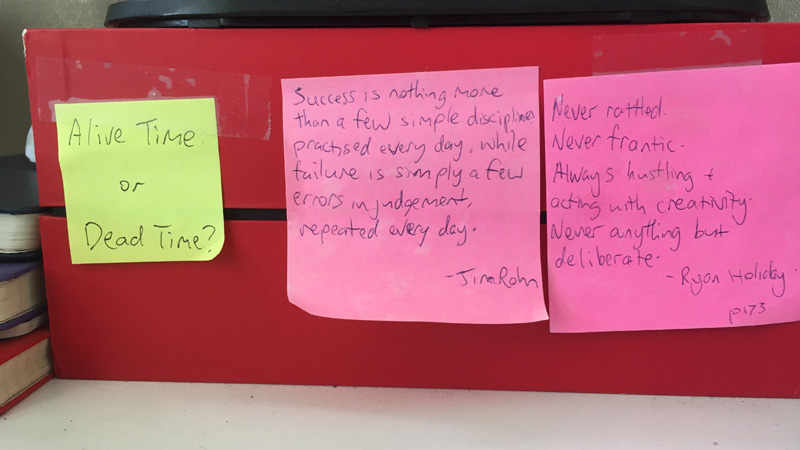
If you spend a lot of time on Twitter each day, you start to feel a sense of vicarious productivity.

Discussing links, chatting with several people at once, managing followers: none of it really matters, and yet it’s easy to lose sight of this when you’re immersed in it. 

You think you’re achieving things by commenting on and distributing content produced by others. But unless you’re being paid to manage your Twitter account, you’re really just engaged in a highly interactive distraction.

We’re only going to become more familiar with the presence of constant distractions. I have not a goddamn shred of research to back up this suggestion, so bear with me.

Regular internet users readily switch between dozens of social applications, interfaces and conversations every hour: email, instant messaging, Twitter, Facebook, et al.

Compare this constant multi-tasking to what our parents were familiar with: that is, concentrating on the task at hand – using the skills that you’ve chosen to build your career upon – before dealing with what’s ahead.

I might suck at explaining it, but the skills that a savvy internet user possesses are radically different from the previous generation. And I’m not one to give much thought to generational difference, but unless I’m much mistaken, we’re learning to think in a totally different way.

I’m aware that I’m extrapolating my own experience onto a wider demographic.

But I’ve found that instead of regularly focussing on one single task, my attention is divided across several mediums. It’s rare that I can concentrate on one task from start to finish.

Logically, this means that the quality of my creative output – be it a university assignment, a paid article, or an email to my family – is reduced, as I’m thin-slicing my thought contributions across hours or days.

That’s the rational explanation: reduced concentration on a singular pursuit results in a diminished outcome.  But I’m not certain.

I’m still adjusting to this relatively new method of online productivity. But I’ve no doubt that individuals who can successfully navigate a web of procrastination pitfalls will end up miles ahead of their peers.

It’s like Tait Ischia said in my interview: “If all the kids these days spent the same amount of time writing blogs that they did on Facebook, then [the advertising] industry would be a hell of a lot more competitive.

He’s talking specifically about writing, sure. Because he’s a writer. But apply his concept to your ideal pursuit: breakdancing, animation, video production; I don’t know, interior fucking design.

The reality is that if you don’t work at your passion, you don’t get any closer to realising it. It continues to sit out of reach. That passionate carrot that you just can’t be fucked working toward. It’s the difference between putting the majority of your energy into becoming a widely-read writer and just telling everyone you meet that you want to be a widely-read writer.

In this way, nothing about productivity has changed since humans started realising that they required more than just food, shelter and sex to live a satisfying life.

So I suppose that the internet,  in the hands of the unmotivated, might just be a platform that has the potential to be a dense distraction. It’s the marbles, the skateboard, the comic books, the pool halls of previous generations, condensed into a single interface.

Except it’s inside, and you’re probably going to learn fewer skills when traversing the internet for extended periods. But even that statement is wrong; you’ll learn skills, but they’ll be completely different to what you’d learn in a pool hall or a skate bowl.

Historically, the people who are motivated toward an end have achieved things. They’re remembered. They won. And those who stood in the shadow of their achievements weren’t remembered. They didn’t win.

Simpler: the people who get things done win.

This post is a departure from the norm, because I clearly haven’t thought this through. But I’m okay with that. Stepping outside my comfort zone of pretending that I have the answers.

How do you spend your time online, and how do you deal with distraction? Do you think we’re learning to interact smarter?

A Conversation With Anthony Osborne, The Hi-Fi General Manager

April 28th, 2009

hifiweb

Melbourne‘s Hi-Fi  is a day away from the public opening of their Brisbane venue. They’ve opted to establish it in the southern suburb of West End, outside of Fortitude Valley‘s live music hub. The Drones will be the first act to headline the venue, while fellow Melburnians Witch Hats and local act Hits will strike the first cymbals and chords. I spoke with The Hi-Fi’s General Manager, Anthony Osborne, about his expectations for the new room and the nature of the promoter-venue relationship.

Note: this interview was conducted on behalf of Mess+Noise. This is the entire conversation that I had with Anthony, while an abridged version is contained in my feature article, entitled High Stakes, which also includes interviews with several Brisbane music authorities and stakeholders.

We’ve always wanted to grow our business, and Brisbane is one of the key touring markets on the east coast. Brisbane’s part of the roster for most acts; it’s a good market that’s growing in terms of youth culture and population, so it just made business sense.

Did you guys have a knowledge of the local scene up here, or were you assisted by some industry contacts?

We’ve had a good look for a few years before diving in. For all the capital city markets in Australia, we’ve had consultants from a property and hospitality perspective who we’ve worked with to look at different areas of the city, to see what we can put together in terms of a live music venue. Our own knowledge of the touring market has assisted, too. In particular, West End stood out as a good spot, as a good cultural fit for our target market.

Why the West End location, when The Valley has become known as Brisbane’s live music HQ? 

We’re in the business of placing bands who will attract people from anywhere nearby. We’re not really a ‘drop-in’ venue; we put on headlining artists in an effort to fill the room as often as possible. Although we’d like to be in a spot that has a good fit, at the end of the day, we can be a bit more flexible. West End is as suitable for us as The Valley, because of the fact that people will come to the destination to see a particular headlining artist.

West End. Not a cultural desert. (via Cultureboy, flickr)

And I suppose that the audience will hang around after the show and get to know West End a bit more.

Yeah, definitely. We think that pre-show and post-show is important, as you don’t want to be stuck in a cultural desert. People like to be able to go and do something. It’s no sin to not be in The Valley; we’d have happily taken an opportunity in The Valley, but we’re very happy to be in West End.

Did you encounter any resistance when planning for the venue, either from locals or other Brisbane venues?

Everyone’s pretty much welcomed us with open arms. We’ve got a real sense that our venue will be a good fit, and that it’ll be nice to have another venue in the mix.

So you recognised a gap in the market? Did you think that Brisbane was missing a mid-range venue?

There’s room in all the capital city markets for professionally-run venues that have a good tech solution, and a good customer solution. So Brisbane wasn’t missing a venue more than any other market; Melbourne has a lot of options for venues, but you still see people coming in and out of the market, and you see improvements for artists and promoters who want quality. There are some good operators in the Brisbane market, but there’s certainly room for us. It’s not that we recognised a gap; we see ourselves fitting into any market, if we can provide the right solution.

I’ve read that the venue capacity is 1,200.

That’s roughly correct. The capacity tends to get slightly reduced due to guest lists and so forth, but that range is where we’re aiming to be.

Okay, so locally, we’ve got The Tivoli, which is of a similar size [approximately 1,500], and I’m sure you’re aware that The Arena has closed.

Yeah, The Arena closure is disappointing for Brisbane. That venue took some bigger events. We always saw The Arena and The Tivoli – and to some degree, The Zoo – as being competitors who offer alternatives. Artists may still play multiple Zoo shows, as they haven’t had historically had many options at that 1,000-1,200 capacity level.

The Hi-Fi has taken a few of the shows that were scheduled to be played at The Arena; are you looking to occupy a similar market space?

The live industry is essentially promoter-driven at that end of the scale. We can’t match the capacity that The Arena offered [note: commonly quoted at 2,000], but there’s certainly other ways to package the experience. If we’ve got turnkey operations and good marketing and ticketing support, then we can offer a more cost-effective alternative for promoters to use The Hi-Fi. This means that they can perhaps look at reduced capacities with a similar cost result.

We work on keeping the costs down for those who book the room. We think that’s the best competitive advantage that we can offer, in addition to offering a great live experience. It’s about punters and artists; if they’re both happy, then promoters are happy. The ultimate clients in many cases are the promoters, who we get much of our business from. To make them happy, we’ve just got to make sure that the fans want to come to the venue, and that the artists have a great experience. That starts with a good tech solution, a smooth ticketing system, bars and a great sight-line for all in attendance. Melbourne’s Hi-Fi is one of the best viewing venues, and we’ve tried to replicate that with the Brisbane Hi-Fi. It’s purely designed for live music.

I read that the venue will offer seven levels of tiered vantage points.

We’ve designed it to allow everyone in the room to see the stage easily. That’s the most important thing we can do – you know yourself from going to gigs. All of a sudden you wonder why you went, because you’re stuck in a back corner and you can’t see anything. As much focus has gone into that aspect as the sound system.

The venue was previously a hotel for years, which did some live music, but in its last incarnation it was a pool hall. So it had a big space out the back – a big ‘footprint’ – but the inside has been custom-made to our requests. We put in a mezzanine, added a stage, tiered the floor and completely remodelled inside the building.

I’ve noticed that The Hi-Fi has some great national and international acts lined up; what are your plans to support the local scene?

thedrones

We held a promotion to recruit local support acts for the opening night, headlined by The Drones, which received over 200 entries from local acts. Those entries have allowed us to build a database of artists comprising many different genres who’ll be interested in support work. We’ll be pushing those into the mix whenever we’re after local acts.

We’ll be supporting local promoters who want to put on local bands. If promoters approach us with a desire to put on themed nights for whichever genre they’ve organised, such as a collection of indie, or hard rock bands, we support that by actively seeking these kinds of requests. We also make it efficient and reasonable for promoters to put these shows on. We do this a lot at the Melbourne venue, too.

Our main focus is headlining Australian and international acts – that’s certainly the ‘bread and butter’ of our business – but we want to be as open as possible, to support the local scene by creating opportunities for promoters and acts.

How did the idea to get The Drones on board for the venue launch come about, and how did you arrive on the invite-only free show idea?

We were always going to do a free show on the opening night, because we thought that was just a great way to launch the venue. The Grates were booked two days after the launch; we could have just opened with that show, but we wanted to open with an artist who is a good cultural fit for our business. We thought that The Drones were suitable for that purpose as they’re a great, artistic indie band. We approached The Drones with the idea, and they accepted.

We’re doing the free opening show to give everyone an opportunity to come to the venue. We’ll have a lot of people who won’t know The Drones – they won’t be Drones fans per se – but they’ll want to check out the venue. And these people might become Drones fans on the night, or fans of the bands who are supporting [Melbourne's Witch Hats and local promotion winners Hits]. We also allocated 300 tickets to The Drones’ fanclub, which went like wildfire. But we haven’t limited the event purely to guests, as we wanted Drones fans to come to the show, in addition to letting people in ‘off the street’, so to speak.

It’s great that The Drones enabled us to do that, as to some degree they’re making a sacrifice of their own by playing to a percentage of the room who aren’t necessarily passionate Drones fans.

I read a news release that mentioned live video feeds and occasional acoustic sets in a nearby bar.

There’s a standalone bar on Boundary Street called Vinyl, where we’ll be taking live video and audio feeds from particular gigs in The Hi-Fi’s main room and feeding them to Vinyl through a couple of big projector screens in the bar. We wanted to offer this as an add-on to sold-out gigs. We thought we’d take the opportunity to run the gig into a nearby location that contains venue-quality production sound.

We’ve had great responses from the artists, who’ve been very supportive of the idea as most of them realise that it’s an opportunity to spread their ‘brand’. It’ll be up to the artists and their management as to whether they’re comfortable going through with it, but the response we’ve had so far indicates that we’ll be doing the live Vinyl feed quite often.

We’ve done that with Jim Beam, who’ve been partners of ours for a while. They helped us pull the deal together, invest in a bit of production infrastructure, and support it with a bit of marketing, without being overtly commercial. If we can get a good, regular roster of local and international acts who’re keen to run the feed, then it’ll be great for people to be able to hang out at the bar and watch some great acts playing live nearby.

Vinyl will also be putting on some smaller ‘side shows’ where some artists will occasionally perform some smaller sets in an intimate location on a day surrounding their Hi-Fi show. These won’t be heavily promoted; maybe a week out from the show, we’ll advertise that a particular artist is taking a ‘lo-fi’ – most likely acoustic – opportunity, if that suits their style. The venue has a small stage and a decent production set-up, and has a capacity of around 150.

witchhats

What’s The Hi-Fi’s policy on punter recordings and photography?

In most cases, the decision is made by the artist a couple of weeks prior to the gig, so our hands are tied in that aspect. We don’t have a problem with punters taking photos or recording, and most artists these days seem to agree. We provide that service as a part of our business, so if the artists want to enforce a ‘no camera’ policy, then we will oblige.

So photography will be dealt with on a per-artist basis, instead of a blanket venue policy. But it’s a fairly difficult thing to stop, since most phones now contain cameras. And I think thatif a band gets more exposure, regardless of their position, it’s probably not such a bad thing.

Considering the number of venues that are emerging in Brisbane, do you anticipate that ticket prices will go down?

I don’t think that the number of venues will have any impact on the ticket prices at all. Ticket pricing is driven by the number of touring artists and global exchange rates. So if our dollar loses its value and it becomes more expensive to tour the country, ticket prices will increase, though we haven’t seen that occur yet. Ticket prices are promoter- and volume-driven; booking agents won’t necessarily bring more artists to a city if there’s more venues.

I take it that you’re attempting to distinguish the Melbourne Hi-Fi from the Brisbane Hi-Fi.

They’re part of the same group. We recently dropped the “Bar and Ballroom” part of our name from The Hi-Fi in Melbourne; we tended to be colloquially known as “The Hi-Fi Bar”, which is wrong since we’ve never been called that. It just got adopted by our punters, who ran with it. But both venues are run by the same management structure, and they’ll very much work together.

Finally; you’re based in Melbourne, Anthony. Is there going to be a Brisbane-based Hi-Fi team?

There is. There’ll be a production team, an operations manager for the venue and some other full-time staff for marketing and promotion. Although the main company administration is based in Melbourne, we may have some people representing the company nationally over time, while operating out of Brisbane. We’re very excited to get into Brisbane; we can’t wait to get on the plane and have a big opening night!

The Brisbane Hi-Fi is located on Boundary Street, West End, Brisbane. It opens on Wednesday, April 29 with a show headlined by The Drones, featuring support from Witch Hats and Hits.

How To Be A Live Music Critic

April 20th, 2009
  • You must smile smugly when informing the door staff that you are attending on behalf of your allotted publication.
  • You may use several sentences to comment or complain about external factors that led to you missing half or all of the first band’s set.
  • You may attempt to capture the zeitgeist wherever possible, by referring to wider societal, economic or meteorological factors.
  • You must understand the importance of the zeitgeist if you are a music critic.
  • You may refer to the bands’ stage attire or between-song banter if you are unable to accurately or coherently describe their music.
  • You may refer to the venue’s drink prices and the temperament of the bar staff only if you are still short of the word limit, even after describing stage attire and between-song banter.
  • You must not use more than half of your word limit to describe the bands’ music. This is a waste of valuable words, which could be better devoted to describing stage attire, between-song banter, drink prices and/or bar staff temperament.
  • You must make reference to other artists’ sound when describing any band, for comparisons are the lifeblood of the music critic.
  • You may describe a band’s sound as ‘(genre)-tinged’, ‘robust’, ‘edgy’ or ‘angular’, even though you know that these words are meaningless filler.
  • You may not research support bands on MySpace before the show.
  • You may insist that you did not research the support bands on MySpace before the show because you wanted to “be surprised”.
  • You may insist that you did not research the support bands on MySpace before the show because you wanted to “approach with an open mind”.
  • You must never concede that the real reason you did not research the support bands on MySpace before the show is because you are lazy.
  • You may get inappropriately drunk, scrawl meaningless notes which you can’t decipher the next day, forget most of what happened during the show and rely on friends’ accounts and sheer bullshit to scrape together your pitiful pile of words to meet the limit.
  • You must realise that the above description accurately captures the actions of most music critics.
  • You may drink no alcohol, take thoughtful notes, and live vicariously through the rest of the drinking crowd, purely to perpetuate the stereotype that all journalists are hard drinkers.
  • You may not have “just a couple” of drinks. This is completely unheard of.
  • You may slightly nod your head to the rhythm of the bass drum.
  • You may alternate between slightly nodding your head and slightly tapping your right foot to the rhythm of the bass drum.
  • You may not, at any point, gyrate your body or move your arms in response to the music.
  • You may only move your arms to imbibe your drink, or when writing notes while in the process of capturing your thoughts of pure brilliance.
  • You must have your notebook and pen at the ready whenever a band is playing, in order to capture your thoughts of pure brilliance at the exact moment they come to you.
  • You may use the above act for overtly advertising that you are a music critic.
  • You may tell members of the opposite sex that you are a music critic when they ask why you are taking notes.
  • You may lick your lips before responding to the above question, as the questioner will undoubtedly want to make out with you immediately after discovering that you are a music critic.
  • You must refer to any weekday night as a “school night”. While there is some contention as to whether Thursday and Sunday qualify as “school nights”, there are no exceptions to Friday or Saturday. 
  • You must have a smug smile on your face as you write the words “school night”, as if it’s some incredibly clever and original phrase.
  • You must treat every show you see as a music critic with the utmost sincerity, because watching three bands play music to people for a few hours is the most important thing in the world.

A Conversation With Tait Ischia, Junior co-founder and freelance writer

April 17th, 2009

tait_3Tait Ischia is the co-founder of an excellent resource for young creatives named Junior, a freelance writer, and a RMIT Creative Advertising graduate. The degree is listed last for a reason, as Tait believes in getting shit done, instead of basking in his own glory.

It’s no secret that Tait’s Junior – founded alongside RMIT fellow Ed Howley – regularly kicks my inspiration’s ass. They rope interesting, real-life creatives into entertaining conversations; unsurprisingly, their no-bullshit style is a big influence on my interviews. In tribute, this piece will adopt Junior’s bright-highlight style to draw your eye to choice advice that’ll flow from Tait’s brain to yours. Eww.

I sent Tait the link to my Tim Kentley interview, which referenced his initial piece for Junior. Since he’s such a fucking nice guy, he agreed to answer my questions that’d lingered since reading The Enthusiast‘s January 2009 interview.

Tait, I loved your statement in The Enthusiast’s interview: “really, the economy being in the dumps doesn’t mean anything [for junior creatives]“. Marketing budgets might have contracted of late, but businesses still need agencies to develop engaging ideas to raise awareness of their products or services. Hell, you could probably argue that right now is the best time for dedicated creatives to work their arse off and make a name for themselves; on the economic ground floor, so to speak. What do you think?

You’re really asking two questions here. One about the economy and one about juniors. It’s a fucking elephant’s cock of a question, so bear with me.

It’s a tough time for anybody in business, and creative businesses aren’t immune. I’ve heard a bunch of stories where agencies have had budgets cut in half, projects fall over just when they’re ready to shoot, and clients taking away their business entirely. It sucks big time.

Having said that, the creative industries aren’t a giant immovable object. Unlike businesses run by boring dudes in suits, creative businesses are run by people who can change and adapt pretty easily.

So although it’s a tough time for everyone, this is a pretty good industry to be in at a time like this.

The other part to that is everybody in the world right now is re-thinking what the hell they spend their money on. All of a sudden throwing money around on bitches and fine cheeses isn’t seen as a very good idea anymore.

So as far as creative industries are concerned, especially advertising agencies, there’s a whole lot of people reading newspapers and watching TV wondering what the hell to spend their money better on. In other words, a captive audience. Which means it’s the perfect time for clients to advertise. And the word on the street is those clients that do will come out of this faster and bigger than those that don’t.

As far as juniors are concerned, “really, the economy being in the dumps doesn’t mean anything“. I’m glad I said that. I can’t put it any better than what Clemenger BBDO‘s Emma Hill told us in her interview, “It’s the toughest that it’s ever been for juniors. That being said, their advantage is they don’t cost much. So you can look at it as glass half empty or full.”

Many big agencies have put on hiring freezes and a huge amount of poor people are losing their jobs. BUT! And this is a huge but. Good people will always get work. If you’re awesome then businesses will go out of their way to get you in. You will make them money. It’s as simple as that.

All you have to do is prove to them that you are awesome. How you choose to do that is your choice. Here’s a good tip though, again from Emma Hill, “If your idea is a bit gimmicky, you come across as a gimmicky creative. Rather than a genuine, intelligent one.

Show them you’re intelligent and that your work is great – do that and you’ll be fine.

You rose from a ‘zero’ advertising undergraduate to junior ‘hero’ over the last two years, and it’s all documented online. I’m a couple years younger than you, but this is essentially the ethos of our generation: everything we’ve ever done online will be visible to everyone, forever. Gary Vaynerchuk discusses this legacy regularly; what are your thoughts?

That is by far one of the funniest and scariest vlogs I’ve seen in a while. Whatever that guy says should be taken with a grain of salt, then possibly spread on something to make it delicious. Unless you want to be a greasy entrepreneur and have a lot of people hate your guts, don’t talk about your ‘personal brand’ too much.

I think smart people will be careful what they put their real name to. But I don’t think anyone should worry too much about what they put online, especially in this business. The internet is here to stay, so rather than get scared by what people ‘might’ find, embrace it. Put out a lot of stuff you want people to see, and put your name all over it.

I’d rather there be pages and pages of things I’ve made and be proud of on Google than a clean page with nothing on it.

Vaynerchuk reckons that legacy is always greater than currency. The latter is frequently cause for concern among my creative friends – “how do I get paid to do what I love?” Conventional wisdom suggests that the creative industries are tough to break into, in that it might take months or years to work on your passion full-time. What was your experience scraping coin together as an undergraduate – and later, junior at The Surgery – and would you advise that others follow your path?

tait_1I’ve had a lot of fun scraping money together over the years. I moved out of home while at uni and started a profitable friendship with Centrelink [note: Australia's welfare/youth allowance provider].

I moved closer to the city so I could hang-out with my peers and blow my money getting drunk with people like Penny Modra at ThreeThousand. Getting drunk and spending all your savings doing it is a great investment in your career. Like those old douchebags in business school always say, you need to spend money to make money.

If you’re really that passionate about what you’re doing then you will make enough money to survive. If you’re super smart and commercially minded you will make a decent amount of money and possibly own a Mercedes. Best thing to do as a junior is get a full-time job, get paid a salary, stop worrying about money, and focus on doing great work.

Blogs get jobs“. A mantra you share with the likes of Craig Wilson and Gavin Heaton. My experience is that if you’re prepared to invest your time into an unpaid personal project, a smart employer will recognise that investment and reward you with an offer. It’s really that goddamn simple; why do you think people still have a hard time understanding it?

Because everyone’s so frickin’ lazy. The problem with social media and all the ‘gurus’ it has produced is that everyone’s so caught up being a part of the conversation that they forget to actually do stuff.

I suppose it’s OK if you want to be a planner or an accounts person because those jobs require you talk shit and be good at it. But if you want a job actually doing something, it’s not enough to merely want one. You have to prove to business owners that you are good and that you’ll make them money. And of course the best way to prove it is by doing stuff.

Blogs are the easiest way to do stuff. It’s basically like maintaining a Facebook but isn’t a complete time-wasting exercise in vanity. If all the kids these days spent the same amount of time writing blogs that they did on Facebook, then this industry would be a hell of a lot more competitive.

Woody Allen said, “eighty percent of success is showing up“. If you write in a blog regularly you are already doing better than eighty percent of your rivals. Now all you gotta do is write well, try not to piss anyone off and spread the love. After that, getting a job should become a hell of a lot easier.

Procrastination. How do you deal with the urge to shirk your writing responsibilities when YouTube/Wii/the pub seems more enticing?

I’m still dealing with this one. It’s an ongoing struggle for everyone, but I think I’m finally getting on top of it. I recently found this article on procrastination to be pretty fascinating. I think it’s something we’ve all got to deal with in our own time.

Some people are married to their work, some want to actually have a life, and others sit at their desk staring at a blank screen for hours. I don’t have any other advice than sit down and do some work. I recommend ‘just starting’. That’s always been a good motivator for me.

If you don’t know where to start, just begin anyway, and it will start flowing soon enough.

Really, if it’s that big a problem, the best thing to do is to quit all your jobs and have your livelihood depend on your work. If you know you’re going to get evicted unless you write that article, you’ll be working your ass off.

And if you don’t do it and get evicted you’ll know what it feels like and you’ll never do it again.

You studied creative advertising at RMIT. Was it a kick-ass, practical degree full of industry-applicable knowledge? Would you recommend taking it?

To tell you the truth, I have no idea whether taking that course was better than taking any other university course. It was as awesome as it was shithouse.

I made some incredible friends. One of our lecturers became our weekly Junior whip cracker, Stan Lee. We were exposed to the industry and all the shit it stirs. Sometimes I wish I had gone to Melbourne Uni and done a good old arts degree but even that has its own ups and downs.

I think the best advice is to never let your schooling get in the way of your education. University is just a building. Most of them don’t even have any good resources anyway. If you go to a uni where you can immerse yourself in culture, ideas and people than you’re on the right track.

So as far as that’s concerned I definitely recommend it as a course. Just don’t go there hoping to learn everything there is to know about advertising.

What’s next for Junior?

Good question. We’ve got a few big things on the horizon. Nothing I can divulge on right at the moment because there’s a chance it will all die in the ass. But as soon as its locked in we’ll let you know.

Otherwise I’m meeting with Woody from SneakerFreaker Magazine tomorrow for a beer and a chat and an interview. It’ll be nice to do an interview that isn’t advertising focussed. I haven’t done one of those in a while.

What’s next for you?tait_2

I’m headed to New York City in June. I’m done with Melbourne and this wasteland called Australia. I’m ready to be a very small fish in a very big pond and put myself to the test, Big Apple-style. I’ve got a handful of contacts, a neat little folio of work and this thing called Junior that I’ll be taking over with me. I’m staying for nine weeks but if all goes to plan I’ll be staying a little longer.

Right now though, I’m taking some time off to read books, go to the cinema, pick chestnuts and freelance.

Why freelance? What attracted you?

Not having to be at work at 9am every morning and 8.30am on Mondays. I can also focus on my work much easier without an office buzzing around me. It’s a temporary thing for me before I go to NYC, but I can see why some people can’t do it and why others swear by it.

We interviewed Todd Lamb on Junior and he told us this, “I don’t have any advice other than freelancing is 100% gambling. It’s unsteady and with no guarantees. So you better be brave and you better be OK with falling flat on your face. But I recommend everyone try it, it is a different way to live.

So there you go. It’s helped me work better and more efficiently in the two months I’ve been doing it and I’ve made enough to pay the bills so I’m doing OK.

Finally; why did you stop blogging? I figured that freelancing  would mean that you could better spread your time between client, publication and personal writing, as well as Junior and name-yer-social-network-flavour-of-the-month.

Ah, that old chestnut. I literally blogged for about two weeks. That blog got me in with the lovely people at Right Angle Publishing – as discussed in my interview with The Enthusiast -  which was why I started it in the first place. So after I achieved my goal I just stopped. I was a student when I started it and I don’t really think the same as I did then either.

I’m not a huge fan of ‘marketing comment’. I think there’s a place for it but I don’t want to be a strategy planner or a social-media guru. I want to be a creative. And a creative doesn’t comment on what other people do, they go out and do stuff themselves for other people to comment on.

So yes I sorta do plan on blogging again, but only when I can use it to show the world my creativity and not just to add to the already saturated pool of marketing comment.

If you’ve read this far and you haven’t yet subscribed to Junior, it’s best you click here and follow-through. Don’t be scared; it’s likely that Tait Ischia’s writing will regularly kick your inspiration’s ass, if the above interview hasn’t already. Contact Tait via email or Twitter.

A Conversation With Shan Welham, FasterLouder.com.au Queensland Editor

April 9th, 2009

shan_welhamShan Welham (aka QueenNahs) is Queensland‘s newest FasterLouder.com.au (FL) state editor. FL is a popular Australian rock music portal whose coverage is divided into six key Australian city centres. Shan assumed the role in January 2009 and now guides the creative contributions of over 40 keen writers and photographers through the south-east corner of Queensland.

Hey Shan, congrats on the shiny new FL QLD editor badge! I gotta know – what was your motivation behind applying? I understand you’re working this around a full-time job; are you driven to make a difference to a popular Australian music portal.. or just a sucker for stress, punishment and a sleep deficit?

Thanks Andrew.  I thought long and hard about whether I really wanted this role as there were many things to consider.

You’ve pretty much answered the reasons why I was debating it with myself and also the reason why I chose to give it a shot and apply – namely, the full-time job and the sacrifice of time with my partner and friends, versus the opportunity to do what I have always wanted: help those who share that passion increase their contribution, develop their skills and demonstrate that there’s a real melting pot of talent here in Brisbane, on and off the stage.

The goal: to help all contributors, and the site, reach their potential. And here I am!

The professional skills I have developed in my 9-5 corporate leadership position provide a strong grounding in building and leading teams, organising events, and the like.  But it’s not just me that will make the difference to FL QLD – there’s a whole team who are working hard to achieve this aim. Finding a balance is my next challenge, as with any change program, it takes a great deal of time and effort at the outset.

But if there’s a strategy, a plan to execute and a willing and motivated team, the results will come – and already the lack of sleep feels very worthwhile!

I like that the job was advertised on-site and that the community was encouraged to discuss the suitability of potential applicants within the QLD portal. Did you enjoy the trial-by-media process? Judging by the public support you received before you were appointed, it seemed to work in your favour!

The support was very humbling, really. However I don’t feel it was necessarily a defining factor in FL / Sound Alliance‘s [note: FL's parent company] decision to appoint me, as there were many equally qualified and community-supported.

FL were very clear about the aims they have for Brisbane in 2009 and the type of person they needed to achieve them.  I guess they embraced my ideas and saw what they were after in me.

To be very honest, the appreciation that I’ve had come my way since starting this role has been surprising. It gives me a sense of pride that I hope to instill in everyone!

As a national music portal, FasterLouder occupies a particular role within the Australian web community. How do you perceive its role, and how would you like to see it develop during your tenure?

FasterLouder presents itself as the go-to portal for interesting rock music information and a sense of music community; however, I feel it only skims the surface right now.  As on online presence, it’s about accessibility, the swiftness of delivery of breaking news, reviews of music releases, retelling and photography of live performances etc while providing a medium for social networking, discussion and free expression.

fl_logoSpeaking for myself when coming aboard in January 2009, the focus appeared to reflect a very southern-states centric vibe; that is, a lot of stories from Sydney and Melbourne or even moreso on the international… and not in any great depth. Though perhaps this is a product of the medium and our shrinking attention spans.

There’s so much happening locally in Brisbane: we’ve got more than our share of amazing musicians, artists, bands, venues, exhibitions, studios, labels and people in general in this scene. They need to be represented and celebrated.  I am working with all interested team members and people in the local industry to increase the coverage of local gigs, news items and encouraging more in-depth articles and photographic assignments in the region.

I’m always happy to make more contacts and hear from more people. The aim is for FL’s Brisbane/Gold Coast pages to be the primary online resource for current, relevant, quality information, writing and photography, that sense of community with a very Brisbane / south-east QLD sensibility.  It’s a long way before we’ll be Queensland’s answer to Pitchfork, but we’ve a pretty good place to start!

It’s widely known that FasterLouder contributors operate on a volunteer basis. What effect do you think this has on the quality of the writing and photography that appears on the site?

There was a disgruntled contributor who wrote to me when I first started who complained about not getting certain gigs, and having to purchase CDs and the like themselves in order to contribute.  They asked to be removed as a contrib, especially as they had an ethos of journalism being a solo occupation.

I found this quite odd, as after after three years of writing for FL and knowing that if you worked hard, covered a range of gigs and delivered consistently, then the spoils of free CDs to review, interviews and those coveted gigs would come your way.  Additionally, media is a team like any other – promoters need media who need writers who need editors and publishers, presenters need cameramen and sound guys, and so forth.

I may be jumping like a CD with a scratch, but this is a team effort and anyone who is keen will be embraced and supported. For some it’s about the gig tickets, for others it’s an opportunity to get a leg up into the ‘paid’ music media through experience and a demonstrable portfolio of work.

shan_2For myself, I didn’t feel so much like a volunteer unless the gigs were free or an $8 local show. $35-$130+ priced tickets (often with a free plus-one) is a nice little sum for a couple of hours writing about what you saw, smelt and heard.  Plus there are generally some freebies – such as those where tickets are available gratis, where no review or photos are required – along the way as “thanks” and a show of appreciation.  I intend to up the ante in this regard while I’m in the hot seat.  I am working to ensure the team feel appreciated in different and measurable ways.

For photographers, it’s a bit different. I feel they’re undervalued in terms of their contribution in promotional material, especially considering the limited time they get to enjoy the performances (or payment when it’s very seldom applicable).  Most work extremely hard, spending a great deal of time, money and effort on their chosen profession – or passionate side-project.  I can’t imagine how much it used to cost to get a professional-quality set of photos done and out to thousands of people almost immediately.. or even if it was possible, as it is now.

The proliferation of free online commentary, photography and other media content serves to diminish the commercial value of these art forms and skills.  It’s tough when Art (capital A as a professional passion) rarely pays much/at all, especially in this business.  This is the way the world is unfortunately – sweat the asset.   For FL to not be in the red and to pay more staff, the commercialism that’s already present would need to become pervasive and voluminous. I believe this happening would damage the site’s credibility.  Just like when your favourite underground, no-commercial-airplay song somehow ends up on a micro car ad

Now, as to quality.  Honestly?  Hit and miss.

But that’s all part of people having and refining their own ‘voices’ and skills.  Development of talent is something that FL should look to do much more of, and that’s why I’m starting some writing and photography workshops in the near future for contribs – an idea which has been warmly welcome, particularly by the photographers – to help impart the learnings and skill of those who I would call the more “senior”, experienced contributors.

I’d be absolutely ecstatic to have anyone whose talents I help develop at FL land work with radio, or such publications like Rolling Stone, Pitchfork, Q, NME and – my personal favourite and type of voice I aspire to – The Word.

I’m interested in the ‘voice’ that you endeavour to portray in your writing. Can you elaborate on your personal style, and discuss the kind of music writing that turns you on? Proverbially, of course..

Something that’s real, knowledgeable and insightful without snobbery or affectation, has integrity and always strives for an edge – with a great sense of humour.   I’ve really gotten into reading The Word in the last 12 months. Rob Fitzpatrick is a gemini wordsmith after my own heart.

Though your career finds you managing srs bsnss operations, you’re effectively wrangling a bunch of hyperactive young’uns in this new role. Which is easier – rational, boring suits, or creative, driven youths – and of the current FL QLD stable, whose work is shining brightest?

Fortunately when reigning from 9-5 corporate battlements I choose my own brave knights to fight the wars.  This makes it easy.  Plus, they’re in the same realm, so they understand the pressures of competing priorities while being time-poor.

With the rapscallions of FasterLouder, you don’t get to choose, but if I did have to, I’d certainly select the greater majority of the “regulars” – they’re all so motivated, enthused and awesomely talented. As well as being super-nice people! I wish FL was a profitable exercise and they could be paid in more than free gigs and promotional oddities from HQ. It’s fairly evident that the younger contribs don’t quite appreciate how much time goes into this role and maybe don’t know that it’s not my only occupation!

In this world of instant gratification, it’s a challenge to communicate with everyone from all the various media and social-networking sites we’re ‘expected’ to maintain!  But that’s okay… they’ll learn in time that quality is what counts…

As you may have gleaned from your interaction with me and what’s happening with the FL site, I encourage active collaboration and participation – that is, empowering those who are working “for” me to take the lead where the opportunities present.

I’m not here to get all the kudos and opportunities myself, I’m here to find them for my team and support them in their development however I can.  They’re all doing so well that I’d say the regulars all take their turn to shine.  It’s the way it should be.

Alright, I suppose that I should ask you about your musical past, given that you’re now editing a frickin’ music site. This is where you flaunt your fantastic taste, boast about legendary shows witnessed and describe which sounds you’re currently fond of, from the streets of Brisbane to worldwide. Go!

Far out.  I could go on for ages… Here’s what I put on my resume for FL:

  • Attend 2-3 live music performances per week, generally these are local up and coming bands in small or underground venues. Eg. Hangar, guerilla gigs (eg Art’s building alley), Ric’s, local pubs.
  • Travel regularly for significant events – eg. Sigur Ros’ release of Heima and live performance in Melbourne 2007; Air at the Hard Rock Hotel, Las Vegas 2007.
shan_mogwai

Shan hearts Mogwai

Have attended the following music festivals:

Which sounds I’m currently fond of?  Too eclectic to give a comprehensive listing..!  Let’s just say I have a very wide range of tastes, jazz (like to sing it a lot) through blues to rockabilly & psycho billy to pure rock, prog to post to post-post, desert, stoner & electronic ambient (still don’t get math so much), LOVE psyche & shoe-gaze indie, oh… man the list just grows!

My favourite band of all time without question is The Beta Band.  I cried like those who disintegrated when Elvis or John Lennon were shot on the news of their demise.  Seriously.  I had to leave work, assume The Caterpillar’s position and lose myself in their sounds for two days. I almost flew to the UK to catch their last show at some summer festival over there.  My one true regret… I should have bought those tickets and boarded that plane.  Now I console myself with rarities, The Aliens and King Biscuit Time to mix it all up…

Locally?  I really dig Idle Cranes and Restream… whatever Tim Steward does always pulls my attention as well… oh and my friend Richie’s rocka/psychobilly band Zebra Rodeo is always a tonne of fun, Richie’s voice is a delight.  I don’t have the chance to get out as much as I used to since I’ve taken on this role, which is a shame really… but it’s for a good cause!

Re: other musical dabbling – I’d send you a shot of the band room in our house, but there’s a shit load of equipment, including some tasty vintage items… so… yeah… *puts hand up to the camera lens* “no pictures!”

Finally: got any hot tips for 2009?

Split various chilis length-ways and put them open in an oven tray with your roasting vegetables, cover with oil and roast as normal. The chili spice will infuse through the vegetables – yum!

Oh, and hit the FL QLD home page… there’ll be a hell of a lot more Brisbane content than ever before!!

FasterLouder Queensland is forever searching for enthusiastic young music writers and photographers. If you’d like to gain experience in either of those fields and you live in south-east Queensland, you should email Shan Welham.

A Conversation With Hunz, Brisbane Electronic Artist

April 3rd, 2009

hunz_02Hunz is a Brisbane-based indie artist who intersects innocent pop melodies with dark electronica. He’s Johannes van Vliet when recording, but his killer sound is augmented by a bassist and drummer on stage. I first saw Hunz perform in support of Yeo & The Freshgoods at Brisbane’s Press Club in November 2008; his music is brilliant, which is why I bought his debut album, When Victims Fight, immediately afterwards.

Hi Hunz! It’s 2009. There’s ten trillion bands on the internets who want our attention. Why should you have ours?

My music is a throw back to my teens, when video games were my escape to the problems that surrounded me.

I use glitches, beeps, pops and the original programs that were popular for writing music back then. I try to cram the songs full of my heart so that when I sing, it all comes out connected and very personal.

I have visions as I write this music, and it is my hope that soon people will see what I see as I embark on animating my music as well.

Your debut – 2008′s When Victims Fight – was marvelous, but I understand you’ve since written a new album.

My new album is called Thoughts That Move, and it was inspired by the RPM Challenge. My wife read about RPM on a website and said, “You should do this”. The concept behind the site is to record an album – ten tracks, or 35 minutes – in a month.

As I logged onto the website I started having doubts. It looked a bit dodgy – I should say I’m a graphics snob, and I feel I have the right to comment on web design and layout; I don’t – but as I looked around, it was evident that my initial doubts were wrong.

The RPM competition is about community and creating an outline that will help people – from bedroom guitarists to performing musicians – record an album within a month, albeit within February, the shortest month! In a matter of moments, I ran out into the lounge room and announced that I would accept this challenge.

A summary of what followed in the month of February was as follows:

  • “Optimistic” Hunz would wake me up.
  • “Creative Ideas” Hunz would hug me during my day-job and whisper sweet nothings in my ear
  • “Realistic” Hunz would put me to sleep (well, keep me awake).

Halfway through the month, “Realistic” Hunz would wake me up. “Creative Ideas” Hunz had stomach cramps and had to go bye-bye, and “Optimistic” Hunz was being bashed.

In the last week, I just let everything go, and it all fell into place. Out popped this album Thoughts That Move, and wow, RPM was done for this year. There’s a more detailed account of the challenge at hunz.com.au.

As an electronic artist, the ability to quickly tweak and modify your songs lends itself to this sort of time-constrained project. How much live instrumentation did you use?

For this album, I asked a friend of mine in Nashville, Jesse Palmer (from a band called Skate Party, who did some tunes for HomeStarRunner) to work on a guitar part for You Said Hello. That was it. Everything else is mostly hand-drawn, which involves drawing in your waveform; another name for this is an oscillator. I would then do some basic ADSR (Attack – Delay – Sustain – Release) on it and use multiple channels to do the Add, Subtract, Multiply setups. It’s like creating your own SoftSynth VSTI plugin, but doing it right in the program instead.

I used the Renoise audio composition software for this project. The other instrumentation was from a lot of old, old loops I have found over time. I love flavour in drums, so I love to cut up live loops and shove them into new beats. I love it when hi-hats ring into snares or kick drums. It adds imperfections, and electronic music needs this to make sure it isn’t so rigid. I used string and Rhodes samples for a few tracks too.

I will eventually merge the live aspect of the music into the recordings, which will be heard on the next album. The guys in my band are amazing, and I would be silly to not have them influence the outcome of my tracks. There are parts they have both come up with that I miss dearly when I listen to When Victims Fight, and I’m not going to let that happen again. The only track on When Victims Fight that mixes electronic elements and the live band was Who Knows, and I feel like it’s a good start.

hunz_03When do you expect the RPM album to be in stores?

This album will be free.

We are currently working out how to present this though, as people have requested physical copies and others are interested in paying something. We are also looking at ways of getting it into some digital distribution outlets so that people get it how they want.

I’m also releasing the original song files in a tracker format for Renoise (.xrns), which means they are 100% destructible, a bit like a GarageBand session.

I really want to pay my respects to the scene that inspired most of how I write music today. Back in the early days when I wrote music, it just got shared around the internet for everyone to pull apart. I guess with this album, I’m going back to that mentality a bit.

So the free album release is more a recognition of your past musical experience than a comment on the nature of musical distribution in 2009?

For me it was just how I used to release music in the past. You just released it online and hope for the best.

I was so excited when I saw that Nine Inch Nails and Radiohead successfully released music this way, for free. It is a step in a different direction that feels like it might just work.

‘Free’ for bands like NIN means that they can live off their live shows.

‘Free’ for bands like me may mean that more people will be attracted to the idea of my music, and then fall in love with it, which will thus provide more demand for me to tour around a bit.

It certainly is a game of “wait and see”, because I have no idea. But it just feels right, and ultimately, I won’t be disappointed. I’m doing music because I love it, and my close friends asked me to release it.

Kickass mindset, man. You’ve already won. I love that you’re already planning the next album. Have any themes solidified yet, or are you still mulling it over? Is it going to be another free digital release? Or more importantly – do you see any alternative to releasing music for free or near-free? I have this notion that music in 2009 primarily exists as a vehicle to get bodies to shows, which you seem to believe as well.

The next disc is going to be more like what our live show sounds like. I’ll create the initial song ideas, work with the guys in creating fresh bass/drum ideas, then take that all into the studio and record. Then I’ll take that home and manipulate it and then go back for mix-down later on.

The theme for the next album is  introvert versus extrovert relationships, and I’m nearly done with the creation of the first phase.

I haven’t yet decided how I’ll approach the release of the next album, but I love the idea of free music. I agree that music might move into a promotional realm for the artist, instead of being a source of major income.

It’s hard for me, because the city in which I work is small. If I play every other week in Brisbane and have people come along, they’ll burn out quickly and will only come to shows every 3-4 months. So my crowds thin out until I have a major release; then it packs up again.

If you’re a touring band around the globe, I could see this working a treat; or at least, somewhere where the population can support it.

Maybe having options for the user would be a treat. Or you sell your album with a ticket to come to any show. So people can just buy the album and support, or people can get the album for free with their ticket purchase. And that ticket works anywhere you play. Maybe it’s universal. Haha, still thinking about that one…hunz_01

I’m guessing you’ve got a pretty sweet home recording set up.

I have:

I then use Buzz, Renoise and Cubase to create everything from there. I stay away from VSTIs (virtual studio technology) and instead draw the wave forms – which can represent percussion or synth sounds – into Renoise.

I also never got into the gear race, which makes me kinda feel like I missed out on something. But it’s been only over the last few years that I’ve played my music live, so I know my future will be more gear-centric.

I imagine that you have some mundane day-job, and that your music is your creative outlet. Am I on target? Hunz – accountant by day, musician by night?

Haha, that’s so great. No, I’m a Creative Director for a production company running the motion design team. Motion design is best generalised as “very pretty movie titles”, but like music, it has very, very deep paths that push to the other side of the spectrum.

I’ve just embarked on setting up my own motion design company called iv motion [eye-vee mo-shun]. It’s a partnership with the company where I work now. It has been a big dream of mine to see music and animation together, all made by the same creative agency, so this is a step in that direction.

In the past, I tried to do all the music and animation on my own, but I couldn’t. I need help. I need crews, and I need to pay them for their work. I am hoping this year brings about some completeness in Hunz, where people will see the two together and understand the music more. My graphics team used to be a part of a production house, but by breaking off on our own, iv motion can work with many production houses to get a broader range of work.

Okay, so I was (thankfully!) way off on my accountant-by-day assumption. Creative Director – that’s awesome. This certainly explains the kick-ass artwork and animation that accompanies your music. I friggin’ love the promo vid that you did for When Victims Fight [below].

You mentioned that you’d like to try and integrate visuals into your live show – what do you have in mind?

Thanks for the love on the promo vid! I stumbled on that idea during another job and saved off my work knowing no client would want zombie-like people walking across the screen! It often happens as you work: something will glitch out, but it looks so freek’n cool that you have to show it somehow down the line, and Hunz works out perfectly for that.

The live video aspect of Hunz will happen over a long period of time. It’s more a money/time thing, and then wanting to do it right. I have invested time into researching some fresh ideas, and with technology, the proper implementation wins over simply being the first one to use it.

I am aiming for interaction of the artist with the video to enhance the mood of the songs. The way that NIN just did their last tour was exactly along the lines of where my head space is at. I haven’t seen it, and I don’t think I am going to watch DVDs of the tour. I’ll try and remain fresh and not taint my creative ideas just yet. I heard Reznor would push on these LED displays and the video on them would move around him to make it look like he was pushing through it. Just so good to see this happening.

Your well of creativity seemingly runneth over. Music is your passion, that much is obvious. Do you have those moments where you wake up in the middle of the night and have to record something, or do you stew on ideas before working on a track?

Melodies greet me often. I’ll be walking along, looking around at life and then the shapes and colours start singing in my head. So I have a phone that records these moments as I hum in the melodies. Most of the time I sit down on the computer and start messing with sounds. Usually it starts talking to me, a flood gate opens up, and then the song is complete.

I feel like I watch the music being made for me and then I pass it on to everyone else. I had this one song that didn’t make sense to a few years back and I thought “Man, How neat is that? I can sit there and create and not know at the same time”.

The influences of artists like Boards of Canada, Radiohead and Nine Inch Nails are identifiable in your sound, but your MySpace mentions that you’re interested in “anyone who complements music with computers”. Can you elaborate on this statement, and describe how your music taste began to lean toward electronica?

That “anyone who complements music with computers” is a way to say ‘hey’ to all the demo sceners of the day, and also to give people an idea that they don’t always have to use guitars for accompaniment. It also is a subtle request for people who use computers to send me their music. I’ve come from the demo scene, and we all used computers to help bring our ideas out into the open, and this helped introduce me to electronica. I’ve always had a soft spot for hand-drawn sinewaves and sawtooths.

The lyrical content on When Victims Fight seems intensely personal; is this a trend you plan to continue?

When Victims Fight was a complex one. It was about all those arguments you have in your head as you’re thinking. I do write about myself, but very exaggerated versions of it. Enough to protect the source but to still be honest and feel it. It will continue out like this; it’s just how I work.

I have a few songs that didn’t make that album because the lyrics were so argumentative. One line is “you should do this”; the next is “well, I’m not sure if that’s where I need to go” .. and it flips around like this with no resolve.

I’m not really into much resolve either, I’m really into the reality of the journey. It’s beautiful to watch the process of people.

You currently handle most aspects of the Hunz project – production, visual, booking, promotion – yourself. Have you accepted this as par for the course due to the part-time nature of your musical career, or do you envisage enlisting external assistance?

I’m really fortunate to have a helpful band. Both guys in the band are helping me out in any way they can, but that is dependent on how much I can “let go”. Which I am learning to do. I have very high standards; some would say too high. So I’m learning that it’s okay to accept what is “second best” in my eyes, because that is still higher than what most people might expect.

I don’t know if the truth of that statement is in my heart yet, but I think it will get there.

My wife also helps out as well and has challenged me – as only someone who knows you can – to do things differently, which has been awesome.

Apart from that, I do need help. I’m creative, and although I’m learning that business is very creative too, it still isn’t my strong point. I do know what I want to achieve, and where the music is heading; I’ll just start constructing that now, and hope that I meet the right people to make it happen.

hunz_04Finally – as a musician in 2009, what’s the biggest barrier to getting your music heard? How do you overcome that barrier?

As I’ve developed as a musician, there are a few ways I’ve noted that you can explore as a band to get heard. I think for Hunz it’s all about people discovering the music kind of on their own. Because these themes are in the music, to do it any other way would be a lie.

I don’t want to push Hunz. I want to let it sit and take on its own life. It’s been wonderful to watch, because often when someone connects with Hunz, they become a fan and want to help me out, which just overwhelms me in the best way. Because of that approach, things take a longer amount of time, so it’s finding the balance between that and connecting with the right people who can help build a platform for you.

I will continue to perfect my art, video art and music over the years to come, and I hope you all decide to watch this process as it unfolds!

Watch the process unfold in real time by following Hunz on MySpace, Twitter and his website. You can stream his newest creation, Thoughts That Move, through the RPM Challenge site.

A Conversation With Snob Scrilla, Sydney hip-hop artist and producer

April 1st, 2009

snob_scrilla1Former Californian hip-hop artist Snob Scrilla – also known as Sean Ray – is now based in Sydney, Australia, where he will release his debut album Day One through Ivy League Records in April 2009. Two singles from his first EP, There You Go Again and Chasing Ghosts, have already garnered radio airplay and critical acclaim, while Houston and next single Heartbreak Scorsese are set to continue the trend. Snob kindly shares his thoughts on the state of the music industry and describes life as a full-time musician in 2009.

Hey Snob! Elevator pitch: give us an overview of your work and your musical career thus far!

My background in music is almost is as varied as it could possibly be. I’ve done everything: from club nights, to writing pop songs for other artists, to hosting nationally-syndicated radio shows.

With this project specifically, Snob Scrilla, it’s a bit of a confused child musically. When creating music as Snob, I set out to create music that’s not limited by a marketing scheme or hindered by a target market.

I want Snob Scrilla to represent all of the random and eclectic musical tastes that I have, and that’s what makes it a bit of a unique thing in this day and age of assembly-line production in the industry.

It’s 2009. Music is a commodity that we’re often unwilling to pay for. The modern musician’s dilemma: how do you get heard? How do you convince the audience that you’re worth the time?

You’re not going to convince anybody of anything when it comes to music. That’s not the point of the art. The way you get people onside – though that shouldn’t be the goal either – is by making relevant artistic expressions that people will see a value in listening to.

I’m not a fan of all of his antics, but one thing Kanye said with regards to his last album has really stuck with me: “art wins in the end.”

I really believe that. I think that artistic integrity and genuine intentions will always succeed in the end, and that’s where we see the most valuable contributions on the part of the artistic community. Not the convoluted messages that we receive in the formulaic, cookie-cutter albums that are increasingly pumped out these days.

I think that in order for musicians to get heard, they have to embrace the free music model.

Artists and labels need to understand that there is no point trying to protect their music from downloads and torrents, because we live in an age where everything will be available for download for free, no matter how much they try to stop it.

People are only going to buy my album or pay to download my single is if there is a perceived value. And as far as I’m concerned, that’s how it should be.

snob_scrilla3Labels won’t get away with screwing over consumers anymore, by pumping cash into one single and neglecting the rest of a project only to release a sub-par product. It’s time for everybody to step their game up!

Your recorded work is a promotional tool to get people through the door at your shows. Agree or disagree?

I can understand how you could see it like that, but I’d have to disagree.

While my recorded material is obviously going to be key to getting people to shows, I don’t think that it should be the goal.

Okay, so what is the goal of your recorded material?

Well there’s different goals for different art. For my new album specifically, my goal was to create an honest and accurate reflection of where I was at in my life.

That sounds like a simple – and probably common – goal, but realistically, it encompasses a lot of things; from my personal life, to my beliefs and standpoints.

Wrapping that all into one cohesive project was difficult, but that was the goal for the album!

As a music fan, I’ve picked up the notion somewhere along my travels that most albums are released at a loss, and that tickets and merchandise are where the initial outlay is recouped. True or false?

Yeah that is very true. Most of the time, albums are released at a loss. If they’re not released at a loss, then there’s still a huge recoupment for marketing and production expenditures that were incurred during the creative process.

This is especially true for debut albums, because there’s generally not a huge fanbase already established and waiting for your project to drop so they can buy it.

So, for new artists especially, shows and merch is definitely the thing that will get you through the period between releasing and the time it will take you to recoup the money you owe before you get to see any profit.

Now that we’ve established your viewpoints on the distribution of your art, tell us about your latest album, and your plans for its release.

Day One is the title of my new project. It’s my debut album as Snob Scrilla and it’s coming out April 24th 2009. It’s the follow-up to last year’s EP, and it’s been the culmination of a lot of growth for me as an artist. The last two singles – There You Go Again and Chasing Ghosts – both had a really hype vibe, and I think a lot of people expected that to be the sound of the entire album, but since I recorded those tracks I’ve grown a lot as an artist and that’s not really the case.

The latest single Heartbreak Scorsese has been doing pretty well after being added to Triple J, as well as getting some spins on Nova as well. Next I’ll be shooting a video for that track and releasing some cool remixes.

So yeah, it’s been a very long time coming and I’m very hyped about it man. I can’t wait for everyone to get the chance to finally hear what I’ve been working on!

Hell, it’s a smooth album man, so you’ve got every reason to be excited. Anyway, you’re signed to Ivy League Records. How’d that relationship begin? I’m intrigued as to how artists get signed; it’s a story that’s not often told. Approached in a smoky bar after a killer show, or something more clean-cut?

Ha the story of how I got signed is much more clean-cut actually. Basically, when Triple J started playing my first single There You Go Again, Pete Lusty from Ivy League heard the track and dug it enough to get in contact with me. We met a couple times, got along really well, and the entire thing was done in a couple weeks.

Kickass story, but we’re missing a slice: how did you start getting played on Triple J?

When I first moved to Australia in 2002 fresh out of  high school, I immediately got busy in the music industry doing any and every job, feature, appearance, or opportunity I could find with one goal: making connections.

I spent about four years doing that before I even started the Snob Scrilla project. One of the connections that I made was Maya Jupiter, who was doing the hip-hop show on the Jays at the time. She kicked the track to Richard Kingsmill (Triple J’s music director), and the same week he added it to his 2008 new music show.

Wsnob_scrilla4hat advice do you have for Australian artists who think they’ve got the talent to be heard?

I think the main thing is getting your music out there any way that you can! You have to be focused on the long-term, not the short-term gain. Like I said, I was grinding for four years before I even started recording.

Now, I’m not saying that everybody else should wait as long as did, I just mean people need to look at the end goal more than getting an immediate return. This game is a marathon, not a sprint, so take steps now to set yourself up later, and not the other way around!

Excellent advice. It reminds me of wine businessman Gary Vaynerchuk, who states that legacy is more important than currency. Take the longview, instead of the possibility of immediate financial gain, because thanks to the internet, everything about your actions throughout your life will be easily visible to anyone. I think you’d dig his stuff.

Alright, so why Ivy League? How much creative control are you allowed? I notice you’re slipping a few free tracks out to your Twitter friends…

I decided to run with Ivy League because they were the label that really understood what I was trying to do with the project, and so they give me a lot of creative control.

I’m not the type of artist that likes to have someone basically craft the entire project, or get other people to, and then just put me on to execute. I don’t see the merit in that approach, and that’s the main reason I stayed away from some of the other offers that we had for the Snob Scrilla project. Ivy was the best home for making Day One happen the way I had envisioned it from the beginning.

As far as leaking tracks.. yeah I tend to do that from time to time. As I always say, I’m a huge advocate of free music. I think it’s something that we as artists need to increasingly embrace, and I do it wherever I can.

As far as Twitter, it’s kind of ideal for leaking stuff because only the kids that are really paying attention are gonna catch what you’re even doing. It’s cool, ’cause that way I know the ones who are getting the free music are the ones who are gonna appreciate it the most.

So kids, if you want to hear new stuff for free before anybody else gets it, follow me on Twitter and I’ll look after you! Haha.

That’s awesome that Ivy League are big on allowing you creative control. Do they provide promotion and booking services too, or are these aspects handled by another agency? Do you think it’s best for one company to direct all of your interests – management, production, promotion, booking – or do you believe in spreading the love between several organisations?

Initially, I was very much for trying to do everything myself. But I think that’s a very cliche, egotistical artist thing to do, to feel like nobody can look after your art the way you can. This is true in some regards, but once you really start to make any head way with your career you are going to want to have good people looking after your respective areas. And when you get to that point it’s best not to have those people in the same building.

It’s good to keep some checks and balances to make sure that everyone is doing what they need to be doing to keep you moving forward. If you have everything under the one roof, you put too much control in the one place. It works best when it’s spread out using specialised groups rather than a localised body and spread too thin.

Beyond Ivy League, can you give us an idea of some of the other groups you work with, and how you made those connections? Your music videos are pretty sweet; who takes care of those? Tie-in question: since you’re clearly still a big proponent of the music video, do you think that the videos hold the same value or importance in this era of broadband and streaming media, as they did a couple decades ago, when the format was first introduced as a promotional tool?

The Harbour Agency handle my bookings, and that connection came about after having them come to a few shows, being impressed with the show, and approaching me. I’m also working with a group called The Chosen Few who now look after all of my artwork and print image [note: including the images throughout this article]. They’re so mad underground that they don’t have a website!

As far as the videos I’ve had a variety of people that I worked with, in fact each video has been a different director. But I’ve been taking an increasingly active role with each vid. In fact with Houston I actually wrote the treatment and co-directed the clip.

I do think that videos still play a big role. Not in the same way that they did before in the promotional sense, but I’m a very visual writer so getting to have a video that compliments the message being conveyed in a song can complete the whole picture sometimes, in a way that you couldn’t get from just listening to the song. It adds more to what can be perceived and inferred and therefore increases the impact of a message.

At what point did it become too time-consuming to manage yourself? Or, considering your recent growth in popularity due to Triple J exposure, do you think it’d still be feasible to handle management, booking and promotion yourself, in addition to writing words and music?

As soon as we started taking the project to labels, I had management on board. Depending on who you approach, it’s important to have someone who can put the right foot forward for you.

As far as having management now, I think if you’re doing things right, you never really stop managing your art to some degree. It’s important to stay active in your own career and interests, otherwise things can slip away from you really quickly.

Obviously this isn’t always easy to do as things get busier and busier for an artist, but relinquishing complete control can be dangerous as well. You need to find a balance; having another person (or persons) on board just allows you to focus on both aspects of your career: the management and the artistry.

You’ve recently launched a redesigned MySpace, which I must say looks pretty badass, and I’m not usually one to pay much attention to artists’ MySpace designs. As you’ve mentioned, you’re also pretty prolific on Twitter, so you’re a clear fan of the fan engagement factor. How do you manage to juggle these communication channels, and how do you choose which of these web apps to pay attention to?

Thanks heaps man! My boy Sam Webster redid the MySpace for me.

I am a big fan of engaging with people as much as possible and sometimes it does get a bit much to handle everything, but I’m able to find time at the moment ’cause I’m not super busy. It’s actually been an ideal time to build everything up, especially Twitter, because my album is done and I’m basically just waiting until it drops to start doing promo and touring.

But even when I’m on the road, I have everything linked to my Blackberry, so people on Facebook, MySpace or even Twitter can be in contact with me, no matter where I’m at.

snob_scrilla2By ‘building everything up’, you mean your web-engaged fanbase? You think that fans actually want to connect with artists? Are you insane?

Actually, I’m full of shit: the only reason I landed this interview was because you popped up in my Twitter stream, and I’d already witnessed you live on the 2008 Faker/Sparkadia tour, so I had a decent idea of which planet you were from.

But seriously, where do you draw the line within the ‘always on’ reality that you’ve embraced as an easily-accessible online figure?

Ha, I don’t know, I guess that line remains to be seen yet. I just feel like the very least I can do for people is reciprocate the energy that they give me when they write or chat or tweet or whatever. I do get some people that add me and IM almost every night with hardcore questions that I would think they would get tired of asking. But everybody is different and I try to have time and patience for everyone.

I think at some point it will become physically impossible to stay on top of it all – and at that point I’ll have to put a limit on it – but until then I’m pretty committed to the all access all the time attitude and I’m always trying to think of better ways to make myself more accessible, so it looks like it will be this way for a while at least! :)

Finally, what are your thoughts on those “360 deals” that’re becoming more common? Have any of your musician friends been approached?

360 deals are becoming more common, and I think they are a joke. They’re a sign of the decline of major labels and their need to find new and different ways to generate revenue and keep afloat.

At the end of the day, I think they are a bad move for most artists. It all comes back to control. If a label owns everything that you do, then they own you. Everything that you do will be tied into paying back any recoupment you might owe. Your income may be tied up in budgeting and marketing for other projects on a label’s agenda not even related to you, before you may see a single dollar.

I have had friends approached with 360 deals, and my advice, every time, is to stay away. It might be a harder and longer grind, but the best thing to do is try and find another way to get your music released. If you can, you’ll be much happier for it in the end!

Thanks very much for your time Snob. What are your plans for the rest of 2009? Any closing thoughts or plugs you’d like to throw in?

No worries man! Thanks for taking the time yourself!

The rest of the year is going to just be touring after the release of the album. Day One is the title and it drops April 24th.

Oh and of course, follow me on Twitter kids, @snobscrilla! Peace for now man!

Snob Scrilla’s debut album Day One will be released April 24, 2009 through Ivy League Records. Catch up with him on Twitter, MySpace or YouTube.