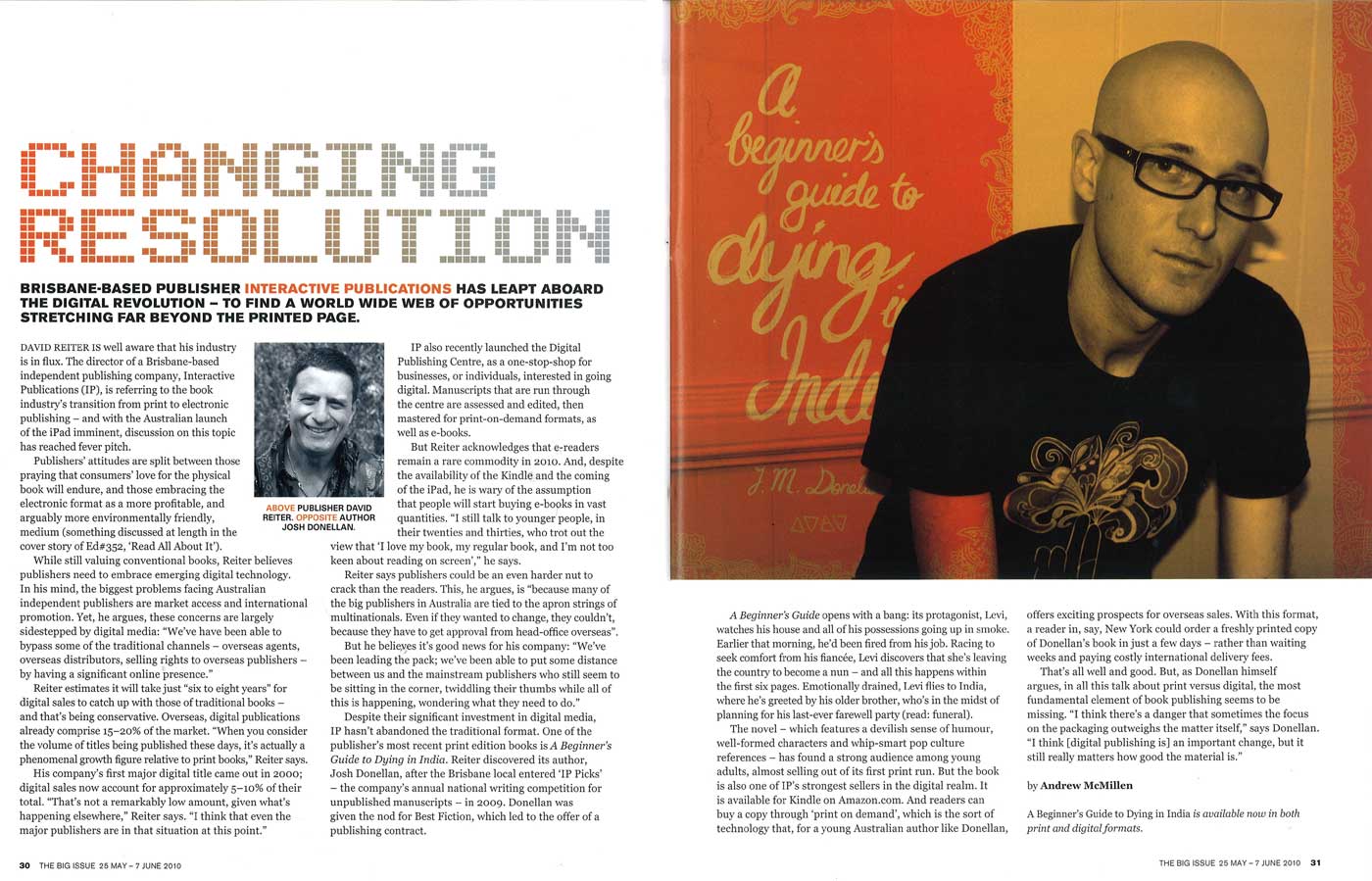
The Big Issue story: Changing Resolution

May 28th, 2010

A story for The Big Issue #355 about Brisbane-based publisher Interactive Publications and one of its young authors, Josh Donellan.

Click the below image for a closer look, or read the article text underneath.

The Big Issue story: 'Changing Resolution', featuring Interactive Publications and Josh Donellan

Changing Resolution

Brisbane-based publisher Interactive Publications has leapt aboard the digital revolution – to find a world wide web of opportunities stretching far beyond the printed page.

David Reiter is well aware that his industry is in flux. The director of a Brisbane-based independent publishing company, Interactive Publications (IP), is referring to the book industry’s transition from print to electronic publishing – and with the Australian launch of the iPad imminent, discussion on this topic has reached fever pitch.

Publishers’ attitudes are split between those praying that consumers’ love for the physical book will endure, and those embracing the electronic format as a more profitable, and arguably more environmentally friendly, medium. (Something covered at length in the cover story of our Ed#352, ‘Read All About It’.)

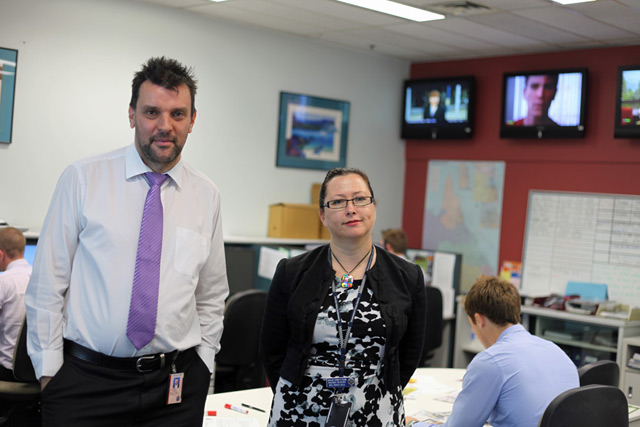
David Reiter of Interactive PublicationsWhile still valuing conventional books, Reiter [pictured right] believes publishers need to embrace emerging digital technology. In his mind, the biggest problems facing Australian independent publishers are market access and international promotion. Yet, he argues, these concerns are largely side-stepped through digital media. “We’ve have been able to bypass some of the traditional channels – overseas agents, overseas distributors, selling rights to overseas publishers – by having a significant online presence.”

Reiter estimates it will take just “six to eight years” for digital sales to catch up with those of traditional books – and that’s being conservative. Overseas, digital publications already comprise 15–20% of the market. “When you consider the volume of titles being published these days, it’s actually a phenomenal growth figure relative to print books,” Reiter says.

His company’s first major digital title came out in 2000; digital sales now account for approximately 5–10% of their total. “That’s not a remarkably low amount, given what’s happening elsewhere,” Reiter says. “I think that even the major publishers are in that situation at this point.”

IP also recently launched the Digital Publishing Centre, as a one-stop-shop for businesses, or individuals, interested in going digital. Manuscripts that are run through the centre are assessed and edited, then mastered for print-on-demand formats, as well as e-books.

But Reiter acknowledges that e-readers remain a rare commodity in 2010 – and, despite the availability of the Kindle and the coming of the iPad, he is wary of the assumption that people will start buying e-books in vast quantities. “I still talk to younger people, in their twenties and thirties, who trot out the view that ‘I love my book, my regular book and I’m not too keen about reading on screen’.”

And, Reiter says, publishers could be an even harder nut to crack than the readers. This, he argues, is “because many of the big publishers in Australia are tied to the apron strings of multinationals. Even if they wanted to change, they couldn’t, because they have to get approval from head-office overseas.”

But, he continues, “It’s good news for us because we’ve been leading the pack; we’ve been able to put some distance between us and the mainstream publishers who still seem to be sitting in the corner, twiddling their thumbs while all of this is happening, wondering what they need to do.”

Josh Donellan, author of A Beginner’s Guide to Dying in IndiaDespite their significant investment in digital media, IP haven’t abandoned the traditional format. One of the publisher’s most recent print edition books is A Beginner’s Guide to Dying in India. Reiter discovered its author, Josh Donellan [pictured left], after the Brisbane local entered IP Picks – the company’s annual national writing competition for unpublished manuscripts – in 2009. Donellan was given the nod for Best Fiction, which led to the offer of a publishing contract.
A Beginner’s Guide opens with a bang: its protagonist, Levi, watches his house and all of his possessions going up in smoke. Earlier that morning, he’d been fired from his job. Racing to seek comfort from his fiancée, Levi discovers that she’s leaving the country to become a nun – and all this happens within the first six pages. Emotionally drained, Levi flies to India, where he’s greeted by his older brother, who’s in the midst of planning for his last-ever farewell party (read: funeral).

The novel – which features a devilish sense of humour, well-formed characters and whip-smart pop culture references – has found a strong audience among young adults, almost selling out of its first print run. But the book is also one of IP’s strongest sellers in the digital realm. It is available for Kindle on Amazon.com. And readers can buy a copy through ‘print on demand’ – which is the sort of technology that, for a young Australian author like D0nellan, offers exciting prospects for overseas sales. With this format a reader in, say, New York could order a freshly printed copy of Donellan’s book in just a few days – rather than waiting weeks and paying costly international delivery fees.

The Big Issue, #355: Heroes and VillainsThat’s all well and good. But, as Donellan himself argues, in all this talk about print versus digital, the most fundamental element of book publishing seems to be missing. “I think there’s a danger that sometimes the focus on the packaging outweighs the matter itself,” says Donellan. “I think [digital publishing is] an important change, but it still really matters how good the material is.”

by Andrew McMillen

A Beginner’s Guide To Dying In India is available now – in print and digital formats.

Learn more about Interactive Publications at ipoz.biz, and click here to visit the homepage for Josh Donellan’s book, A Beginner’s Guide To Dying In India. I don’t read much fiction, but I enjoyed the hell out of this story and would recommend it to anyone.

A Conversation With Faux Pas, Melbourne electronic artist

April 28th, 2010

An interview that I’ve published at Waycooljnr.

Melbourne electronic artist Faux Pas a.k.a. Tim ShielLast week I wrote a feature article for Australian music website Mess+Noise about Faux Pas, a Melbourne-based electronic artist whose ‘digital DIY’ approach has intrigued me since Waycooljnr founder Nick Crocker pointed me in his direction.

I’ve since found Tim Shiel - the man behind the Faux Pas moniker, pictured right - to be a great example of an artist willing to invest time in developing his online presence. Besides using his computer to write and record his art, Shiel offers his music openly and honestly with bloggers, and allows fans to buy and share his material with minimal fuss. Below is the unedited interview that I used as the basis for my Mess+Noise feature ahead of the April 2010 release of his new album, Noiseworks.

Full interview with Tim at Waycooljnr.

Mess+Noise story: Faux Pas: Artist 2.0

April 23rd, 2010

An interview feature for Mess+Noise.

Melbourne electronic artist Faux Pas, a.k.a. Tim ShielFaux Pas: Artist 2.0

Operating under the Faux Pas moniker, Melbourne musician and broadcaster Tim Shiel’s success hasn’t been played out among Melbourne’s live music venues, but online, writes ANDREW MCMILLEN.

“I owe a lot of people a beer.”

This is how Tim Shiel, also known as Faux Pas, jokingly describes his career so far. Unconfined by spatial constraints, Shiel’s success as an independent solo artist hasn’t been played out in Melbourne’s live music venues, but online. The beer-owing remark was a response to his experiences with community radio, which he credits, along with the internet, with disseminating his music to Australia and beyond.

“I don’t play live shows, so radio airplay and internet exposure are really the two main ways in which my music gets spread out there. And the thing with community radio is – and I know this is obvious, but sometimes it bears repeating – in the majority of cases, it’s the individual presenters who make the call about whether they are going to put your stuff to air or not. So there are a lot of individuals who I’m heavily indebted to.”

Full story at Mess+Noise. Visit Bandcamp to listen to Faux Pas - I highly recommended his work.

I also used Tim’s perspective when ‘road testing’ online music service Guvera for Mess+Noise a few weeks back; read that story here.

Rolling Stone story outtake: A conversation with Gavin Parry, General Manager of Digital & Brand Development, Sony BMG

November 11th, 2009

Here’s an outtake from my first Rolling Stone story on streaming music subscriptions. It’s an interview with Sony BMG’s General Manager of Digital & Brand Development, Gavin Parry [pictured below right]. Sony launched the digital music outlet bandit.fm in late 2008. I spoke to Gavin on 25th August, 2009.

Andrew: As I understand it, Gavin, Bandit is currently a pay-per-download site, but in October, it’s being re-launched as a purely subscription-based site for streaming music. Is that correct?

Gavin Parry of Sony BMGNo, that’s not correct. I think what happened with the article in The Herald and everything sort of spiraled out of control and there was misreport after misreport. Essentially what’s happening is we’re continuing the download service, and a subscription service will run along side of it. You can either choose to download on a pay-per-download model, or you can choose to be involved in a streaming model, which is basically a monthly payment plan.

So it’s up to the consumer to consume music how they want, basically.

It’s all about trying to provide as many options as possible, remembering that we also provide all our videos free to the user, free video streaming. Every featured artist on the site, which is about 1,000 featured artists at the moment and that’s increasing, they have three tracks each that are free to the users for streaming. That’s there right now.

How long has the streaming service launch been in the works? I know Bandit was launched in November as a download service.

We’ve had it in place since November, when we organized all our licenses. It’s always been in our plans.

To my knowledge, all the major labels have music for sale in the store, but Sony is the ones running the site. Is that correct?

Correct - you have to be very clear here. What happened with The Herald article is it said we were running the service on behalf of the industry. That is incorrect. At Sony, we’ve set up Bandit and we own and operate it, but we have licensed any music from any other three majors.

And Sony is the main financial backer of Bandit.

Yes.

What do you think the benefits are of a streaming-based subscription model to the previous, per-download model?

Bandit.FM logoI just think it’s about options. There was a lot of feedback online about how people don’t stream music to the PC and people would never use it. If you look at The Music Network this week, they did an article in there that said 50% of kids stream music to their PC on a weekly basis. We know how popular Spotify is in the UK and Europe. There is no doubt that a streaming service, not just to the PC, but to any Wi-Fi device could be quite popular.

Conversely, what do you imagine some of the costs of a streaming-based site might be, such as high bandwidth and the necessity to allow many concurrent users?

The cost from our perspective or the cost to the consumer?

The cost from your perspective.

From our perspective, basically you have to employ someone like Akamai to cope with the volume. We currently employ Akamai. You are familiar with what Akamai is?

I haven’t heard of Akamai, no.

Rather than streaming from our servers, we basically employ a series of other computers, a network of computers that Akamai operate to take the load off of us so the streaming that occurs from a local PC - if you’re in Perth and you’re streaming from Bandit, you’ll be streaming from a computer in Perth rather than a computer from our hosting arrangement. This means the biggest cost to us is actually paying Akamai to be able to operate that high bandwidth.

There are also hosting costs, obviously to ingest and to hold - we’re up to about 70 Terabytes worth of data. The cost of hosting is pretty significant, as well.

Where do Australia’s internet service providers sit within this discussion? Are you concerned that Australia’s network might be ill prepared for this kind of streaming model, given that other territories have had faster connections and unlimited bandwidth, compared to Australia?

I think it will be fine. It just depends on what sort of plan you’re on. Obviously, cable will work fine; it depends on what plan you’re on with the ISPs. A lot of the bandwidth now should be able to cope with the streaming service.

I can imagine traveling throughout the city and falling into black spots with mobile phone coverage and having the song interrupted by buffering might be a bit annoying.

It’s the same thing you’ve got if you’re on a Wi-Fi network. You’re up to the vagaries of what the network might be. There are concerns but it will all be up to the consumer to ensure the bandwidth they’re paying for with their ISP is adequate to stream the music.

With Bandit, did you consider putting in place an advertising-based free service, as Spotify had done in the UK?

We essentially have got that in place with the video streaming, and with the ‘three free tracks’, which is a limited audio catalog. The problem you’ve got is the advertising model globally, when you actually look at Spotify and other services like iMeem and Last.fm, those services have really struggled to generate enough advertising revenue to continue to operate.

On a similar note, is Bandit’s launch time to beat Spotify to the Australian market?

Spotify logoNo, not really. To be honest, when we launched Bandit in November, Spotify was on the radar and probably has significantly upped its profile in the last twelve months. Bandit’s plan was always to have a subscription service operating around October/November of this year.

The other thing I should mention is there is another service that we’ll operate, and again, this is all about providing options to the consumer. We’ll be operating a model very similar to eMusic as well. People can sign up and pay a monthly fee and receive a certain value of downloads.

A certain value, what do you mean?

Are you familiar with the eMusic model?

No.

You pay a monthly fee, but you are given a certain value for that fee. You’re given a value; for say $20 a month you’ll get $30 dollars worth of value that you can download. It’s not about streaming. Again, it’s a regular payment plan, but it’s all about downloads.

Will this value package be launched at the same time in October, or is it currently available?

The plan is we’ll launch it at the same time as we launch the subscription package.

Are you able to provide some figures on Bandit since it launched in November, such as how many users or what is the volume of weekly downloads?

We’ve got a monthly net browsers now of around 80,000. We’re doing about 2 million page impressions per month. We’ve got over 50,000 active users that have actually purchased something. That’s probably enough to give you an idea. We’re quite happy where we’re at after only nine months being operational. We’re pretty much on plan, as far as where we expect the service to be. We’ve done very limited marketing so far.

I was looking around your website earlier, and I noticed that a lot of artists have unique content-rich splash pages, which includes images, artist’s recommendations, and news [example below left]. Who supplies the content that is displayed on those pages? Is it managed in house or is it syndicated?

Queens of the Stone Age on Sony's Bandit.fmWe’ve got our own editorial team that puts together news stories, and also looks after Bandit on Twitter and our Facebook page. We also have licensed in the All Music Guide.  When you’re looking at all the biographies and all of the similar artists and influenced by, that all comes from the All Music Guide.

What we’re trying to do is build a very deep, rich site that is more than just a download store. You can see how it’s been built by creatives. They’re very graphical and it’s a very appealing site. That shows with our average session duration which is around 15 minutes.

How many staff are working on Bandit full-time?

We’re still in development mode, so we’ve got a team of probably four developers. We’ve also got a person in customer service, editorial, operations, and also we have a programmer who deals with the other labels.

It’s still a pretty small team of around ten, would you say?

Yeah, which we’ll scale down once we’ve finished the development phase.

What inspired the decision to make Bandit operate within the browser as opposed to an external program, such as Nokia’s Music Store?

It’s really a matter of what you can support. If you build something within a browser - it’s really a phased approach. The first thing is once you build it within a browser, you know you’ve got a higher chance of compatibility with most computers. If you build an application, it’s much more work to get compatibility with all the various operating systems. It’s really initially a cost consideration, but having said that; we’re currently working on a download manager which is built using Adobe AIR. That’s basically an application that will sit above the site, which will manage the download process, and also manage your library. We have to roll that out in October, as well.

October is going to be a big month for you, then.

Yeah, the guys are flat-stick at the moment. We’ve got them down in the dungeon, working hard!

Final question - are Sony using the Australian Bandit Store as a kind of testing ground for potential expansion to foreign territories?

I think the focus is just making the Australian site a success, and then we’ll see where it goes from there.

Fair enough. That’s all my questions. Did you want to add anything else?

'Grunged' channel on Sony's bandit.fmThe other thing that we’ll be adding in October is a level of social networking, which will be quite interesting. In that case, the core part about Bandit is the channels. You can see different channels which split music be genre, by demographic. We put up the faith channel yesterday, which is all about Christian music. Coming in October, when we launch the social network piece, each user will not only have a user profile, but also will have his own channel. The idea is that a user can go on, select their own playlists, stream music, connect to other artist, connect to other channels, connect to other users, and in that way we’re actually giving people a lot more context. Their channel will be a representation of themselves, musically, online.

This idea of ‘channels’ kind of makes me think that you’re trying to build on the concept of the radio station, so everyone has their own channel.

To some degree, that’s it, the ability to essentially create your playlist. We think the subscription service also has quite relevance to families, and it’s not just focused on teenagers and young adults. I think the subscription model going to a family where they have unlimited music online, and they can basically just turn Bandit on to their stereo, set up their playlists, and play music in stereo, I think that is a big thing. In that case, they are actually setting up their own radio station.

Okay, thanks for your time, Gavin. I appreciate it.

No problem.

How I Pitched ‘For The Record’

November 1st, 2009

The Music Network logoIn June 2009, The Music Network published my first commissioned article. It was the first in a five-part series called ‘For The Record’, a retrospective feature on the album format and whether it’s still relevant. Start with part one here.

I recall spending a couple of hours on a May morning putting all of my thoughts and feelings on ‘the album’ down onto paper, and then transcribing it into a document and emailing it to the assistant editor. At the time, these articles (and the resultant commissions) were just about all I had going, so I threw myself at the opportunity completely.

It’s funny and a bit embarrassing for me to look back over this pitch, as it’s quite childish, incoherent and - as I’ve since learned - the exact opposite of what most editors look for in story pitches: brevity and clarity.

Below is how I initially pitched the article to the magazine for their ‘Digital View’ section (which later became ‘Digital & Media’ after their redesign).

The Music Network - Death Of The Album pitch (this is a placeholder title, btw)

This is a feature discussing the reduced importance that consumers place on the concept of the album, and how the music industry should largely adopt a new ‘organising principle’ in order to match consumer demand. I will be careful to qualify this by stating that release schedules should be re-examined on a per-artist basis, though, because the album still has some place; it’s just been marginalised.

The articles will use a consistent, measured tone that injects humour and attitude, but forgoes condescension. I’ll strive for objectivity here, though this is a topic that I could easily rant about subjectively. ;)

I envisage five parts, though it could go one less or more. This will become apparent once I start writing.

Precis:

I: A history of the album

  • Why does the album exist? Who imposed the 74-minute limitation?
  • Summarise the development of the format; Sony, Phillips, competing technologies, how it took a decade for the CD to supersede the LP
  • Album historically serves as the preferred way to contain profits and maintain both consumer interest and a release schedule. Containment and maintenance.
  • From LP to CD to digital; the medium has changed but the ‘organising principle‘ (the album - a term attributed to Gang Of Four’s Dave Allen) remains the same
  • The industry revolves around the album: release schedules, record deals, album reviews, pricing structure
  • Why is this a problem? Hint at changing consumer habits, and part II

II: What’s changed?

  • Objection: “I still listen to albums!” So do I. Because it’s still the most prevalent manner of distributing music.
  • It is important to understand this point: albums are still sold, whether digital or physical, but the widened choice afforded to consumers has resulted in a decreased attention span.
  • To illustrate: here’s a regular album. It’s front-loaded with some great songs, the ones that you heard before you bought it. Then you get to the second half of the album and, more than likely, it’s not as good. Think about all those times you’ve tried really hard to enjoy later tracks on album just so that you claim to honestly love it all. It’s hard work; I’d argue it’s an unnecessarily big ask on the listener.
  • It’s a complaint as old as the album itself: “A few of these tracks are awesome, but the rest are a waste of time.” Hi, MGMT.
  • Define consumer; who is buying music in which format? Different trends for different demographics
  • Discuss ‘killer versus filler’: Bob Lefsetz quotes here
  • No band deserves all of your attention, and it’s selfish of them to expect that from you. No band claims to be the best band in the world, except The Hives. So why do they tack noticeably sub-par songs onto the end of otherwise riveting albums? Because record labels are tied to the concept. Lead into part III.

III: What hasn’t changed?

  • The main point to reinforce here is the change in consumer (listener) habit. Technology and portability has severed our attachment to the album format. Provide anecdotal evidence of what the album (LP) used to represent; a social object that could only be played in the home, or at a dance hall.
  • Every notion you hold about albums - the great, the poor - are built upon a format created to streamline label profit
  • If our attention has splintered beyond the confines of the standard 12 tracks/45 minutes, why do new albums keep appearing on store shelves, both virtual and physical?
  • Quote iTunes facts here - single vs album sales
  • Point out the correlation between these facts; that is, a division between consumer habit and industry habit.
  • Visual analogy: picture listeners and labels as running on two parallel lines. While the latter ignores the changing habits of the former, the two shall never meet. Piracy and discontent will deepen the divide.
  • Major label profits have dived as a result of piracy, sure, but consider an alternative: that consumers are sick of spending $20 on a disc with only a couple of good songs. It’s easier to download the lot and listen to what you want, or to just pick and choose individual tracks.

IV: What needs to change in order to better serve consumer interest?

  • Marketing structures and strategies (thanks Jade!). Label-signed artists who are locked into multi-album deals have it tough.
  • These multi-album deals perpetuate the ‘few strong songs, mostly average songs’ trend to which we’ve become accustomed. To which we’ve responded with ignorance, piracy or pick-and-choose song downloads.
  • What we need is increased quality control on the label’s part. Work with artists to allow them to discover the medium with which they’re most comfortable releasing music, and then work with them to realise these goals.
  • Gone are the days of slapping a ‘one-format-fits-all’ tag on all artists, with the end-goal of album after album. There may be artists who still want to do that, absolutely. But to portray the album as the only marker of recorded success? This is a fallacy has been disproven.
  • It is vital that adequate pricing structures and business models are adopted for a variety of releases - single song, small collection of songs (EPs), live performances - to ensure that artists can live comfortably off their earnings. So that they may continue to make music.
  • This is an aspect that is often forgotten among the frequent discussion surrounding ‘the music industry’. All too often, we forget that the industry is built on the creative talents of songwriters, musicians and performers whose music engages. Music is an inherently social creation that is only becoming more social, as fans connect online and artist revenue streams continue their shift from recording-based to performance-based.
  • Discuss alternative business models; hint at part V

V: The future of a reduced reliance on the album as the organising principle

  • I imagine a steady stream of single tracks, with occasional EP and album releases. I think Bloc Party have done this recently?
  • Give examples of artists who have tried alternative release models + quotes
  • Give examples of artists who have successfully trialled new models. Avoid relying on big cases here (eg Radiohead, NIN); if this is to be believed, I’ll need to give more compelling examples than artist with millions-strong fanbases.
  • Reinforce why a reduced reliance on the album is not a bad thing. Our listening habits have changed, but we still feel an attachment to the album concept. Cognitive dissonance might be worth including here.. or that could just dilute my argument. Will see.
  • Reinforce the ‘digital’ aspect here, for this is The Digital View, damnit! Digital is the entire reason that the album has become a less pertinent format of music dissemination.
  • But - what of record stores, if a reduced reliance on albums (’records’)? There’s a discussion for another column, one that’s not necessarily attached to this five-part album discussion.

After the articles were approved - and I totally rejoiced, as this was the first time I’d written anything other than CD or live reviews for money - I ran the above pitch past my friend, David Carter, who lectures at the Queensland Conservatorium. His expertise on matters concerning the music industry are documented on his blog, Where To Now?

David’s comments in (an appropriately academic) red.

I: A history of the album

  • Why does the album exist? Who imposed the 74-minute limitation?
  • Summarise the development of the format; Sony, Phillips, competing technologies, how it took a decade for the CD to supersede the LP
  • Album historically serves as the preferred way to contain profits and maintain both consumer interest and a release schedule. Containment and maintenance. think you might be missing something here re production and distribution costs that need discussion up-front; what was the first album? why was the first album? these might be better ‘organising principles’ here - trace development of the album as a collection of singles to autonomous artwork - point out that the album-as-art had to do with innovative / creative use of the medium rather than an inherent element of the medium itself
  • From LP to CD to digital; the medium has changed but the ‘organising principle’ (the album - a term attributed to Gang Of Four’s Dave Allen) remains the same
  • The recorded music? industry revolves around the album: release schedules, record deals, album reviews, pricing structure ‘music’ industry has always included other revenue streams - side point but worth pointing out
  • Why is this a problem? Hint at changing consumer habits, and part II

II: What’s changed?

  • Objection: “I still listen to albums!” So do I. Because it’s still the most prevalent manner of distributing music perhaps a more important objection - ‘I still want to sell albums’?
  • It is important to understand this point: albums are still sold, whether digital or physical, but the widened choice afforded to consumers has resulted in a decreased attention span not so sure about this - Your assertion that ‘widened choice’ has resulted in ’shorter attention spans’ is problematic - I don’t think you can prove a causal relationship here and not sure if it’s really attention span you’re talking about or a lower tolerance for filler? I think you’re getting at changing methods of the consumption / reception of music thanks to advances in computing and telecommunication technologies and while this has resulted in wider access to certain types of content the key thing here for music listeners has been the ability to easily re-order and separate out albums. It’s not the ‘internet’ that has ‘killed’ the album but rather the ability for consumers to ‘roll their own’ albums. - one point I think you’re missing in terms of what’s changed is ‘technology’; particularly the iPod. It seems to be there in III but not explicit here? Another point to make is that online the cost of manufacturing and distribution approaches zero for both content creator and consumer and this has fundamentally changed the marketplace.
  • To illustrate: here’s a regular album. It’s front-loaded with some great songs, the ones that you heard before you bought it. Then you get to the second half of the album and, more than likely, it’s not as good. Think about all those times you’ve tried really hard to enjoy later tracks on album just so that you claim to honestly love it all. It’s hard work; I’d argue it’s an unnecessarily big ask on the listener.
  • It’s a complaint as old as the album itself: “A few of these tracks are awesome, but the rest are a waste of time.” Hi, MGMT. this has always been the case with pop music and why labels used to sell singles; need to think about / discuss why digital is different.
  • Define consumer; who is buying music in which format? Different trends for different demographics and also think about what / why they’re buying and what they end up doing with it. Maybe there’s an element of musical discovery in exploring ‘album tracks’ by Nick Drake or Dylan (for example) that grow your appreciation for their artistry; maybe you want the physical backup of a CD; if your iPod is your only music storage device what happens to those mp3’s you don’t want to listen to anymore?
  • Discuss ‘killer versus filler’: Bob Lefsetz quotes here
  • No band deserves all of your attention, and it’s selfish of them to expect that from you. No band claims to be the best band in the world, except The Hives. So why do they tack noticeably sub-par songs onto the end of otherwise riveting albums? Because record labels are tied to the concept. Lead into part III. or because they don’t think the tracks are sub-par; because they’ve bought into the notion that the format is art rather than product; because the drummer wrote the song and was complaining about not getting enough writing / royalty credits; etc. - there are a lot of reasons albums contain filler, some of which pertain to market expectations but not all. Don’t think you’ve made this point convincingly.

III: What hasn’t changed?

  • The main point to reinforce here is the change in consumer (listener) habit. Technology and portability has severed our attachment to the album format. Provide anecdotal evidence of what the album (LP) used to represent; a social object that could only be played in the home, or at a dance hall. think you can provide physical evidence here in terms of sales from the iTunes music store - overwhelmingly consumers are buying singles;
  • Every notion you hold about albums - the great, the poor - are built upon a format created to streamline label profit and a format that still must make monetary sense to the labels - even online; why? discuss.
  • If our attention has splintered beyond the confines of the standard 12 tracks/45 minutes, why do new albums keep appearing on store shelves, both virtual and physical?
  • Quote iTunes facts here - single vs album sales
  • Point out the correlation between these facts; that is, a division between consumer habit and industry habit.
  • Visual analogy: picture listeners and labels as running on two parallel lines. While the latter ignores the changing habits of the former, the two shall never meet. Piracy and discontent will deepen the divide. suggest you need to discuss / take into account that albums and bands still make money off physical discs - at present people are still buying CD’s, despite all the rhetoric; perhaps not so much that the labels are running parrallel to consumer sentiment but that they haven’t viewed digital downloads as a fundamentally different product?
  • Major label profits have dived as a result of piracy not sure if you should concede this point - have they dived because of piracy or because of a format / consumption shift? , sure, but consider an alternative: that consumers are sick of spending $20 on a disc with only a couple of good songs. It’s easier to download the lot and listen to what you want, or to just pick and choose individual tracks this is an old argument that I don’t think you need to embroil yourself in - this isn’t about copyright and piracy it’s about how (if) recorded music can be marketed and monetised.

IV: What needs to change in order to better serve consumer interest?

  • Marketing structures and strategies (thanks Jade!). Label-signed artists who are locked into multi-album deals have it tough.
  • These multi-album deals perpetuate the ‘few strong songs, mostly average songs’ trend why? ideally everyone involved wants an album worth of strong songs - what stops this happening? wonder if there’s something here to do with advances in technology / no development money allowing a lesser level of songwriter / composer access to an audience? to which we’ve become accustomed. To which we’ve responded with ignorance, piracy or pick-and-choose song downloads.
  • What we need is increased quality control on the label’s part. Work with artists to allow them to discover the medium with which they’re most comfortable releasing music, and then work with them to realise these goals.
  • Gone are the days of slapping a ‘one-format-fits-all’ tag on all artists, with the end-goal of album after album. There may be artists who still want to do that, absolutely. But to portray the album as the only marker of recorded success? This is a fallacy has been disproven. not sure this is what labels are doing though - again, they want to make the most money they can from a release in the context of a very unpredictable market; if they thought they could do this with singles they would; why haven’t they?
  • It is vital that adequate pricing structures and business models are adopted for a variety of releases - single song, small collection of songs (EPs), live performances - to ensure that artists can live comfortably off their earnings there’s a fallacy going around that artists used to live comfortably off their earnings from record sales - it’s not true - very few artists (particularly major label artists) made / make significant personal profit from album sales; the real money for artists is and has always been in royalties, touring and merchandising. There is such a small percentage of records that actually make anyone any money it’s ridiculous - why then have record companies and artists perpetuated such a seemingly flawed business model? So that they may continue to make music.
  • This is an aspect that is often forgotten among the frequent discussion surrounding ‘the music industry’. All too often, we forget that the industry is built on the creative talents of songwriters, musicians and performers whose music engages. Music is an inherently social creation that is only becoming more social, as fans connect online and artist revenue streams continue their shift from recording-based to performance-based think you need to address the differences between music as product vs music as service in here somewhere
  • Discuss alternative business models; hint at part V

V: The future of a reduced reliance on the album as the organising principle think you might want to review / throw out some of this and incorporate whatever’s left into part IV - particularly artist examples. Don’t think there’s enough new ideas here to warrant a fifth part.

  • I imagine a steady stream of single tracks, with occasional EP and album releases. I think Bloc Party have done this recently?
  • Give examples of artists who have tried alternative release models + quotes
  • Give examples of artists who have successfully trialled new models. Avoid relying on big cases here (eg Radiohead, NIN); if this is to be believed, I’ll need to give more compelling examples than artist with millions-strong fanbases.
  • Reinforce why a reduced reliance on the album is not a bad thing. Our listening habits have changed, but we still feel an attachment to the album concept. Cognitive dissonance might be worth including here.. nah - be honest; too many people out there already saying ‘this is the future’. not enough willing to say ‘I’m unsure / conflicted / fascinated’ or that could just dilute my argument. Will see.
  • Reinforce the ‘digital’ aspect here, for this is The Digital View, damnit! Digital is the entire reason that the album has become a less pertinent format of music dissemination.
  • But - what of record stores, if a reduced reliance on albums (’records’)? There’s a discussion for another column, one that’s not necessarily attached to this five-part album discussion.

Read the published articles here: part onepart twopart threepart four and part five.

Note how the latter half of the series totally deviated from the initial pitch, as - like David rightly pointed out - there weren’t enough new ideas to warrant needlessly dragging the feature out. So I decided to interview some musicians instead; always a reliable fallback for any stuck music journalist.