Sound Alliance. You mightn’t be familiar with the name, but most Australian web users will be aware of their music communities: inthemix, FasterLouder, and recently, Mess+Noise. The alliance was formed when Neil Ackland joined Libby Clark and Andre Lackmann, who launched dance music community inthemix out of a spare bedroom in 2000. They’ve since expanded to a team of 45. Their influence on the Australian web industry is huge, so when the opportunity to interview Neil arose, I jumped at it.
Andrew: Neil, you’ve obviously had a lot of experience with planning, goal setting, and so forth for the Sound Alliance. When planning a new venture, have you found it’s best to shoot for the top, as opposed to aiming for a less ambitious goal?
 Neil: I think it depends on how you value success, really, in terms of shooting for the top. I think we’ve taken a very long-term view to a lot of the ventures that we’ve launched. I think the game we’re in is not a make-a-quick-buck game, by any stretch of the imagination. I think our intent here is of running inthemix, for example, and sites like FasterLouder, and Mess+Noise, and [gay/lesbian community] SameSame require constant energy, nurture and investment – both in terms of time and money – to get them to continue to grow and to continue to flourish.
I don’t think we ever went into this thinking that it was going to be a massive success [when inthemix first began in 2000]. We just saw an opportunity in the market to do something a little bit interesting. We saw some gaps there, and fundamentally just believed that online was the way of the future for the way people were going to consume content. Whether that happened in a year or ten years, we were confident that was eventually going to be the way it was going to go.
Over the last couple of years, it’s started to really bear fruit. I think we’re an ambitious bunch and we obviously want each of our media properties to be the leading destination within that category. We didn’t come into it saying, “Let’s go global, and take in the world and become the next MySpace,” or whatever. It was always much more about providing a good solid base for Australian music fans, I suppose.
What were your goals with Sound Alliance for those first couple of years?
I’ll put it in context for you. Before we had Sound Alliance, inthemix [ITM] was the first business that we launched. It was set up as a hobby. We came together, the three partners here, and we’re all really passionate about dance music and electronic music, and we set it up as something that we do in or spare time, outside of our day jobs, and very humble beginnings.
We never really had any great aspirations of it becoming Sound Alliance, at that time. It was more a case of wanting to do something we were really passionate about. All of us had day jobs that didn’t really fulfill our entrepreneurial flair, our passions, or our interests. They were just day jobs. We wanted to do something a bit different outside of that.
It just flourished from there. The first couple of years were about were trying to establish enough of a business model around inthemix so that one day we could stop doing our day jobs and do it full-time. That was the first goal and the first dream that we wanted to achieve.
It must have been an amazing time, at the point where you could quit your day jobs and focus on inthemix and Sound Alliance as a business.
Yeah, I actually got fired from my job, so…
That was convenient!
[Laughs] It was actually the best thing that ever happened, to be honest with you. It was a good time. It was really exciting. I think whenever you’re launching a new business, you’re young, enthusiastic, and you are confident in your ideas and you want to go out there and have a go, it’s a really exciting time. I think that is what I love about setting up new businesses, that feeling of something new. I think ultimately, the three of us are all entrepreneurs at heart. We get a real buzz from seeing things, coming up with ideas, or working with other peoples’ ideas and taking them through to fruition.
I look back on that stage of my career very fondly, because at that time, the game was much more about something that you’re really passionate about. I was just bouncing out of bed in the morning, really enthused and excited about the day. Working all the hours, going out on the weekend and getting amongst it and really immersing myself and seeing, and enjoying something that was very fresh and new at the time.
inthemix was one of the first online communities in Australia that really had some momentum behind it. It was really exciting to be a part of that. You really felt like you were part of something bigger than just a business. It was much more than a business. It was a bit more of a movement, I suppose, at the time.
So from starting as a part-time hobby, and not really measuring your goals in any specific way, how has that changed since Sound Alliance has become a profitable business, of late, with its numerous ventures?
It’s changed a lot in a sense, but now there is a lot more responsibility. It’s far more professional and the scale of it has changed dramatically over those ten years. The same fundamentals exist; we’re still passionate about our product and our sites, and we’re really passionate about the subject matter: the music industry in general, and being a part of that.
I think that running a team of 45 staff is a big responsibility. I think our business skills have probably expanded and evolved over time, quite a lot. I think we’ve really been able to refine our business model and our business skills, and learn about quite a diverse range of areas within the music industry. It’s become a real business now, rather than just a hobby.
That’s good, because if you do the same thing for a long period of time, it has to constantly evolve and change, otherwise, you can’t stay engaged at the same level. I think for the three partners in this business, it feels like every year we’re almost taking on a new role and a new challenge. We’re constantly engaged, so it doesn’t feel like we’ve been in the same job for ten years because we haven’t; we’re always doing something new and fresh and interesting. It keeps us focused and really engaged with the business.
You and your Sound Alliance co-founders were recognised as ‘Creative Catalysts’ earlier in the year. Are you often approached by young people who view you as a source of creative inspiration, or was that a new experience for you?
We were really surprised by that. We were quite honored to be included in that list. I wouldn’t say that type of thing happens very often. I think we probably try to provide as much inspiration as possible to the people within our team: our staff, our contributors, our state editors and that type of thing, whenever we get an opportunity to speak to them face-to-face, or get some time with them. I think inspiration is really important.
We put a lot of effort into trying to nurture talent within our business. We’ve had a lot of staff who joined us as contributors. Tim Hardaker joined inthemix as a part-time writer when he became a contributor while he was at uni. He’s been with us for six years and is now the General Manager of inthemix. Those are the types of things that we are quite proud of, in terms of not just giving people inspiration, but giving them opportunities to succeed, as well.
In the early days of Sound Alliance, who were your sources of inspiration?

I was inspired by quite a few people in a lot of different areas, just generally people around me. I was quite inspired by different promoters and DJs. When I first came to Australia in ’98, I met quite a few different people around the Sydney scene. I found it really vibrant and really open and welcoming, versus what I’d experienced in the U.K.
There were some interesting inspirations. Jon Peters, who was the brainchild of kGrind, back in the day. He was a really interesting guy who had some really stretched thinking and really out-there ideas. He managed to get people to buy into his ideas and I found that really inspiring at the time; that the power of an idea could be enough to bring a whole group of people together behind something. That was quite inspiring. I was always inspired by people who had come from not much, but who had still been able to achieve a lot with a bit of street smarts and because they were passionate about what they did.
Did you have a mentor during that time?
I didn’t, actually. I’ve always relied heavily on my business partners, and them on me in return. I don’t think it would have been possible to do what we’ve done with just me running the business, or just the two of us. I think the “alliance” part of Sound Alliance is one of our key strengths.
There are so many facets of running a business and getting a business from where we were to where we are now. It’s not just beyond my own skill set, but just things I’m not passionate about that my other partners are, the technical or legal aspects or financial or accounting aspects of the business. All these different areas, I would look at any one entrepreneur who was able to launch a business on their own and try to do all those things and think that was pretty amazing, because the skill set required is really quite broad and quite vast. That’s why I always felt that I had support and a different skill set requirement amongst the three partners in the business.
We help each other through the tough times, and we share in each others’ successes.
Despite being the head of Australia’s largest independent online publisher, your personal online presence is reasonably subdued, in that you don’t tend to blow your own horn too often. Was this a conscious strategy from day one, or are you naturally modest?
I’m not crazy about being thrust into the limelight, it has to be said. I prefer to let the results and our products do the talking rather than me, always. In the last year or so, I’ve probably taken a bit more outward approach to getting our name out there. I’ve had some success around that, but I don’t know. There is so much to our business that is just about the team effort. I’m happy to fly the flag for the team, but I don’t really see it being something that’s about any one particular person.
You can see where I’m coming from though. Guys in their sales and advertising fields don’t tend to let their achievements speak for themselves too often. I respect that you’re pretty low key about your achievements. That’s really awesome.
I suppose I’m very aware of the tall poppy syndrome in Australia. I’ve seen a lot of people come and go, over the years, who have come out telling a big story and shouting from the rooftops about not a lot, in terms of actual delivery, or the reality of what they’ve got. I’ve always looked upon that type of thing with a bit of cynicism, and I just think it’s never really been our style. We’ve got a slightly different approach to the way we do things and that’s worked for us so far. We haven’t really felt the need to go shouting too much.
Is there a particular reason why you don’t share your business and motivational thoughts with the world, in the form of a blog, or is it just a matter of being time-poor?
It’s funny you say that. I am actually setting up a blog at the moment, which will be probably going live in the next few weeks. We’re going to combine blogs, so there will be a developers’ blog, which will be Andre [Lackmann] who is the CTO here. He and his development team want to share some of the work that they’ve been doing and invite input from other developers, around some of the social media tools. Myself, and Stig [Richards], who runs the agency [Thought By Them] here, will be updating our side of the blog, which will be coming at the music industry from amarketing/brands/advertising/digital kind of perspective.
A lot of it does come down to just being dedicated to something and being very time-poor. I’m interested in changing. I do read a lot of blogs and I follow some people whose opinion I really value. I think we’ve got some interesting stuff to share. I don’t think we’ll be updating it every day or anything, but I’m sure there will be some interesting tidbits coming through.
Definitely. I think you’d attract a significant audience if you guys told the story behind what’s going on with Sound Alliance and how you got there. That’d be a great story.
Cool, thanks for the feedback. Let me know what you think of the blog when it goes live.
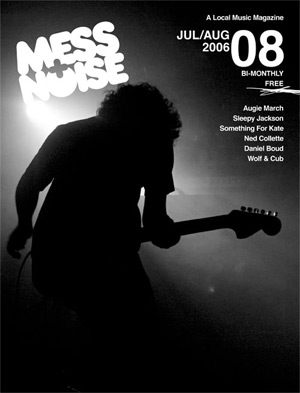
I will do. Personally, my connection to Sound Alliance began when I started writing for FasterLouder in June 2007. I now write for Mess+Noise [pictured below right, in magazine form], and I’ve always thought it was interesting that one of these sites pay its contributors, while the other doesn’t. What’s the difference between the two?
 When we were initially presented with the opportunity to acquire Mess+Noise, we were really interested in the community. We really loved what they’ve been able to create and recognized how unique it was, in the sense that it really didn’t take a lot of time and a lot of different factors to create success in terms of doing a community online. Those guys have achieved that really well.
One of the things we were really attracted to about Mess+Noise is that it had a real focus on allowing its writers to focus on quality, and not be constrained by either an advertorial approach to content or word limits, or the speed at which they had to respond. They very much did things their own way, at their own pace, and they said exactly what they wanted to say. We really respected that. I liked that about what they were doing.
I think FasterLouder, for us, is a great platform for writers, photographers, and creative people to start engaging with the live music scene. I think the way we would view Mess+Noise is that it was less about the immediacy of having the gig review and photos up a couple of days after the gig; it was much more timeless, and focused on quality over quantity.
We wanted to take a different approach with Mess+Noise and try to focus on that; really try to nurture some of the great professional writers and professional photographers who are out there, and bring them across to Mess+Noise to engage with the site.
Our reason, I suppose, is that a young writer could hone their skills, cut their teeth if you like, by contributing to FasterLouder, and eventually when they’re ready, they’ll be able to move up to start writing for Mess+Noise, and start to be paid for what they do. That’s the path we’re hoping we’re able to take young writers and young photographers on, and that they can see that we can nurture those skills, give them feedback, and pass them through that process to a point where they can hopefully become professional writers or professional photographers.
That’s really cool that you talk about it like that because I’d like to continue the discussion along those lines. I found my experience to be exactly what you said. Taking the time to contribute for free is wonderful and a great opportunity for people who are just starting out in web publishing; often the experience, the community feedback and the industry freebies are seen as a reward in themselves. But as you know, there comes a time when these free contributors decide to move onto paid work. I think the Australian street press has a similar staff turnover: writers learn the ropes and then tend to leave within a few years.

I think it’s really tough. It’s changed the dynamics and the economic structures of a whole range of things. The one thing I do think something like FasterLouder helps provide is an opportunity for feedback. It gives a great feedback loop and an opportunity for writers to see how many people have viewed their articles, and to get people to ‘heart’ and comment on it, discuss it. I think that is one of the great things that FasterLouder offers, in terms of being able to get some feedback on your writing.
You could put something out on a blog about a gig that you went to on the weekend, but the number of people who are likely to see it is quite limited. I think you get to expose your work to a broader range of people and the pressure is not as intense, and as high as it would be as if you were writing for a very critical, discerning audience on a site like Mess+Noise. The parameters are not quite as restrictive.
I think that’s really cool that you guys have kind of had that strategy from the start at FasterLouder, and then progressed on to Mess+Noise when the time was right.
I think we tried to adopt that approach even before we had Mess+Noise, in the sense that the heads of the talented and the really passionate always pop up above the crowd, and we try to bring them in. As I said before, we’ve got staff here who came through that contributor process, and have now come through to be full-time employees down the line, or just contributors being paid by Mess+Noise.
There are not millions of opportunities, but they do come up occasionally. Where possible, we always try to include the people who’ve worked with us over that time.
The people who are really outstanding do tend to rise above the crowd and receive more opportunities, so it’s kind of a natural selection process. That’s cool. Moving on; your LinkedIn profile states that you’re adept at establishing profitable business models from niche social media.
You’ve done your research!
How long did it take for inthemix to become profitable, broadly speaking?
Off the top of my head, I’m not entirely sure about inthemix. I think inthemix was probably more of a phenomenon than even we thought it was going to be. Our approach with what we did with our business was always to reinvest. inthemix, in isolation, had we just kept that company running as five or six people working on the business, it would be an extremely successful business, but what we’ve chosen to do is to build our company out, create Sound Alliance, and reinvest all that money back into building the business we have today.
I think in isolation, inthemix is still a fantastic company, business, and community; all of those things, and it continues to grow. Every time we think we’ve definitely reached our maximum audience at the site, it defies belief and keeps on going. That’s a really solid business model right there. I didn’t really answer your question, did I?
No, not specifically, but that’s okay. [Laughs] Has Sound Alliance ever sought venture capital funding?
Yes, we have. We’re one of the few Australian companies in our industry who have succeeded in getting venture capital funding. I know a lot of people who have tried and failed. The process is exhausting, and it’s a whole new world out there, I can tell you.
We managed to get a round of funding last year, and the partner is Albert Investments Group, which is a parent company of Albert Music, the publishing and recording business. They have music studios over in Neutral Bay; they’ve got AC/DC and Dallas Crane, and a few other acts. They’re a really great fit for us.
We’ve really seen eye-to-eye with them in terms of the cultural sphere of our business and the fact that they’re family-run. They’re one of the oldest music businesses in Australia, and they ended up being a really great partner. There were a lot of companies fishing around out there when we were entering that ‘boom’ period just before the financial crisis There were a lot of conversations going on. I don’t think there was a single online company worth its salt that hadn’t been approached by numerous people, at that time. It was just the way it was back then.

We’re very fortunate. We managed to take on a partner as a minority shareholder in the business, who shares our goals and our vision for what we’re trying to achieve. They are hugely supportive in getting us there, and have been able to provide a lot of value and not just in terms of capital investment, but in terms of the network they’ve been able to open us up to, their skills, and knowledge of the music industry have all been invaluable.
So you guys had pursued that for most of your time as Sound Alliance, but you only found a partner, just last year?
No, we’d only been out there looking for about nine months, or something like that. It wasn’t something that had been a priority prior to that.
Returning to yourself; do you have a daily routine?
Not really. If I had the choice, I would probably a lot more routine focused. My day is pretty irregular, in terms of what happens. I have a lot of regularly scheduled meetings that happen week in, week out but outside of that, I could be pulled in any number of directions, depending on what’s going on at any one time.
In a way, I kind of like that aspect of my role, in that it’s very dynamic and it requires me to use left brain/right brain, and switch on and off in different occasions and at different times. It’s what keeps it really challenging. No, I don’t have a massive routine in terms of the way I structure my day.
Has this changed since you started ten years ago?
I wouldn’t say I’ve always been a massive routine person, in terms of what I do. I will always try and dedicate some of my day to researching into keeping up with what’s going on out there. I don’t always do it at the same time every day, but I’ll always spend some of my day doing that whenever I can sneak it in; when I’m on a cab checking my phone, checking out news stories and blogs, or when I get home before I go to bed at night, or however I can squeeze those types of things in. I don’t say “At 9:00 in the morning, I’m going to do this for twenty minutes.” I’m a bit more sporadic than that.
Do you ever struggle with procrastination?
When I’m tired, yeah, but I tend to make quite quick decisions. I’ve learned over the years that you can’t dwell on things too long. You have to use your instinct and your gut to make a lot of your decisions, where when you’ve got time to procrastinate and pore over the details, that’s great, and sometimes I’ll do that. But generally, my instincts will tell me which way to go and I just don’t have the time to procrastinate.
So you don’t have any trouble remaining focused on the task at hand? You just devote the time necessary and then move on?
Yeah, I think I can get through quite a bit of stuff quite quickly. I can process a lot of things during the day and move through quite a few things in a short space of time. If I have to focus on something, I’ll go home and work from home. If I’m writing something really important or working on numbers or spreadsheets, I’ll put my headphones on or get out of the office and try to focus on it there.
Let’s talk about [Sound Alliance marketing consultancy arm] Thought By Them for a moment. Is it at the stage where companies and events come to you for consultancy or do you guys still submit proposals for these projects, like regular businesses?
 It’s a lot more people coming to us now. It used to be, in the early stages, us going out there and trying to tell people about what we’re doing. We’ve never really been out there in terms of pitching all the time, and trying to win big pitches. We have taken the approach that what we’re offering is quite a specialist thing and it doesn’t suit all brands; it only suits certain types of brands at some stage in their lifecycle. More often, they’ve kind of found us rather than us finding them.
With Thought By Them, we didn’t want to get too big, too fast. We try to focus on delivering really good value and really good ideas, and constantly innovating, rather than exploding and taking on too many clients. We’ve really focused on having one client in one brand category, rather than having a lot of different clients in the same category.
It’s been a really organic approach. I think that’s really suited us because we’ve been able to learn a lot during that time, and really hone our skills, like how unique our position is in the market.
How did the music licensing and CD production arm of Thought By Them come about?
We don’t do too much of that at the moment, to be honest. It was really more a case of just seeing opportunities for brands. We don’t tend to work within strict disciplines, in terms of our work arrangements and that type of thing. We tend to be quite fluid, and try and react as things are going on amongst consumers and provide our solutions right to that, rather than sticking within a mandate of just being a digital agency, or an events agency, or a music agency.
With music licensing, and that type of thing, if it’s the right solution for what one of our clients is looking to achieve, then we would recommend it. It’s not something that we roll out as part of any standard product offering.
I’m assuming that digital music distribution has affected the CD production aspect that you guys offer.
Yeah, but the CD production stuff is such a small part of what we do. We’ve only really done it a few times for specific clients when it’s been a requirement, but it’s not really a core part of what Thought By Them is doing.
You’re a few years older than me, so you knew a time before the web dominated our means of mass communication. Something that I’ve been doing more and more in the last year is reaching out to individuals who inspire or fascinate me, such as yourself. Do you have any tips for approaching these seemingly ultra-busy, really important figures?
[Laughs] I can only look back on the people who have approached me, and the ones that have had success in doing so. I’ve never shut the door on anybody or denied anybody my time, if they’ve been polite in the way they’ve approached me and I think I can assist them. If they’ve taken an interesting approach, then I’ll always give my time.
I’d be surprised if many other people who are in the industry would take a much different approach to that, but I’m sure some people do. Generally speaking, I think if people were reaching out, asking for information and advice, I’m more than happy to try and provide it, if I can squeeze in the time.
 With Nick Crocker [pictured right; Native Digital owner, and my mentor], for example, when he first got in touch with me, it was a matter of a mutual friend saying, “Hey, you should catch up with this person. It’s worthwhile meeting up with him,” as he came to me through Luke at Universal. There was never really an agenda. It was just an interesting guy worth catching up with, much the same way as he now passed your details along to me, and we’re talking today.
I think it’s good to really try to work on your network. You don’t always have to start by targeting somebody who is right at the top of your inspiration tree. You can find your way there by other means.
It’s best to just have a go. I think you’d be surprised; a lot of people have this misconception of “Oh my God, I could never just find that person’s email address, or contact them through LinkedIn or Twitter, and ask them if they fancy coffee.” There is no harm in trying. I think you might be surprised. I’ve probably had a couple of people approach me with an ulterior motive; maybe they were a recruiter or something like that and I might not have got back to them, but generally speaking, if I think it’s somebody who is doing it for the right reasons, I’ll always respond.
I’ve definitely found what you mentioned about being surprised about who will meet up with me. It’s an approach that Nick introduced to me this year, and I’ve definitely been blown away by the response, the respect and attention that I’ve received from some people I would have never thought would have given me the time of day. It’s pretty amazing.
There is this outward perception that the music industry is so unapproachable, and that all these people are up on a pedestal, but it’s not like that at all. I think they’re all just real people doing their thing, and one of the things that always attracted me to work in the music business is that I saw this bunch of people that had all come together of their own steam. Their own entrepreneurial tendencies and flare are at the core of what the music industry is all about. It’s a whole bunch of people who are really passionate and determined, and they really love what they do and really love the industry itself.
I’ve found it’s quite consuming and quite seductive to be so drawn into a space by that. That’s why if you’re talking about getting someone’s time, they’ve all been in that position before, so I think most of them recognize that and they’re happy to pass on any pearls of wisdom they might have, to do their bit.
Much as you have, today. Did you have any specific tactics that you used to connect with inspirational or motivational figures when Sound Alliance was starting up?
Not really. I would just try and make sure that I was very present. I think if you’re really passionate about working in the music industry, you have to walk the walk and talk the talk. You got to do your research, get out there, go to the gigs, go to the clubs, or whatever your particular genre interest is. Meet the people, network, and get amongst it. That’s how opportunities and many things arise. I think you’ve got to live the life and get amongst it if you really want to be taken seriously in getting into this space.
We’ve just been interviewing some staff this week. We invited some junior staff members to come back in and do a presentation to us on some ideas of how they would help promote some releases. The presentations yesterday were from this young guy and girl, and I was blown away by the amount of research they’d done, and how they seem to know our product. They’d gone into this great level of detail to understand what it was they were coming back with, even though they hadn’t really been given direction. Even though their ideas were slightly off in some areas, it was so impressive just to see people going to that level. I think that’s what it takes to get your foot in the door in this industry: you have to really stand out, and be really prepared to go the extra mile.
There are a lot of people who just think “Oh yeah, it’d be cool to work in music,” or cool to work in fashion, or whatever, but it’s not really the right reason to be involved in something.
My final question, Neil, I understand that Sound Alliance has a new web project on the horizon. Can you give me any hints on its focus?
We’ve got quite a few actually. I don’t know which one you’re talking about. [Laughs]
I can talk about a couple of things we’re doing. We’re re-launching inthemix towards the end of this year, though there’s no specific date set yet. It’s a fairly major sort of overhaul for inthemix, in terms of functionality, tools, the design, and what it offers.
I think it will send that whole community off onto the next level, in terms of their engagement with the site, what they can do with it, and what it can give them. That’s something really exciting, whether you’re a DJ, producer, or just a punter, we’re going to offer a lot of things on those levels that are going to enable them to connect to other people in the same space and really take the essence of what ITM’s strengths are and style them up a little bit more.
inthemix has been running on the same platform for about four years and we know it’s a little bit tired and dated; it’s not exactly Web 2.0. We’ve been honing a lot of those tools on our other sites and seeing how people use them and interact, and getting them ready to roll them out on the big beast [ITM]. That’s a pretty exciting project for us, pretty massive, and it brings to an end about a four-year development schedule.
We’ve basically been putting all of our sites onto one codebase, one unified codebase. It basically means you’ll be able to make a change or add a new piece of functionality and they’ll all simultaneously go across all the sites. It will just have a slightly different front-end design look and feel. It will mean we will be able to get new developments to the market quicker, cheaper, and much more effectively without reinventing the wheel every time. This is quite a big launch for us.
We’re also working on a whole heap of mobile stuff at the moment; we’re just about to launch a mobile site for Mess+Noise, to give that a try. We’ve launched mobile sites for inthemix forums, and we’re going to be rolling out a whole range of mobile stuff, possibly some apps, and a few things down the track, as well.
We have this other thing called Sound Alliance Labs which we just launched recently, where we’ve allocated a budget every year, and our staff can pitch their own ideas for development. We have a monthly meeting where they have to come in and pitch ideas, not necessarily revenue-generating, not necessarily great business ideas, but just things they’ve seen or things they think would complement what we’re doing. They can either pitch them to the management team either individually or as groups.
If we like their idea, we give them a budget and they can work on it outside of their hours. So if the developers come up with a great idea for an iPhone app or something like that, we give them a budget and pay them outside of their standard work hours to go away and develop it. We’re going to give an award for the best lab project every year, based on all the submissions that come through. We’re trying to maintain a focus on innovation and make sure that our staff have an opportunity to do all the things they’re really interested in outside of work, while bringing the benefit back to Sound Alliance, for the greater good of the overall company rather than going off and doing them on their own. We can just see a lot of our team working on some really exciting things, and we wanted to bring that within these walls, rather than see that innovation go off elsewhere. It’s things like that which are exciting and fun and challenging.
And it’s fascinating for an outsider. It’s been really interesting to hear you speak about your past, the present, and the future. It’s been great to speak with you, Neil, and I thank you for your time.
Cool, happy to share with you. I hope it’s been useful, and I look forward to seeing what’s ahead for you.
If you’d like to get in touch, Neil Ackland is on the emails and the Twitters. Coincidentally, Denise Shrivell of Digital Ministry published an excellent interview with Neil earlier this week that focuses on the business side of Sound Alliance. Take a look.

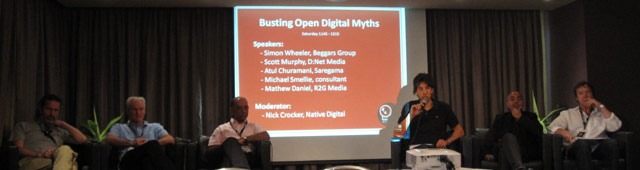
 The Beggars Group music blog strategy filters down to indie labels like Sydney’s
  Beyond Remote Control, EMI Music have maintained
  Australian indie label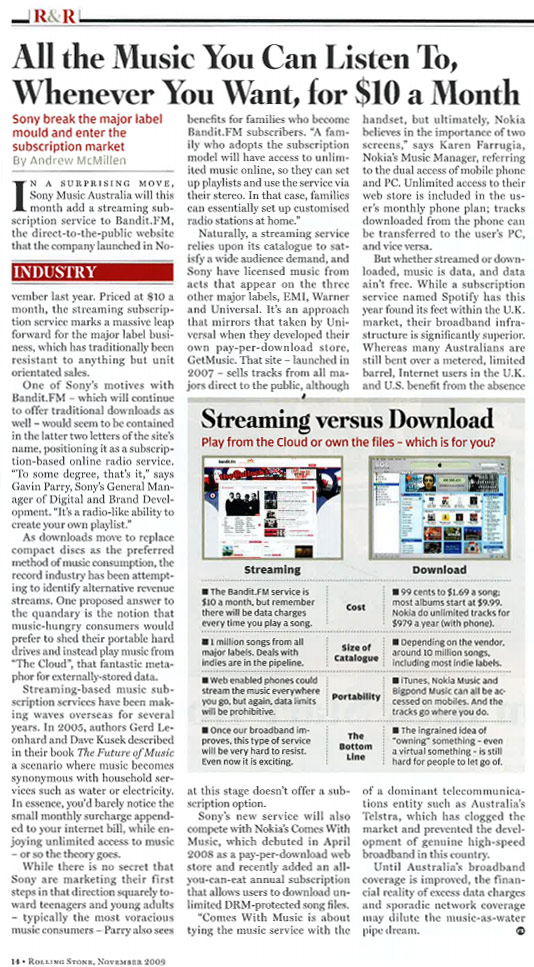
 It would be good to get perspective on it that wasn’t just from Sony – the main thing is this can’t be a PR piece for them. A non-Sony artist who will be for sale there is good, maybe a comment from someone at one of the other majors. Nokia also do a subscription of sorts, so maybe that’s something to consider…
 September 9-11, I attended
  I mean, the conference is nothing without its delegates. No shit, right? I’d read this beforehand and understood it at a basic level, but it really didn’t click for me until I was there among the masses that I realised – hey, any industry is built on the people who work within it. An event like Big Sound simply enables connections between people to happen at a more rapid rate.
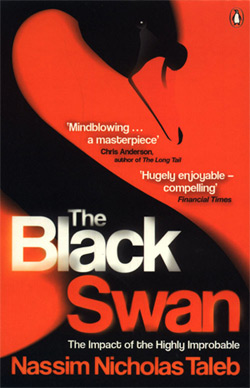 For the last couple months, I’ve been reading a book by
  I’ve been online for like 10 years, and I’m only just beginning to consciously pay attention to this stuff. Cumulative advantage dictates that the more time you spend online building meaningful relationships and contributing to the internet, the easier it’ll be to get what you want.