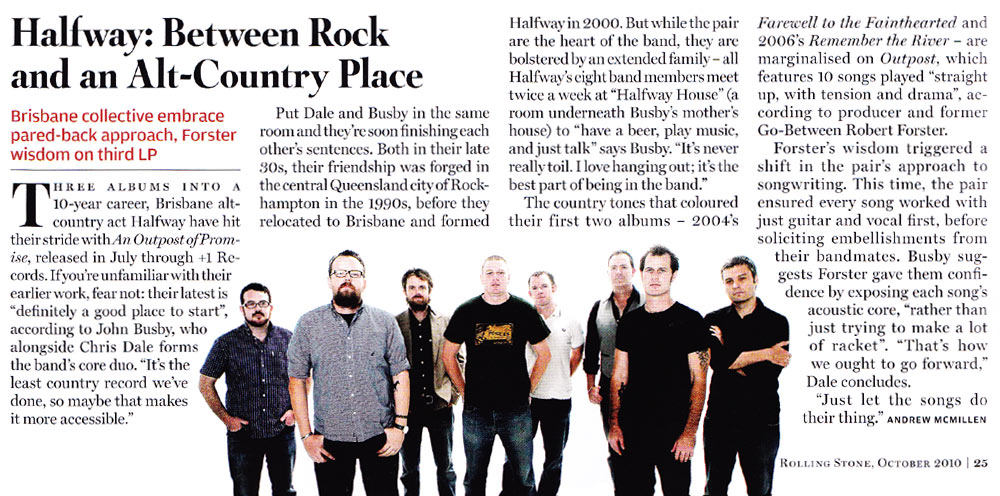
The Weekend Australian story: ‘Dirty Three’s divine trinity of sound’, March 2012
A story for The Weekend Australian’s Review section, published in the March 3-4 edition.
Dirty Three’s divine trinity of sound
by Andrew McMillen
In his 2009 book The 10 Rules of Rock and Roll, Australian singer-songwriter Robert Forster wrote that “the three-piece band is the purest form of rock and roll expression”. The author had American band Nirvana in mind when he penned that line but admits instrumental trio Dirty Three fits “the whole theory and idea perfectly”.
Brandishing an unconventional guitar-drums-violin configuration, Dirty Three formed in Melbourne in 1992 and has celebrated its 20th anniversary by releasing its eighth album, Toward the Low Sun. Forster, co-founder of Brisbane pop giants the Go-Betweens, describes the band’s unique musical style as “the magic of a chemical explosion”, and notes “they come from the time of grunge. They existed when Nirvana existed; another three-piece who were chaotic, mad and intense on stage. You can probably still see a bit of that in them.”
Dirty Three’s catalogue evokes by turns deep melancholia – due largely to Warren Ellis’s emotive violin strokes – and sublime euphoria when the three members lock into a rhythmic pulse that is, oddly, reliant more on guitarist Mick Turner than drummer Jim White. Bobby Gillespie of Scottish rock band Primal Scream has referred to Turner’s idiosyncratic playing as “the way that stars are spaced out in the sky”, while White is more interested in exploring experimental percussive techniques than holding down anything resembling a standard rock drumbeat.
Yet viewing Dirty Three through the lens of rock – or, for that matter, jazz or folk – is wrong. And although the band lacks a vocalist, it doesn’t sit comfortably with what’s typically understood as instrumental music, either. “Normally people who do instrumental music can be quite dry and sedate, whereas Dirty Three put on a show,” Forster says. “They have an aesthetic of something like ‘minimal’, or instrumental music, but they have a rock ‘n’ roll attitude. It’s almost like there was an invisible lead singer there. That was part of their appeal, besides the fact that they have very good melodies, and that there was something charismatic about the band.”
The group’s absence of vocals has affected the course of contemporary Australian music in strange ways.
Gareth Liddiard says Dirty Three has been “a huge influence on what I do lyrically” with Melbourne band The Drones, of which he is lead singer, as well as his solo material. “They made me realise that if you’re going to have words, they need a f. . king good excuse to be there in the first place. They better be good, otherwise why bother?”
Liddiard says Dirty Three’s music “sounds like someone pushed a drum kit down the stairs and plugged a violin into a f. . kin’ Marshall [amplifier]”. He follows this stark assessment with the highest compliment: “For my money, they’re the best band from this country, ever.”
Before the band’s formation, all three members had spent years playing in various rock groups. “It seemed like there was this healthy live scene starting in Melbourne,” Ellis says of the early 1990s. “There was a lot of venues to play in, a lot of opportunities to get out and play in front of people. The live scene provided a livelihood for a lot of people. Bands were really trying to confront and challenge you, and there was this great crowd of people going along to check it out each week.”
Ellis puts the band’s irregular musical components down to a desire to be different. “When we started off, we really wanted to challenge people’s conceptions and also to go against the mainstream,” he says. “There’s something great about feeling like you’re out there, flying your own flag. There is something really empowering about it.”
The story behind the trio’s debut gig is emblematic of the hunger for original live music in Melbourne at the time. Ellis had a friend who owned a bar called the Baker’s Arms; he told the violinist that he wanted background music but didn’t want to play CDs. Ellis asked White to play drums; he, in turn, asked Turner to play guitar. On a Friday afternoon, hours ahead of the band’s first performance, the trio rehearsed some ideas in Ellis’s kitchen, then played them that night.
“We had to play for three hours, so we made the songs really long,” Ellis says. This ideology is occasionally reflected in the length of the band’s recordings, too: ‘Deep Waters’, from the 1998 album Ocean Songs, runs for 16 minutes. Ellis’s pal enjoyed the performance, paid them $50 apiece and asked them to come back the next week. To three young men trying to support themselves as working musicians, this was a great deal. “We’d go down and play every Friday night, and get out of our brains,” Ellis says. “Our mates would come along; it was just this great Friday night where nobody had to clean up the mess after.”
Two decades later, the trio commands a worldwide following and the kind of deep respect among the Australian music community that has been afforded to few acts. All three attribute the band’s longevity to the fact they rarely meet face to face: Turner lives in Melbourne, Ellis calls Paris home, and White splits his time between Brooklyn, Detroit and Australia.
A week or two before its national tour in March to celebrate the release of Toward the Low Sun, the band will convene in the Victorian capital for rehearsals and simply to catch up. “We usually sit around talking for a few hours talking, just because we haven’t seen each other for so long,” Turner says. “We don’t necessarily talk about music; just about life, our friends, our families.”
The guitarist believes this close friendship is another reason they have lasted the distance. “We’ve all got a high regard for each other,” Turner says. “If you lose respect for your bandmates, that’s when it’s going to fall apart, I think.” Ellis agrees. “We’ve always treated each other as equal in the musical sense, and in terms of the group’s profile. We share all the songwriting, and royalties equally,” he says.
“Nobody’s seen as contributing more or less. We’re a group, in the purest sense.” The trio are in regular contact via phone and email; a necessity, given that they split band management duties three ways.
“We did that a long time ago,” White says. They were once managed by Rayner Jesson, who also handled Nick Cave and the Bad Seeds, but that relationship ended a few years before Jesson’s death in 2007. “It ebbs and flows over the years in terms of how engaged we are,” says the drummer, who handles their tour bookings. Last year the band played just two shows together: a festival slot at All Tomorrow’s Parties in Tokyo and a benefit concert in January for 3RRR announcer Stephen Walker (to raise money for the legendary broadcaster’s multiple sclerosis treatment) at the Forum in Melbourne, featuring Cave on keyboard.
Turner admits the lack of a single decision-maker can be problematic. “If a question comes up, it’s got to be fielded around, so it takes a while to be answered,” he says. “One of us might be on tour, and it’s hard to get down and do your email when you’re in the middle of travelling.”
The three men occupy themselves with other creative outlets during the band’s downtime. White regularly tours and records with other bands: last year he toured with Australian folk-pop trio Seeker Lover Keeper, and the week after we spoke he was scheduled to play shows in Helsinki, Geneva, Istanbul and Tel Aviv with American singer-songwriter Cat Power (real name Chan Marshall) who is one of only two vocalists to have lent their voices to Dirty Three songs. The other singer is Sally Timms, of British rock act The Mekons; both contributions appeared on the trio’s previous release, 2005’s Cinder.
Ellis has been a member of Nick Cave and the Bad Seeds since 1995; he plays electric mandolin and guitar in the band. With Cave, he has scored several films, including The Assassination of Jesse James by the Coward Robert Ford, The Road and Australian film The Proposition, directed by John Hillcoat, which won the pair an AFI award for best original music score in 2005. He also played in Cave’s other rock band, Grinderman, which announced a hiatus at the Meredith Music Festival last December after releasing two albums together.
Turner splits his focus 50-50 between art and music. His distinctive paintings have appeared on the cover of all of the band’s albums besides its 1995 debut, Sad & Dangerous. His work has been exhibited at galleries across the world and he plans to release a fourth solo album later this year. The guitarist recently attended his primary school reunion, and was amused to discover not one of his former Black Rock State School classmates had heard of his 20-year-old band; unsurprising, perhaps, given that the trio’s sound exists on the periphery of contemporary Australian music tastes.
Ellis’s Bad Seeds bandmate, Ed Kuepper, calls Dirty Three’s output “a form of pure expression”. According to Kuepper – who co-founded Brisbane punk rock group the Saints and whom Turner considers “one of my only guitar hero figures” – the band consists of “three very recognisable, distinct musicians and they don’t get in each others’ way. They probably become even stronger together. It’s a rare thing.
“It’s a really unusual thing that they do in terms of Australian music; the approach to the way they play, and the non-standard rhythm [section],” Kuepper says.
“Very few people do that. Even fewer have any sort of success because in some way it’s quite an esoteric thing that sits outside of the kind that seems to get lauded in Australia, which is generally a lot more mainstream and musically conventional.”
Since Toward the Low Sun is an extension of the band’s remarkably consistent canon, rather than a stylistic reinvention, it’s unlikely Dirty Three’s eighth album will set the ARIA charts alight on release. The nine theatre shows the band has booked in March, though, are likely to sell out, if its previous national trek two years ago – billed as a performance of the 1998 LP Ocean Songs in full – is to be used as a benchmark of popularity on the live circuit.
The new album had a particularly long gestation period: the band recorded for six days in February 2010, then didn’t review the recordings for more than a year. It did some additional recording in March last year. An American producer based in Melbourne, Casey Rice, captured the first session at Head Gap Studio in Preston: he worked with the band on its last release, Cinder, too.
“They’re very focused,” Rice says of Dirty Three’s work ethic in the studio. “A lot of time it’s not just a matter of trying to get it right in a performative sense; it’s more of a feel thing.” The band will play a song slowly, then speed it up for the next take; it will try a song played softly, and then louder; White will work the kit with his drumsticks, then try his brushes for a softer percussive tone.
“The basis of everything is tracked live,” Rice says. “If there’s more than an electric violin, guitar, and drums on a song, then it’s been added as an overdub. So the bass, extra strings, mellotron, and nylon stringed guitar were overdubbed. But the process remained the same for Toward the Low Sun: they set up, and played it down. That’s what works about Dirty Three; that’s where the magic comes from.”
There’s that word again, the one Forster used: magic. A distinct sense of the otherworldly encompasses everything the trio does. Yet it’s not exactly the most accessible sound in the world, and there are few points of reference for unfamiliar listeners to latch on to. Liddiard recounts an anecdote that highlights the band’s divisive nature.
“I’ve seen Dirty Three 40,000 times,” says Liddiard, exaggerating only slightly. “I remember standing behind two dudes at one of their gigs; it could have been in Sydney, or Perth. One guy’s like, ‘This sounds like cat shit, let’s go.’ The other guy just looks at him, incredulous. Like: ‘What the f. . k? Can you not hear that?’ That really sums them up. Some people just don’t get it. And if they don’t get it, there’s something wrong with them, I find.”
Dirty Three‘s tour starts in Perth on Friday, then WOMADelaide, Adelaide, March 10; Port Macquarie, March 12; Melbourne, March 16; One Perfect Day Festival, Gippsland, March 17; Castlemaine, March 18; Sydney, March 21; Brisbane, March 22; Lismore, March 23.
Toward the Low Sun is out on Remote Control Records.
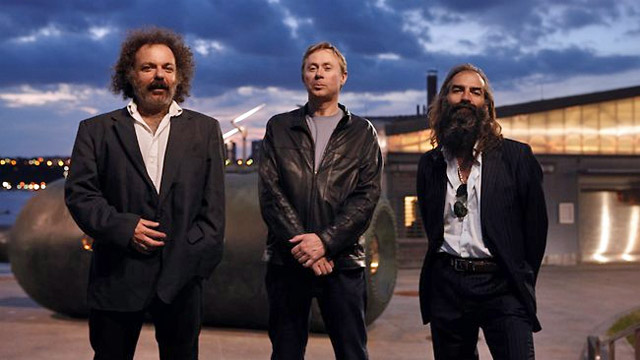
This story was originally published in The Australian; view online version here. For more Dirty Three, visit their website.
 I think it was the opposite of one of those moments. I think of a Fight Club Moment as something that breaks you down and demolishes the pretense and bullshit entitlement you have in your life. This wasn’t that. It instilled a lot of confidence in me. It was like, “ok, I am better than I knew. That’s awesome, maybe I can build on this.”
 Yeah, I’d heard of the books obviously but I think Tucker recommended
 Fucking breathe. It’s not as precarious as you think it is. There’s no need to be anxious. See, it’s really easy when you’re that young and you don’t have a safety net to think you have to cling to everything for dear life, everything is a crisis, everything is mission critical, nothing else can be the priority.