The Vine: Top Things of 2010 – TheVine Critics Poll
A list of my ten favourite music-related things of 2010, for The Vine.
Andrew McMillen: The 7 Best Songs and 3 Best Gigs of 2010
Songs:
Big Boi - ‘Shutterbugg’ (feat. Cutty)
Precis: Impossibly addictive; the single standout track from an album full of ‘em.From the album Sir Luscious Left Foot: The Son Of Chico Dusty, reviewed in July for The Vine: “Built around a compact backbeat and unique usage of the talkbox, Boi’s chorus hook in ‘Shutterbugg’ – “Now party people in the club, it’s time to cut a rug / And throw your deuce up in the sky just for the shutterbuggs” – is irresistible. It’s one of the best singles of the 2010, regardless of genre.” (Link)
Crystal Castles – ‘Baptism’
Precis: A gripping vision of an electronic apocalypse.From the album Crystal Castles II, reviewed in May for The Vine: “‘Baptism’ is the best thing they’ve ever written, surpassing Crystal Castles I standout ‘Air Wars’ by a considerable margin. On ‘Baptism’, they do everything right. Sheets of urgent synthesisers give way to a dainty, circular keyboard melody pasted over a pulsating beat, before Alice Glass’s pained vocals are met by the synthesised opening phrase cut into staccato triplets. ‘Baptism’ concocts an air of foreboding unlike anything they’ve summoned before.” (Link)
Foals - ‘Spanish Sahara’
Precis: Slow-burning pop songwriting perfection.From the album Total Life Forever, reviewed in May for The Vine: “‘Spanish Sahara’ sits in the album’s centre; in turn, it forms the beating heart of Foals’ revised artistic direction. In stark contrast to their previously-accessible singles, the epic song’s payoff occurs over halfway into its seven-minutes. Singer Yannis Philippakis urges listeners – and himself, perhaps – to “Forget the horror here / Leave it all down, here / It’s future rust, and then it’s future dust”, as the song slowly builds upon a sparse introduction to climax amid an ethereal lead guitar melody, thundering tom rolls and, ultimately, a somber, circular synth pattern. As an artistic statement, ‘Spanish Sahara’ is peerless among indie pop circa 2010. (Link)
Surf City - ‘Icy Lakes’
Precis: The definitive noise pop track of 2010.(Listen)
From the album Kudos, reviewed in November for Mess+Noise: “It’s a saccharine rave so wide-eyed and beautiful that you wish it to never end. While the rhythm section stays pinned to a groove, the guitarists shear off great chunks of the surrounding landscape with abrasive, Jesus & Mary Chain-like chords. Needling lead phrases punctuate each section, while the singer says “When your icy lakes swallow me” in the chorus over and over (or so I imagine; it’s pretty hard to tell through all the reverb). The result is a song more deserving of that idiotically-overused descriptor “widescreen” than any song that came before it. The best part is that the band is acutely aware of the rare musical alchemy they’ve tapped into, and opt to extend the jam to nearly eight gorgeous minutes.” (Link)
My Disco - ‘A Turreted Berg’
Precis: Musically ominous; lyrically, even darker.From the album Little Joy, reviewed in November for Rolling Stone: “Album closer ‘A Turreted Berg’ – characterised by a subterranean bass hum, a simple backbeat and screaming guitar squalls – is the single best song they’ve released. ” (Link)
Die! Die! Die! – ‘Frame’
Precis: Frantic, emotive, timeless.From the album Form, reviewed in August for The Vine: “Closing track ‘Frame’ proves the singular highlight. It might be the most satisfying, most perfect song that Die! Die! Die! have ever released. Its sparse verses shiver in anticipation of the release offered by the towering chorus (“Give up the ghost, you can’t escape / We’re too close; I am here now”). ‘Frame’ is a masterpiece in three-point-five minutes.” (Link)
Tokyo Police Club – ‘Bambi’
Precis: Clipped electronica and sharp drums, intercut with a killer pop chorus.If you asked me to pick a song released in 2010 that best evokes ‘joy’, this would be my first choice. It remains as exciting in December as when I first heard it in August. You should play it five times in a row, at least.
Gigs:
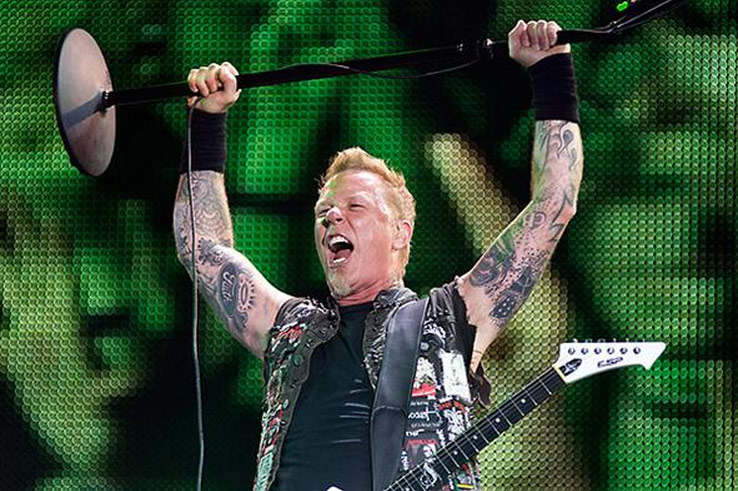
Metallica – Brisbane Entertainment Centre, Saturday 16 October (review)
“For the first hour, it’s exciting enough just to be in the same room as Metallica. Metal bands don’t come bigger than these four men, and since it’s been six years between visits, there’s electricity in the air. From the moment the lights dim and their introduction music – ‘The Ecstasy Of Gold’, the theme from The Good, The Bad and The Ugly – plays, we’re transported. We forget we’re in a big, shitty shed 20 clicks from the city centre. This show is about spectacle, and nothing’s done by half. It’s something special to witness a band who still sound fresh in a stadium despite having been in the game for nearly 30 years, and having punched in this weight division for more than half of that. This is their norm. By their standards, playing to 13,000-odd fans probably qualifies as an intimate show.
As they rip through the climactic vocal section of ‘One’ with blistering intensity (“Landmine! Has taken my sight! Taken my speech! Taken my hearing!”), I realise what a rare talent they have, to make some these tired-ass songs sound fresh. And then they follow up ‘One’ with ‘Master Of Puppets’, one of the greatest metal songs ever. There’s no-one not grinning, headbanging or fist-pumping. For some artists, reminiscence is a dirty word. Not so for Metallica, who dip deep into their back catalogue tonight, all the way back to their 1983 debut Kill ‘Em All. The house lights are requested for their finale, ‘Seek & Destroy’, during which dozens of Metallica-branded beach balls are dropped from the ceiling and punted around by both band and fans, and by this point, I can’t stop grinning. I’m not alone.”
Massive Attack – Brisbane Riverstage, Tuesday 23 March (review)“They wield a back catalogue that makes lesser artists tremble, and they’re not afraid to use it. British trip-hop production duo Massive Attack close out their first Australian tour since 2003 with a commanding performance at the Brisbane Riverstage that delivers on all fronts: sonically, visually, and emotionally. Speaking to The Vine (link) on the eve of their Perth show nearly two weeks ago, Grant Marshall – a.k.a. Daddy G, who forms half of the core duo alongside Robert del Naja (3D) – spoke of how he’s learned that “you’ve got to give people something that’s quite memorable”. Check that box. Take a song like ‘Teardrop’. It’s that rare kind of musical composition whose impact is felt across generations, gender and race. Tonight, it’s performed by longtime Massive Attack collaborator Martina Topley-Bird, whose talented, vocal loop-heavy support slot proved a fascinating precursor to the main act. Their most distinguished tune has been reworked into an arrangement comprising little more than a backbeat and her beautiful voice that sings of love, loss and hope. It’s a touching moment for the thousands stood in silence, and as the song climaxes, I decide that it reaches a summit of human expression through music that few others can lay claim to.”
Faith No More – Soundwave Festival @ RNA Showgrounds Brisbane, Saturday 20 February (review)“Immaculately dressed in pale suits, Faith No More immediately establish rapport with the tens of thousands who crowd the main showground bowl to witness the reunited headliners after their 12 year absence. Opening with a full-band lounge version of ‘Reunited’ by vocal duo Peaches & Herb, it’s made immediately clear that their ‘Second Coming’ tour is no half-baked cash-grab; instead, the band are serious about doing justice to what was left behind in 1998. Serious, that is, while maintaining the playful, casual air for which they became known. (During set closer ‘Just A Man’, Mike Patton hijacks a video camera and – mid-song, without dropping a note – forces the operator to film his cock, which briefly appears on the giant screens that flank the main stages – video of the incident.) Any doubts about their reformation were squashed the moment the suits walked onstage.”
To see the rest of the critics’ choices, visit The Vine.
Elsewhere: my 10 favourite Australian albums and five favourite Australian songs of 2010, for Mess+Noise.
For The Record: An Album Retrospective Part 5
In the final piece of a five-part puzzle, Andrew McMillen examines the digitally-inspired shift in consumer habits away from the long-established album format. After speaking to passionate Australian artists like Hungry Kids Of Hungary, Urthboy and Eleventh He Reaches London last week, Andrew verbally prods two innovative Brisbane-based acts who have turned the album-release expectation on its head.
Were this album-centric article series an actual album, we’d have since bypassed the hit singles, the forgettable middle filler, and the surprising experimental freak-outs. This’d be track twelve; the last gasp that’s strategically-placed to reward the attentive hard-core of fans. Luckily, reader, track twelve is this metaphorical album’s hidden gem: it describes two Queensland acts who’re subverting the traditional cycle in favour of a flexibility that benefits both artist and fan. Press play and get comfortable, won’t you?
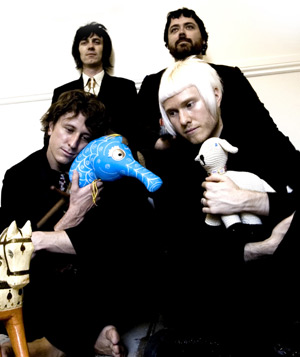
Brisbane natives Drawn From Bees [pictured right] are riding a healthy buzz following their recent national tour and more than a few nods of approval from Triple J. The art-rock four-piece have self-imposed an interesting alternative release strategy: a new record every six months. Explains bassist Stew Riddle: “Over a few drinks after our first rehearsal last year, we decided to use the fact that we’re a band of four songwriters to our advantage, and aim for a prolific introduction to the band. We felt that it would be interesting to break from the new-band cycle of ‘release an EP, tour for 6-12 months, release another EP’, and instead try to put something out every six months.” But the Bees are in a unique situation that encourages frequent releases; Riddle admits: “Dan, our singer, is also a producer, so we can afford to record very cheaply. If we had to hire studio and producer time, it might be a very different story.”
Two EPs into their two-year experiment, Riddle contemplates the band’s feeling toward the album format: “I tend not to think about what we’re doing in terms of working towards an album, as to me, the length is largely irrelevant. I feel that each record needs to make a statement, and to be a snapshot of where the band is at that particular time. Our third release is looking to be an 8 or 9 track record that has a more melancholy flavour. Is it an album or an EP? We don’t know, so we’ll just call it a record and let other people decide!”
When asked where he thinks the album format belongs in the future of music, Riddle is sceptical. “It’s a hard one to judge. It seems that while the physical single is dead, the digital single is now king. No one buys albums anymore, but if you look on my friends’ mp3 player, they tend to collect not just full records, but full catalogues of acts that they love. I think that the album will live on. Certainly, at least in the sense of releasing bodies of music that make various statements at different points in an act’s career. Does it mean that the length of an album will remain between 30 and 70 minutes? Maybe not. Musicians aren’t constrained by the format anymore; vinyl and plastic don’t dictate the length.” With a fourth release due around Christmas to bring the four-EP commitment to a close, what’s next for Drawn From Bees? “We’ll probably do an album. Or a greatest hits box collection, who knows?” laughs Riddle.
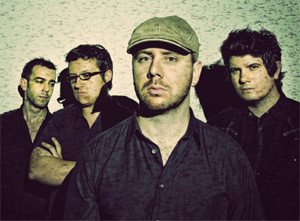
From a regular-release ideal to a staggered album: meet Brisbane indie rock band 26 [pictured below left], who’re midway through an ambitious project to release a twelve-track album in three-song installments every three months. After releasing two albums in the standard manner since their 2005 debut The King Must Die, singer/guitarist Nick O’Donnell explains the genesis of the concept dubbed 26×365: “We don’t sell all that many hard copies anymore, so we decided to release the next album in small portions. We were finding that people were buying singular songs rather than the whole albums off of iTunes.”
Each of the four parts to 26×365 is priced at $3.39. O’Donnell continues: “We thought maybe we could package a couple of songs together at a lower price point and you could get people buying them because they think they’re getting a bargain, as they’re getting three songs for the price of two. By April next year we’ll have the twelve songs that you can buy as a whole product, but our true fans can get the songs every three months. This allows us to introduce the songs gradually into our live set; in terms of the record, it’s like our fans are coming along for the ride.”

With the new release, the band are aiming to reduce the comparative tedium that they’ve experienced with past releases. “It’s not like the situation where the band records the whole album and they’re already already kind of over the songs; you know, you’ve already been playing the songs for a year or so. As an artist, you get to the end of the album process and the songs aren’t fresh for you, but they are for the public. So you’re pretending that they’re new to you, but they’re not.”
The band’s website further addresses the reasoning behind the project. Perhaps unwittingly, 26 have put their heads together and specified a bold manifesto for independent artists the world over. 26 state:
Unless you’re Coldplay, Metallica or Andre Rieu, the one thing a band must do is maintain momentum. Peoples’ attention span is becoming shorter and shorter, so we want to be attracting CONSISTENT attention.
The 26×365 release process will allow:
- New material to the audience, but not so quickly that it will lose its impact.
- Offer a time-based point of interest for the band
- Allow the audience to see how we are progressing as a band
- New content for an entire year, including pictures, videos, blogs, and give aways
- New gig material for an entire year and having it ready for consumption on iTunes. No waiting for the whole album to be released.
The purpose of this article series is not to eulogise the demise of the album, or to bemoan the recording industry’s omissions. Instead, it’s to highlight that right now is a better time than ever to consider the ideal manner in which to distribute music to an artist’s fanbase. For independent artists, a direct artist-fan (one-to-one) connection may be the most appropriate business avenue. For bigger artists – the aforementioned Coldplays and Andre Rieus – a one-to-many, traditional distribution method may still be the ideal outcome. The keyword in this discussion is choice. Not only do customers now have the ability to choose how they consume music with more freedom than ever before; now, artists are privy to a wealth of release strategies, business models, digital distributors, while still retaining the option to engage in traditional physical product manufacturing and distribution.
“A lot of purists tend to complain now that an album’s artwork is gone. I think it’s really great, because what has gone is all the shit surrounding the music. You can still get the music itself, so you’re getting the purest version of the art, because it’s just the music. It’s nothing else.” – Nick O’Donnell, 26.
Brisbane-based Andrew McMillen writes for several Australian music publications. He can be found on Twitter (@NiteShok) and online at http://andrewmcmillen.com/
(Note: This is part five of an article series that first appeared in weekly Australian music industry magazine The Music Network issue #748, July 27th 2009. Read the rest of the series: part one, part two, part three, and part four)
Marketing Metallica
I stated that I’d write more about Metallica’s new release – so, let’s go.
I like Death Magnetic. It’s very listenable. There’s some kind of guilty, schoolboy pleasure attached to getting to know these songs. Hetfield’s jagged riffs and stupid lyrics. Hammett’s busted fax machine wah-pedal solos. Ulrich’s ever-interesting drum fills. Trujillo’s.. well, who?
Just kidding. Hey, he actually gets a few moments to himself on this record! There’s now a lawsuit going on between some bass guitar manufacturers over Trujillo’s image, but unfortunately not over his hilarious onstage stance.
And then there’s the whole scandal about the album’s compression. I read that and downloaded the Guitar Hero III version, which sounds better, I guess. I didn’t pay for it – what do I care?
I’ll pay to see the band when they next tour Australia, and I’ll enjoy the experience.
That’s what the entire Death Magnetic release was – an experience. Holy shit, people still get excited en masse about album launches! This probably happened earlier in the year when Coldplay’s album dropped, but I don’t listen to them.
Its release was to music what The Dark Knight was to film – an event. It got people talking. It piqued interest on a large scale. And that’s a pretty fucking cool achievement for a bunch of mid-40 year old men.
The Metallica marketing angle that I find endlessly amusing, though, is how they continue to portray themselves in promotional photo shoots. So fucking brutal! Smile? Impossible! We’re in the biggest god damned metal band the world has ever seen, we can’t compromise our hard-motherfucker image!
Witness the hilarity of their facial expressions and hand gestures in the selected promo photos below. I realise that some of these are five years old, but they’re too good to resist.
Hetfield’s being dragged in by a big-game fisherman. Trujillo, what the fuck are you doing with your arms? Seriously, dude.
Lars points. Hetfield raises eyebrow. Trujillo scratches chin. Hammett itches elbow. So fucking metal!
Lars points. At me. For downloading his music without paying. I kick the ground bashfully and avert eye contact.
Hetfield throws his hands in the air like he just don’t care. Hetfield looks like a douchebag.
This is the quintessential promo shot that’s been attached to every Death Magnetic story I’ve read in the past three months – both online and in print – and yet it took me fifteen minutes to find. I think I’m overqualified to make fun of Metallica since I just spent fifteen minutes finding a photo to make fun of Metallica.