Mess+Noise story: ‘Covering Brisbane’s Sound’
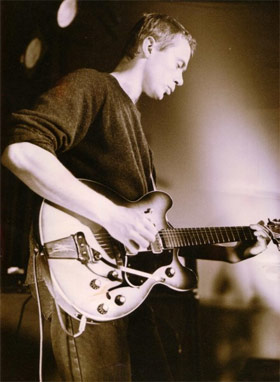
This story originally appeared on Mess+Noise on 2 March 2010. View it there with a couple of dozen photos by Elleni Toumpas; a selection of her images from the night are embedded throughout this blog post.
Covering Brisbane’s Sound
ANDREW MCMILLEN reviews six Brisbane bands playing six Brisbane covers at the launch of local indie music compilation Brisbane Sounds on Saturday (February 27). Photos by ELLENI TOUMPAS.
For Brisbane indie music fans, few dates on the calendar are more highly regarded than the annual Brisbane Sounds launch. What began as a hobby for 25-year-old founder Blair Hughes in 2007 has since evolved into a full-time passion that’ll take him to international music industry conferences SxSW and The Great Escape in the coming months. Hughes - the recent recipient of a much-needed Brisbane City Council “microgrant” - otherwise self-funds the not-for-profit project, whose dual goals are to highlight the quality of independent music being produced within the “River City”, and to promote it on the world’s stage.
The former schoolteacher [pictured below] has proudly taken on the role of local music ambassador. “People of all ages should be coming out to gigs, purchasing local music and really supporting the artists that are part of their own backyard,” he told me ahead of the launch. “I just feel that in Australia, people view ‘local music’ as being substandard and unprofessional, when in fact our country has thriving local music scenes with artists creating quality music.”
Twenty-four such artists appear on Brisbane Sounds 2010 – a compilation disc sold online - and six of them performed at Saturday’s launch at The Zoo in the Fortitude Valley venue, where Hughes works the door several nights per week. Besides venturing overseas to spruik Brisbane’s diverse range of indie talent, he plans to promote the project throughout the year via a series of spin-off shows, a “pop-up music shop” in conjunction with Brisbane Marketing and a weekly stall at the popular West End markets to foster community awareness.
Between bands, a selection of choice cuts by notable local artists such as Powderfinger, The Go-Betweens, The Grates, An Horse and I Heart Hiroshima were played over the PA, while the hundreds in attendance inspected a portrait series by Brisbane music photography group Underexposed. In the spirit of the event, Hughes asked the bands – whose musical styles range from folk and grunge, to hip-hop and indie-rock - to each cover a song written by a Brisbane act during their set.
‘Birds & Elephants’ by Bigstrongbrute [listen to the original here]
Australian audiences are more receptive to contemporary folk instrumentation than ever, owing to a recent obsession with the likes of Fleet Foxes, The Middle East and Mumford & Sons. As a result, Lion Island are a surefire crowd-pleaser, and one of the brighter hopes of wider industry recognition to appear on the Brisbane Sounds 2010 compilation. Their robust sound encompasses banjo, trumpet, violin and six-strong sing-a-longs atop acoustic guitars and songwriting smarts. The band tip their hats to indie-pop act Bigstrongbrute - formed by Paul Donoughue as a solo project in 2006 - with a cover of ‘Birds & Elephants’. Instrumentally sparse but vocally strong, the band members’ appreciation for their friend’s creation is evident, as they recreate a song whose original recording gradually devolves into a joyous, off-kilter chorus of voices and clinking bottles.
‘Notice’ by Pink Services [listen to the original here]
With an appetite for distortion, grunge and teenage angst, Dirtybird - heir apparents to lauded locals Violent Soho - fulfil the garage rock quotient on tonight’s bill. Bassist/singer Dylan Briscoe’s wails are studious replicas of Bleach-era you-know-who, while guitarist Jordan Mengel exhibits an understanding of the instrument that ventures far beyond the genre’s stylistic simplicities. Dirtybird continue the trend of covering current-era Brisbane acts. In a reference that flies over the heads of most in attendance - myself included - the trio opt to play ‘Notice’ by fellow young-grunge purveyors Pink Services. In a final act of slightly-overdone rebellion, Briscoe rugby-tackles Mengel and drummer Harley Brown to end the set.
‘Know Your Product’ by The Saints [listen to the original here]
The Coalition Crew’s inclusion on the bill is a ballsy move by Hughes, whose diverse tastes are seemingly not shared by the majority of tonight’s crowd. Nevertheless, a vocal minority appreciate the band’s lively take on Aussie hip-hop with live instrumentation. Their cover choice is the most controversial of the night, and the band know it; the six-piece opt to play it straight down the line, with minimal stylistic embellishments. A trumpeter and saxophonist are drafted in to blow the signature melody, though their unfamiliarity with the source material is evident in their silence during the verses. Chris Bailey’s anti-consumerism screed is tonight delivered by bassist Toxic Al, while MC Yuin Huz hesitantly backs up the chorus. They’re out of their comfort zone - this much is clear - but they rise to a Brisbane classic with aplomb and respect. A shame that they’re met with minimal applause, however.
‘Alone’ by Custard [listen to the original here]
It’s telling that tonight’s crowd numbers peak with a performance by Grand Atlantic, the purest rock ‘n’ roll band on the bill. Telling of their influences, too, that they choose to cover ‘Alone’ by Brisbane pop geniuses Custard. Built around a killer vocal hook and a surging chord progression during the chorus, the quartet recreates the 1994 Wahooti Fandango cut with style and integrity. Situated among a selection of the band’s own creations, their uncomplicated approach to the genre suddenly make a whole lot more sense. In the context of Custard - led by David McCormack, who rates among the city’s finest pop songwriters - Grand Atlantic’s vision to follow in the footsteps of the greats (not to be mistaken with The Grates) is admirable.
‘Black Bugs’ by Regurgitator [listen to the original here]
A few shows shy of their 100th performance, The Cairos fly the flag of youthful exuberance alongside Dirtybird (minus the on-stage tackling). Their maturity as performers and songwriters continues to grow, though their songbook is not yet filled with enough reasons to distinguish them from other indie-rock luminaries on the national and world stage. For their cover, they ask a question that’s remained unanswered since it was first posed in 1997: “What’s at the end of Satan’s rainbow?.” The band’s suggestion that the Unit-era, Ben Ely-penned song is close to their hearts hints at a video game fascination, to which most in attendance can relate. Like many of the singles from Regurgitator’s triple-platinum classic, ‘Black Bugs’ is a stylish blend of synthesised pop music and alternative rock. The Cairos’ absence of a keyboardist prompts some amusing synchronised vocals to mimic the song’s final ascending melody.
‘Sich Öffnen’ by Not From There [listen to the original here]
It’s midnight by the time tonight’s headliners appear, and the crowd has thinned considerably - more likely due to their late slot, than any disrespect. It’s well-known that The Gin Club comprise some of the city’s finest current songwriters, including Ben Salter, whose ‘You, Me And The Sea’ was awarded the best folk song/ballad of 2008 at local industry body QMusic’s annual awards. The Club’s numbers vary from show-to-show. Tonight, they consist of five core members who trade instruments and vocal duties throughout the hour onstage.
All but Salter file off for their cover choice. “I don’t usually rely on cheat sheets for lyrics,” he warns, “but you’ll see why in a moment.” Then he launches into Not From There’s ‘Sich Öffnen’, a song written almost entirely in German, but for the bridge (”Watched you laugh/Watched you cry/Watched you fade away”). Once we get past the hilarity, it’s an endearing performance of a local classic by Salter, whose only misstep is a temporary inability to hit the required “awoo-woo-ooo-ooo-oohs” in the chorus. It’s a beautiful moment, and an apt cover with which to close a memorable night whose soundtrack stretches from the 1970s to today.
This story originally appeared on Mess+Noise on 2 March 2010. Photos by Elleni Toumpas.
Filed under Published Writing | Tags: blair-hughes, Brisbane, brisbane-sounds, dirtybird, elleni-toumpas, feature, grand-atlantic, lion-island, mess-and-noise, Music, Music writing, Published Writing, Review, the-cairos, the-coalition-crew, the-gin-club, the-zoo, Writing | Comment (0)Anwyn Crawford discusses live music review techniques
Owing to both arrogance and pride, it took me a while to realise that as a music critic, constructive criticism from your peers should be welcomed. I get it now, which is why I was thrilled to receive an email from Anwyn Crawford in response to my Porcupine Tree review earlier in the week.
“I have some thoughts on your recently linked-to live review,” she wrote, “if you’ll permit me to share them with you.”
Of course.
Anwyn is an Australian music critic based in Brooklyn. Her words have appeared in The Age, Loops, The Wire, Mess+Noise and Cyclic Defrost; contributions to the latter two are under the pen name Emmy Hennings. You should read her Overland opinion piece on Nick Cave, entitled ‘The Monarch Of Middlebrow‘.
Anwyn doesn’t consider herself as a freelance writer, because in her own words, ”I probably only publish about three articles a year”. That said: she knows her shit. I’m holding her advice on par with what Andrew Ramadge told me last year.
The topic of discussion - my Porcupine Tree review for The Vine - can be found here. You should read it before reading the below, which is an unedited copy of what was sent to me.
First up, it’s far too long. Unless you’re going to be deliberately discursive, or be pursuing a particular thesis about a cultural event that is significant to a lot of people, for instance Marcus’s review of The Tote’s last evening, then less than half that length is ample. Believe me, readers don’t want or need that much information in a live review format. I’m not saying this because I think it should be a “dumbed down” format or that readers aren’t capable of digesting something more complicated - they are - but it’s important to respect the expectations of the form that you’re working in, whatever that might be, which means that if you break the expectations for a particularly compelling reason, then the results will be more fruitful. Part of the skill of a live review, I think, is try and relay, in a reasonably short numbers of sentences, your experience of the performance to a readership. This means trying to pick representative moments of the performance - or occasionally unrepresentative moments, if these seem to get closer to the truth of the event. A song-by-song catalogue has little narrative interest for a reader.
Secondly, and this is my big beef with so much music writing - PUT YOURSELF IN IT. I know that the first rule of essay writing that we’re all taught at school is never to use the first person pronoun. It’s time to put that rule aside. Reviewing is an inherently subjective act. It’s your opinion, and your experience - own it. This doesn’t mean describe what you had for dinner and how your feet were sore and “Oh, I missed the opening band” (classic street press gaffe), it means: don’t let your writing be bloodless. A reader wants to know why the performance might have mattered (or not mattered) and the only way they’re going to be able to get a handle on that is if you tell them why it mattered to you. It will also, almost inevitably, make your sentences shorter and more energetic, because you can can avoid clunky constructions like “One expects” and its many bet-hedging variants. “I think” “I was ecstatic” “My brain was melting” “This has stayed with me for days” - don’t be afraid to say I.
Thirdly, avoid Latinate constructions and “pretentious diction”. I’m with George Orwell on this one. Translate them back into plain English. “Resultantly” = “As a result”. It doesn’t sound more sophisticated when you write “Resultantly”, it just confuses the meaning. Same goes for words like “emotive” (emotional) “reciprocate” (respond) “regale” (you need “shout” or something similar there, because “regale nonsense” as a clause makes no grammatical sense without a subject who is being regaled). Take a sentence like: “It’s a fittingly exhilarating close to an achingly beautiful song, into which the singer interjects a heartily-applauded full band introduction.” It took me about three runs to actually figure out what that meant. “It’s an exhilarating close to a beautiful song, and when singer XY pauses to introduce the band, he gets hearty applause”, is much clearer.
And lastly, also related to Orwell’s timeless advice, avoid cliches and ready-made phrases. Chords nearly always “flourish”. A band is too often on a “jaunt” when the writer doesn’t want to use the word “tour”. There are millions of basslines that “pulse” and countless pianos that sound “plaintive”. Find a more interesting and a more accurate word, if you can, but bear in the mind the above: don’t let it become pretentious. Verbs are your friend, adjectives are often not.
Just the kind of kick-up-arse I needed. Thanks, Anwyn. Pay attention to her blog.
Filed under Writing | Tags: anwyn-crawford, australia, criticism, emmy-hennings, feedback, george-orwell, mess-and-noise, music-criticism, nick-cave, overland, porcupine-tree, Review, the-vine, Writing | Comment (0)A Conversation With Craig Mathieson, Australian music journalist
I wrote recently that Craig Mathieson wears the crown of Australian rock journalism. Allow me to elaborate. He’s recently released Playlisted: Everything You Need To Know About Australian Music Right Now, his third music-related book, and his byline has regularly appeared in Rolling Stone, Juice, Mess+Noise, and Fairfax news publications. He’s even got a Wikipedia entry.
Craig, at this point in your career, which writers do you view as your contemporaries?
My contemporaries are simply the good writers, those who have a voice and critical faculties. In terms of age that group is all over the place. Most are younger ; I named Shaun Prescott, Tim Finney and Emmy Hennings as talented examples on my blog. A few are older - I’m 38 years old. And I’m still flummoxed that someone decided to knock up a Wikipedia entry for me.
You stand as an example that it’s possible to earn a decent living as a full-time freelance music journalist in this country. Am I right, or do you have another job on the side to supplement your writing?
I’ve freelanced full-time for twenty years, but it’s been divided between music and film. In the music scene I’m a veteran, in film I’m still something of a kid. My career to date comes in two parts: 1989 to 1999, which was very music-orientated, mainly in Sydney; burn out and a corporate sojourn at Sony Music during 2000 and the first half of 2001; back to Melbourne and dividing my time between film and music ever since.
The way film and music writers/critics are considered is chalk and cheese. Everyone has a film critic, but the idea of a music critic – as opposed to the music writer who might pen the odd review – being on staff is anathema. I was the film critic for The Bulletin, the ACP-owned news weekly, from 2002 until it closed in January of 2008, and that was an absolute pleasure.
Having two disciplines to write about has also made me a stronger critic – it gets you thinking about the work you’re appraising in different ways.
Do you think it’s still possible for freelance writers to earn a decent living in 2009?
I’m sure it would still be possible today for freelance writers to swim upstream as it were, but there’s the question of what they’re striving for? There are very few secure full-time jobs at the end of the rainbow and not everyone is comfortable doing the freelance shuffle, because there’s not a safety net present.

Though you mostly focus on how the musicians profiled in Playlisted sound and appear, I noticed the occasional comment about demographics and marketability. Is the marketing/promotion side of the industry of particular interest to you?
It does interest me, because it impacts on how music is perceived and sometimes, to the artist’s detriment, it can be the defining element of someone’s career, as opposed to the actual music they produce.
Before playlisted.com.au, a blog created when Playlisted was released, you’d not blogged elsewhere. Why?
I didn’t have the time or the inclination. I knock out a fair few words every week and I’m focused on maintaining a decent standard of living for my family – marriage/mortgage/offspring tends to refocus a lot of younger freelancers and move them onwards; I have a stubborn streak. Even now, doing the blog for Playlisted, I’m sporadic at best.
Aside from Mess+Noise, you seem to write exclusively for print. Aside from the fact that its publications pay better, what do you enjoy about writing for print?
As a freelancer, you can’t underestimate how important “pay better” is, but aside from that I’m attracted to the audience size, which is pretty sizable when you file for The Age or the Sydney Morning Herald. I’m also a traditionalist, in that almost every day of my life since the age of 12 I’ve read one of those two Fairfax titles, so to be a part of them now is very satisfying.
Which are you favourite music blogs, both Australian and otherwise?
Mainly the online voices of writers whose work I already enjoy, be it Simon Reynolds or Anwyn Crawford. I don’t have much time for the blogs that are focused on being first – first review, first streaming – with something. “First-ism” grows dull quickly.
You wrote most of Playlisted in the summer of 2008. How much editing and revision was required between then and its November publication?
There was a sturdy editing process, then proofing, for a solid period between April and June. I’m not the cleanest writer and I’ve never been much of a sub myself, so I’m sure it needed work (“needs more,” I’m sure someone will snort). But after that it entered a kind of publishing limbo until November, when finished copies appeared and the whole release/promotion rigmarole kicked off.

When writing, are you much of a procrastinator?
It can take me a while to start, but once I do I tend to find a groove very easily and I work quickly, until finishing, after that. It’s rare that I junk a draft – most pieces come together reasonably smoothly.
As for procrastinating at the start, unless I’m under extreme deadline pressure then I actually try to take the time to enjoy it. Sometimes it’s worth letting your mind wander a little, you might have a far better lede than that intricate one you’ve been obsessively plotting just come to you.
Finally, what’s thrilling your ears lately?
I’ve been compiling end of year lists for various publications, so this week’s scope has been a little wider than an ordinary week, but in terms of recent releases I’m enjoying Fuck Buttons, Whitley, Denim Owl and Rihanna.
I genuinely like pop music and I write about commercial releases quite frequently – to me that’s part of a critic’s job, to try and take everything in and see what may or may connect the mainstream and the alternative scenes. I get frustrated that some younger critics are almost specialists, they can become completely niche-orientated. I’d love to read them taking on something completely outside the aesthetic they’re drawn to.
Thanks Craig. I highly recommend Playlisted; buy a copy here. Keep an eye on Craig’s blog here.
Filed under Conversations | Tags: anwyn-crawford, australia, craig-mathieson, emmy-hennings, fairfax, freelancing, Interview, Juice, magazine, mess-and-noise, Music, music-journalism, playlisted, procrastination, rolling stone, shaun-prescott, simon-reynolds, tim-finney, Writing | Comments (3)Writers outsourcing interview transcriptions: lazy or smart?
An interesting discussion on the Mess+Noise boards today.
The thread linked above is dedicated to transcribing interviews, and the hatred thereof. The first message:
[transcribing interviews ] …is possibly the most tedious task on god’s earth.
oh lord, I hate it.
It was started in February 2007 and has been periodically resurrected as M+N writers bemoaned deadlines and the tedium of transcription.
I wrote this, 17 November 2009.
I’ve outsourced every interview I’ve done (ie. dozens) since June this year to a mother of five in Israel. Rates are very reasonable and her work is top-notch. Message me if you want a reference.
Mobile phone on speaker > Sony USB recorder > YouSendIt. Word document back within a few days, always.
I’ve mentioned this fact on my blog before, where I detailed how I came across the services of transcriptionist Tamara Bentzur of Outsource Transcription Services after interviewing Neil Strauss and querying him on the matter. From my interview:
Do you have any interview transcribing tips?
Yeah - outsource it. (laughs)
For real. Even if I couldn’t afford it.. I just have to have someone else transcribe it. Sometimes it’s good to listen to because then you relive the conversation, but sometimes I find it easier if if I can fucking find someone I could pay a little bit to do it. Even when I didn’t have the money, I was like, fuck - it just makes my life easier.
So I did, and like I said, I’ve engaged Tamara’s services dozens of times since June. She’s awesome. It’s one of the best decisions I’ve made this year.
Some of the other writers didn’t take too kindly to my admission.
M+N writer A.H. Cayley - talented in her own right, and certainly a young writer to keep an eye on - didn’t like the suggestion at all.
Jesus, NiteShok. How incredibly lazy. Her name should go right next to your byline, I think.
I hope you pay her more than half of what you get paid, given that transcription is the longest, most tedious part of the process, and the least fun.
My response:
It’s her business. She is a professional transcriptionist. Why are you so offended by this concept?
Cayley again:
I think it’s incredibly lazy, and I’m not sure I’d have the gall to call myself a writer if I didn’t actually do the writing part.
Each to their own.
Whoa. That stopped me in my tracks. A strong accusation. M+N writer Shaun Prescott came back with:
well, transcribing isn’t really writing. if the Q&A is going to be published as is, then I don’t see a problem with it.
I doubt niteshok has Israeli women transcribe his live reviews while he sits in the corner dictating in his slippers with a pipe.
Great imagery there. Craig Mathieson - the former editor of M+N, who also wears the crown of Australian rock journalism - said:
C’mon Anne, handing off the transcription doesn’t make you any less of a writer.
Cayley then admitted she’d gone too far. But the whole discussion got me thinking.
Does outsourcing interview transcription devalue the role of the writer?
M+N user MichaelDudikoff suggested:
I actually applaud McMillen for his inventiveness while worrying that he might miss nuance.
A fair statement. The responsibility of transcribing a conversation is significant, especially considering the reputation of the publications in which my writing appears. But I trust Tamara. She hasn’t let me down in the five months we’ve had a business relationship. I proof-read everything before it’s submitted, of course, and pay attention to the construction of sentences to ensure that it reads as the conversation played out. Where Tamara’s unsure of certain phrases or the speech is inaudible, she’ll timestamp the section and move on, leaving me to listen back to the audio and finalise the correct transcription.
Writers, what are your thoughts? Is outsourcing interview transcriptions lazy or smart? Does it devalue the role of the writer? Do you feel I’m less of a writer for engaging the services of a professional transcriptionist to free up my time elsewhere?
Filed under Writing | Tags: devalue, Interview, interviewing, Journalism, mess-and-noise, neil-strauss, outsource, outsource-transcription-services, tamara-bentzur, tip, transcribing, transcription, Writing | Comments (12)A Conversation With Andrew Ramadge, news.com.au and music journalist
Here’s a conversation I had in August with Andrew Ramadge [pictured right], one of my favourite Australian journalists. He writes about consumer technology for news.com.au, and music for Mess+Noise and The Brag. He came to my rescue when I was humbled by Hungry Kids Of Hungary. He’s written a lot, but my favourite article of his - the one that really brought him to my attention - is ‘Tall Tales And True‘, a look at the state of Australian music journalism for M+N in March 2009.
Andrew: Hey Andrew. I’m mostly interested in how you got into journalism, and how you’ve progressed from print to online journalism. When did you first become interested in writing professionally?
My father was a journalist and he still is. He edits a newspaper now. When I was a bit younger, I swore that I wouldn’t get into the media, that I wouldn’t follow in his footsteps, which as you can tell; I failed at. [laughs]
The first time I realised I really loved writing was when I was at university, in Melbourne. I was doing a Bachelor of Arts. Most people do a Bachelor of Arts when they don’t know what else to do, or when they just want to get on the dole for a while. I was one of those people who really enjoyed it. I loved writing essays, forming arguments, and at the same time I was reading the street press, and reading record reviews. I’ve always loved music. At that point, the street press critics were emerging writers and I thought I could do that as well. I sent in reviews to Beat and that’s how I got started.
So music journalism was your way into the industry?
Yeah, that and the fact that my father was a journalist, so I suppose people would say I always had it in me, anyway. After I finished my degree, I moved to Sydney. I was looking for work and a position was open at News.com.au and I took it. One of the reasons I got into online journalism was because I started my career as a web developer. I sort of had a little bit of experience in journalism, and a lot of experience in online. It seemed to be the perfect synthesis.
Was the opportunity at News.com.au for a consumer tech journalist, or did that role evolve?
I started off as a general news desk journalist. I was doing a little bit of sub-editing, a little bit of production work, as well as putting in calls, and just highlighting the news of the day. After I’d been there about a year or year and a half, I think, before News.com.au put in a new section for technology. Again, because I’ve got a background in computers, and online development, I was kind of a perfect fit. I applied for that job once it became available and I got it.
Do you find it odd that you find you got a job at News without an internship or without that kind of way into the industry, which I know a lot of students do pursue?
I suppose; I’d already been working when I was in Melbourne, for the street press, and also editing the website for Beat magazine online, so I had an online editor experience. Also, I think internships are becoming more rare nowadays. I think Fairfax may have actually suspended their cadetship program recently.
I think the ways that people get into journalism now are different than they have been in the past. One up-and-coming technology journalists that I know is Ben Grubb, who’s also from Brisbane. He will have a career in the industry because a lot of people know him and are keeping an eye on him. He didn’t do a cadetship. He did it himself. He started a blog. He showed he had talent, ambition, and I suppose he went around making good contacts.
Cool. What did you learn during your time writing for street press? You started as a freelancer, I suppose, and then you became a staff member when you were editing.
Yeah, I started out writing reviews and features. At that point, Beat had a website, but it was pretty perfunctory. It wasn’t very good. I wrote a business case for the publishers of Beat magazine to start a new website for them, and then I built it and edited it. That’s that side of it.
What I learned about writing when I was at street press was the same thing everyone learns, really, which is a pretty good introduction: some free CDs, you get to go to a lot of concerts and meet people and figure out how everything works, really. I also eventually learnt not to be precious, which is another good thing. I learnt that there are only so many times that you can get angry at an editor for changing a few of your words. After that happens for a few years, you sort of get used to it, which is a very good lesson to learn, especially for mainstream media where the editing process is a lot more intrusive.

How did you make the transition to Mess+Noise?
When I found out about Mess+Noise, I left Beat. I continued to edit their website but I stopped writing for them, by and large, and threw myself into Mess+Noise, which was the best experience I’ve ever had. It was wonderful.
I joined them for issue two of the print magazine, after I’d seen issue one. That changed the way that I think about everything, really. I went from doing the regular street press thing, which is 400 word reviews and 1,000 word features, to just having free rein to do whatever I wanted. What I wanted to do for Issue 2 was write a 3,000 word piece, not about a particular band, but about a genre and scene in Melbourne, which at the time was the art rock scene, which was centered around the Rob Roy Hotel. That’s what I did.
It was really liberating to just be able to do that. I also realised that anyone could do that. It’s if you have someone who promises they’ll publish it as well, you’ve got an extra impetus.
When I joined Mess+Noise, the editor at the time was Danny Bos, and he really opened up a huge amount of possibilities for me. A bit later on, Craig Mathieson became the editor, and I learned a lot from him, as well.
How did Mess+Noise come about? I’m not too familiar with its history as a print magazine, only the website.
It grew out of another website, which I’m not 100% clear on the back story of, but it was called Mono. It was an Australian music website that was in the late ‘90s, I think. Danny Bos was a member of the team who did that.
After Mono, Danny started Mess+Noise as a website. In some ways it was similar to how it is now. It was mainly a discussion board. He really wanted to put out a music magazine, so as soon as he got organised enough and got his money together, he started doing that. Then it was put out every 2 months for a bit over 2 years. There were 16 issues.
I read that they were purchased by Destra a couple of years ago.
Yeah.
And as of late last year, they’re owned by The Sound Alliance.
Yeah, that’s correct.
How do you think this site got such a strong following and such a devoted, loyal audience? That’s always fascinated me. It audience seems to be quite opinionated and quite passionate about the indie scene in Australia. How does that come about?
Some of it was a follow on of momentum from Mono, so a lot of the people who used to talk about music on that website followed Danny to Mess+Noise. I also think it grew a reputation over the years of publishing really high quality music journalism, which if you do it for long enough, then it can get you a lot of respect and a lot of people following what you publish.
Do you enjoy writing for the web more than print?
A little while ago I had my first feature in The Weekend Australian; a full-page feature. I enjoyed writing it and seeing it in print, as well. But I suppose I’m one of those writers who is at the right age to still feel very nostalgic about print, which a lot of writers my age do. I had to come to the thinking that “just because it’s in print means that it’s necessarily better than the web”.

When I opened up the paper that weekend, I still liked reading it and seeing it there, but I realised it wasn’t as important to me as some of the stuff I’ve written for online. I think for me, that sort of distinction between print and the web is starting to go. It’s much more about the quality of the piece itself. It doesn’t matter where it’s published.
You mentioned that a lot of people still think that what appears in print is perhaps more valuable and more valid than its web equivalent.
Yeah.
I think that might be related to the fact that print still pays quite well and it still has that professional reputation, whereas I suppose a lot of other online outlets aren’t..
..don’t have the same reputation and they don’t pay as well, is what I think you’re trying to say? It depends on the magazine, the newspaper, or the news website or whatever. Obviously, street press doesn’t pay very well at all. That’s a print title, whereas the website of Pitchfork Media might pay ten times as much as street press.
Part of it is that. It’s not necessarily whether it’s print or web. It’s just the title that you’re writing for. I can tell you that at News.com.au, we pay our online freelancers a professional rate, the same rate that they would get if they were getting if they were writing for the Sydney Morning Herald in print.
As for reputation, you’re right; with newspapers, let’s continue talking about the Sydney Morning Herald. That’s been around for what, a hundred or more years? I think it has been around for more than a hundred years. Over that time, it has built quite a reputation. If you work a few years in there, then – in a sense - the reputation brushes off on you.
But I guess what we’re going to see now is that websites that have been around for a long time aren’t going to go away. The big websites that are there now, theoretically, are going to continue into the future. If they don’t, another website will take their place. They’ll build their own reputations, as well. Give it another 10 or 20 years and you might end up seeing that websites have a stronger reputation for breaking news or publishing quality journalism than print does.
I guess time will tell on that. You mentioned online freelancers for News Limited titles earlier. Do they employ many of those at the moment?
I’m not really sure how many freelancers we’ve got all up. I know that in the technology section, we’ve had several freelancers.
I spoke to a guy from the Brisbane Times a couple of months back and he said they’d pulled all their freelancers because they couldn’t afford them.
We haven’t dropped any of our freelancers, yet. I’m not sure that we will, either. I think everyone realises that at the moment, online publishers are trying to figure out how to make money, and they’re not being particularly successful. That’s a whole range of reasons, and obviously, that’s why both News Limited and News Corp internationally and Fairfax in Australia have both flagged that they’re probably going to be charging for content soon.
I guess that’s why magazines and newspapers can afford to pay writers 70 cents or $1 per word, in some cases, because they do have a traditional advertiser base who understands the rates, and the magazine editors can apportion rates per what they receive from advertising.
Obviously I’m generalising here and trying to make sense of it, but I can see that website editors might not have figured that out yet, which is where the debate about paid content comes in. They’re trying to monetise the user base.
I’d be happy to talk to you about this off the record, but not on record, only because I don’t want my opinions on the matter to come back to haunt me at work.
Fair enough. You mentioned you got your first piece published in the Weekend Australian. How did you get that in there?

Well, The Australian is owned by News Ltd, which is the parent company - the sister company of News Digital Media, which is the publisher of News.com.au. They had an article that they thought I’d be good at. They sent me an email.
They approached you; that’s interesting. I’m sure, over the years, you’ve become familiar with and adept at pitching article ideas. When did you first start to do that, because I’m assuming that during your time at street press, you didn’t get much freedom to pitch new ideas.
You’re right; I didn’t have a huge amount of freedom in what I could pitch. For example, I couldn’t pitch an article on a band that no one else but myself really cared about and that was never going to pay for advertising. Also, I couldn’t pitch for large opinion pieces or in-depth features that would have taken several pages. That’s not the way that street press works.
I did have a little bit of freedom in being able to pitch about local bands. For example, if there was a really great band in Melbourne, I could pitch to the editor and if they ever had a spare half page or something, then I might be able to use that for a small article, which is one of the limitations of street press - and why I joined Mess+Noise was almost evolutionary for the way that I started working.
I still had to pitch articles. What we used to have in the early editions of the magazine was an editorial board; when I say board, we just met at the pub, really. It was a group of writers and editors, and we’d all have to pitch what we wanted to do to the whole group.
There were no limitations. We could pitch whatever we wanted. Half the time, everyone would be like, “Great, let’s do that.” That’s how I came to write 3,000 word articles about a particular scene. In one case, I think there was a 5,000 word article about one musician, or the storyteller series, where I interviewed different musicians about how they came to write some of my favorite songs. That sort of stuff would never have been in street press, but it still was subject to a pitching process.
You started with verbal pitching at the pub. Do you still pitch articles to your current editor?
Of course. Now that I’m working for a big company like News Limited, pretty much every article that I write has to go through a pitching process.
How does a story idea come about? Do you read something you’re interested in and you think about the angle you’d like to take? Or in some cases, would there would be a news event you have to write on, or your editor asks you to write about?
It’s probably a mix of both, about half the time an editor asks me. There are different sorts of editors; there’s a technology editor, and then there is also whoever is actually running the news portion, whether it is the morning editor or the afternoon editor. Something might be going on that they want a story about, so they’ll ask you to write.
The other half of the time you’ll pitch an idea of your own. You’re exactly right; those ideas come from things that you’ve read or perhaps you’ve had a tip from a source, or whatever. Also, the other thing to note is that your story won’t always come through. You might get a tip off and investigate it but find out later that it’s either not worth the story, or someone told you the wrong thing, or it doesn’t stand up.
What makes a good editor?
I’ve worked with different publications and different styles of publications. Obviously, a magazine editor is very, very different than a breaking news editor. By breaking news I mean somewhere at a pace like News.com.au, which tries to stay up with what’s current 24 hours of the day, 7 days of the week, and tries to be informative about what’s going on at that very moment.
I’ll talk about magazine editors in general, only because that’s where I’ve written a lot more of my feature articles for. In a good editor you need confidence; to not accept any bullshit, either. If someone doesn’t like something, they need to tell you and that’s fine. You also need to be very supportive of your writers.
Do you see yourself becoming an editor in the future?
Yeah, and I think I’d really like that as well, but no time soon. I’m not done with my writing yet. There are still a lot of things that I want to write.
You have News.com.au and you’ve got Mess+Noise occasionally. Do you have any other publications that you write for?
Yeah, I’ve been involved with Mess+Noise for a very long time now, and I used to be an editor there. I was editing the reviews and opinion section of the magazine before it went online. I still write for them whenever I can. It’s just a matter of finding the time now, because I’ve got a full time job and it’s very demanding.
I also have a weekly column in The Brag called Pop In Print. Last year I published an essay for Overland, which is a literary journal. In the future, I’d like to continue publishing pieces in places like Overland and Mess+Noise, which favor in-depth, long-form journalism.
I saw you comment on ‘Tall Tales And True‘ where someone asked you what you got paid for the article. You told them that you’ve long since given up on expecting to be paid for everything you write, and instead you try to focus on what you’re passionate about and telling the best story you can. If you get paid, that’s a bonus. Does that come back to not being precious, which you mentioned earlier?
No, it’s not about being precious, this one. When I first joined Mess+Noise, when it was a magazine, I didn’t get paid for any of the articles that I was writing at that point, only because Mess+Noise didn’t have any money. It was a love job, a do-it-yourself job. Basically, it was just a zine, a very pretty and very high quality zine, but it was still a zine.
Now, I’m really passionate about this; everyone needs to pay the rent, and I suppose I’m lucky enough that I can pay the rent by being a journalist during the day. Even if I couldn’t, I’d still prefer to get a day job and then write about what I want, out of hours, without having to worry about whether or not it’s going to contribute to the rent.
The reason being is that there’s a huge weight lifted. You can write about whatever you want if you don’t worry about whether or not you’re going to get paid for it. A lot of the best things I’ve ever written were for no money and I went into it knowing, and just stopped being concerned. If that’s not a concern, it frees you up to actually prioritise what you really want, which is: “I’ll write this exactly how I want, about what I want.” I’m a big fan of do-it-yourself culture.
It’s interesting because you did that for Mess+Noise and you started with street press, which as you say pays pretty poorly, and in many cases, for all contributors, it’s a love job. The people who write for it love writing about music. Do you find the time to write for pleasure lately? I notice you haven’t been updating your blog very often.
The blog is simply a collection of the things that I publish in Brag, so it’s about 6 months behind the print version at the moment. I don’t have a lot of spare time lately. Hopefully, that will change.
Do you have any daily routines?
No, I’m incredibly disorganised. [laughs] My routine at work depends on what’s going on during the day and what I’m going to try to do in that day. If you’ve got a day where you can go and try to find a new story and break some news, your routine will be a little bit different than when something is broken in North America overnight and you’re following it up.
Are you a procrastinator?
Sometimes, yeah. It’s funny; when it comes to my writing outside of work, the writing I do after 9 to 5, I tend to leave things a little last minute.
Has that been a problem?
Yeah, it can definitely be a problem sometimes. One of the biggest problems it can cause is to add to your stress level. I don’t think anyone would argue that people who are a bit more organised tend to get less stressed out about things and stressed out about getting things in at the last minute. Then again, it depends. Every writer that I’ve ever met works in completely different ways. I’m not too worried about it.
I ask that question of a lot of people, if they procrastinate and how they deal with it. It’s definitely a recurring theme, especially with writers, to sit on a task you know you’ve got until the very end, at the last possible moment. I often think that working that way is possibly sacrificing the potential quality of the piece. If you’re rushing to have it done by a certain time, you’re not fully thinking about the issue, unless you want to argue that by mulling it over for so long it’s just ticking away in your subconscious and you know exactly what you’re going to write.

I believe very strongly in the second model, which is that even if I’m not writing something, if I’ve been thinking about it for a month, what I end up writing in the last day of that month will probably be pretty good. Not probably, actually a lot better than if I’d started on the first day of the month. I can guarantee you I would have been sitting there thinking about the issue for the 30 days before I started writing.
It’s interesting how that works. How do you find new music to write about?
To be honest, probably this year, I’m not writing about new music as much as I have done in the past. As you know, the column that I write every week is about old music. I think that’s probably because when I was editing the review section of Mess+Noise a few years ago, I was totally caught up in everything that was happening that week. I suppose just for a change of pace, when I started doing my column, I started focusing more on what was really important to me and what I was really passionate about. Every record I write about now is not necessarily new but I think it’s got something in it, a reason for people to listen to it, or a reason for people to read about it.
How do you find new music to listen to?
Nowadays I rely a lot on my friends. As you would imagine, a lot of my friends are music critics and they’re probably doing what I used to do, which is keeping on top of things that happen every week, new releases, and who’s touring. Anything they recommend to me I usually give it a try.
So you kind of take the back seat these days and let others drive?
A little bit. I don’t necessarily want to do that forever, but at this point in my career and life, I’m pretty happy having music recommended to me, rather than searching it out all the time, but again, that’s just because of time constraints. I don’t have as much time as I used to, and I’m also no longer a reviews editor, so I don’t get quite as many CDs sent to me.
Thanks for your time, Andrew!
Andrew Ramadge writes for the Technology section of news.com.au. For an outdated list of his writing, check his MySpace and Pop In Print. He’s also on Twitter.
Filed under Conversations, Writing | Tags: andrew-ramadge, australia, beat, ben-grubb, Everett True, fairfax, free, freelance, history, Interview, Journalism, melbourne, mess, mess-and-noise, money, Music, news-corp, news-ltd, news.com.au, noise, pay, pitchfork-media, pitching, procrastination, Street Press, sydney-morning-herald, tall-tales-and-true, Technology, the-australian, the-brag, Writing | Comment (1)