A story for The Monthly in the May 2013 issue – my first contribution to the magazine, in ‘The Nation Reviewed’ section. The full story appears below; the illustration is credited to Jeff Fisher.
On a Tuesday morning in March, 80-odd young people wearing red T-shirts hopped off two buses in Lismore, in northern New South Wales, and began canvassing shoppers and retailers in the central business district. Their quest, as declared on their chests, was to help end extreme poverty. Not in Lismore per se, but globally, by petitioning the federal government to bump up its foreign aid spending.
The team was one of many converging on Canberra from around the country, as part of “The Roadtrip”, a week-long campaign organised by the Oaktree Foundation, the youth-run group that also arranged the MAKEPOVERTYHISTORY concert in 2006. About eight hundred “ambassadors” were taking part all over the country. Their aim was to gather 100,000 signatures, or around 125 each, over the course of the trip via a smartphone app.
The target didn’t sound overly ambitious. But, by noon, many of the locals out and about in central Lismore had been approached several times. Some were starting to get ticked off. “We’re actually irritating people now,” noted a group leader, Tammy, and the entire team retreated to a McDonald’s restaurant, where the buses were parked. One overweight team member was in tears. A local woman had accosted her, shouting: “If you stopped eating at fuckin’ McDonald’s, there wouldn’t be any poverty!” The canvasser’s peers moved in to soothe her. “That’s really rude,” someone countered.
Three days earlier, the volunteers, aged from 16 to 26, had met for the first time at the University of Queensland in Brisbane to undertake an intensive course in political campaigning. Most were university students; a handful were still in high school. Ebony from Townsville was a champion skateboarder pining for her board. James, 21, was a soccer-mad Scot. Emily Rose, a petite redhead, showed off an unnerving party trick: the ability to dislocate her limbs at will. Each had stumped up $400 to cover food, travel and accommodation costs.
The ambassadors had been taught some handy lines: “The door to ending poverty is opened by thousands”; “Two-thirds of the 1.3 billion worldwide living in poverty are our neighbours”; and “Australia’s fair share is just 70 cents in every $100 to fight global poverty”. This last line was central to the campaign. In 2000, Australia agreed to adopt the United Nations’ Millennium Development Goals, aimed at reducing extreme poverty. This meant setting aside 0.5% of Australia’s gross national income for foreign aid by 2015 (recently put off till 2016) and 0.7% by 2020. Currently, the nation contributes 0.37%.
“The government has made a commitment,” the Roadtrip ambassadors pitched to shoppers. “We’re here to keep them true to that.” At night, the team slept rough in local church and sports club halls. By day, when not canvassing or on the buses, the team courted the local media, debriefed, attended further campaigning lessons and enjoyed “personal energising time”, as spare hours were denoted on the itinerary. Some members worried that they were falling behind on their petition targets. “Relax, it’s not about the signatures,” said a group leader. “It’s about the movement.”
The day before they were in Lismore, the team had detoured briefly to the retirees’ paradise of Bribie Island, where half the group “chalked the boardwalk” with messages – “Help keep the promise of a fair share!” – while the other half were assigned the task of “painting the town red”, by asking local businesses to display campaign posters in their shop windows.
Many shop owners were charmed enough to comply. “I don’t think they’ll achieve anything, but good luck to them,” a 74-year-old manager said. A girl serving ice-cream next door could barely remember the pitch – “something about foreign aid?” – but said she assented to their request because “they were young, and looked like they were important”.
Wyatt Roy, the 22-year-old local MP, joined the ambassadors for a barbecue lunch. Wearing sunglasses and a crisp white shirt with rolled-up sleeves, he stood on a picnic table and said, “In this job, very often do people come to me with problems, and very rarely do they come with solutions. Thanks so much for doing what you’re doing.” As the team left Bribie, a sudden downpour washed away the chalked messages. The ambassadors coasted into Canberra two days later, via Kempsey and Port Macquarie, late on Wednesday afternoon, with 47,000 digital signatures.
The next morning, at seven o’clock, the various busloads from around the country assembled at Parliament House. A giant map of Australia had been painted on the lawn, and the eight hundred ambassadors stood within their respective state boundaries. Chanting slogans, they made a lot of noise. Greens MPs hung around. A cherry picker was on hand so that TV crews and Oaktree’s media team could take shots from above. Bob Carr, the foreign minister, addressed them. “We are on target for 0.5%,” he said, before turning and gesturing behind him. “It’s up to you to persuade everyone in that building that they’ve got to act!”
Scores of meetings had been scheduled between ambassadors and their local MPs, but many representatives either cancelled or sent staff in their place. Julie Bishop, the shadow foreign minister, slated to speak at the morning assembly, sent her apologies, too.
The bus trip home, via Sydney, was a long one. A question kept coming up: had they actually made a difference? Was Wayne Swan, the treasurer, any more inclined to heed their call to increase spending on foreign aid by a third, to 0.5% of gross national income? His sixth federal budget will answer that, on 14 May. No one is holding their breath.
“Marijuana Use Most Rampant in Australia,” read aNew York Times headline in January 2012. Cannabis – marijuana, weed, pot, hash; whichever other name you prefer – remains the most widely used illicit substance in Australia today by a big margin. Approximately 1.9 million Australians aged 14 years and over have used cannabis at least once during the past year; more than a quarter of a million smoke cannabis every day, according to data compiled by the National Cannabis Prevention and Information Centre (NCPIC). Keep in mind, too, that these figures were taken as part of the 2010 National Drug Strategy Household Survey; plenty more users were either unaccounted for, or chose to lie about their drug usage, so the true figures are probably even higher. This reality can be viewed one of two ways, depending on your personal politics.
Either: it’s great that so many Australians enjoy the occasional puff, as its illegality is an arbitrary hangover from conservative generations past, and its negative effects are significantly less serious than those incurred by alcohol abuse or tobacco addiction.
Or: it’s outrageous that so many Australians smoke up, as cannabis is a devil weed whose availability should be pushed further underground lest its psychological and subversive effects further corrupt otherwise sensible citizens.
Illicit drug use is not a topic that attracts moderate views. Weaned on the powerful moralising of media sensationalism, political cowardice, and harsh words from the police force, many Australians are raised to believe that drugs are bad; the province of losers and law-breakers.
Progressive views are slowly prevailing across the Western world, though, as many realise that the Nixon-led ‘war on drugs’ – which celebrated its 40th anniversary in 2011 – did very little to break the cycle of power, violence and addiction that has forever plagued illicit drug culture. (For a succinct primer on the topic, my brother Stuart McMillen recently published a 40-page comic, ‘War On Drugs’, which outlines why drug prohibition hasn’t worked.)
Immediately following the 2012 Presidential Election results in November, cannabis users worldwide rejoiced at the surprising news that two states in the war-on-drugs heartland, Colorado and Washington, had voted to legalise recreational use under state law. Colorado users will be able to grow up to six plants; in Washington, users will buy from state-licensed providers, and the sale of cannabis will be taxed and regulated, much the same as alcohol and tobacco already is. If you’re over 21, the drug will be legal to sell, smoke and carry – as long as you don’t drive while high.
Australian pot smokers wondered whether they might see a similar decision – if not soon, then at least in their lifetimes. TheVine snooped around on your behalf, with a view to determine Australia’s current cannabis laws on a state-by-state basis and look to its future legal status.
Dr Alex Wodak, president of the Australian Drug Law Reform Foundation, points out that Australian states don’t have ballot initiatives like the one that led to the recent weed votes; in fact, most US states don’t. “Australia will not see ballot initiatives on taxing and regulating cannabis like Colorado and Washington states,” Wodak tells TheVine. “Our cannabis reforms started in the 1980s in South Australia. We have had two decades of creeping liberalisation of our cannabis laws at the state/territory level. I think this process will accelerate now, but that it will still take a couple of decades before Australia taxes and regulates cannabis in all states and territories.”
Legal weed in Australia? “It’s now inevitable,” continues Wodak. “There are so many contradictions and issues undermining cannabis prohibition. Sooner or later, the bosses of one or the other major [political] parties will realise that it is in their interest to get there first. But all social policy reform is slow.”
To illustrate, Wodak points out that 2012 is the 40th anniversary of South Australia becoming the first state to begin reducing the emphasis on the criminal law in relation to homosexuality. Jailing someone on the basis of the sexuality is a social policy that looks completely abhorrent and archaic nowadays. “I might be wrong,” he says, “but I think taxing and regulating cannabis will be slow to happen in Australia, and we will first go through many stages of watering down our criminal laws.”
So what is the current state of Australia’s cannabis possession laws? The answers might surprise you. As The New York Times put it earlier in 2012: “The prevalence of marijuana use in Australia is widely accepted, if not openly condoned, and at least three states have moved to decriminalise the possession of small quantities for personal use.”
This is the transcript of a presentation I gave at the Brisbane Emerging Writers Festival on Saturday 15 October 2011, as part of a panel discussion around the topic of “Writing online – How different is writing for an online audience, how can you do it creatively, and what are the challenges and opportunities for writers working in this field?”
Team Bondi, L.A. Noire and The Truth: The Perils of Online News
by Andrew McMillen
This is a cautionary tale about online journalism. It’s about learning first-hand how the internet can be a beautiful and terrible place to break news. It’s about choosing what kind of writer you want to be.
In June, the biggest story of my career was published. It was the result of four months of investigation, based on my interviews with 11 former employees of a company named Team Bondi, who made the biggest, most expensive video game ever made in Australia, called L.A. Noire. These 11 sources all spoke to me on the condition of anonymity. Between them, they’d spent a combined 24 years at Team Bondi. They each alleged that their experiences working there were uniformly terrible: long hours, no overtime pay, a praise-free workplace led by a guy who treated them like crap. As a result of these factors and high staff turnover, the game took seven years to make, which is an incredibly long time in the games industry. I put these allegations to the Team Bondi founder, who did not deny what his former employees had told me, and made no apologies for his style of management.
My story encapsulated all of this, and was published on the gaming website IGN. Within 24 hours it received over 120,000 hits, and was being reported and analysed by the gaming media around the world. My four months of patient work – including building trust with my sources, and many conversations with IGN’s editors about the story’s final shape – were reduced to a handful of quotes and rushed summaries rewritten by other gaming journalists. To my knowledge, nobody tried to track down my 11 sources and verify what they were saying, nor did anyone seek additional comment from Team Bondi.
Soon after the story was published, two other former employees emailed me, and provided some more information, including company emails they’d saved from their time at Team Bondi. This new information shed more light on the fact that the company had been stringing their employees along for years, consistently saying that the game was close to being finished, even though it clearly wasn’t. I combined this new information into a supplementary feature that was published on the gaming website, GamesIndustry.biz.
One of the more interesting comments made by one of my sources in this second story related to the breakdown of the relationship between Team Bondi and Rockstar Games, who published L.A. Noire. You might know them as the guys behind games like Grand Theft Auto and Red Dead Redemption. My source said, and I quote:
“I’ve heard a lot about Rockstar’s disdain for Team Bondi, and it has been made quite clear that they will not publish Team Bondi’s next game. Team Bondi are trying to find another publisher for their next title, but the relationship with Rockstar has been badly damaged.”
Now, keep in mind that these are informed comments made by a person who worked at this company for a few years. Still, these are some pretty strong allegations to make, about some high-profile businesses. My source has inside knowledge, for sure, but it’s very easy to start these kinds of rumours – namely, that one of the world’s best-known videogame companies has decided to cut ties with the Australian studio that they’d sunk millions of dollars into. In the eyes of every sane and rational person in the world, though, allegations and rumours stay just that until they’re either confirmed or denied by those in the know.
Over the next couple of days, I was surprised to find that many websites were not exercising caution when publishing these additional rumours. Some sites didn’t even acknowledge the source of these allegations, instead simply saying that, quote “Rockstar have decided not to publish Team Bondi’s next game”. Full stop. It was alarming and disappointing to see my work skewed beyond its original form, purely because other writers didn’t care enough to provide full context.
To complicate the situation, neither Rockstar nor Team Bondi made any public comments on any of these matters. I learned during this process that their silence bred a kind of quiet acceptance of ‘the facts’ of my stories – which is a really shitty thing. To this day neither company has publicly commented on what I reported.
This whole experience was simultaneously exhilarating and depressing for me. Exhilarating because it was the first real newsworthy story I’d worked on, and I got a kick out of watching it being passed around the world. Depressing because I also watched commenters misinterpret my findings, and fellow journalists misrepresent my work in their editorials. It made me wonder what would’ve happened if I was less restrained with my own analysis and storytelling. Arguably, my stories would never have been published if they didn’t meet editorial standards, but the manner in which other online publications were loose with the facts made me wonder how far I could’ve stretched the truth and gotten away with it.
This is an interesting thought to entertain. And I should point out that my two published stories on this topic did not stretch the truth in any way. But hypothetically, let’s say that I’d fabricated a few quotes that were supposedly made by my anonymous sources. The reader wouldn’t know any better, and it’s doubtful that I’d even get found out. The story was re-reported with such breathless enthusiasm, often containing only the most inflammatory and controversial quotes, that it would barely have mattered. The success of the stories, and the additional opportunities that have since been offered to me, might have led me down an entirely different path. I might have become addicted to seeking easy controversy in my journalism, had I made that choice.
I didn’t, and I haven’t. I’m glad I was thorough and responsible in my reporting, but the alternative is still fun to think about occasionally.
This experience taught me a valuable lesson, about how quickly people tend to believe what they read online as the truth, especially in the absence of denial from the parties in question. The more the story was reported around the internet, the more true these allegations became to most readers. This is reflected in the comments sections of these articles. I watched the tide turn from acute doubt, to utter contempt for Team Bondi and Rockstar, in a very short period.
This experience taught me that no matter how thorough and careful I am with my own work, once a story is published online, it’s completely out of my hands. I think that, in the rush to ‘first’, some web publishers are a little loose with their words. This is troublesome, because whoever reads their articles may not have the time or inclination to read the initial source material, and if a website has their facts wrong when re-reporting a story, then the reader’s understanding of a situation may be compromised. It’s hard to shift facts in people’s minds once they’ve come to a conclusion, and I think web journalists, editors and publishers have a more pronounced responsibility than their print counterparts to check the facts and exercise caution before hitting ‘publish’.
It’s tough, though, because on the internet, there is little incentive for this kind of cautionary, responsible journalism. Inflammatory and controversial stories spread much faster than their circumspect alternatives. This has always been the case, with any kind of news, but the trouble with the web is that the publishers of these kinds of stories are rewarded with traffic, which in turn directly benefits them, as advertisers are more willing to pay them to run ads on their sites.
A few thoughts to close. Writing for the web, it’s very easy to become swept up in instantaneous, inflammatory, controversial reporting. But I urge you not to go down this road. To do so is to toss away your integrity, to swallow your pride and sense of self-worth in favour of short-term gratification. It is a fucking shame that online journalism appears to be built on this principle, and that it is so ingrained in our day-to-day web browsing that you probably don’t even notice.
Like I said, there’s little consequence for following the path of ‘publish first, fact-check second’. But if you have even a shred of integrity, again I urge you: do not take the path of least resistance. Always err on the side of caution before pressing ‘publish’. You owe it to your readers, your sources, your fellow journalists and yourself.
Embedded below is footage of my second live Q+A event as Queensland ambassador for National Young Writers’ Month 2011: a conversation about journalism with Christina Ongley and Janette Young.
The 80 minute conversation took place on May 20, 2011 before around 20 young writers – mostly high school students – at the Bundaberg East State School library. I’ve included some background information about the event below. Scroll down to watch the conversation via the embedded Vimeo clip, or read the transcript underneath. All photos taken by Paul McMillen. Visit Facebook to see the full set of photos.
From left to right: Janette Young, Christina Ongley, and Andrew McMillen.
Under 25 and interested in a career in journalism? Ahead of National Young Writers’ Month (NYWM) 2011 – which runs from June 1-30 – two of Bundaberg’s most experienced journalists will discuss how they’ve built their lives and careers around writing and publishing words. Given the focus of NYWM, this free 90 minute session will be targeted toward aspiring (and current) writers and journalists under the age of 25.
Christina Ongley is the editor of the Bundaberg NewsMail and the Isis Town and Country. Her career in journalism began in Bundaberg in 1998, when she worked in the NewsMail’s newsroom for four years. During that time, her roles included reporter, feature writer, sub-editor, chief of staff and news editor. For the following six years, Christina lived and worked in the UK for a three-edition daily paper in Essex named The Echo, where she was soon promoted to news editor. Prior to her reappointment at the NewsMail, she was the media and communications executive for Surf Lifesaving Queensland.
Janette Young is an editor and journalist of more than 30 years’ experience, starting in the newsroom of her local newspaper in the UK at the age of 18. At 26, she became the first woman editor in her newspaper group and from there moved on to work on The Times in London and at the Press Association in Fleet Street during the Gulf War. Since moving to Australia in 1991, Janette has worked within News Limited, West Australian Newspapers and APN News & Media. She was Assistant Editor with The Courier-Mail in Brisbane and subsequently with The Sunday Times in Perth, and in 2009 was a finalist in the Queensland Media Awards for Best Business / Property Report. During her career, Janette has been Launch Editor of a number of magazines and newspapers, and has lectured and tutored Bachelor of Communications students in Print Media, Media Law and Ethics and Online Journalism. For more on Janette, visit her website.
Andrew McMillen (@NiteShok) – the Queensland ambassador for National Young Writers’ Month 2011 – will facilitate the session. A graduate of Bundaberg State High School in 2005, he’s now a Brisbane-based freelance journalist whose work has been published in Rolling Stone, The Weekend Australian, The Courier-Mail, triple j mag, Mess+Noise, TheVine.com.au and IGN Australia. For more on Andrew, visit his website.
Embedded footage below. Please note that the vision does drop out a few times throughout the video due to camera file size restrictions. The audio remains consistent throughout, however.
Q+A transcript as follows. Andrew + audience questions and comments are bolded; Christina and Janette’s comments as labelled.
Andrew: Thank you all for coming. This is the second event I’m running in Queensland for National Young Writer’s Month. I’m the Queensland ambassador for that event. And here we have two women who have spent most of their adult lives in journalism. So I wanted to invite you all to come and talk about that, and what that involves.
I’m a freelance journalist myself, and National Young Writers Month’ is about… the funny thing is that it starts next month. I have to explain to everyone who I meet. So these events are to inspire people to set goals for themselves, register on the website, join the community, start talking about writing, and start meeting those goals during the month of June.
I’ve got some postcards here if you’d like to grab them at the end, which tell you more about it. But today we’re talking about journalism. Most of you in the room are high schoolers, obviously. I wonder if any of you know right now that you want to be a journalist once you graduate?
[no-one raises their hands]
Christina: No work experience candidates?
Andrew: No one? That’s interesting, because I wondered if you two knew that you wanted to be journalists when you were in high school.
Christina: Partly, actually. When I was about seven or eight years old I used to make up my own sort of mock newspapers and show them to my parents and get them to give me marks [for] them. And I was the editor of my school paper as well. But I’ve always had a really strong background in sports, so when I went to uni I actually was going down the human movements and physio sort of path and then it took me about six months to figure out that that wasn’t what I wanted to do after all. So quick smart, went straight back to journalism. So I sort of floated with it for a long time and then decided it was something I wanted to do.
Janette: Well, actually from a very early age I was very determined to become a journalist. I went to a girls’ school and in my day they used to try to push you towards secretarial work. And they set me up for work experience which I cancelled and contacted my local newspaper and at the age of 15, basically started working in newspapers. They used to pay me expenses, which, for me, was huge amounts of money. And I started getting published even when I was 15. I used to work in the local paper on my school holidays, which was great because when I left school I was one of the lucky ones who got taken on direct entry, because I’d already been published and I was obviously passionate about newspapers.
I never particular had a desire to work in radio or TV. It was always about print media, because I love writing. And I qualified at the age of 22, so they put me through university, which was great because I didn’t go broke while I was studying. And I learnt so much on the job. It was so good to have the direct entry because it meant that I could put the theory into practice and it was just wonderful.
Christina: That’s something that was really rare these days now, as well.
Janette: Very rare, and it’s really unfortunate that they don’t do that because my son’s studying journalism and I taught journalism at Edith Cowan University [in Western Australia] for a couple of years in my spare time because I believe that people don’t get taught enough by people who actually know what they’re talking about. And the practical experience of working in newspapers cannot be replaced by any amount of theory. And I’ve seen young people come through who might not necessarily have excelled at school sometimes, but they make fantastic journalists because they’re hungry.
[Audience]: I started journalism at university, but got so disenchanted by the theory that I decided to become a schoolteacher instead.
Christina: I think it’s a real shame the way that journalism degrees are going now. When I studied about 15 years ago, at the time the body of lecturers were people who had really impressive journalism CVs and it wasn’t just about crafting a story. They could tell you about really tough interviews they had to do, or tough situations they had to confront and how they dealt with them. That was really inspiring. Some of these were people who’d been there in the Bjelke-Petersen era and had some really amazing stories to tell. Just as I was leaving, because I’ve still got a couple of good friends who were lecturers back then, there’s been this real shift towards academia in the lecturing body. I think, for me personally, it sort of sucks all the life out of it because you learn, as you say, all the theory. But it’s very hard to get inspired by people who have spent their life in research and not actually at newspapers or at other broadcast media outlets.
[Audience]: One lecturer who my friend and I counted the number of times he would say the word ‘commonsensical’. He said it like 47 times in two hours and then I was like, “Well, maybe this isn’t for me.”
Christina: I guarantee that word would never make it into a newspaper.
Janette: Absolutely not, and never in a headline. Anyway, but it is true and it is a shame. My son, I have had to encourage him to continue to be focused but at the end of the day it is worth it. It is an exciting job and the potential for an individual to make their mark and make a difference in the world is huge. And even now, even though strictly speaking I’m not working in newspapers, I still mentor a lot of young journalists. When I left university for some years after that, I continued to mentor young journalists.
It’s about having a passion. It is a trade if you like, it’s a practical skill. I call myself a wordsmith, and that doesn’t leave you. It’s a great trade to have. I can take you around the world; can take you to all sorts of places that other people can’t get to, and you can meet loads and loads of people that you would never otherwise come across. So if that’s what you like doing, great. If you don’t like talking to people all the time, then don’t do it.
Christina [pictured right]: I think that’s probably one thing that… this is National Young Writers’ Month coming up, and I think it’s great when people have a real passion for writing and I interview a lot of young people for jobs. I’ll say “what is it that you love about journalism, and why do you want to be a journalist?” A lot of them say, “I really love to write”. And that’s really important, because you can’t teach someone to write well. You can sort of hone their skills and get them to a reasonable standard, but if they’re not a born writer, you can’t teach them to be.
But the thing I think that’s almost more important to me is: do they like people? Because everything we do is about people. It’s telling peoples’ stories; it’s telling stories that affect people. Readership and people are generally at the core of what we do. So I’ve interviewed a number of young people for cadetships of various kinds. And I’ve looked at some of their submitted work. They write well, but they’re so timid. And I think, “can they pick up a phone and ask someone a tough question? Can they stand up for themselves sometimes when they get a bit of criticism, as we inevitably do at a newspaper? Do they really enjoy having a rapport with people?”
And if they don’t think they can do that, then I’d much rather have someone who has those personal skills and maybe isn’t such a great writer, as someone who’s a fantastic writer but can’t actually talk to people. That love of people and telling peoples’ stories is just as important, to me, as being able to write well. In this field anyway.
Janette: Absolutely.
[Audience]: Andrew, perhaps now it might be a great time to introduce our panel?
Andrew: Good idea! Next to me, we have Christina Ongley. Christina Ongley is the editor of the News Mail. And to her right is Janette Young, who has worked throughout journalism and media for over 30 years, I believe.
Janette: Afraid so. [laughs]
Christina: Like it or not.
Andrew: And my name’s Andrew McMillen. I am a freelance journalist based in Brisbane. To go back to that question I was asking these two earlier; I didn’t know I wanted to be a journalist pretty much until I was a journalist. I went to Bundy High, as these four did as well [gestures to audience]. And I knew that I loved reading and writing. I was pretty good at English. I got a few English awards, but I didn’t know I wanted to be a journalist.
I went to UQ in Brisbane and studied Communication, which is about half journalism, half media studies. And that degree wasn’t very enjoyable. It was, as we were discussing earlier, quite dry and quite academic in its approach. So that didn’t inspire me at all, but during that time I moved to Brisbane. The second year I was there, I started writing for street press, which is the local free newspapers that are put out in record stores and music venues across Brisbane. Music was my passion. I wanted to write about music, and writing about music for them meant that I got free tickets to go to shows that I otherwise would have paid for, so it was a nice little money-saver. Money [from writing] at that time was negligible. It wasn’t on my agenda at all. It was just free tickets and definitely a hobby for me, not a career.
I did that for a couple of years, getting paid very little. Then I worked for a web design company which was fun for about a year and then I stopped doing that. I was at a crossroads in my life and I thought, “what do I want to do next?” I’d had a couple of years experience in journalism for those music publications and I knew that I really enjoyed, that so I wanted to see how far I could take that. So in the last two years, I’ve been pushing that music freelance journalism angle, and I’ve been published in Rolling Stone, and triple j mag, and The Weekend Australian and a couple of others.
But since then I’ve realised that music journalism is not what I want to do. I want to do feature-length stories for magazines and newspapers, so that’s where I’m heading now.
Christina: It’s a tough area to break into.
Andrew: It is, but with those couple of years of doing [journalism] – first as a hobby, and then secondly as just trying to find my way in terms of what I wanted to do – I couldn’t make that decision [to pursue featuring writing] without having those experiences beforehand.
Christina: Is anyone planning on studying any sort of communications or media-type degree? [one student puts his hand up] What are you going to be studying?
[Audience]: Film and television at QUT, hopefully.
Christina: What’s your greatest interest? Is it the screenplay-writing angle?
[Audience]: I love all of it. Every aspect of media that I’ve explored so far. I really wanted to head down today because I think journalism is such a big branch of media, radio, and film, and television. It’s pretty imperative to know all about it. That’s where I’m coming from.
Christina: Great.
Andrew: I should point out that, if you have any questions for any of us at any point, just raise your hand and we’ll get to it. I’ve got stuff prepared, but this is about you. It’s about what you want to get out of it, so if it’s not going where you want it to, just raise your hand and ask a question. The answer was for these two: Janet knew she wanted to be a journalist. Christina was a bit iffy, and I didn’t want to be a journalist.
Christina: And we all ended up in the same place!
Andrew: Were you setting goals in that point in your lives, in your late teens; your early 20s, in terms of where you wanted to be?
Christina: I went to a private girls’ school on the Gold Coast, and I probably can’t say I was a particularly rebellious teenager. I wanted to do well but what I did really rebel against was the intense pressure that was on us at school to decide the rest of our life at the age of about 13 or 14. At the end of year eight, they sat us down and said, “you’ve got to choose these ten subjects for years nine and 10, and then those will pare down to five or six subjects at year 11 and 12, and then those will go onto probably decide what you study at uni, and that’s going to be the rest of your life.” So, figure that out at 13 or 14. I thought, “what?!”
So I studied the subjects that I enjoyed and I wasn’t too fussed… it didn’t bother me that I started a course at uni that I then changed my mind away from and switched courses. I mean, I was setting goals. I guess they just changed along the way and I wasn’t too bothered if they changed. I just thought that [in] my late teens, early 20s, surely there was going to be a little bit of wiggle room in there to maybe not get everything right and make some decisions later on if I needed to.
Janette [pictured left]: I think the reality is that in today’s world it’s accepted that most people will have two or three careers. Just because you happen to start doing something at 20 doesn’t necessarily mean you’ll be doing it 40. And I left News Limited after 20 years. I hit the 20 year mark and went, “okay, what do I really want to do now?” Because I could stay there quite happily for the next 20 years after that.
And I had a very successful career and I was not only the first female editor but the youngest editor of my group when I was 26. In the U.K. I worked on the Times in London. I worked on Fleet Street. I worked on Press Association during the Gulf War, which was very exciting. I worked with News Limited over here. I was launch editor of magazines. Great fun.
But sometimes you get to a point where you think, “well, what else can I do?” And the great thing about a journalism degree… I think journalism, law, and engineering are the three degrees that are so practical and so useful in the world, because you can take them anywhere and they’re basically like a tool kit. Journalism teaches you so much, teaches you about people and how to talk to people, how to write, how to manage yourself, how to present; how to do so many things that are important today.
I think that, personally, I was very goal-driven and I still am very goal-driven. Everyone’s different. Everyone has their own path to travel. Although I work in PR work – mostly with not-for-profits, although I work a lot with large corporate as well – I [also] work in behavioural communications. And I love pushing peoples’ buttons and making them behave in a different way. It gives me a real sense of pleasure.
I work up to the highest level and that’s because I used to, as a journalist, talk right up to the prime minister. I’m not scared of anybody, because I know what they do, who they are, how they operate. And so for me, working in the communications world – which is really what I do, though it’s just the corporate and the not-for-profit areas – I find it very comfortable, because I’ve been there as a journalist for so many years. And I know a lot of people. You meet all sorts of people, and people remember you. And you just have the best time, and sometimes the best parties as well, which is great. I was in the budget lockup for three years in a row and that’s a really exciting thing, because you’re there at the cutting edge of what is happening right now.
I think that’s the thrill of being a journalist. You’re actually ahead of the news, and I get a real buzz out of that. I still keep myself pretty involved in what’s happening out there. I like to make a difference. I like to lobby. At the moment I’m lobbying a couple of ministers over getting some funding for Salvation Army because they’ve said ‘no’ and I’ve said, “well, not good enough”.
So you can do that sort of thing. And I think that if you treat journalism as something [where] every day you rock up to work and you give it your best, you’re going to do really well with it. If you’re looking at a soft option, don’t bother, because you won’t last very long.
Christina: It is one of those things where every day is very different. It’s not like you work on a project for a week or two, and carry it over from day to day with you. You might have some stories that might need a few days’ work or some things that require ongoing investigation, but generally every day is a fresh day. Every day is different, which is one of the great things about it, really. If you’ve had a bad day, you can leave it behind and move onto the next one.
One of those things to draw on – that both Janette and Andrew have said – is I think sometimes we forget, too, that journalism can be a really great privilege. We’re allowed into a lot of settings that the general public sometimes isn’t. We’re given access to people and places, whether it’s getting free concert tickets or getting to have a chat with a minister or the prime minister or whatever it is; we do get these privileges as part of our job.
I think because of that, we need to respect the responsibility that we have then to deliver those messages to people and not take advantage of the position that we get given. There’s a lot of criticism, and this is something that probably Janette will be very familiar with.
You’ve got the press gallery, who are the core of people who are in Canberra covering Parliament all the time. They’re the regular parliamentary reporters that each of those larger newspapers send down to Canberra; there’s often a bit of criticism because they’re there all the time, mingling with MPs and press secretaries and the people who make Parliament tick, that there’s a bit too much closeness. Sometimes they will say “is the press corps getting a bit too close to the politicians?”, and these are things that can be easy to forget when you don’t think enough about the privileges you get in this part of the job we have.
Janette: It is true, actually. One of the things I used to teach was media, law, and ethics. Very interesting; what I used to do was teach the students the law first, and then the ethics, because often what is ethical might not be legal, and what is legal might not be ethical. Just because you’re allowed to do it – coming back to that point – doesn’t mean that you should.
The impact of newspapers and all media on peoples’ lives can be huge. So you have to treat people with integrity. I think if you do that… and as I say, I’ve been in the business for 30-odd years, and I dealt with a lot of very difficult stories and I was a fixture at The Courier-Mail for quite a while there. We were doing some real head-kicking stuff over prostitution and drug use and all that stuff.
If you treat people with integrity and remember to be a bit kind, because not everyone is used to dealing with media, and just remember that what you write or what you put to air or whatever can have a big impact on peoples’ lives, so it’s a big responsibility to be a journalist. You have a back bench behind you. You have people like Christina standing there, basically being a safety net for you. At the end of the day – and this is the great thing about it; you’re out there representing your organisation, but representing your newspaper or TV station. You have to behave with a high level of personal integrity.
There’s a really important message that I like to get out to the general public, that yes, there are some people out there who abuse the system [as journalists]. There are people out there who unfortunately don’t check their facts and who stop asking the questions. I always say to young journos, “you don’t stop asking questions until you get the answer you actually believe”. If you can keep your feet on the ground, and actually get to the heart of whatever the issue is, then you’ve got a great story.
It’s done with integrity and kindness. I’ve done a lot of what we call ‘death knocks’, where you go to someone’s house when someone’s died. It’s a terrible thing to have to do to somebody. But the fact of the matter is that if you do it kindly and if you do it with humanity, they actually… I’ve had people ring me up thanking me for the story that I’ve written about their family member, which is a great feeling because what you’ve done is encapsulated someone’s very valuable life, and paid tribute to them. Because everyone’s valuable to people around them.
If you take that sort of approach rather than a ‘knock ‘em down and take no prisoners’ approach, you can actually do a real community service through your paper. The News Mail does an excellent job in that, in that it tackles things very respectfully and really thinks about the people and community before it charges in and starts publishing things willy-nilly.
Christina: Thank you.
Janette: It’s true. There you go; it’s the only praise you’re going to get. [laughs]
Andrew: How do people react when you tell them you’re a journalist?
Christina: There are a whole range of reactions. Some people say, “that must be really interesting”. Others will tell you that the News Mail spelt their name wrongly 20 years ago, and they’ve never forgiven the paper ever since. Or people say “I better watch what I say”, and I say. “well, if I’m not at work, I’m not at work…”
I think people have varying respect for journalists depending on what their experiences have been with journalism, journalists, or newspapers. We can do a lot of good for community groups and I think you’ll find that most people we work with generally have a really positive outlook about the work that we do and the good that we can do.
But unfortunately the other side of it is that we have to do some hard stories. We have to report on people being in court. We have to report on people when their businesses go bust, and perhaps they haven’t been completely honest with all the people that they owe money to. And these are things that can affect peoples’ reputation, so the work we do isn’t cut -and-dry. And the impact, as Janette said, that we can have on people and in communities such as ours can be vast, that we generally tend to guard what their idea of journalists is, I suppose.
Janette: I agree with you, actually. I think to a large extent the respect that you get treated with is down to you. How you behave as an individual is really important. So when you go out there, say you behave with integrity, you conduct yourself professionally… and this sounds slightly terrible, but you don’t get too involved, because you’re not there to pass judgement. You’re there to actually report.
Reporting changes from era to era. Social issues change constantly. Newspapers are simply a reflection of the society in which we live. If we don’t like what’s in the newspapers, we’re actually complaining about our own society. We don’t write about anything that’s not there. We actually write about what’s there. It’s an interesting thing. I am a big collector of old newspapers, and I’m talking really old; 1800s. My oldest one is 1783 and a copy of the Times. In that paper they talk about slavery, they talk about all sorts of things, but not once do they talk about green issues. Not once do they talk about all the things that really matter to us today.
Christina: Female equality… [laughs]
Janette: Female equality doesn’t even rate a mention. It’s very interesting and all media generally – I can only talk about newspapers because that’s really what I spent most of my life in, although I do work a lot with TV and radio. I go on radio quite a lot now, but to me print media is there, and it’s in law, unfortunately, for us what can be shown on TV – and they can just about get away with it – can’t be put into newspapers, because people keep newspapers, and every newspaper gets read by at least three people.
So you really have to be very responsible in that way but basically, yes, I think that people need to reflect on their own society behaviours before they start criticising newspapers too much, because all we’re doing is reporting what’s going on.
Christina: In fact we had a letter to the editor in today’s paper where this man started his letter not exactly criticising our newspaper but saying, “look at all the rubbish that’s in newspapers these days”. But he ended up by finishing saying, “I guess if they’re writing what people want to read, this is actually what’s going on in the wider world, and what a terrible state we’re in”. I think you’re right, that was really —
Janette: So it was really a ‘I hate the world’ letter. That’s an unfortunate situation for him, but hopefully he’ll get over it. [laughs]
Christina: That’s right, and [hopefully] he keeps on buying the paper. But I guess that’s another thing to think too. We really are chroniclers of history, if you like. When we look back at old papers and think that they’re fascinating, I’m sure those people didn’t think back then that they would be writing something that in a hundred years’ time or whatever we would look back on as a study of society. But of course we do. There’s almost no better reflection of what’s going on in the world at the time, so what we do now, people will be looking at in 10, 20, 30, 50 years’ time and using that to judge what Bundaberg, or what Queensland, Australia was like in that era.
Andrew: Which comes back to the responsibility that you were talking about.
Christina: Absolutely. Down to the slightest thing; if you get a fact wrong then that fact, unless properly corrected, remains wrong for years. As Janette says, when it’s there in black and white print and it’s not something that just flashes up on a screen and goes away and can be forgotten about, it really is very, very final and very long-lasting.
Andrew: I think of journalism as helping people to make sense of the world around them. That’s how I view it; how I define it. I wonder if you have different definitions of what journalists are.
Janette: I think it depends on your audience, actually. I’m a big fan of the Financial Review. I love it because it just tells me what’s going on. It leaves me to make my call. But a lot of newspapers, a lot of people don’t feel comfortable doing that. The Courier Mail’s the perfect [example], every single story they have — don’t get me wrong because I love The Courier. I’ve worked there for years and a lot of friends work there. But every single story they have a comment [next to the story] and I go, “Oh, for goodness sake’s, don’t tell me what to think. That’s okay, that’s me. I know a lot of people do like it.
Christina: I think it’s generally our job too, especially any sort of politically related or anything to do with government or policy can be really dry, and really complicated and you think “people aren’t going to want to read about that, not the way they’re presenting it”. So it’s our job to take those boring or complex issues and try to break them down into something more simple for people.
Janette: You contextualise it, so basically – like the budget. What the News Mail produced was designed to target its own community. “What’s important to us right here, forget everybody else out there, what’s important to our community?” That’s the job of a journalist. You actually dissect the information. There’s reams and reams of it that comes out of the budget and then you say, “this is important to you; this is what you should be aware of. This could actually make a difference to your lifestyle or it could make a difference to your hip pocket,” or whatever. In that way, it does make sense of the world around us. I think it also – if a newspaper gets it right, they put the right stories on the right pages, and that’s why people buy it.
[Audience]: Do you believe it’s possible to be completely objective?
Janette: I do.
Christina: I used to have a lecturer who said, “you don’t always have to be objective, but you do have to be fair”. I think it can be difficult. I do think it’s possible to be but I think it can sometimes be difficult to be. I think probably more so in smaller communities because your access to contacts, or pool to contacts is so much smaller. You’re very aware of the impacts that stories will have on people that you might know very well. It is a lot more challenging, I think, to confront those in smaller communities.
It’s easier in bigger places or with bigger papers to burn a few bridges, because you can build some other ones. You burn bridges here [in Bundaberg], you’ve got to mend them if you want to keep on going. Those things are certainly challenges.
Basically, unless we sort of set out to have a bit of fun with a story, or to say, “we’re going to definitely present a certain kind of angle because we want to campaign on this” or point out that we view an issue a very particular way, our job really when it comes down to it is not to comment, or what they call ‘editorialise’. It’s to say, “let’s take an issue. A few people are going to look at it a few different ways. Let’s report credible spokespeople, not just Joe Blow off the street, and let’s report what they say”. It’s our job to report what other people say on these issues or how they analyse them.
[Audience]: I feel that objectivity can be lost not only in how you structure your article, but where it’s placed. Value judgments on what is on the front [page].
Christina: Absolutely.
[Audience]: Is it something that’s thought about?
Christina: Probably not in the objectivity sense, but essentially, if you look at the front page of a newspaper, it’s supposed to be your greatest advertisement for your product, which is your newspaper. You want it to sell. You want to put the story on the front that you think will appeal to the widest and greatest audience. That doesn’t necessarily come down to the way it’s reported, but the story itself, and if you think it will be appealing to your readership. Lots of things decide or come into play when you’re deciding where to put things on pages.
Normally, we say in journalism, generally people will put more of their attention into what’s on the right-hand page. They’re natural readership patterns, or reading patterns. We’ll put our best photos usually on the right-hand pages. Probably put our strongest stories, or what we consider to be stronger stories on our right-hand pages; which is not to say that the left-hand pages aren’t as important, but research over time has shown those are generally the way people read.
There are those kinds of decisions going on. At the News Mail, one of the things that I’ve always felt to be quite important, because people have often complained there’s always so much bad news on the front page — and that’s because good news doesn’t sell. We know that. [laughs] We get the figures and we see what sells. But it’s important to me to have page three — that’s generally the first thing that people see when they open the cover paper. For me, I want that story to be bright, and upbeat, or quirky, or entertaining. That’s what page three is to a newspaper, to me.
Janette: What they call ‘water cooler stories’; stories that people are going to talk about the next day. Every paper, when you draw up a broadsheet page – broadsheets are the big papers, tabloids are the small papers – it’s when you draw up a broadsheet page that you basically have a heavy story across the top, heavy duty, because you’ve got about eighty centimetres of copy there. Then you’ve got your mains, which is going to be something probably social. Then you’ve got a quirky one there and the something that’s probably community on the bottom. That’s pretty much the formula for putting together page three in the major papers.
That doesn’t change. That doesn’t change from the U.K. to Australia. It’s just the way people like it. People feel comfortable. People like to be entertained. They like the important or what we consider the big news on the front, and often, unfortunately, it is bad. Not always, but often. But inside once you hit page three people like that mix. It keeps them entertained, keeps them happy, which is great.
Christina: From an outsider’s point of view it may not seem we put that much thought into where we put them, but there’s a lot of different things going on when we place our photos and stories on pages. A lot of it, too, comes down to context. If we’re reporting an ongoing story, and we might report it three or four days in a row. [We’ll say] “we put it on page three yesterday. We don’t really want to do that again. Let’s give it a different position in the paper because it’s probably not perhaps as important as it was yesterday but we still want to make sure we give it a really visible read.” Lots of different competing interests, I guess, in putting pages together.
Janette: Journalists do get questioned quite hard when they’re putting their story together. When you put a story together, you have to be balanced by law. That’s how it works. You have all the right of reply, and all those sort of things that you’d know about. All the right of reply and that sort of thing is very important, but it’s also very important in terms of the whole balance. You’re not allowed to just go out there — unless you stick ‘comment’ on it, in which case you carry the can for that comment. It’s actually saying ‘this is my view, I don’t necessarily expect you to agree with me’. Andrew Bolt’s made a career out of that. That’s the way it is.
But, the time you stick ‘comment’ on it and also when you talk about objective… once someone’s worked for a political party, if they work for a mainstream major newspaper again, they’ve got to have at the end of every piece they write the fact that ‘this person worked for a political party’. You’ve got to tell people what you’ve done. That’s why journalists think very long and hard before going to work for a political party.
Christina: I guess in Australia too, where Janette started her career in the U.K., and there’s a much greater breadth of newspapers in the U.K. There are well-known papers that take certain political leanings. They can afford to because there’s a big enough readership, a big enough variety of newspapers. If people know they’re sort of a bit left wing they’ll buy the Guardian.
Janette: People also buy on that basis. They buy the paper that suits their political view.
Christina: They’re catering to their own audience. We can’t really afford to do that. Certainly not as regional papers because we’ve only got one readership and if we alienate half those people, then we’re in trouble. But even for our larger newspapers here, most of our capital cities still have monopoly newspapers. There’s really not a lot of competition, which, although it means they’ve to a point got some guaranteed readership, it does mean that they can’t afford to alienate their readers by taking certain political leanings in their reporting. Even though over years, especially probably in the Murdoch press [News Ltd] there’s been criticism.
Andrew: As an editor, Christina, what do you like to see from your writers; your journalists?
Christina: Initiative, first and foremost. At regional papers we have a lot of young staff, a lot of people who might be fresh out of uni and so there’s a lot of development that you have to do with them to get them to the stage where you could leave them to their own devices. But generally, I like to see people who show a bit of initiative, not just in the way they write but in the way that they deal with people.
If they’re trying to get a comment on a particular story and they hit a brick wall, try and find a way around it. Not to give up, and also to see different angles in stories. You might find there are events we report on every year and we could report the story the same way each year. Or court stories, you’ll find we get people appearing for drunk driving and wilful damage and whatever in court, every single day, but it’s about finding a different way to tell the story.
I like people to be passionate about what they do. Not to see the job as a nine-to-five because it’s not. We try and do the best thing by our reporters that we can, but news doesn’t run on a nine-to-five schedule, or on a Monday to Friday schedule. So it has to be about give-and-take. So I guess we need people to be flexible, and to understand that.
But I guess also I like people to, as we were saying before, realise the privileges they have. If we get a reporter come to us who’s not from Bundaberg, there’s no better job in the entire community to have to get to know your way around town, to get to know the people who drive the place than to be a journalist, because your very job depends on you getting out and about, meeting new people all the time; tackling the issues of the day. That really is, as I said, quite a position of privilege and a great adventure. Every day generally is a lot of fun.
I think flexibility and a willingness to try new things [is what I like to see], because Scott [Thompson] is someone who just started at the Isis Town and Country, which is our Childers paper. Scott does quite a bit of work for us in Bundaberg as well, but every single day we’ve pretty well thrown him into a different situation. He’s show a willingness to tackle it and that’s something that to me, as an editor, is really important. What’s been your most interesting job so far, do you reckon?
Scott: I don’t know. Childers is a place in that, it’s a small town, so you know everyone and you don’t get overwhelmed by it, but there’s always things. It’s very tourism-based so just going out and meeting people and hearing some of their stories have been interesting. You get to do things that you might not do in regular jobs. I’ve been out and I’ve seen scrub pythons eat like seven guinea pigs in a row and I’ve got to pat baby macaws and things like that. Every day’s something different, and you never get sick of your job. That’s a really good thing.
Christina: The other good thing too – the sort of paper that Scott’s working at because Childers is a bit smaller, sometimes people take a little while to get used to newcomers and it’s sometimes hard to crack into that because people think, “this is our local paper, and he’s from Bundy, but that’s Bundy and we’re Childers!”. People can get quite parochial. It takes that sort of persistence as well to say, “I’m not a local boy, but I’m getting to know people”.
We were at an event together a couple of weeks ago, at the reopening of the Apple Tree Creek memorial rotunda, and in the space of about five minutes I must have seen Scott say ‘hi’ to about 20 people who just working past. “Hi Scott,”; “Hi, how you going Dorothy?” People he’d got to know, just in the six weeks that you’ve been with us. It’s a great job in that respect, but if you get knocked back you’ve got to keep trying, that’s for sure.
Andrew: I do want to draw a bit more on Scott, and the path that he’s on now. Could you tell everyone a bit about how you came to work for the Isis Town and Country, Scott?
Scott [pictured right]: I studied a Bachelor of Journalism at UQ, and my biggest regret is I didn’t start writing or looking for stories in my first year. You should always be looking for stories, even if they’re just writing on a blog or something, or looking for small places that are easy to get into. You should always be looking for stories.
I got to my fourth year and I had nothing to show for myself. I’m thinking, “I’m supposed to be getting a job by the end of the year,” so I went out and started writing for, like Andrew, the street press. I did an internship at Time Off, which is one of the free street press magazines, in Brisbane. I blogged for U.K. magazine Rock Sound for Soundwave Festival [2011]. They picked one person out of all Australia, and I basically built up a bit of a portfolio and then I approached Christina, because my parents still lived here and they told me that there was this job going in Bundaberg.
I got knocked back for the cadetship because I’d already graduated, but I got the job at Isis Town and Country, so I’ve been here for five or six weeks. It’s been really eye-opening in that it’s a lot more full-on that just doing the street press, but you’re not thrown in the deep end. Christina’s given me a lot of help and I’m quite thankful for that.
I’ve probably learnt more from actually doing my job than learning about it at university. Like other people have found out, it’s very dry and academic based. I think with QUT they do [a] more practical approach [to the journalism degree], and that’s much more important, but I’ve learnt more from actually going out and doing the work, than learning about it.
Christina: And that’s not to say if any of you are thinking about studying any sort of media or communications, that’s not to say that it’s not a valuable exercise [to study at university]. There are a lot of things that it’s really handy you know before you come to a job, like a bit about ground legal knowledge like what’s defamatory, what might be contemptuous. Those kinds of things are really valuable for you to know.
But I’m sure a lot of people – and I know I could say the same thing as Scott – that I felt I learnt so much more in my first few weeks of my job than I probably did altogether at uni. But he’s right; the thing that got him his job was me looking at his published work. To me, that showed someone who got off their rear end and done some stuff of their own accord, who wrote well. I could actually see how he wrote and that gave me a glimpse. Looking at his university record wouldn’t have really done anything. Just because you get a high GPA doesn’t really reflect an awful lot. That was far more important to me.
Even if you guys aren’t interested in journalism necessarily, whatever sort of path you are interested in, do try and get work experience, because one of the reporters that I have at the moment, she very directly got a job because she did work experience with us six months ago. Ever since then we were trying to find an opening for her. If you can take the initiative and in your school holidays, or even through your school-provided work experience programs, definitely take advantage of it, because if you get yourself noticed and they get to know your face, your name, and what you’re capable of, then you’ll definitely find it smooths the path for you later on.
Andrew: Who knows what a freelance journalist is?
Audience: I think I do. I don’t want to embarrass myself…. You write your own stories and sell them to magazines, so you’re not actually employed by anyone? You write the stories and then you sell them to the magazine or papers who want them?
Andrew: Yeah, that’s basically it. I’ve been a freelance journalist for about two years now, and it means that at any one point I can think of a story idea and have 12 or 15 different publications that I could potentially sell that idea to. I don’t actually write them first, though, because I might not know if I’m going to get paid at the end, and I don’t necessarily want to waste my time.
[Audience]: So you just think up the idea and sell that idea to a paper, and tell them that you’ll write about that idea if they pay it?
Andrew: Yeah, it’s about marketing yourself. I’ve got a few good clips under my belt for Rolling Stone, The Weekend Australian. I always mention those first if I’m introducing myself to an editor. [That way] they know ‘this is not just some guy off the street. He’s actually got some credibility’. Maybe. [So it’s about] the intro, and then the [story] idea and how you’re going to approach it, who are you going to talk to, how long you think it’s going to run to, and then you pass it on to the editor. It’s for them to decide whether they go ahead with it.
Christina: Freelancing is notoriously difficult in Australia, to make a career out of it. And to get paid well. But what you’ll find, and what Andrew may have already found this, is that even as a freelancer once you’ve built up a relationship with a certain publication, they might then commission you to do some stories as well. It can actually go both ways. It’ll usually start off with you pitching an idea to them, and then once they’ve looked at your stuff and say, “we can rely on this guy; he writes well, he hits the nail on the head. Next time we need something done and maybe we can’t get it done by our own staff we’ll give Andrew a call and see if he can do something for us as well, because we’re happy to pay for it.”
Andrew: I did an event in Brisbane on Tuesday evening about freelance journalism with John Birmingham and Benjamin Law; two guys who are pretty well-known freelance journalists based in Brisbane. They were talking about how most magazines these days… if you think of any magazine, basically, they only have skeleton staffs. Once upon a time, they would have had dozens of people working on Rolling Stone with staff writers, these days there’s only an editor-in-chief, an editor, an art editor, and the rest are just freelancers or they don’t actually work in the office; they just are around Australia, and can be called on anytime.
Christina: Those people buddy up to local newspapers, because they read stories that you’ve actually done the hard work on and then say, “hey, can you give me a phone number for that person; we’d love to do a story for New Idea”. I say, “no, do your own hard work!” [laughs]
Andrew: Christina referred to it being difficult. It definitely is, because on a daily basis you’re marketing yourself, trying to get paid. You don’t know where your next pay check’s coming from. Some weeks I’ve had nothing. I’ve been pitching stories all week, and nothing’s come back. Next week I get commissioned stories that are worth thousands of dollars. It’s very up and down, and very stressful at times.
Christina: You’ve got to be organised too. If you just work for a newspaper or any organisation, you get your weekly or fortnightly or monthly pay check and that’s fine. You don’t have to do anything. If you’re a freelancer, you’ve got to keep track of your jobs. You’ve got to keep track of, “have they paid me?” Some pay on time and some don’t. You really have to be very organised, to firstly get the work and then make a buck out of it. It’s not the easiest way to do it.
Andrew: I did want to point it out because we’ve been talking about careers, but there are alternatives to that kind of method [of getting a job at a single publication].
Christina: Which is great if you want the freedom to work on your own stuff, or you might actually have another full-time job. Perhaps writing on the side is a passion of yours and that’s something you can still continue to do. I guess that’s a really good thing as well, that journalism is a lot of things. It’s not just working at a local paper and reporting on news stories. There’s science writing and finance writing. You might find a lot of people who have different life experience or different kinds of educational qualifications, but still write well can make really good science writers or health writers or medical writers, or whatever. There are a lot of different paths you can take, I suppose, to get to that place.
Janette: You would often commission a person who’s an expert in their area to write an article for you. They have to have a fairly strong track record to do that. As an ex-features editor, you’re very careful about using people who call themselves freelance journalists but actually haven’t gotten any qualifications to do that. They can be quite dangerous because journalism is full of legal potholes. When you send your journalists out there, the one thing you need to have in them is complete confidence because what they bring back, you’ve got to trust that implicitly.
Christina: You make your decisions based on that.
Janette: You do, absolutely. If people go out there and bring back information that hasn’t been checked out thoroughly, or is incomplete, or even worse… I used to get a lot of contact from people who do some course and think they were freelance journalists and I’d have to break the happy news to them that actually, they weren’t. You can do freelancing if you are an expert in your field. That’s a different set of criteria all together and when you’re writing opinion pages they’re the people you do tend to tap into.
Really to be a freelancer, to be a successful freelancer – and credit to you for working in that area – you actually have to be better than the people they have on staff, because unless I’m really strapped and have no one else to do it, I’m thinking, “who can I get to write this story that must be written?” If I know you’re actually going to go do a better job of it because you’ve got good contacts, got good writing style and I like everything you do – but it’s not a style that I want all the time, or a subject I want all the time – then I’ll go and ask you, because at the end of the day people like quality journalism.
It’s great when people rip out a story or article and keep it. If you’ve got a freelance journalist – and there are some around, some excellent ones around who you know will deliver something that’s out of the ordinary – then yes, you’re going to pay them.
Christina: The other long-held debating point as well – and this goes back to people who have expert areas, but write as well, is reviews. Whether it’s restaurant or food reviews or reviews of theatre, that kind of thing; when I was growing up there was always this argument of, “do you want someone who’s a great journalist and like film and TV, or do you want someone who’s gone and studied film and TV at uni and really understands a lot more of the nuances in it, but also happens to write well?” Perhaps they’ll make a much better critic. Same for restaurant reviews. You don’t want to send someone along who’s like… I like to eat out, but that doesn’t make me an expert. [laughs]
Janette: From an editor’s perspective as well, there’s people who are experts in their field, whether it’s film and TV, they have their own reputation to consider. They are very careful about what they say and don’t say. That gives you confidence as well because you’re actually putting this person out there — if they write something that really isn’t up to scratch, then their reputation in that field can be damaged, so they don’t do it. I’ve found them very reliable, actually. The worst thing is to send in someone, as you said, to do a review of something and they really don’t know their subject. It’s very embarrassing.
Christina: Reviews can get you into trouble. There are actually some really well-known examples of some quite outlandishly critical restaurant reviews which ended up getting the newspapers into legal trouble and costing them quite a lot in fines. Sometimes these things aren’t really judged to be fair comments. Then you end up paying for it.
Andrew: I want to point out that, at no point during the couple of years I’ve been doing [freelance journalism], have any of many editors I’ve been involved with asked “do you have a degree in journalism?” or, “have you studied?” It’s far more important to have the clips, the bylines, that you’ve had published, than a piece of paper saying you studied for three or four years, doing a degree.
Christina: In fact, when Janette first started out explaining how she got into journalism, she said she went in as a direct entry reporter. We have, just probably three weeks ago, taken on a first-year cadet, which… the way the pay structure works in journalism is when you come out of doing a degree in journalism or communications you come out as a third-year cadet and spend a year doing your cadetship, and then you become a graded journalist.
We really wanted to take on a young person who hopefully was local so they’d grown up in the area, who we could really develop at the newspaper, give them on-the-job experience, because we felt we could give them just as good development of their skills and qualifications at the newspaper as they could at university.
I actually approached one of my company bosses saying, “can we still get first-year cadets?” He said, “you can, but geez, we haven’t done that in a long time”. That was really important to us. She grew up in Childers. She moved to Bundaberg a couple of years ago. She doesn’t have a degree. In fact she’d been doing a little bit of work in our advertising department and I said, “you’re going to have to take a bit of a pay cut”. She said, “that’s okay, because I know that’s what I want to do”.
To me, that was far more important, that she was someone who has a lot of ties to the area, so she’s not just going to leave after she’s done a year and got her experience and move onto a bigger paper. She’s at least going to be someone who will stay with us for a while. She knows people and really enjoys what she does. It doesn’t matter to me that she doesn’t have any university experience, because we’ll give her the benefit of our training, of company training that APN as a company puts on.
I already saw the way she wrote and her turn of phrase and thought, “she can do it”. That’s rare. You don’t often get those opportunities, but it’s something I’d like to see happen more often because I think sometimes we underestimate young people and what they’re capable of. I guess the other side of that, there are some people who really want the university experience, not necessarily for the educational qualification but they want the experience of that mishmash of people at university, meeting people from all different walks of life and I guess the coming of age and social experiences that uni can offer. I never discourage it. But it’s not necessary, if you don’t think that uni’s for you.
Andrew: I highly recommend studying at university, and staying on campus at college. I look at my degree; that was neither here nor there, but staying at campus and making all the friends who I’ve maintained for years, and the social events surrounding [college] – that was awesome.
Christina: Yeah, they’re formative years.
Audience: I went to Women’s College, and when you move from Bundaberg you have nobody, and then you go to college and instead of living in a house and knowing nobody, then you meet all these people, it was great.
Andrew: Scott can probably concur, as well. He went to St. Leo’s [College].
Scott: Yes.
Christina: Great. I lived off-campus actually because I was very determined not to be one of those pampered residential kids. I was quite self-righteous about that.
Scott: [College] is kind of bad thing because it breeds laziness. You get everything done for you, get your meals cooked for you, get your rooms cleaned…
[Audience]: But if you’re a scared 17 year-old…
Scott: That’s true.
Christina: Going back to this cadetship job; maybe that’s a risk sometimes, that a lot of 17 year olds are scared. A few of the people we spoke to, a couple of whom are members of the writers’ group actually, really good kids, but just weren’t ready to be journalists. We had this girl come in who’s just a couple of years older and it made all the difference in the way she carried herself.
Andrew [pictured left]: Janette made a reference earlier to how, when she was editor, she would commission experts in certain areas to write opinion pieces or write features on those topics. It doesn’t have to be that way. To give an example, I now do some video game journalism for a website called IGN. The way I got into that was because late last year… to give you a bit of background info, Australia’s video game development industry is about 700 people-strong. That’s 700 people who are involved in making video games you play on PlayStation or Xbox or Nintendo.
The news leaked out [late last year] that the biggest video game developer in Australia had shut its doors and fired all the staff. They were based in Brisbane. The news lingered for a couple of weeks, and no one was really reporting on it, or confirming or denying that it actually happened. There was nothing coming out from the actual company. I wanted to know if it was true, because it interested me – firstly, that the biggest company could shut down and no one really knew the reason, and how it couldn’t be confirmed for so long.
I started investigating myself by contacting some people who used to work for the studio and got a picture of what it was like to work there. With that information I put a request through to the CEO of the company – which was still going, but no one knew it at the time. He was happy to talk to me because I’d done my background research and I hadn’t just called up to say, “is it true that you guys are closed?”
When it first happened he had some calls from journalists who were like “So you’re closed, hey? What happened?” He felt he was being antagonised by them, rather than [feeling] a compassionate approach. With that background information that I’d found myself, he opened up and told me why their business model wasn’t working, and what happened to the company, and what’s next for them – which wasn’t that they’re shutting their doors. They were just downsizing a hell of a lot. That story [‘Krome Studios: Things Fall Apart’] was an international exclusive, because no one else was covering it and no one seemed to care, so I got in there and got the story.
Janette: That’s your news sense coming out, and that’s journalism. With regard to using experts, what I’m trying to say is if I want a piece written about a specific topic or area, that’s when you call in your experts. You’re talking big names here.
If I want a piece of journalism about a business or company or organisation that’s shutting down, that’s news sense. Regardless of whether your credentials have checked or not, that’s where your journalism degree comes into play. All the things you were saying, and what editors want to hear; “I did my background, I did this, I did that”. Regardless of whether you say “it didn’t matter to me”, actually it has made you the person that you are. I hate to say this, but you are a product of your university degree. And you are a product of the system. And that’s not a bad thing, because that’s what underpins, when we come back down to the reliability of information you read in the media, and as an editor, that’s what you’re looking for. That’s what you need.
For instance, everything that you’ve said to me… if you’d rung me up, even without me asking you “are you qualified?”, because you don’t need to. You can tell the ones who aren’t qualified. It’s just so clear. They don’t use the language that we use in journalism and all those things, you tick all those boxes, and then you’ve got a story. Unless you tick all those boxes, you haven’t got your balance. You haven’t got your background. You haven’t got everything that you need to actually make a rounded story.
So yes absolutely, I think that a lot of journalists… and in fact we should talk about initiative as well, there are stories all around us all the time. It’s a question of recognising them. That’s another skill that you gain through training and experience.
Christina: And just living a little as well.
Janette: Absolutely, just being aware and contextualising it and reading other newspapers and actually understanding the importance of what that meant. You said — what were you telling me just then? Seven hundred game companies, so this one closing down wasn’t like a corner store. Actually a corner store is a big thing nowadays. It isn’t like something insignificant happening in a vast industry. It’s like a graphics company closing down. How many graphics companies are there? Most of them are sole traders and dinkering along. One of those goes, but you put it in context immediately. You said “this is a small industry, this is a major player”. It’s gone.
There’s also the “what happens now?” There’s also, “why did it happen?” And so you go and do your background checks. Actually, I have to say you’re a bit following the creed of journalism and if you’d rung me up with that story I’d have listened to you and I probably wouldn’t have said to you “do you have a degree?” I know you’ve got one because the way you talk; you wouldn’t talk that way unless you had one.
Christina: You’ll probably find in situations like that as well, the fact that you didn’t have a big newspaper backing you might actually have helped you out. Because as soon as you say, “hi, I’m Andrew McMillen from The Courier-Mail”, people will freeze up sometimes. But you get the opportunity to actually explain who you are and that you’ve done a bit of looking into it. It’s a different path in sometimes. It’s the same for us. “Hi, I’m [whoever] from the News Mail,” and some people go, “Ohhiiiii, how are you?” That’s a path to success. Other people don’t like the News Mail so much. It’s an instant turnoff. As I said, everyone judges based on what experience they’ve had with the name [of the publication].
Janette: It’s not always the fault of the current editor, either.
Christina: No, but that’s all right. The other thing I was going to point out, you mentioned some of the different work you’ve done. Sometimes I think people can really pigeonhole what freelance work is or what journalism is. There’s a lot of copywriting you can do. When I was living in the U.K. for a number of years, I worked at a particular paper. I used to write the odd travel article that I’d freelance through a bigger national paper. I used to go out with a guy who was a graphic designer, so sometimes I’d get some copywriting through websites he’d work on. Sometimes that might be as boring as explaining high-definition television, or some gaming stuff. These were things I didn’t know anything about, so you have to do your own research, and make sure what you can write for people will be believable and in laymen terms enough so that it’s understandable to someone who were just like you before they picked up that article, or looked at that website and didn’t know what they were talking about.
Janette: It’s interesting. You have a trivia night with journalists and they have the most eclectic amount of information you’d ever believe because we all… when you work in a newsroom or work in a features department you have to be able to research really quickly and get to groups with ideas really quickly. As a business writer, I can get across company core values, what they’re doing, how they’re doing it, where they fit really quickly. They go “Wow!” I say, “I’ve been doing it for a few years; you get good at this stuff”. But most people don’t have those skills, and again, it’s an interesting thing. You are basically a jack-of-all-trades in terms of information. You kind of become instant experts in things. That’s what we need to be because, if you work for a major daily newspaper, you come out of conference and you say to a journo “I want a thousand words on this subject”.
They may know nothing about it but they just go “okay”, hit their contacts book, hit the rounds. Learn about it, find people who know a lot about it, and talk to them really fast, and that’s the difference. The difference between a piece of journalism about a subject and a piece written by an expert in that subject; talk about objectivity… I don’t expect the expert to be objective. They have a very strong view but we stick their name on it and they have to stand by their opinion.
But when a journalist writes a piece it has to be very balanced. When you look at feature articles, I look very hard at the intro but then again a lot of the time the decision on what a story’s about has been made at the back bench level. We’ve told them what the story is and that’s based not on our own personal view. It’s because, like [how] Christina’s here today; anyone who works at senior levels in the media is out there talking to people all the time, and important people, and people who are ordinary, and people who are just connected.
You find out an awful lot of information so you’re not making an impromptu decision. You’re making a reasoned judgment. You’re saying this is what people are saying out there. I used to run what they used to call the Monitor section, the big opinion section in The Courier-Mail. That was my baby. I used to have a range of people in my contacts that I would ring up on a Thursday afternoon and say, “these are the stories I’m working on. What’s important to you? You tell me what’s important to you.” Some of them were housewives, some were business people, all sorts of things. I respected all of their opinions.
Christina: I think that’s a common misconception. I think people think that I’m an editor and I get the opportunity to hob-knob with a lot of well-known or perceived as important people in town, that the opinion of our newspaper is driven by that. It’s not. If we want to address good discussion and debate type stories, we want to appeal to what everyday people are talking about… Janette referred to it before as a ‘water cooler story’. That comes from the idea that in the old days, people used to talk around the water pump in the village, or when they’re at work and go to the water cooler. It’s those discussion topics that, when people are passing each other in the street or in the workplace, what are those basic things that affect them that they talk about?
Whether it’s for instance, one of the big topical things to come out of the budget in the past couple of weeks was teenage mums and when they should go back to work after having had children. That’s something that affects a lot of people. It’s about addressing those kinds of issues that we think the everyday person is talking about, not what the mayor’s talking about or the big businessmen in town. That’s not what drives us as a community paper because they’re a very small part of our readership, in reality.
Janette: We have to talk to them because they’re the decision makers, the influencers, the ones who actually make the call at the end of the day. We need to know what their thoughts are. That’s when newspapers really come into their own in the community, [when] they can put out there what decision makers are thinking about and actually ask the question; “is this right; is this wrong?” I think that’s a very important role to play.
[Audience]: There seems to be a pattern that I know from my experience; it wasn’t just that studying journalism in university is very dry. It wasn’t just that. I was better at that and I knew that journalism was dry, and I could tell like Scott said; you have to put yourself out there and have to have the passion. You have to get up and go find the story. I didn’t really want to do that, and that seems to be a pattern. You don’t just need people skills and writing, you also have to have the real drive.
Janette: The hunger for stories.
Christina: Yeah, look; it depends on what sort of journalism you’re interested in. If you’re into feature writing or music writing, you still have to have the hunger but you don’t necessarily have to have the need to be confrontational. You find a lot of hard news journalists who — one of my friends, we went to uni together, [we were] like peas in a pod. But we knew instantly when we started working for different papers as soon as we graduated, and he was the guy who loved being out staking out peoples’ houses and really loved hitting people up, and had enormous guts. I remember thinking, “oh geez, that’s not me at all”. I loved sitting down and talking to people and getting a great story out of someone, that you know they would tell you something they wouldn’t tell another journalist because you took the time to understand them better, relate to them a little better. That was the kind of journalist that I was as a young person.
I think you can still be passionate and hungry without necessarily being hard-nosed. But at the same time, those kinds of journalists are very sought-after. There’s probably a bit of extra prestige, rightly or wrongly connected with it in some ways, and [it’s] quite hard to break into. You have to really work at it to get into it.
Janette: I think [you need to be] inquisitive as well, in the same way you were talking about that story just now. It’s that interest in the world around you. I find… I have Austar, because I love watching all the overseas news. I watch all the overseas news channels. I love to know what’s going on out there because I don’t get enough of that through my own media here in Australia. I probably will never get enough of it. I watch the [Federal] budget from start to finish. I watch the election from start to finish. It comes on; I’m sitting there glued to the chair. I’m reading; I’m making my own decisions so when they come on later and start interpreting, I’m like “whatever. I saw the speech, don’t worry about it. I know what’s going on.”
That’s me, and I like to be informed. I think that if you like to be informed and you are inquisitive and you see the story and, “go hang on; that’s important because….” and that’s important because it’s what puts it into the newspaper, and it can be important because of its importance to the community for whatever reason. It’s important because it’s got implications for peoples’ lifestyle or budgets. There’s all sorts of “it’s important because”.
I used to work on the back bench to various newspapers as chief sub, which is like the conduit for all the copy that comes through. I used to have a ‘WC’; I used to go through stories because they come in, loads and loads of stories. It was, ‘who cares?’ You put ‘WC’ by it, it was like it was dead, gone. No one cares. That’s my judgment, but someone has to make the call at some point. You’re making that judgment based on experience and based on your knowledge of your readership. At the end of the day your readership is who you’re talking to. ‘Who cares?’ is actually a really important benchmark to have in newspapers. People ring up and say, “I’d like to put something in the paper”. You go, “that’s actually not of very much interest to a lot of people”.
Christina: Or it might affect you.
Janette: You personally, but it’s not that interesting, the ‘who cares?’ And other people you’re talking to them, they go “blah, blah, blah…” and you go, “that’s really important and we should do a story on that”.
Christina: If it’s affecting you, it’s probably affecting thousands of other people in town as well.
Janette: That’s right. And they say, “oh, is that a story?” And you go, “yep, absolutely.”
Andrew: [to audience member who has been asking most of the questions] What are you doing now, if I may ask?
[Audience]: I’m doing my graduate diploma in teaching, and then I’m going to do my Masters.
[Audience]: [to Andrew] You said before about some of the contacts that you made. You said that you got a hold of a few past employees about the video game company. How do you get the numbers of these people if you’ve never met them before? You don’t know anything about them.
Andrew: It’s a good question. The way I did it… I’m not saying this is the only way, but there’s a website called LinkedIn which a lot of people use for their professional histories. You can search by ‘past employer’. I searched for anyone whose past employer was ‘Krome Studios’, which is the name of the company involved, and that uncovered dozens of people. I just hit every single one of them via email. Actually, those that had websites or personal blogs; I hit them and said “I want to look into this. Can you tell me anything, or do you know anyone who was working there recently?” Not everyone replied, and some people even told me to “bugger off, just leave it alone”, but a few did [reply positively].
Christina: Persistence comes in.
Andrew: Yeah. A few people did open up and gave me contacts who had just been laid off by the company. I had a range of people who’d been there from five years ago, up until the week it closed.
Christina: And take this however you will, because I’m sure a lot of you use social networking sites a lot, but they’ve opened up a lot of research tools to newspapers. If we’ve had some crime stories — to give you an example; there was a pretty awful stories probably two or three months back. I’m not sure if any of you might have been familiar with it but a twenty-four year old woman who was seven months pregnant when she was killed, she was found dead in a house. It looked as though she might have been stabbed. There was a bit of mystery around it.
We basically were able to come up with a name because the police wouldn’t release it to us straightaway. We were able to come up with a name through looking at Facebook connections between people. Then, thankfully because we’ve got quite a number of employees at the News Mail, when we threw that name around the building one of the advertising staff said, “my mum knows that girl’s grandmother”. Through speaking to her grandmother we were able to speak to her dad and do this really quite heart-wrenching story about this dad’s pain for his daughter who had a drug problem and got caught up in the wrong crowd. And no one was ever able to crack that story because they didn’t have the same contacts, just through the community that we had. That story is still ongoing, but Facebook particularly has opened up a lot of research paths for us in that way.
[Audience]: Do you find there’s a lot of controversy around reporting peoples’ names in the paper? If you have a court case and it’s particularly horrific, like a lot of controversy surrounding that?
Christina: Actually there is law in place that dictates what you can and can’t report. Sometimes we do make a judgment call. Sometimes we can report someone’s name and we decide maybe it’s better not to, but generally — to give you an example; you’re not allowed to use the names of child victims of any sort. You’re not allowed to use the name of someone who’s been accused of any sort of sex offence until it’s been established that there’s enough evidence for it to go to trial because that recognises the fact that perhaps someone might have maliciously made an accusation against them and you’ll ruin their reputation if you report their name until that later trial time.
There are very specific measures that are put in place legally to govern what you can and can’t report. We just find that the best way to deal with that is to treat everyone the same. You follow the law to the letter because once you start making exceptions, then it’s very difficult for you to justify or explain why you treated this defendant one way and that defendant another. You really need – with court [reporting] especially – you need to be able to treat everyone fairly.
When I talk about using judgment, to give you an example; I had a court case about twelve months ago where there was a couple of young guys who plead guilty and were convicted of stealing from a guy and assaulting him. They said, in their defence, that this man they’d beaten up and stolen from had actually offered to sell his wife for sex to them. The reporter had originally included that man’s name and his wife’s. I thought, “just in case the guys made that story up, for the sake of that woman, I’m going to take that out because people don’t need to see that”. It’s not important; it doesn’t add anything to the story. It didn’t really change anything about it except for the fact that someone’s dignity was protected.
Sometimes it is a bit of a minefield and a lot of people will call us threatening legal action because we’ve used their name in the paper, but generally it’s just because they don’t understand how court works and what we are and aren’t allowed to do. We always take the time to explain it to them. Some are accepting, and others not so much. [laughs]
Janette: It has been accepted in the legal community that, for instance, drink driving. The News Mail carries the names of people who’ve been convicted of drunk driving that week. Where I did my cadetship there was a lot of shoplifting; very poor people who would go shoplifting. So used to get these very upset women saying, “please don’t put my name in the paper,” and I’d go, “[it’s] not my call”.
As you say; level playing field. It is regarded by the police certainly – and by the legal system generally – that part of the repercussions of drinking and driving is to be publicly humiliated. That’s really a sad fact of life, but it is a deterrent for people. They might not be deterred by a large fine, but they would certainly be deterred by people knowing about it in their own community. It’s not something people generally are very proud of.
[Audience]: You were saying before you’re using Facebook. Are you finding some sort of online media and basically everything online is becoming a big part of the industry?
Christina: Absolutely. It’s something that’s a really difficult thing for newspapers to navigate at the moment because we tend to find that we have quite specific audiences, different audience, those who read the paper and those who read us online. Just by people who leave comments on your stories, you get to know the different clients of readers you have. Websites are definitely becoming the way of the future. The difficulty a lot of newspapers are facing at the moment is that they’re not as commercially viable yet as paid advertising is in newspapers. That’s how we survive. Obviously we make money out of the cover price of newspaper, but that’s a small percentage compared to the revenue that comes in through advertising and advertising allows us to exist as a company.
We’re sort of in this state of flux at the moment. We’re doing a lot of work on our websites and making sure that we stay relevant to younger people especially because I don’t know about you guys; would most of you look at websites rather than pick up a newspaper? Would that be fair to say? [most of the audience raises their hands] Yeah. It’s really important for us to maintain that, while not losing our newspaper audience at the same time. At the moment we’re in this awkward middle ground of maintaining the two.
Janette: The other aspect of social media and the internet generally is the unreliability of information that’s contained on it. It’s a real minefield, especially for journalists. It’s a valuable resource, no question about it. I don’t know how we managed without Google, quite frankly. I can’t remember how we managed without Google. It is very important to check the reliability of the information and that comes right down to published papers and that sort of thing. People have access to a means of communication that really has and still has no legislation that is workable around it. It’s very interesting. Newspaper sites, funnily enough are one of the most reliable forms of information gathering.
Christina: And publicly trusted.
Janette: Exactly right, but also all the Facebook sites and that sort of thing; be very careful about what you put on your Facebook site because it is out there in the world and it can come back and bite you. It does put a window into your own personal world, and I know we all warn children and young people nowadays, but do take it very seriously. It’s very important but also, from a journalist’s perspective, if there’s information that’s on the internet in whatever form, we tend to actually require them to follow it up with other means of inquiry. We don’t trust internet information generally unless it comes from a very, very reputable site. Then we tend to identify that source as well. If it’s wrong, we blame them.
Christina: That’s an interesting thing to bring up. When you’re researching for assignments… there’s always this age-old argument that we’re giving our kids as good an education now as we were twenty years ago, and everyone just copies and pastes everything from the internet. There are actually some really good theories around at the moment that says because there is so much information on the internet, actually you are getting really good skills of analysis because you have to weed out the good from the bad and decide what is relevant, and what is trustworthy, and what isn’t. There is quite a lot of skill of analysis that involves using websites these days. I wouldn’t discount it out of hand.
I tell you what; sometimes, if we’re trying to crack some stories or we’ve got a spare 20 minutes here or there, it’s terribly fun if you know a few underworld criminal names in Bundaberg, and figuring out who knows each other and, “oh, I hadn’t expected that name to crop up”. [laughs] It’s actually quite an adventure, but as Janette says, your Facebook profiles are your reputation, and it’s something that when we’re researching stories we get a pretty good idea of who people are based on what sorts of photos, what sorts of comments they put up on their social networking sites.
Andrew: So tell us more about this underground criminal network in Bundaberg…?
Christina: Going back to this story about this seven-month pregnant woman who was killed; because of some names that we were familiar with that were in the mix, we have a court reporter who goes to court every day. You get to know who the usual suspects are, I suppose. I probably wouldn’t want to mention too many names, but [laughs] but once you’re familiar you realise, there really is a network. [A teacher indicates that most of the students have to leave to catch buses.]
Andrew: Guys, thank you so much for coming. This is part of National Young Writers’ Month. There are postcards up here if you want to grab one, for more information about the website. Join the community, start setting some goals about writing if you’re so inclined, and talking about writing.
Please thank my guests, Janette and Christina.
++
For more on National Young Writers’ Month 2011, visit the website. For more on Andrew’s involvement as Queensland ambassador, click here. For the full set of photos taken by Paul McMillen during the session, click here.
On March 11, concerned members of Brisbane’s music community turned out in force to protest a proposed 2am shutdown on all live music venues and nightclubs. I reported for Mess+Noise.
Melbourne had its march for the ages last month, though it was too late to save The Tote. Yesterday, it was Brisbane’s turn to take to the streets in response to proposed legislation that threatens to undermine its vibrant nightlife and culture.
While the Victorian SLAM rally was triggered by a “senseless and arbitrary” liquor licensing regime that tarred all live music venues with the same high-risk brush, the situation up north is a little different. The Anna Bligh-led Labor Government and Police Department Union last year launched an inquiry to curb alcohol-fuelled violence across the state. A proposed response is to close licensed venues at 2am, and enforce a “lockout” at 12am, thereby overruling the existing 3am lockout.
Ahead of the inquiry’s findings – to be released on March 18 – concerned punters gathered outside Queensland Parliament House, a kilometre south of the CBD and located on the edge of the Botanic Gardens. Pitched as a peaceful, strictly drug- and alcohol-free protest named “Reclaim The Nightlife”, the organisers’ expectations for 2000 attendees seemed ambitious as the clock struck 4pm.
Full story (and more photos) at Mess+Noise, published March 12 2010; above photo by Elleni Toumpas.
This was the first organised protest I’d attended. It wasn’t a particularly well-organised or memorable occasion. On the ground, I made the decision to report purely on the proceedings, instead of conducting interviews and collaborating those results into my story. I probably wouldn’t use that same approach on similar events in the future, but for this time, at least, I felt it was worthwhile.
Is it arrogant for me to state that my Bachelor Of Communication is worthless? Probably.
Aside from being a physical reminder of my ability to (somewhat) focus on a goal for three-plus years, a degree is only useful if a potential employer needs to check that box before hiring me. Since I don’t see myself applying for a job that requires a résumé ever again, can you see why I feel this way?
Andrew McMillen became Andrew McMillen, BComm on July 24 2009. An old dude who speak at the ceremony said to my fellow graduands something along the lines of: “Having invested years of your life studying here at the University Of Queensland, you understand that a university education is more than simply attending lectures and handing in assignments.”
Cue sniggers, because that’s exactly what I found my university education to be: a matter of attending lectures and handing in assignments. Essentially, doing enough to pass, without extending myself.
Why didn’t I extend myself? A good question. The old dude was hinting that a university education is what you make of it. There was a whole lot of extracurricular bullshit like networking, volunteering and university politics that absolutely didn’t interest me. So I opted to show up to class occasionally, hand in assignments, and do enough to pass.
I suppose I always felt that studying Communication was a waste of my time. The cute summary of the program I give to people is that Communication is half journalism, half media studies. And entirely rooted in events that happened decades ago; practices that were established centuries ago.
Why didn’t I quit? Another good question. I’ve made it clear that I don’t value the certificate that’ll sit in my closet for eternity. I guess I took the easy way out by sticking to what I’d started, rather than course-correcting from what I constantly felt was a misguided pathway. Call it parental pressure, call it social expectation; my boss last year told me I’d be fired if didn’t finish the degree. Another example of me not wanting to rock the boat, not wanting to cause a scene, not wanting to stray from the presupposed outcome I’ve allowed others to dictate since high school, even while feeling nothing toward the journey itself.
As I write this, I feel a misguided arrogance tickling the edge of my consciousness. It prompts me to spout something like: “Almost everything I was instructed to learn and understand throughout my degree was written at a time before the internet! Newspapers are dying, traditional journalists are displaced! The internet changed everything! That a university education is valuable is a fucking fallacy!”
That’s my irrational response to this discussion. I’ve attempted to curtail it many times, both psychologically and in conversation, but it still tends to rear its head. I know there are a thousand arguments against what I just wrote; entertain me with them if you wish.
I won’t pretend to empathise with my fellow graduates, Communication or otherwise. But as I sat among the hundreds, I thought thoughts like:
How many of them feel entitled to the certificate they’re about to receive?
How many of them feel that they deserve to walk right into a job, a career, simply because they passed classes for a couple of years?
How many of them are prepared for the world in which we live – one that values the sharing of ideas rather than the submission of formulaic assignments that fit into predetermined criteria?
How many are going to proudly call themselves ‘professional communicators’ for the rest of their lives, without irony?
How many are going to fail to realise how sad it is to self-define by a Bachelor/Doctorate/Master ‘of’?
How many of them blog?
I’d like to think that I’m being realistic, here, expressing these sentiments. Refusing to accept that life is as easy as the steps set out by the people who run the business of tertiary education: study, degree, career, happiness, death.
I’d like to think that I’m being honest with myself, and that I’m achieving something by sharing my feelings of discontent.
I’d like to think that I’m being pragmatic by shrugging off congratulations; the myth that completing a degree is worthy of recognition.
But it’s probably pretty clear that my assertions are filled with contradictions, hypocrisy and half-truths. I’m not looking for reassurance. I know where I want to be and who I want to represent, and I know that I didn’t need a certificate to signify either.
Maybe I’m alone on this among my peers, but I’d hope not. It’d make things a lot easier for me were they that delusional, but mostly I’d just pity them.
Kind of ironic that the graduation ceremony’s guest speaker, ABC reporter and journalist Chris Masters – whose speech greatly inspired and motivated me – has been awarded honorary doctorates and degrees, but chose to never set foot within a university.
It’s not all bad. My time at university prompted me to write the first post on this site, in May 2008. That single decision – inspired by frustration and helplessness – pointed me in what felt like the right direction. Namely, far from sandstone hallways and dull classrooms.
Thanks for boring me into action, University Of Queensland! IOU $16,306.
Lately I’m of the belief that the best way to learn is to study and ask questions of those who’re older than me. This realisation only dawned on me after I noticed that I was paying the most attention not to my peers, but to those with decades more knowledge and experience.
And maybe this is a simple, elementary realisation to have – I mean, the entire education system is built on this old-teaching-young structure – but what I’m trying to say is that for perhaps the first time in my life, I’m starting to throw away the bullshit arrogance that’s become a part of my personality, and I’m instead listening to and taking on board the advice of the wise.
I just came across your site after seeing your comment on the Earley Edition Twitter list. I saw that you’re a sub-editor and contributor to many publications, so I thought I’d ask for some advice.
I’m Andrew, I’m 21, I live in Brisbane, and I write for a bunch of places including The Music Network, Mess+Noise, Rave Magazine and FourThousand, as well as my blog.
I conducted an interview in Sydney with one of my favourite writers a fortnight ago – Neil Strauss, six times New York Times bestseller – and I’d really like to get the interview published as a feature article in a publication similar to the Virgin and Qantas in-flight mags.
Any advice you can spare as to how to pitch this article to editors will be very much appreciated. I have an inkling that’s not so much who you are, but who you know – I started writing for TMN and M+N only after being introduced to the editors of those publications by a mutual friend.
Thanks Lucy – nice to e-meet you! :)
Andrew
A couple of hours later, Lucy floored me with some valuable, honest advice that’s applicable to any freelance writer. With Lucy’s permission, I’ve reproduced her reply in full.
I hope you find Lucy’s words as entertaining and inspiration as I did . Thanks again, Lucy.
Hey Andrew,
Great to hear from you! It’s always wonderful to see new writers coming into the industry with a healthy dose of passion. Thanks for stopping by my site, although I have to say it’s not as functional and relevant as yours – I’ve been meaning to get a blog up and running for a while but it keeps getting punted down my ‘to-do’ list. Sigh.
Anyway, to your questions… It sounds like you’re already well on the road to finding some good outlets for your work, and it’s great to be concentrating on something you love. I think the best way to carve out a niche for yourself in such a competitive industry is to write about what you love and make yourself indispensable in that area (another thing I haven’t really managed to do – I’ll write anything!). So snaps to you. Street press like Rave Mag and niche independent pubs like FourThousand and Mess+Noise are fabulous for getting some quality bylines and to start building a name for yourself in music/arts writing, so hopefully they’re paying you OK and giving you regular stuff.
You’re also right about it often being who you know instead of what that gets you work … I worked on staff at Text Pacific for VirginBlue’s mag and have continued to get work as a freelancer there because of it. Same with ACP mags (Qantas, Austar, Foxtel, Ralph, etc), where I was a sub for a while and got to know the people who hand out commissions. Buying people a beer after work has never been so important! Try and get to every meet-and-greet opportunity you can, and hand out cards like it’s nobody’s business.
BUT, that said, I’d like to think getting writing work is also about the simplicity of having a great idea at the right time. Editors are usually an overworked, underpaid bunch of creatives who spend their life trying to come up with new angles on old stories or interesting ways to sell an idea. So, if your email lands in their inbox at the right time, with the right wording and after the right amount of caffeine, you’ve usually got a foot in the door. And speaking of doors, SQUEAKY ones help too… I know a few pretty ordinary writers who keep getting work simply because they pitch madly and constantly to spread their chances.
So basically, get an email template up and running and get into the habit of sending it out to as many editors as you can get email addresses for. Aim for two new contacts a week or something to build up your contact list. I’d make your pitch short and sweet, and include everything in the body of the email, because editors don’t often have time to open an attachment. Get straight to the point and just introduce yourself in one line, then put your idea forward with a snappy headline (try things that catch their attention like puns on the theme of your story or name of the writer, etc, or a play on words that sticks in the mind without being contrived) and the first paragraph of your proposed story that will hopefully have them wanting to read more. Sometimes I outline what could follow in the rest of the article a few quick dot-points, including any talent you might have already lined up or are able to get hold of… If you don’t hear anything back from them in a week, send it on to somebody else. And if you DO hear back from them saying they’re not interested or whatever, don’t give up – keep sending it around!
Of course it pays to do your homework and make sure your idea fits with their mag. For instance, at VirginBlue we were constantly getting emails from freelancers pitching ideas about great travel articles on skiing in Japan, which would have been perfect for an airline that actually flew there. Same goes for seasonal stuff – don’t pitch a winter-themed story at the end of winter, because by the time the story goes through three months of so of production, it will be sweltering. Blah blah blah, I’m sure you already know all of this!
Now for the bad news. Unfortunately it’s very hard to get much published as a freelancer at the moment. Lots of my regular monthly commissions have dried up (including Virgin Blue!) because the first thing most big publishing houses do in a downturn is cut staff writers, reign in their freelance budget and start syndicating material from their international partners or sister media channels (for instance, Text Pacific is owned by Channel Seven, so they’re re-working interviews done for TV or by international titles at Pacific Mags, rather than paying for a whole new story).
You’ll also see the same thing happening a lot at Fairfax and News Ltd, which are using a lot of AAP-sourced material and have laid off a shitload of journos in preference of regurgitating older material or taking free contributions (from academics, researchers, etc) and even just cutting book sizes to reduce their costs. Personally, I think this sucks and it’s a bad way to run any successful media organisation, because it’s only a matter of time before readers get the shits with being served the same old story for the same price. BUT, it’s something we all have to deal with for a few months and hope it all blows over sooner rather than later. If you have an economics degree, it might be a good time to be an accountant for a while! Ha haaa. Or not.
Ironically, it’s usually the smaller publishing houses that are used to having their backs up against the wall that keep commissioning good writers during down times, because they live and die on the quality of their rag. Which is where you answer lies… research the THOUSANDS of crazy little magazines floating around out there and pitch to them. You’ll be amazed how many custom magazines, online newsletters, and little niche publications there are out there, and you probably have more chance of winning a pitch because there’s less competition for their bylines. It’s less glamorous, but it pays the bills and builds up some solid contacts that are usually less flighty than the big wigs. At the moment, without much work at all coming in from the likes of Virgin Blue or Qantas, SMH, etc, I’m living off smaller, quirkier commissions from weird places like a business magazine for dentists, an in-store brochure for GO-VITA health stores, some film reviews for Optus magazine and a bit of marketing writing for websites. It’s all super snore-ville stuff, but hopefully I’m just biding my time till the market picks up, the ads start coming back to mags, and the commissions start rolling in again. Fingers crossed.
So, my advice to you is to keep pitching those great ideas to all the pubs you want to write for. Just don’t lose heart if you don’t get heaps of work straight away, because it’s seriously a bit tough at the moment. It will pick up, and when it does, you’ll be ahead of the queue! But also, keep writing for those independent publications and keep writing about stuff you love. And keep up the blog!!
Try not to get ripped off with anything less than about 40-50 cents per word, too. Somewhere around .70 per word is more reasonable, but it’s a fine balance between getting published and earning a living at the moment, so find out where that line is for you. Also don’t write for free for these big guys unless it’s an on-spec arrangement and you think you might get paid for later work.
Geez, I’ve rabbited on. Are you still awake?
I hope that helps mate. Let me know how you go, and keep up the passion levels. It’s hard to do sometimes, but if you really love words then it’s all worth it in the end! And it can be a great lifestyle – even in tough times like … um, right now.
On a Tuesday morning in March, 80-odd young people wearing red T-shirts hopped off two buses in Lismore, in northern New South Wales, and began canvassing shoppers and retailers in the central business district. Their quest, as declared on their chests, was to help end extreme poverty. Not in Lismore per se, but globally, by petitioning the federal government to bump up its foreign aid spending.
 “Marijuana Use Most Rampant in Australia,” read a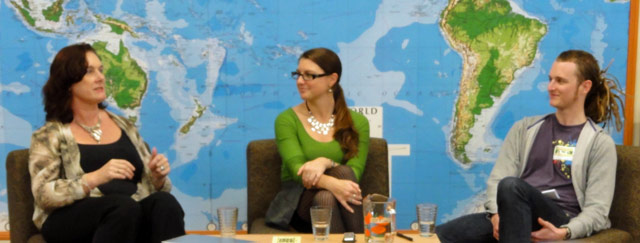
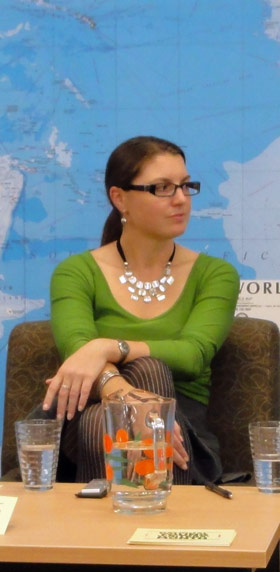 Christina [pictured right]: I think that’s probably one thing that… this is National Young Writers’ Month coming up, and I think it’s great when people have a real passion for writing and I interview a lot of young people for jobs. I’ll say “what is it that you love about journalism, and why do you want to be a journalist?” A lot of them say, “I really love to write”. And that’s really important, because you can’t teach someone to write well. You can sort of hone their skills and get them to a reasonable standard, but if they’re not a born writer, you can’t teach them to be.
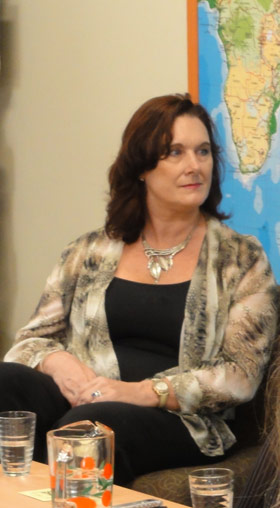 Janette [pictured left]: I think the reality is that in today’s world it’s accepted that most people will have two or three careers. Just because you happen to start doing something at 20 doesn’t necessarily mean you’ll be doing it 40. And I left News Limited after 20 years. I hit the 20 year mark and went, “okay, what do I really want to do now?” Because I could stay there quite happily for the next 20 years after that.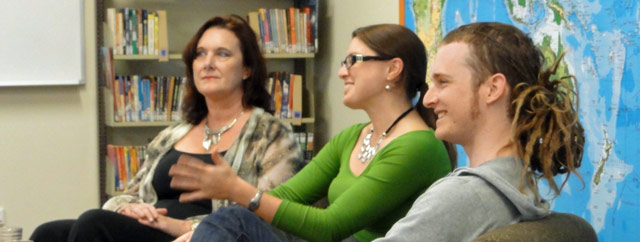
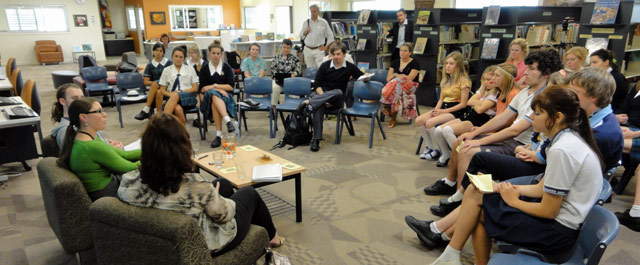
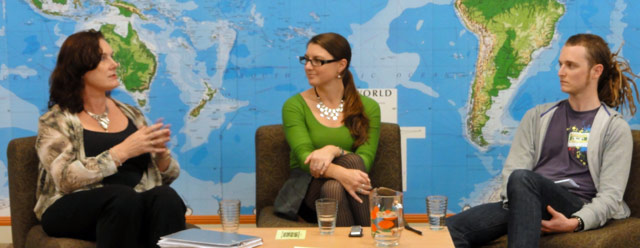
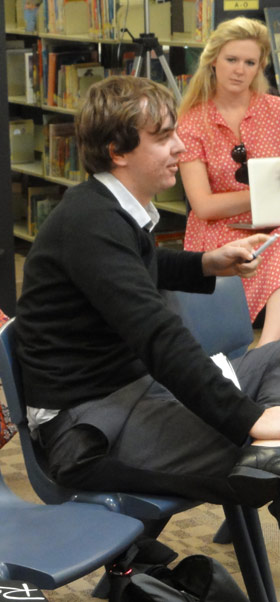 Scott [pictured right]: I studied a Bachelor of Journalism at UQ, and my biggest regret is I didn’t start writing or looking for stories in my first year. You should always be looking for stories, even if they’re just writing on a blog or something, or looking for small places that are easy to get into. You should always be looking for stories.
 Andrew [pictured left]: Janette made a reference earlier to how, when she was editor, she would commission experts in certain areas to write opinion pieces or write features on those topics. It doesn’t have to be that way. To give an example, I now do some video game journalism for a website called IGN. The way I got into that was because late last year… to give you a bit of background info, Australia’s video game development industry is about 700 people-strong. That’s 700 people who are involved in making video games you play on PlayStation or Xbox or Nintendo.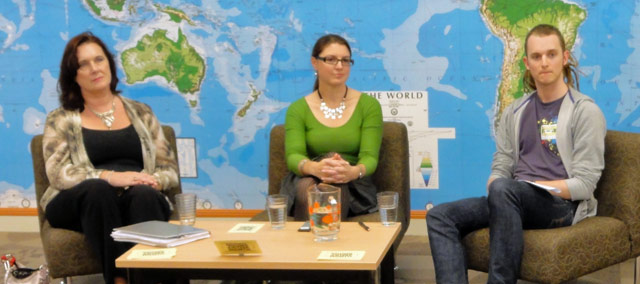

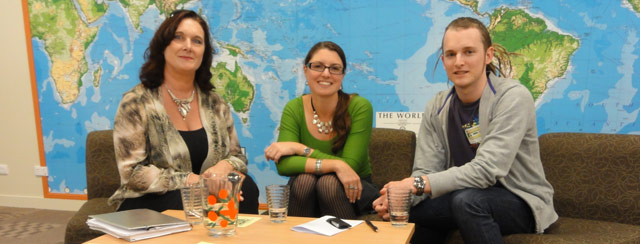
 Melbourne had its